An anti-hero romance is a love story built around a male lead who operates outside the moral lines most of us live inside. He might kill, cheat, manipulate, or rule through fear, and the story does not ask you to pretend otherwise. The central appeal is watching that man, the one everyone else fears or despises, become utterly, ruinously devoted to one woman, even when he has no idea how to do it gently.
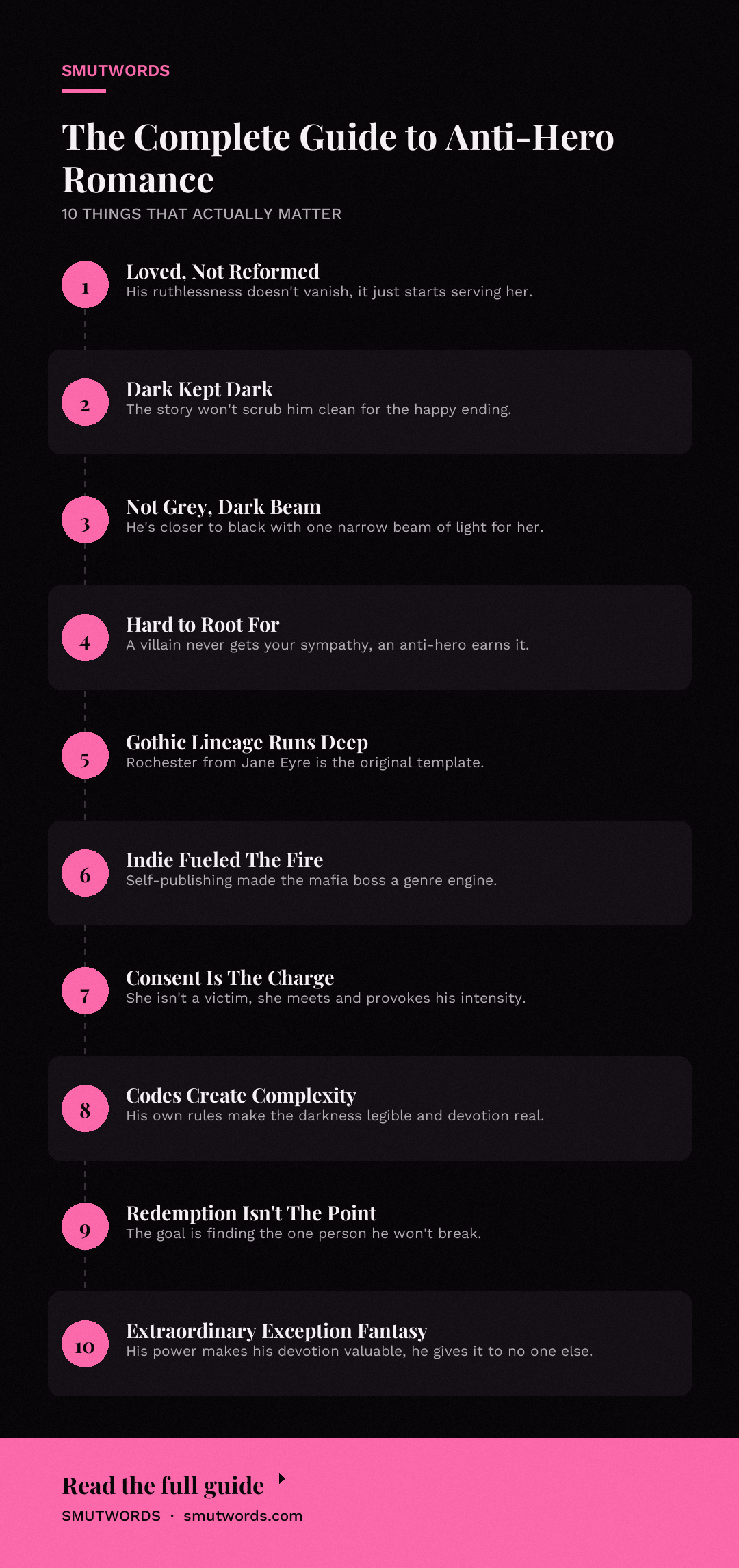
The hero is not reformed so much as redirected. His ruthlessness does not vanish. It simply starts serving her.
What Anti-Hero Romance Actually Means
The term describes a romance where the hero's moral compass points somewhere dark, and the narrative keeps him there rather than scrubbing him clean for the sake of the happy ending. He is not a misunderstood nice guy with a rough exterior. He is genuinely dangerous, genuinely selfish, and genuinely capable of acts that would land him in prison in real life. What makes him a romance hero instead of a villain is the exception he makes for the heroine.
The distinction matters. A classic romance hero might be brooding or arrogant, but his core values align with the reader's. He would not hurt an innocent.
An anti-hero does not share that guarantee. He has a body count, a criminal enterprise, or a history of cold calculation, and the story asks the reader to accept that as part of the package.
The term "morally gray hero" gets used interchangeably, but gray suggests an even mix of light and dark. Many anti-heroes are closer to black with a single, narrow beam of light pointing at the heroine.
Redemption is not required, and this trips up newer readers of the genre. An anti-hero romance can end with the hero still deeply flawed, still running his shadow empire, still capable of violence. What changes is his allegiance. He chooses her, and that choice carries more weight because of everything he is choosing against.
Common misconceptions abound. The anti-hero is not the same as the bad boy with a heart of gold, though the two share DNA. The bad boy is a rebel who skips class and rides a motorcycle; he is performatively edgy but fundamentally soft.
The anti-hero does not perform. His edge is real, and his softness, when it appears, is a vulnerability he hates showing.
Nor is every dark romance hero an anti-hero. A dark romance can feature a villainous lead who never earns any sympathetic framing. The anti-hero sits on a specific shelf: dark enough to thrill, sympathetic enough to root for.
Where Anti-Hero Romance Comes From
The romantic anti-hero has deep roots in genre fiction, and in romance specifically the lineage runs straight through the Gothic tradition. Think of the brooding Byronic hero of the 19th century, the man with a scandalous past and a dangerous reputation that the heroine slowly uncovers. Jane Eyre's Rochester is the template: secretive, manipulative, morally compromised, and yet the object of enduring love.
Those early Gothic romances established the fantasy that a woman's devotion could reach the unreachable parts of a damaged man. The contemporary anti-hero romance as a distinct marketing category emerged more recently, roughly in the 1980s and 1990s with the rise of category romance lines that leaned into masculinized heroes with troubling jobs. The "warrior" hero of medieval romances and the spy hero of romantic suspense both contributed, giving readers men whose violence was sanctioned by context.
What changed over time was the removal of that sanction. Modern anti-heroes are more often criminals, mob bosses, or vigilantes whose violence is not state-approved. The outlaw framing makes the moral tension sharper.
The explosion of indie publishing and self-published dark romance in the 2010s turned the anti-hero from a recurring character type into a full genre engine. Authors no longer needed a publisher's approval to put a contract killer or a mafia don at the center of a love story. Readers responded with enormous appetite, and subgenres crystallized around specific flavors of anti-hero: the mafia boss, the hitman, the motorcycle club president, the morally flexible billionaire.
The billionaire romance overlaps heavily here, since wealth often purchases the kind of impunity an anti-hero needs to operate. These days the anti-hero is less a deviation from the romance norm than one of its most bankable pillars.
How It Shows Up in Erotica
The craft of writing a strong anti-hero romance lives in the tension between who the hero is and who he becomes around the heroine. On the page this usually means the author establishes his darkness early and unapologetically. The reader should witness or hear about an act that makes them swallow hard, something that confirms this man is not playing at being dangerous.
That scene is the anchor. Everything the hero does for the heroine afterward reads against it.
From there, the story shows his devotion in ways that are consistent with his nature. He does not suddenly become a soft-spoken caregiver. He clears threats with a phone call, he buys the company that made her cry, he shows up bloody to protect her and expects no gratitude.
The erotic scenes carry this same charge. The anti-hero's sexuality is often commanding, possessive, and tinged with the same ruthlessness that defines his other actions.
What makes it work is the heroine's active consent and enjoyment. She is not a passive victim of his intensity; she meets it, matches it, and sometimes provokes it deliberately.
Variations on the type are many, and knowing them helps a reader find the specific shade they want:
- The mafia boss or crime lord: violence is professional, protection is absolute, and his world operates on codes the heroine must learn.
- The hitman or assassin: often colder, more detached, with his attraction to the heroine representing the first crack in his emotional armor.
- The vigilante: his violence serves a justice system he does not trust, which gives the reader moral cover to enjoy his methods.
- The ruthless businessman: no literal kills, but he ruins competitors and treats acquisitions like warfare; an anti-hero for readers who want the power fantasy without the blood.
- The anti-villain: he was on the wrong side of a conflict and flips sides, or his goals are sympathetic even if his methods are not.
What separates a flat anti-hero from a compelling one is the specificity of his code. A generic dark, brooding man who is mean to everyone until the heroine smiles at him is not an anti-hero; he is a bully with a marketing problem.
The anti-hero needs an internal logic the reader can trace. He will not kill children. He honors his dead mother. He never lies to the heroine even when the truth damages him.
Those rules make his darkness legible and his devotion meaningful.
The heroine's role matters just as much. She cannot be a blank slate who simply absorbs his intensity. The best anti-hero romances give her a spine that bends but does not break. She challenges him, sees through his performance of menace, and insists on being treated as an equal even when he is used to owning every room he enters.
Enjoyed this? Get a free book.
Join the list and we will send a complete free story straight to your inbox, plus new releases every week after that. No credit card, no catch.
That push-pull generates the romantic friction, and it is often sharper and more satisfying than in a conventional romance because the stakes are higher. He is not a man who learns to share his feelings; he is a man who learns to share power.
Similarly, the hate to love dynamic shows up frequently in this genre, because an anti-hero rarely charms his way into a heroine's bed. He usually earns her trust through combative, wary interactions that gradually thaw. The distrust is earned, which makes the eventual surrender feel like a victory for both characters.
Anti-Hero Romance vs Morally Gray Hero vs Dark Romance
These three terms blur together in reader conversations, but they point at different things. A morally gray hero is the broadest category. He has questionable ethics but may never cross into outright criminality. He might lie, manipulate, or act selfishly, yet his actions stay within a range the reader can rationalize.
The anti-hero is a subset of the morally gray: a man whose actions are darker and more consistent, often illegal or violent by default rather than exception.
Dark romance is the broader genre umbrella that contains many anti-hero stories but is not defined by the hero's morality. A dark romance might feature a kidnapping, an arranged marriage to a monster, or a captivity scenario where the hero is genuinely villainous and the story is about the heroine surviving and transforming the dynamic.
In a pure anti-hero romance, the hero has sympathetic motivations the reader can access. In darker romance, the hero's redeemability is often the central question, and sometimes the answer is that he is not redeemed at all. The anti-hero sits between the gray hero and the true villain, close enough to the edge that the reader occasionally wonders which side he will land on.
There is also a meaningful difference from the redemption arc romance, if that term is on your radar. A redemption arc story makes the hero's transformation the plot: he sins, suffers, and earns forgiveness. In an anti-hero romance, the hero is not necessarily seeking redemption. He may never apologize for who he is.
The romance is not about fixing him; it is about finding the one person he refuses to break. Readers who want the messiness of a man who stays dangerous will prefer the anti-hero. Readers who want the catharsis of watching a man become good should look for a redemption arc instead.
Frequently Asked Questions
What makes a hero an anti-hero instead of just a villain?
The key is sympathetic motivation and the exception he makes for the heroine. A villain is defined purely by opposition to the protagonist. An anti-hero has his own code, a backstory that explains his darkness, and at least one relationship that reveals his capacity for loyalty and care. The reader can understand why he is the way he is and root for him despite it.
Does the anti-hero have to be a criminal?
No, but criminality is a common shortcut because it creates immediate moral distance. The anti-hero can be a ruthless corporate raider, a corrupt politician, or a vigilante whose methods are illegal. What matters is that his behavior places him outside conventional morality.
The crime is less important than the reader's awareness that this man would not fit into a normal, law-abiding life.
Is anti-hero romance the same as dark romance?
Not exactly. Dark romance is a broader category defined by its tone and content, which often includes taboo situations and high stakes. Many dark romances feature anti-heroes, but some feature outright villains or scenarios that do not center on a morally gray man.
Anti-hero romance is better understood as a character type that frequently appears within dark romance and also shows up in lighter contexts.
Will the anti-hero always cheat or hurt the heroine?
A well-written anti-hero romance reserves his cruelty for the outside world and protects the heroine from it, but the journey to that point often includes moments where she catches his sharp edge. He may be cold, dismissive, or manipulative early in the story. The arc is about him learning that she is off-limits, not just as a target but as someone worthy of his better instincts.
Physical abuse aimed at the heroine is generally not part of the genre, and readers who encounter that should consider the book a different, darker subcategory.
Why is the anti-hero so popular with readers?
The fantasy is about being the exception. Most people will never be the person who softens a dangerous man, but fiction lets readers experience that kind of singular importance. The anti-hero's power makes his devotion feel more valuable, because he gives it to no one else.
There is also a vicarious thrill in spending time inside a world where the usual rules do not apply, and where a man's violence is framed as protection rather than threat.
Can an anti-hero romance have a happy ending?
Yes, and most of them do, but the happy ending looks different from a conventional one. He is not going to settle down in the suburbs and coach soccer. His happy ending usually involves finding a way to have the heroine and keep the parts of himself he refuses to surrender.
The genre is more interested in a satisfying compromise than a total transformation, which is exactly why it appeals to readers who find perfectly reformed heroes less interesting.
Final Thoughts
The anti-hero romance works because it gives readers permission to enjoy a man who is dangerous without demanding they pretend he is safe. The best versions of this trope respect the darkness, give the heroine real agency, and let the hero stay recognizable even as he falls in love.
If you are new to the genre and want a target for your first read, look for a mafia romance with a heroine who talks back and a hero whose code is consistent, and use that as your baseline for what this corner of romance does best.
If you have already been through a dozen crime lords and want a different flavor of moral flexibility, the rockstar romance genre offers its own breed of selfish, chaotic men who are dangerous in different ways, and the soldier romance subgenre gives you trained killers whose violence comes with a veneer of duty.
The anti-hero is a shape, not a single story, and there is room in it for every kind of dark.





Loading comments…