Kink negotiation is the pre-scene conversation where partners explicitly agree on what will and will not happen. It covers activities, limits, safewords, and aftercare preferences before any play begins. In erotic fiction, these conversations often rank among the most intimate moments on the page. They deliver the vulnerability and trust that make later surrender meaningful.
A strong negotiation scene does more than tick a consent checkbox. It builds the emotional architecture that lets readers believe the power exchange that follows is genuine, chosen, and rooted in mutual desire. This guide breaks down how kink negotiation works in real practice and how skilled authors translate it into compelling, charged fiction.
What Kink Negotiation Actually Means
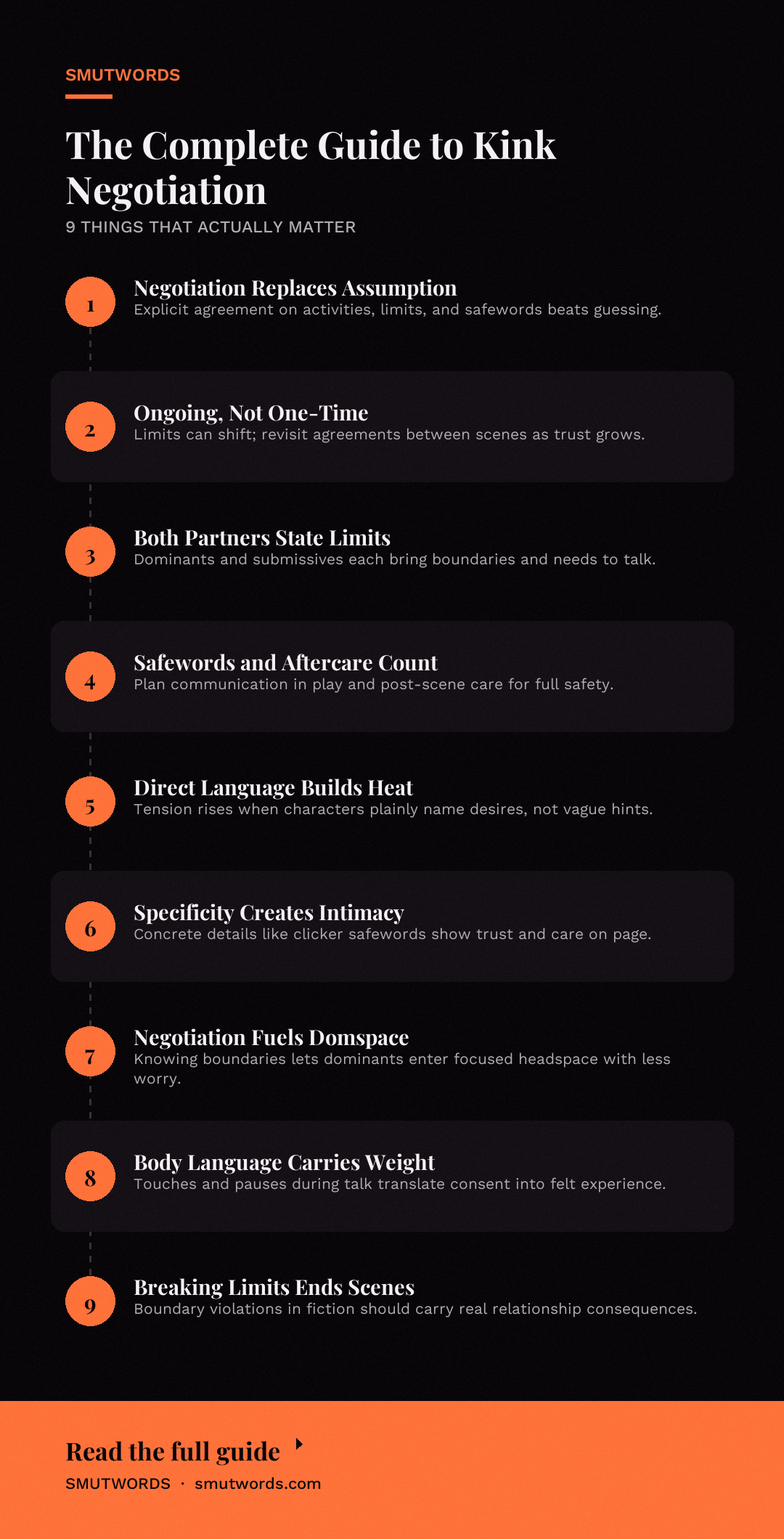
Kink negotiation is a structured conversation that establishes the terms of an erotic scene or ongoing dynamic. It covers three core areas: what activities are on the table, what is absolutely off the table, and how the partners will communicate during play. The conversation also addresses practical logistics like safewords, aftercare needs, health considerations, and whether the agreement covers a single scene or an ongoing relationship structure.
The name matters less than the function. Some call it consent negotiation, scene planning, the boundaries talk, safeword setup, or a hard limit discussion. Whatever the label, the core purpose stays the same: replacing assumption with explicit agreement.
Negotiation does not count when rushed, when one partner pressures the other, or when it happens through innuendo and hoping the other person guesses correctly. It requires direct, plain language.
Critically, negotiation is not a one-time event. A thorough negotiation covers the current scene but also establishes how future agreements will be handled. Partners might agree that limits can be revisited between scenes, that either person can call a halt at any moment, and that certain topics require fresh consent each time they come up.
Many practitioners treat negotiation as an ongoing conversation rather than a single pre-play chat. Desires shift, trust deepens, and curiosity about new activities often evolves alongside comfort levels.
Common misconceptions about negotiation abound. Some believe it kills spontaneity or ruins the mood. In fact, it creates the safety that allows play to feel truly uninhibited. Another myth holds that only the submissive or bottom partner has limits worth discussing.
In reality, every participant brings boundaries, preferences, and physical or emotional needs to the table. Negotiation is a mutual exchange, not a list of demands from one side. The dominant or top partner's comfort, experience level, and triggers matter just as much.
Where Kink Negotiation Comes From
The explicit, verbalized negotiation ritual has roots in the late twentieth century BDSM community. It emerged alongside frameworks like SSC (Safe, Sane, Consensual) and the later RACK (Risk-Aware Consensual Kink). These frameworks developed partly in response to real-world legal cases and public misunderstandings about BDSM, where consent was often presumed absent because the activities looked violent or coercive to outsiders. Community leaders began codifying consent practices to distinguish consensual play from abuse and to protect practitioners legally.
Within erotic publishing, the shift toward showcasing negotiation is more recent. Older erotic and romance novels frequently skipped the conversation entirely, presenting sudden, instinctive BDSM dynamics where a knowing glance sufficed. The assumption was that a skilled dominant simply read a partner's needs without discussion. That trope has faded substantially over the last two decades, particularly as readers demanded healthier models of consent in their fiction.
Contemporary romance and erotica now treat negotiation scenes as essential beats, especially in works centered on power exchange, bondage, and other edge-play dynamics.
Genre history shows a clear trajectory. Early publications in the 1980s and 1990s often featured protagonists who stumbled into kink without prior agreement, sometimes with troubling undertones. The rise of indie publishing and reader communities with vocal standards around consent narratives pushed authors to include negotiation as a matter of craft, not just ethics. By the 2010s, well-reviewed BDSM romance typically dedicated real page time to the boundaries talk, and readers began to expect it.
Publishing trends now treat kink negotiation as a narrative device that builds tension, establishes character voice, and makes eventual submission or dominance feel psychologically coherent. The best modern erotic fiction does not present negotiation as a chore to get through on the way to the good parts. The negotiation itself becomes a good part.
How It Shows Up in Erotica
A well-executed negotiation scene in erotica does double duty: it establishes ground rules and generates its own slow-burning heat. Authors who handle this well understand that the conversation itself can be an act of intimacy. When characters sit across from each other and discuss exactly what they want to do to each other, the tension is not diminished by the directness. The directness is the point.
Strong fictional negotiation scenes typically follow a recognizable rhythm. The initiating character names an activity and tests the waters, often phrasing it as an offer rather than an expectation. The other character responds with enthusiasm, hesitation, or a counteroffer.
They trade details: which toys, which positions, which words to use or avoid. They arrive at a shared vocabulary for the scene, sometimes assigning titles or honorifics they will use only within play. Finally, they settle on the safeword and the post-scene plan for aftercare.
The best versions of these scenes reveal character through their negotiation style. A meticulous, detail-oriented dominant might ask precise questions about physical sensation, comfort levels with specific implements, and what the bottom wants to feel during the aftermath. A more playful dynamic might weave negotiation into an existing flirtation, with one partner asking pointed questions and the other answering in escalating detail.
The negotiation should sound like the characters, not like a legal contract read aloud. Dialogue that parrots community safety language word-for-word often reads flat. Characters adapt the conversation to their own cadence and relationship context.
Variations on the negotiation scene depend heavily on the type of play involved. A heavier scene featuring bondage demands more granular discussion around safety, nerve pressure, and duration. A fantasy scenario, such as a roleplay dungeon encounter, requires negotiation around physical positioning, stimulation levels, and how much restraint the bottom will tolerate. Even lighter dynamics benefit from negotiation about how long delays can last and what desperation looks like on each partner.
Enjoyed this? Get a free book.
Join the list and we will send a complete free story straight to your inbox, plus new releases every week after that. No credit card, no catch.
The key difference between a flat negotiation scene and a great one comes down to specificity. Listing rules generically, with lines like "I trust you to know my limits," reads thin and skips the vulnerability that makes these scenes compelling.
When a character says something precise, like "The gag means I can't safeword verbally, so we use the clicker twice if I need out, but I want you to check my eyes every few minutes," it accomplishes several things at once. It proves the characters know each other, it grounds the scene in concrete risk, and it lets the reader feel the weight of the trust being placed.
Negotiation scenes fail when they flatten into exposition or sound like the author photocopied a BDSM 101 handout. They succeed when the conversation deepens the dynamic and shows why these specific people play the way they do.
Body language carries as much weight as dialogue in strong negotiation scenes. The way one character reaches out to touch the other's hand while naming a hard limit, the pause before answering a question about past trauma, the way the dominant partner repeats the submissive's boundaries back in their own words to confirm understanding. These small physical and verbal details translate consent into felt experience rather than abstract principle.
Aftercare discussion is a vital component that separates good negotiation from great fiction. When characters plan what happens after the scene, from weighted blankets to water and quiet conversation, it signals that the intensity to come exists inside a container of care. Committing to an aftercare plan also communicates that the dominant partner views the scene as a shared experience rather than a performance they deliver.
In longer narratives, the aftercare negotiation often pays off in the post-scene chapter. Readers see promises made before play get honored afterward, which strengthens the sense that these characters can trust each other with increasingly intense dynamics over the course of the book or series.
Kink Negotiation vs Domspace
Readers and writers sometimes confuse kink negotiation with the altered mental state some dominants experience during intense play. The distinction matters because they occupy opposite ends of the scene timeline. Kink negotiation happens before any play begins, as a grounded, deliberate exchange of information and boundaries.
Domspace refers to the focused, sometimes euphoric headspace a dominant partner enters during the scene itself. In that state, the dominant may experience heightened confidence, narrowed attention, and a sense of being fully absorbed in the dynamic.
The relationship between the two comes down to memory. A dominant who has negotiated thoroughly can enter Domspace with less worry because the boundaries are already established and committed to memory. On the page, this dynamic plays out when a dominant references specific negotiated details mid-scene, confirming that the pre-play conversation shaped their behavior even while they operate inside an altered state.
A character who skips negotiation and expects to improvise their way into Domspace reads as reckless, and the fiction usually frames such behavior as a red flag. The strongest narratives show negotiation as the foundation that makes Domspace sustainable, particularly across a longer dynamic where both partners plan increasingly complex scenes together.
Frequently Asked Questions
What exactly counts as kink negotiation?
Any explicit, direct conversation where partners agree on activities, limits, safewords, and aftercare for upcoming play counts as negotiation. It requires clear language, mutual participation, and genuine agreement rather than pressure or assumption. Small talk that vaguely gestures at interests without stating boundaries does not qualify.
Is kink negotiation the same as consent?
Negotiation is the process by which consent gets established for a specific scene or dynamic. Consent is the ongoing agreement that can be revoked at any point, which is why safewords exist. Negotiation sets the terms; consent governs how those terms get honored during play.
Why do negotiation scenes show up so often in romance novels?
Readers value them because they demonstrate emotional intimacy and trust outside of physical acts, making the characters' eventual surrender or control feel earned. These scenes let authors show characters communicating honestly, which builds a foundation for the relationship arc. They also generate tension, because spelling out exactly what will happen lets anticipation build before a single touch occurs.
Can negotiation happen mid-scene or does it always come first?
The initial agreement should always precede play, but negotiation can and should continue during a scene when anything changes. If a partner wants to try a new activity or the agreed plan shifts for any reason, they pause and discuss it before proceeding. Treating stated limits as absolute means introducing new elements requires fresh, explicit agreement.
What are hard limits versus soft limits in this context?
Hard limits are activities that are never on the table under any circumstances, and negotiation treats them as non-negotiable. Soft limits are activities a partner might be open to under the right conditions, often with specific caveats or careful pacing. During negotiation, partners typically clarify soft limits thoroughly so both people know exactly what conditions would make those activities acceptable.
What happens if a character breaks a negotiated boundary in fiction?
When handled realistically, breaking a stated limit ends the scene and carries relationship consequences. The partner who was harmed typically withdraws trust, and rebuilding that trust becomes the central conflict of the narrative arc. Some darker erotic fiction explores boundary violations as a deliberate plot device, but skilled authors frame such moments clearly as violations rather than romantic gestures.
Final Thoughts
Kink negotiation is where the truest intimacy in power exchange fiction lives. It is the moment characters stop performing and start speaking plainly about what they want, what scares them, and what they need to feel safe. Pay attention to how your favorite authors handle the boundaries talk, and notice how the strongest scenes make you feel the trust building line by line.
If you want to see a masterful blend of careful negotiation and escalating heat, look for a novel that pairs an explicit safeword discussion with a slow-burn dynamic. Watch how the early conversation pays off in every later scene. The characters who take their agreements seriously are the ones worth following to the last page.







Loading comments…