
Ogre romance is the subgenre of monster romance built around a huge, tusked, often green-skinned male lead and the woman who ends up in his keeping, his bed, or his cave, usually all three. The appeal sits in a specific gap: a body built for violence that chooses tenderness, and a heroine who is the only person on the continent who gets to see it.
If you have been circling these books for a while, or you just finished one and want to understand why it wrecked you, this is the long answer. Ogre romance has moved from a niche corner of fantasy romance into a proper category with its own conventions, its own shorthand, and its own recurring arguments.
What Ogre Romance Actually Means
An ogre romance is a romance novel or story in which the central love interest is an ogre: a large, nonhuman, typically monstrous figure drawn from folklore and fantasy, characterized by massive size, unusual strength, prominent tusks or underbite, and a face that reads as frightening rather than handsome by conventional standards. The heroine is usually human or near-human. The romance is the point. The monster exterior is the obstacle that gets reframed as the prize.
The term borrows its creature from European folklore, where ogres were child-eating giants with no romantic potential whatsoever. Modern ogre romance keeps the silhouette and throws out the malice. What it keeps is the scale.
An ogre hero is usually described as somewhere between seven and nine feet tall, broad enough to block a doorway, with hands that make the heroine's look like a child's. That physical disparity is the engine of the whole subgenre.
What counts as ogre romance versus something adjacent comes down to the love interest's body and origin. A few working distinctions:
- Ogre: huge, tusked or heavy-jawed, often green, grey, or blue-grey skin, tribal or clan-based culture, frequently from a marginal or despised people.
- Orc: close cousin, usually more militarized, with a warrior-culture framing; orc romance and ogre romance share most of their DNA and often get shelved together.
- Troll: leaner or more feral, sometimes with regeneration or stone-skin traits, less common as a romance lead but present.
- Giant: purely about scale, usually without the tusks or the monster-face coding.
The thing that does not count: anything where the love interest is a beautiful humanoid with a small cosmetic flaw. If the hero would pass on a red carpet with a hat on, it is not ogre romance. The genre requires a genuinely non-normative body and, crucially, a narrative that treats that body as desirable rather than something to be forgiven.
Three misconceptions come up again and again. First, that ogre romance is a niche curiosity. It is one of the fastest-growing corners of monster romance and has been for years.
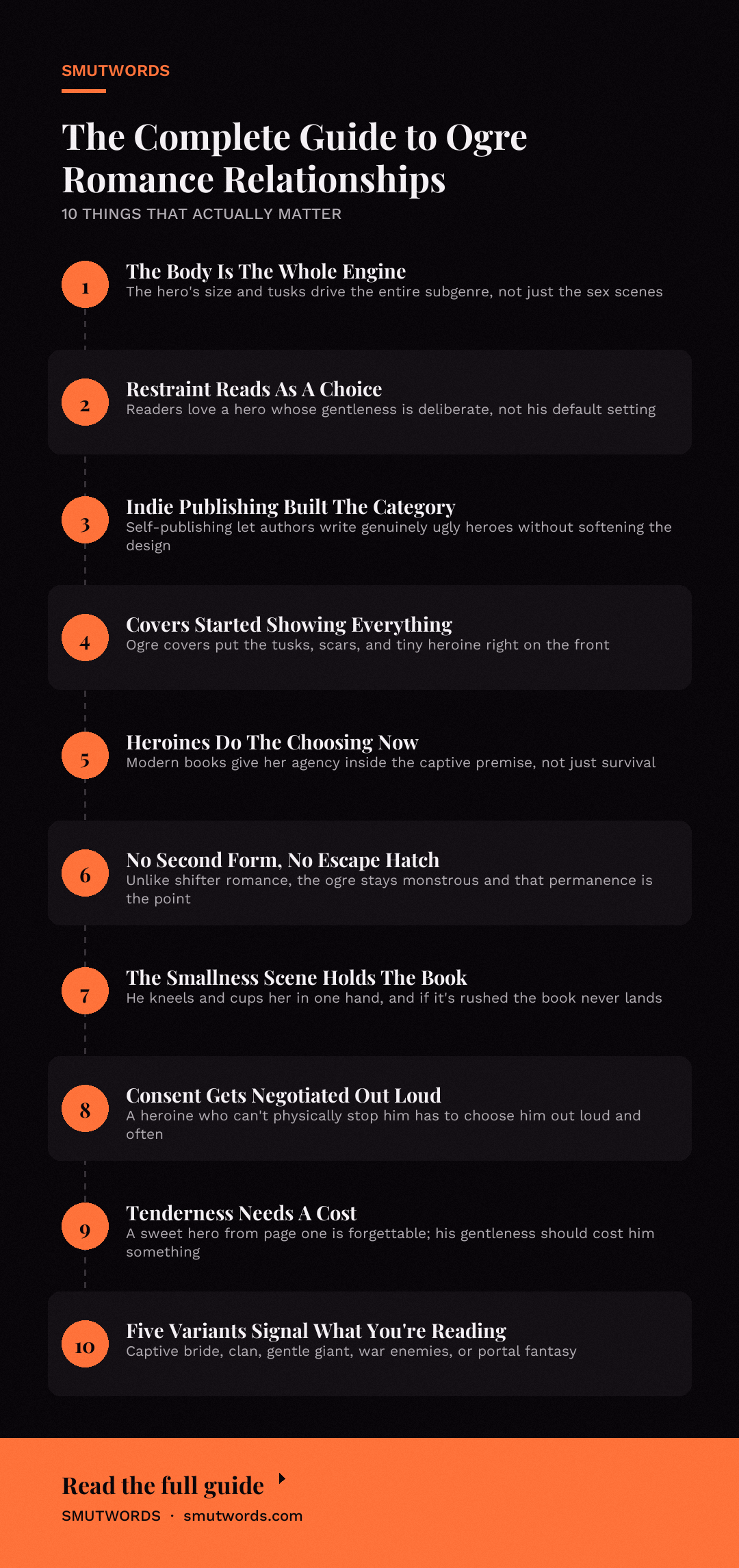
Second, that the ogre is a stand-in for an abusive partner. Readers who love these books are usually drawn to the opposite: a hero whose size makes his restraint visible, and whose gentleness reads as a deliberate choice rather than a default. Third, that the heroine is passive. The best ogre romance heroines are practical, mouthy, and frequently the ones doing the pursuing once they decide they want him.
Where Ogre Romance Comes From
The honest history here is short and recent, and it belongs to publishing rather than folklore. Ogres have been in fantasy fiction for centuries, but almost always as obstacles. The shift happened when romance readers, already deep into vampire and shifter territory, started asking for monsters who stayed monstrous.
The fairy-tale retelling boom of the 2000s and 2010s did part of the work, teaching readers to sympathize with the beast. The reverse-harem and why-choose explosion of the late 2010s did another part, normalizing nonhuman love interests and clan structures.
The real turning point was the rise of indie-published monster romance as its own category, roughly from the late 2010s onward. Self-publishing let authors write heroes who were genuinely ugly, genuinely huge, and genuinely adoring, without a publisher asking them to soften the design.
Cover art changed first. Where monster romance covers once kept the hero in shadow or partial silhouette, ogre romance covers started showing the whole thing: the tusks, the scars, the tiny heroine tucked against a chest the size of a door.
The genre's growth tracked the broader surge in orc and troll romance on reading platforms, and the two categories now feed each other constantly. Ogres appear in fantasy romance, in portal fantasy, in alien-adjacent settings where the "ogre" is technically a species from another world.
That last overlap is worth naming, because plenty of books marketed as ogre romance are functionally closer to alien romance with the serial numbers filed off. The creature's origin matters less than the size, the tenderness, and the clan.
What has changed most over time is the heroine's role. Early ogre romance leaned hard on the captive or traded-bride setup, where the heroine had no choice and the romance was about surviving into affection. Current books still use that premise, but they increasingly give the heroine agency inside it: she negotiates, she chooses, she is the one who decides the marriage is real.
The ogre's arc changed too. He used to be the one who needed to prove he was safe. Now he is usually already gentle and the story is about the heroine, and the reader, learning to trust a body that looks dangerous.
How It Shows Up in Erotica
On the page, ogre romance runs on contrast. The prose spends its first act establishing how much space the hero takes up, how loud he is, how the floorboards complain under him, then spends the second act showing how carefully he moves around the heroine. A hand that could crush her pauses at her jaw. A voice that carries across a valley drops to a rumble for her alone.
Good ogre romance writers front-load the physical intimidation and then spend the rest of the book paying it off in tenderness.
The heat level varies wildly, from closed-door fantasy romance to explicit monster erotica, but the mechanics of the explicit version lean on the same contrast. The size difference kink is doing the heavy lifting.
Authors handle the anatomical mismatch in a few standard ways: careful preparation, the ogre's deliberate slowness, sometimes a knot or barbs borrowed from shifter and alien conventions, occasionally a hand or mouth scene standing in for the main event until the heroine is ready. The best-written version makes the care itself the erotic charge. He is not cautious because he is boring. He is cautious because he is terrified of hurting the one thing he wants.
Enjoyed this? Get a free book.
Join the list and we will send a complete free story straight to your inbox, plus new releases every week after that. No credit card, no catch.
The recurring variants are worth knowing because they signal what kind of book you are picking up:
- Captive or traded bride. The heroine is given or sold to the ogre, usually by a village, a lord, or a treaty. The tension is whether the arrangement becomes a real marriage.
- Clan and pack structure. The ogre belongs to a tribe or war band, and the heroine has to win over or be protected from his people. This borrows openly from pack dynamics, and the protective, possessive flavor is close to what readers want from the territorial shifter trope.
- The gentle giant. He is a farmer, a healer, a craftsman. No war band, no clan politics. The conflict comes from the outside world's fear of him, not from his own nature.
- Enemies-to-lovers across species. He is on the other side of a war, and the heroine has to reconcile the monster she was taught to hate with the man who keeps saving her.
- Portal or isekai. A modern heroine lands in his world and has to learn the culture. Useful for letting the ogre explain his own customs to the reader without an info dump.
What separates a strong ogre romance from a flat one comes down to a few craft points an editor notices quickly. The first is whether the ogre has an interior life on the page. A hero who only exists to be huge and devoted is furniture. The ones readers remember have their own fears, their own humor, and a reason for the gentleness beyond "she is small."
The second is whether the heroine's attraction is allowed to be physical and specific. Books that skip past the desire and jump straight to emotional devotion read as squeamish about their own premise.
The third, and the one that sinks the most books, is whether the tenderness has any cost. A hero who is sweet from page one with no internal obstacle is pleasant and forgettable. The strong version gives him something to overcome: a history of being seen as a beast, a fear of his own strength, a clan that will punish him for choosing a human. His gentleness should feel like a decision he keeps making.
There is a specific scene type that ogre romance does better than almost any other subgenre, and it is worth naming because readers hunt for it. Call it the smallness scene. The heroine is hurt, cold, sick, or frightened, and the ogre, who could level a building, spends the entire scene making himself smaller to comfort her.
He kneels. He cups her in one hand. He lowers his voice to a whisper he is not built for. If the writer gets that scene right, the whole book holds. If they rush it, the book never quite lands.
Consent is handled unusually well in the good ones, because the physical stakes are so high. A heroine who cannot physically stop a nine-foot hero has to be written as choosing him out loud and often. That is part of why the genre reads as safer than it looks.
The explicit negotiation, the checking in, the way a careful ogre asks before he touches: it is the same logic covered in the safewords guide, transposed into a fantasy where the power gap is literal. Readers who want a printable negotiation scene dressed as fantasy courtship will find a lot to like.
Ogre Romance vs Hybrid Shifter Romance
The comparison that trips readers up most is hybrid shifter romance, and it is worth sorting out because the two get shelved together and are not the same thing. In hybrid shifter romance, the love interest has two forms and moves between them. The human shape is available, the animal shape is the secret, and the drama comes from the shift. The body the heroine touches most of the time looks human.
Ogre romance has no second form. The ogre is the ogre, always, and there is no version of him that passes. The entire erotic and emotional architecture depends on that permanence. Readers who love shifter romance for the transformation will often want ogre romance for the opposite reason: they want a hero with no escape hatch, whose strangeness is the whole point.
Where the two overlap is the possessiveness and the clan structure. If that is what you are chasing, you may enjoy both. If the shift itself is what you like, ogre romance will feel like a different genre entirely, closer to merman romance in its commitment to a body that never becomes convenient.
Frequently Asked Questions
Is ogre romance the same as orc romance?
Mostly, for practical purposes. The two are shelved together and share heroes, tropes, and readers. Orc romance tends to lean more militaristic and war-band flavored, while ogre romance leans more toward solitary giants or tribal outsiders. Some authors use the terms interchangeably within a single series.
Do ogre romance heroes ever shift or have a human form?
Rarely, and it usually signals a hybrid story rather than a true ogre one. The genre's appeal depends on the hero staying monstrous. Books that give the ogre a handsome human shape for the third act frequently lose the tension that made the first two acts work.
How explicit do these books get?
It ranges from sweet fantasy romance to fully explicit erotica, often within the same category list. Check the heat rating before you buy. The size difference drives most of the explicit scenes, and authors handle the physical mismatch with preparation, pacing, and a lot of checking in.
Is ogre romance always a captive-bride setup?
No, though the setup is common enough that readers expect to encounter it. Plenty of books use portal fantasy, arranged treaty marriages, enemies-to-lovers war plots, or simple small-town introductions where the heroine meets a local giant who has been quietly longing for her for years.
Why is the ogre always described as ugly?
Because the genre treats the unattractive body as desirable on its own terms. The ogre's face is not something the heroine learns to tolerate; it is something she comes to want. That reversal is the whole appeal for a large share of readers, and softening the description usually undercuts the book.
Where should a new reader start with ogre romance?
Pick based on what you already like. If you want clan politics and possessiveness, look for books with a war band and a heroine who has to win her place. If you want pure tenderness, look for the gentle-giant variants. Either way, start with a standalone rather than a five-book series so you can test the subgenre cheaply.
Final Thoughts
The best starting point, if you want to understand why this subgenre has such a devoted readership, is a book that commits fully to the premise and never cheats with a convenient transformation. Read one where the heroine is genuinely afraid in the first chapter and genuinely wanton by the last, and where the ogre's care costs him something among his own people.
That book will show you the whole architecture at once: scale, restraint, chosen tenderness, and a heroine who does the choosing. Once you have read the good version, the flat ones become obvious within ten pages, which is a useful skill in a category this fast-growing.





Loading comments…