
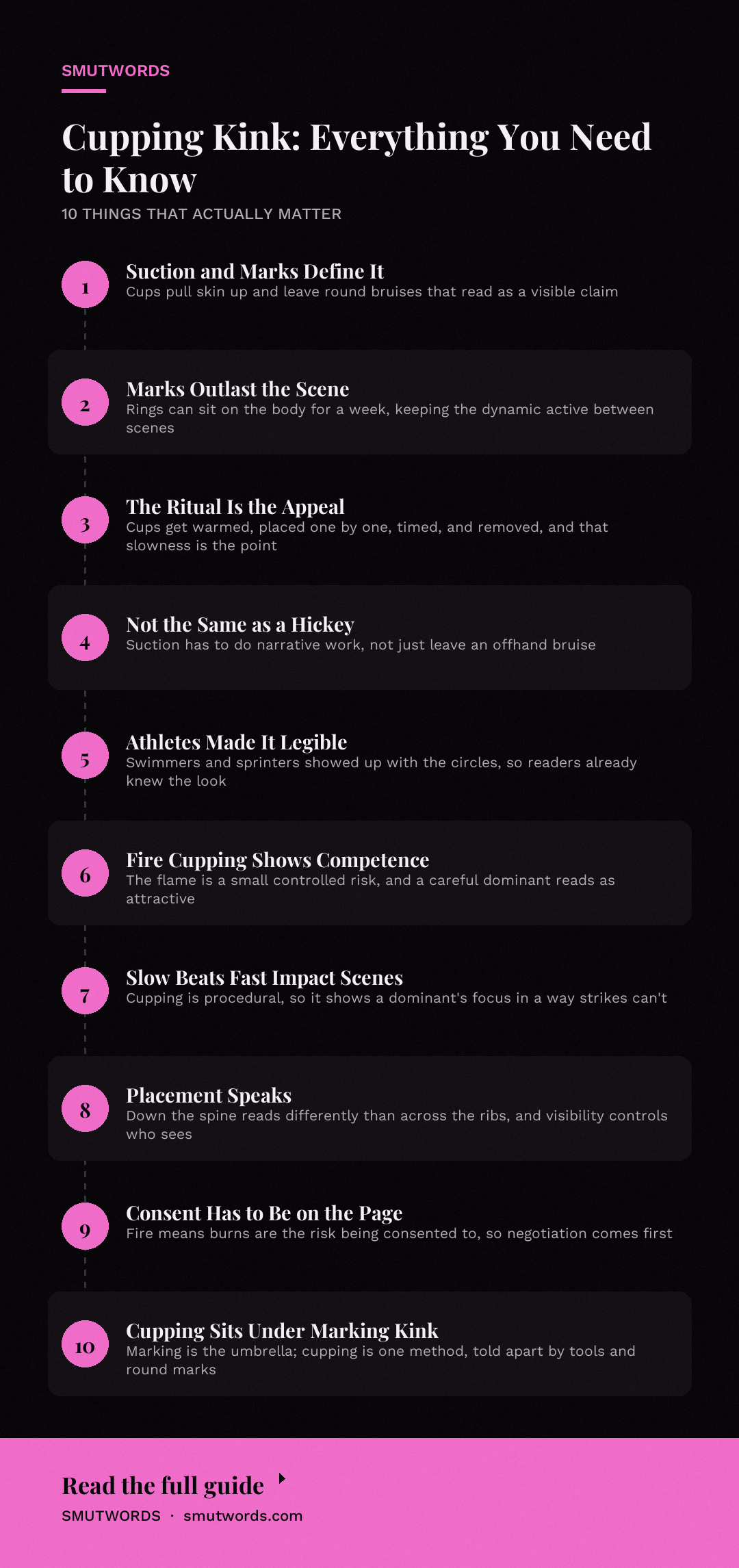
A cupping kink is a fascination with suction applied to skin: heated glass cups or silicone devices that pull flesh up and leave round marks behind. In erotica and romance, the cupping kink turns those marks into a visible claim, a punishment, or a slow intimate ritual between a dominant and a submissive.
The appeal is simple and physical. A bruise from a paddle fades in a day. A ring of cupping marks can sit on someone's back for a week, working on the body long after the scene ends. Readers who love possessive heroines and heroes who mark what's theirs find a lot to work with here.
What Cupping Kink Actually Means
The name comes from the practice itself. Cupping is thousands of years old across Chinese, Egyptian, and Middle Eastern medicine, where practitioners used heat or suction to draw blood toward the surface of the skin. A cup is placed on the back, shoulder, or thigh, air is removed from inside it (by flame or a pump), and the vacuum pulls the skin upward into the glass.
The result is a raised, tight circle that darkens over the next day into a bruise. In a kink context, the medical rationale drops away and what's left is the sensation and the visual: pressure, heat, the drag of skin being drawn, and the marks.
What counts as a cupping kink in fiction? Three things usually line up:
- The suction itself. A scene where pressure is the point, whether that's glass cups, silicone suction cups, or a dominant's mouth applied hard enough to bruise.
- The marks as evidence. The bruises matter as much as the sensation. They're read, touched, and admired afterward, sometimes by other characters.
- The ritual. Cupping requires setup. The cups have to be warmed or sealed, placed one by one, timed, and removed. That slowness is a big part of why writers reach for it.
What doesn't count: a scene where a character gets a hickey and the book moves on. Suction has to be doing narrative work, either as sensation, as marking, or as a display of a dominant's patience and control. A single offhand bruise isn't the kink. A carefully placed row of circles across someone's shoulder blades is.
Common misconceptions worth clearing up. First, cupping isn't the same as beating someone. It's a pressure and heat kink, closer to temperature play crossed with marking.
Second, the marks aren't always dramatic. A light silicone cup might leave a faint pink ring for a few hours.
Third, it isn't purely a modern wellness trend that wandered into smut. The bruise-marking instinct is old and shows up in every genre that cares about possession.
Where Cupping Kink Comes From
Therapeutic cupping has a long documented history in traditional Chinese medicine and across the Middle East, and it traveled into Western wellness culture over the last few decades. Athletes started showing up at press conferences with the telltale circles on their backs, and suddenly everyone recognized the look without knowing what produced it.
That recognition is what made the cupping kink legible to readers. A writer doesn't have to explain the marks. The audience has already seen them on swimmers and sprinters, and already half-read them as evidence of a body that's been worked on by someone else. Erotica borrowed that visual shorthand and turned up the voltage.
Within romance publishing, the marking kink has run through vampire fiction, motorcycle club books, and any subgenre where ownership matters. Cupping slots into that lineage neatly. The genre's real shift happened as dark romance and high-heat contemporary got more explicit about kink practices in general: negotiation scenes, safewords, aftercare, the whole apparatus. Cupping came along with that wave because it's a practice with a built-in visual payoff.
Fire cupping has a particular hold on writers. The flame is a small, controlled risk, and risk on the page creates tension without requiring violence. The dominant has to be careful, which lets the author show competence, and competence reads as attractive. That combination is why fire cupping scenes have become a recognizable trope even in books that never use the phrase.
How It Shows Up in Erotica
On the page, a cupping scene moves slowly. That's the whole craft advantage. Most impact scenes are fast: the strike, the gasp, the aftermath.
Cupping is procedural. The dominant chooses the cups, warms them, sets them down one at a time, watches the skin rise, times the removal.
Every step is attention. If you want a scene that demonstrates a dominant's focus on a submissive's body, this is one of the most efficient tools in the genre.
Strong versions of the trope share a few traits:
- Sensory specificity. The heat of the glass, the drag of skin lifting, the pop of release, the tenderness the next day. Weak scenes summarize the suction; strong ones describe the pull.
- Placement as language. Where the cups go says something. Down the spine reads differently than across the ribs or inside the thigh, and the marks' visibility controls who gets to see the claim.
- Owner's attention. The dominant is watching their submissive the whole time, reading reactions, adjusting. A scene where the submissive is left alone with the cups loses the intimacy.
- Aftercare written on the body. The best scenes don't end at removal. They follow the marks: the inspection, the too-warm shower, the partner who presses a thumb into a fading bruise days later.
Variations authors use:
- Fire cupping for the flame, the heat, and the controlled risk. Often the centerpiece.
- Vacuum or silicone cupping for gentler scenes, or scenes where a character is new to the practice and the marks are easier to control.
- Suction marking without cups: mouths, suction toys, anything that leaves a bruise. Blurs into hickey territory, which some readers prefer.
- Possession marks where the cups are applied symbolically, sometimes in patterns, before a character goes out in public with the marks hidden or deliberately not hidden.
- Punishment framing where the cup placement is chosen to sting, the marks as a consequence the submissive has to carry around.
The flat version of the trope treats the marks as decoration and skips the process. If the scene reads like a cover illustration (ooh, circles) and the submissive barely reacts, the writer has wasted the practice. The good version keeps the sensation and the ownership both live. The reader feels the suction and sees the claim.
Cupping pairs naturally with other scene styles. If a book leans possessive, cupping fits with the slow, controlled approach you see in a scene play chapter of any well-built kink romance. If a book leans warm and domestic, the tenderness after cupping can carry more emotional weight than the marks themselves.
Writers who read a lot of spanking scenes and understand that rhythm will recognize it: setup, sensation, brief aftermath, then the soft landing. Same shape, different tool.
Enjoyed this? Get a free book.
Join the list and we will send a complete free story straight to your inbox, plus new releases every week after that. No credit card, no catch.
The Safety Line Writers Can't Skip
Suction on skin can burn, blister, and bruise more than intended, and fire involved in any capacity means the scene has to be negotiated before the cups come out.
Competent writers show this. A dominant and submissive discussing limits, a safe word established in advance, a check-in during the scene. Readers who want the realism will notice when it's missing, and the ones who write about the marks lasting for days need to show a character who knows how to keep the marks safe.
The RACK (Risk-Aware Consensual Kink) framework describes exactly this: informed consent about the specific risks, not a blanket yes. If a scene involves fire cupping, the risk being consented to is burns, not just "some marking." A quick line about a safe word or an established rule does more for a scene than paragraphs of reassurance.
A good safeword exchange before the cups come out can also do characterization work, which is why strong kink writers keep it in. Watching a dominant ask is a small intimacy. Watching a submissive decide what to allow is another. The negotiation is a scene in itself when it's written as one.
Aftercare and the Marks That Stay
Cupping aftercare has an extra layer compared to other kinks: the marks outlast the scene, so aftercare spreads out over days. A character checking the marks, dampening the burn with a cool cloth, pressing gently on a fading purple ring in the mirror the next morning. That extended timeline is one of the reasons writers like the practice. It gives the relationship a small recurring prop.
Writers who lean into sustained aftercare can borrow the pacing from impact play aftercare, which also handles skin that needs attention after a scene. The two practices often show up in the same book for the same reason: they combine sensation with visible evidence and a tender cleanup that characters can linger over.
Cupping marks are visible territory, so scenes often overlap with other practices in the same library. A character who submits to cupping and then to mummification in a later chapter has a body that keeps records. That continuity of marks, from one scene to the next, is exactly what possessive-romance readers follow.
Cupping Kink vs Marking Kink
The two terms blur constantly, and the confusion is real. Marking kink is the umbrella: any practice where leaving a mark on skin is part of the appeal. Bites, hickeys, brands, collars, and yes, cupping all sit under it. Cupping is one specific method, distinguished by tools, heat, and the round shape of the mark.
When a book describes circles left behind, that's cupping. When it describes a partner wanting the marks to be permanent or highly visible, that's marking as a broader drive. Writers often use cupping as a means to the markings they want, which is why the two terms travel together.
The other nearby concept is bruise marking. Similar, but not tied to a tool. Press a thumb hard enough into someone's hip and you've left a bruise; that's bruise marking, not cupping. Cupping requires the suction to be the mechanism, the cups or the sealed mouth or the vacuum device doing the work.
If a scene uses cups but never shows the marks afterward, you can still call it a cupping kink scene, but the marking payoff is missing. That's what separates a scene that lives up to the kink from one that just name-drops the gear.
Frequently Asked Questions
Is cupping kink the same as the wellness treatment?
Same physical practice, different intent. Wellness cupping is done for circulation and muscle tension; a cupping kink is about the sensation, the marks as a claim, and the intimacy of a dominant working on a submissive's skin. The erotica version borrows the look and the ritual, not the medical rationale.
Why do readers like cupping marks in romance?
Because they last. A single scene that leaves marks on the body for days keeps the dynamic active between scenes, which fits perfectly with possessive and ownership-driven subgenres. The marks become a reminder every time the character sees them in a mirror, and readers feel that continuity.
What are the common types of cupping in erotica?
Fire cupping is the flashiest and the one writers use for risk and heat. Vacuum and silicone cups show up for gentler scenes or scenes with a character new to the practice. Suction marking without cups, mouths and suction toys, blurs into hickey territory. Most books mix at least two.
Is cupping safe to write into a scene?
In writing, safety means showing consent, negotiation, and aftercare on the page. The physical practice can burn or blister if done carelessly, so a scene that includes it should reference a pre-scene conversation about limits and a safe word. That's realistic and it makes the scene stronger, not weaker.
How is a cupping scene different from an impact scene?
Pacing and mechanism. Impact scenes move fast with strikes; cupping is slow, procedural, and built on sustained pressure and heat. The dominant is choosing and placing cups one at a time, which lets the writer show control and attention in a way that's harder to do with a fast scene.
Do cupping kink scenes show up in dark romance?
Yes, and in contemporary and kink-forward books too. Dark romance uses them for punishment and possession; lighter books use them for slow, careful marking scenes with heavy aftercare. The trope travels well because the underlying appeal is the same across subgenres.
Final Thoughts
The cupping kink works because it turns a slow, careful ritual into something the body carries afterward. Writers who want attention, marking, and a mark that stays on the skin for days will find the practice does most of the emotional work for them.
If you want a book that makes full use of the lingering mark, pick up a possessive dark romance and watch the first chapter where the hero inspects a submissive's back. The cupping scene is usually where things turn.
For more on how those relationships get negotiated before the marks arrive, the fluid bonding discussion and rope safety entries are good companions. They cover the same instinct: care taken in advance so the mark, when it lands, is one the submissive wanted. If dominance in a gentler register is more your thing, the breakdown of kitten play vs pet play runs the same negotiation logic through a different set of rituals.






Loading comments…