
Alien abduction romance is a subgenre of science fiction romance in which a human protagonist is taken from Earth by an extraterrestrial being or species, and the captivity that follows becomes the foundation for a romantic and sexual relationship.
The alien abduction romance plot runs on a very specific engine: a human wakes up somewhere they did not choose to be, belonging to someone who did not ask permission, and over the course of the story that possession turns into something the human wants. The capture is the setup. The relationship is the payoff. Everything between those two points is the book.
It's one of the most commercially durable corners of indie romance publishing, with a readership that returns to the same premise hundreds of times because the premise delivers something very specific: total displacement, absolute stakes, and a partner whose entire biology and culture is built to make the human feel chosen.
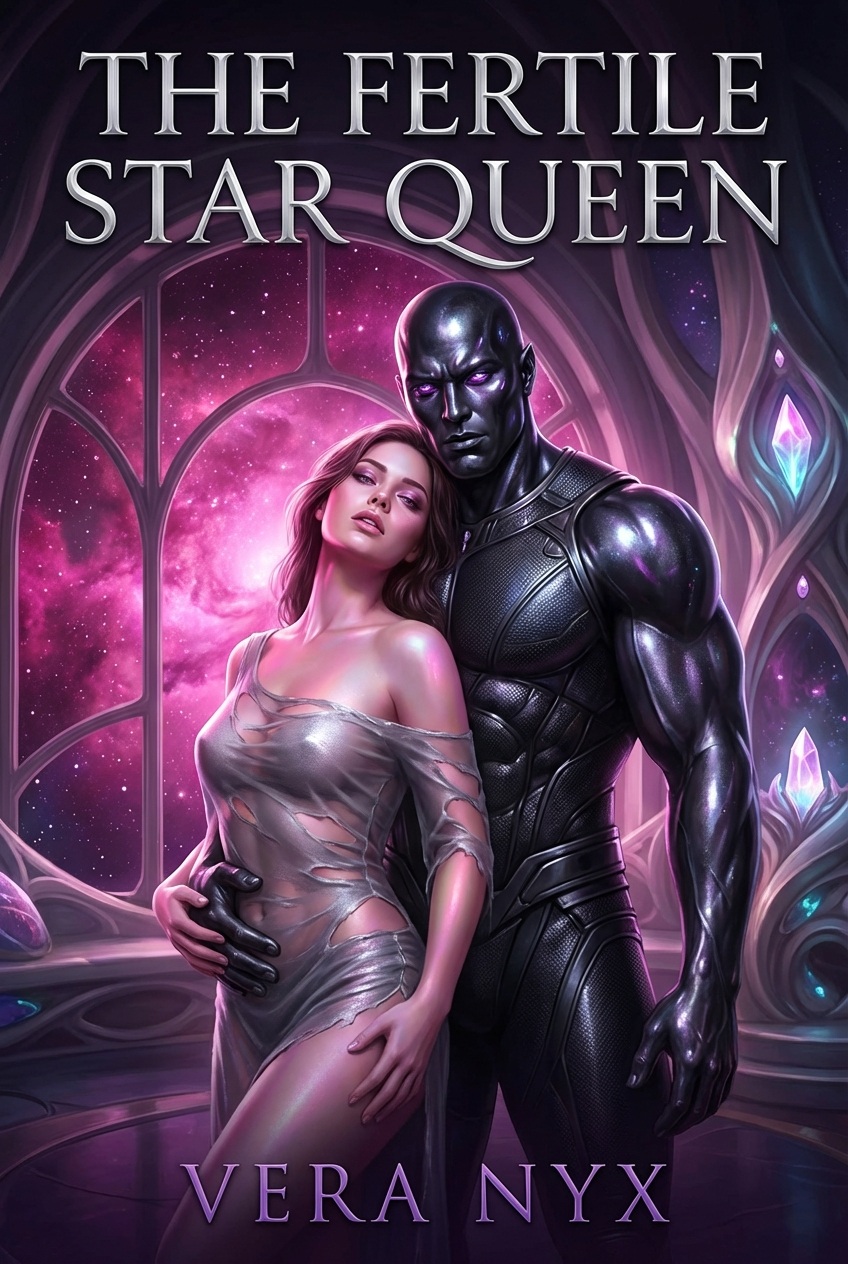
If you have ever scrolled past a cover with a scaled chest, a starfield, and a woman in a torn dress looking up at something enormous, you already know the shape of it.
What Alien Abduction Romance Actually Means
The name is almost entirely literal. There is an alien. There is an abduction. There is a romance, in the genre sense of a central love story with a satisfying ending.
The word "romance" is doing structural work here, which matters: an alien abduction story without a genuine romantic arc is science fiction horror or erotica without the HEA, and readers will notice the difference immediately.
What counts: a human taken off Earth (or taken from an Earth-adjacent setting) by an alien, with a romantic and usually sexual relationship developing between them. The capture can be violent or gentle, deliberate or accidental, the work of the alien love interest personally or the work of a third party from whom the love interest then protects the human. All of those count.
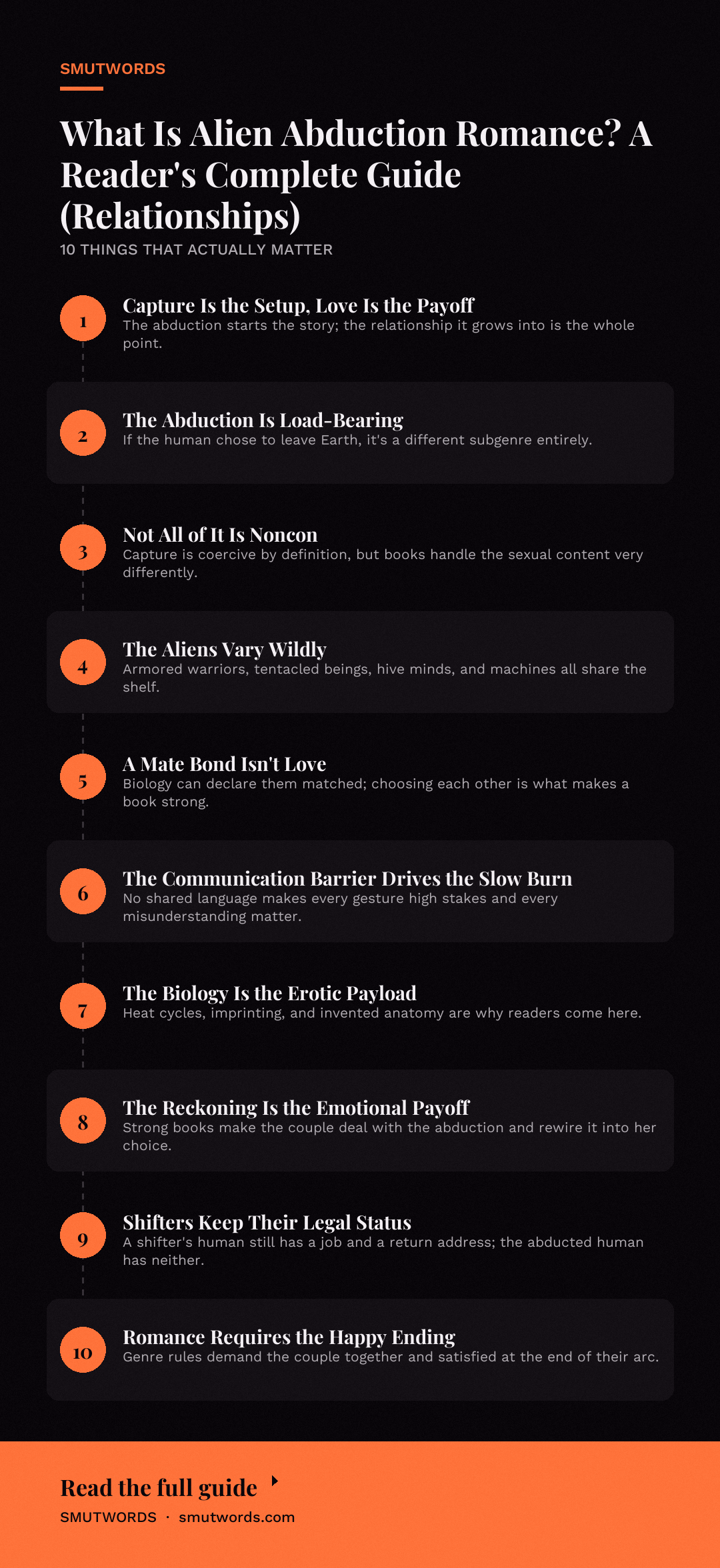
What doesn't count, at least not as the trope readers mean: alien-human romance where the human consented to the trip. If she signed up for a breeding program, bought a ticket on a colony ship, or chose to leave Earth, that's a different subgenre with a different emotional texture. The abduction is load-bearing.
Three misconceptions show up constantly in reader discussions:
- That it's all noncon. It isn't. The capture is coercive by definition, but how far the story takes the sexual content along that coercion line varies enormously. Some books lean into the forced circumstances. Plenty downplay or sidestep the forced element entirely, framing the abduction as desperate necessity on the alien's part, or as rescue disguised as capture.
- That the aliens are all the same. The genre contains everything from armored warriors with mating instincts to aquatic beings with tentacles, from hive-mind collectives to sentient machines running bodies for the purpose. The kraken romance and AI romance corners of the market share DNA with alien abduction even when the being in question technically isn't extraterrestrial.
- That a mate bond is the same as love. Many alien abduction romances include a fated-mate mechanic, comparable to a soulbond in fantasy romance, where biology declares them matched before either party agrees. The bond creates a physical and emotional pull. Whether the characters choose each other on top of that pull is what separates a strong book from a lazy one.
The alt names readers use tell you which flavor they want. "Alien captor romance" leans into the power imbalance. "Forced proximity alien" emphasizes the trap rather than the taker.
"Mate bond abduction" promises biology doing the heavy lifting. "Sci-fi captive bride" signals a marriage plot, often with a treaty, a trade, or a breeding program behind it.
Where Alien Abduction Romance Comes From
The abduction narrative is older than the romance genre's use of it. Betty and Barney Hill's 1961 account of being taken aboard a craft established the modern abduction story in the popular imagination, complete with missing time, medical examination, and the sense of a superior intelligence handling humans like specimens. That template fueled decades of science fiction, film, and television, and it always framed the aliens as a threat, a mystery, or a mirror.
Romance publishing took that template and changed the last frame. The alien became a potential partner. The examination table became a bed. The impossibility of communication became the obstacle to intimacy that the couple works through, which is a very old romance engine wearing new skin.
The genre's commercial form owes a lot to the way romance publishing fractured into niche digital imprints and self-publishing in the 2010s. Writers who wanted to write heavily sexual science fiction romance without the constraints of a print category found a direct audience and built long-running series around shared alien worlds and species.
What started as a niche within a niche became one of the most reliable category romance formulas in digital publishing, with authors running series of six, ten, twenty books in a single universe.
The trope has drifted in two directions since then. One direction is darker and more explicit about the captivity: longer books, more psychological interiority, often with genuine horror elements.
The other direction softened the abduction into something closer to rescue, with the alien love interest framed as having taken the human for her own good or in defiance of a worse fate. Both sell. They satisfy different appetites.
There's also a clear publishing history in the covers. Early entries leaned on pulp-era imagery: saucers, leering grey aliens, damsels in distress. Contemporary covers show the alien love interest as an idealized, often shirtless, humanoid figure with a few obvious deviations, the audience's fantasy front and center.
How It Shows Up in Erotica
Editor's-eye view: alien abduction romance is a machine for generating intensity, and the books that work best know exactly which levers they're pulling.
First, the capture scene sets the contract. The best versions tell you in the first fifty pages what kind of book you're holding. Is the alien a brute in need of a lesson or a soldier running out of options? Is the human furious and fighting, or does she immediately recognize something in the creature that nobody on Earth ever gave her?
The capture scene answers those questions, and readers decide from it whether to trust the author for the next three hundred pages.
Second, the communication barrier is the engine of the slow burn. When your leads don't share a language or a culture, every gesture is high stakes and every misunderstanding matters. Authors use translation tech, mate-bond telepathy, or gutting it out with body language to solve this, and the choice shapes the whole book.
Enjoyed this? Get a free book.
Join the list and we will send a complete free story straight to your inbox, plus new releases every week after that. No credit card, no catch.
Telepathy solves everything and often kills tension. A translator chip with rules and flaws is a gift. Pure body language forces the couple to be in each other's physical presence constantly, which is where the forced proximity does its best work.
Third, the biology is the erotic payload. Alien anatomy, heat cycles, imprinting, breeding instincts, mating marks. Readers who want vanilla human contact have no shortage of options; they came here for the unfamiliar. The alien breeding trope is the most direct version of this and often overlaps with heat-based narratives elsewhere in romance, like the structure of alpha/beta/omega dynamics.
The difference is that the alien version gets to invent the biology from scratch, which means anything can be a turn-on if the author commits.
Fourth, size and scale are reliably in play. Many aliens are enormous, and the size difference kink gets a workout here. A strong version treats the mismatch as a logistical problem the couple has to solve and finds increasingly creative ways to solve, with humor and care. A flat version just notes that he's big and moves on.
Fifth, the culture is where the alien's heart lives. An alien with a homeworld, a history, a clan structure, and a reason for abducting this specific human is a character. An alien who only exists to growl is a prop. Series that build a shared universe and populate it with structures, politics, and other couples let each new book feel both familiar and new.
Sixth, the reckoning is where the emotional payoff lives. The good ones eventually make the couple deal with the abduction itself. She did not choose this, and a relationship built on a thing she didn't choose needs to be rewired into one she does.
The best alien abduction books make that renegotiation a scene, sometimes a whole chapter, where the human gets to set a boundary on her terms and the alien accepts it, or learns to. This is where readers of safewords and negotiation wish these books showed their work more. In the strongest books, the negotiation is built into the plot as a physical thing: a decision, a refusal, a step forward she takes on her own.
What separates a strong alien abduction romance from a flat one, condensed:
- The human has her own want. She wants to go home, or she wants to stay, and either way the reader needs to feel her choosing. A protagonist who just reacts to the alien's decisions is furniture.
- The alien has a reason that pre-dates her. A dying species, a treaty, a war, a clan debt. If the abduction happens because the plot needs it, the reader can feel it.
- The culture is more than costuming. Specific rituals, specific taboos, specific misunderstandings. The stranger the culture, the better the fish-out-of-water tension.
- The barriers are real and consistent. The translator glitches when the alien feels something, and the reader learns to dread the glitch before the couple mentions it.
- The conclusion honors what happened. She gets the choosing moment. He gets the admission. The book doesn't pretend the abduction was no big deal just because the sex was good.
One more craft note: pacing. The capture pushes hard, the middle should slow into negotiation and discovery, and the resolution should bring the intensity back up. Books that front-load the capture and then drift into domesticity lose readers. Books that maintain a threat or a deadline through the middle keep them.
Alien Abduction Romance vs Territorial Shifter Trope
Readers browsing both often ask the difference, since the shape feels familiar: a dominant nonhuman takes a human, claims her, and the claim turns into love. The key difference is legal status.
A shifter claiming a mate operates inside Earth's rules and usually inside some community structure, which is why the territorial shifter trope often overlaps with pack dynamics and the social order that comes with them. The human in those books still has neighbors, a job, and a return address.
The human in an alien abduction romance has none of that. She is off-world or in a ship, under alien law, in an unfamiliar environment, with a mate bond or a mating instinct that goes well beyond werewolf tradition. Kraken and angel versions of the abduction shape exist too, but the standard distinction holds: the shifter story assumes the human belongs to a society. The abduction story assumes she doesn't, which raises the stakes.
That's also why alien abduction romance is often read as fantasy rather than simulation. No one orbits a space station and expects a werewolf's rules. The whole point is that the familiar world, and its protections, are gone.
Frequently Asked Questions
Is alien abduction romance always non-consensual?
No, though the capture is coercive by definition. Many books place the sexual content after the human reaches some form of genuine wanting, and some authors route the abduction as forced marriage or diplomatic necessity rather than personal capture. Read the content notes if you want to avoid the darker end of the trope; plenty of series sit firmly in the fantasy-rescue lane.
What is the difference between alien abduction romance and alien breeding romance?
Abduction is the larger subgenre and usually the main plot. Breeding is one specific focus within it, where the alien's species need, heat cycle, or reproductive stakes drive the sexual content. A book can be alien abduction romance with no pregnancy content at all. Readers wanting the breeding side of it should look for that phrasing in the description.
Why do readers like alien abduction romance so much?
The abduction removes everything familiar, which means the protagonist's entire previous life and identity are gone. That makes the alien's focus on her total and exclusive in a way everyday romance can't easily match. Add in a physically powerful nonhuman partner and mate-bond biology vowing permanence, and the fantasy is a very particular kind of total belonging.
Can alien abduction romance have a happy ending?
It has to, if it wants to be shelved as romance. Genre conventions require the couple together and satisfied at the end. Some darker series end on a cliffhanger between books, but the final resolution of the couple's arc should be genuinely happy. Readers returning to the trope are returning for the guaranteed ending as much as for the ride.
Do I need to read an alien abduction romance series in order?
Usually not strictly, but you'll get more from the worldbuilding if you do. Most series follow a new couple per book but rely on the reader already knowing the species, the politics, and the recurring side characters. Starting mid-series is workable and often how readers discover a favorite author; the first book of the series is where the world rules get spelled out.
What's the difference between alien abduction romance and sci-fi romance more generally?
Sci-fi romance includes humans falling for humans on spaceships, mercenary romances, colony stories, and any relationship story with a science fiction setting. Alien abduction romance is the specific slice where a human is abducted by an alien and the relationship grows out of that captivity. If the abduction is the plot's central engine, it's the trope. If the abduction is a subplot, it's sci-fi romance with a captive element.
Final Thoughts
The trope works because it does something almost no other subgenre does: it gives the reader a protagonist who has lost everything familiar and a partner who considers her the most important thing in the universe. There's no social circle to navigate, no ex to dodge, no rental agreement to renegotiate. There is just the two of them, and the whole story is the distance between them closing.
If you want to see what the trope looks like when the author takes the abduction seriously, with a real ethical reckoning built into the romance, start with a book that commits to the culture and the consequences before the chemistry. The ranked recommendations below include several that do exactly that, plus a few that lean into the heat first and let the reckoning catch up later. Either way, they're the right place to start.






Loading comments…