
Power exchange is the deliberate, consensual trade of control between partners: one person hands over authority, the other takes it up, and both agree on the terms. In practice it runs from a single scene where someone is tied and told what to do, to a full-time relationship where one partner makes the rules and the other follows them.
The term itself is the umbrella over D/s, Total Power Exchange, service submission, and the dozens of smaller arrangements people build inside it. It is probably the most common kink structure in all of erotica, even when nobody on the page uses the words.
What Power Exchange Actually Means
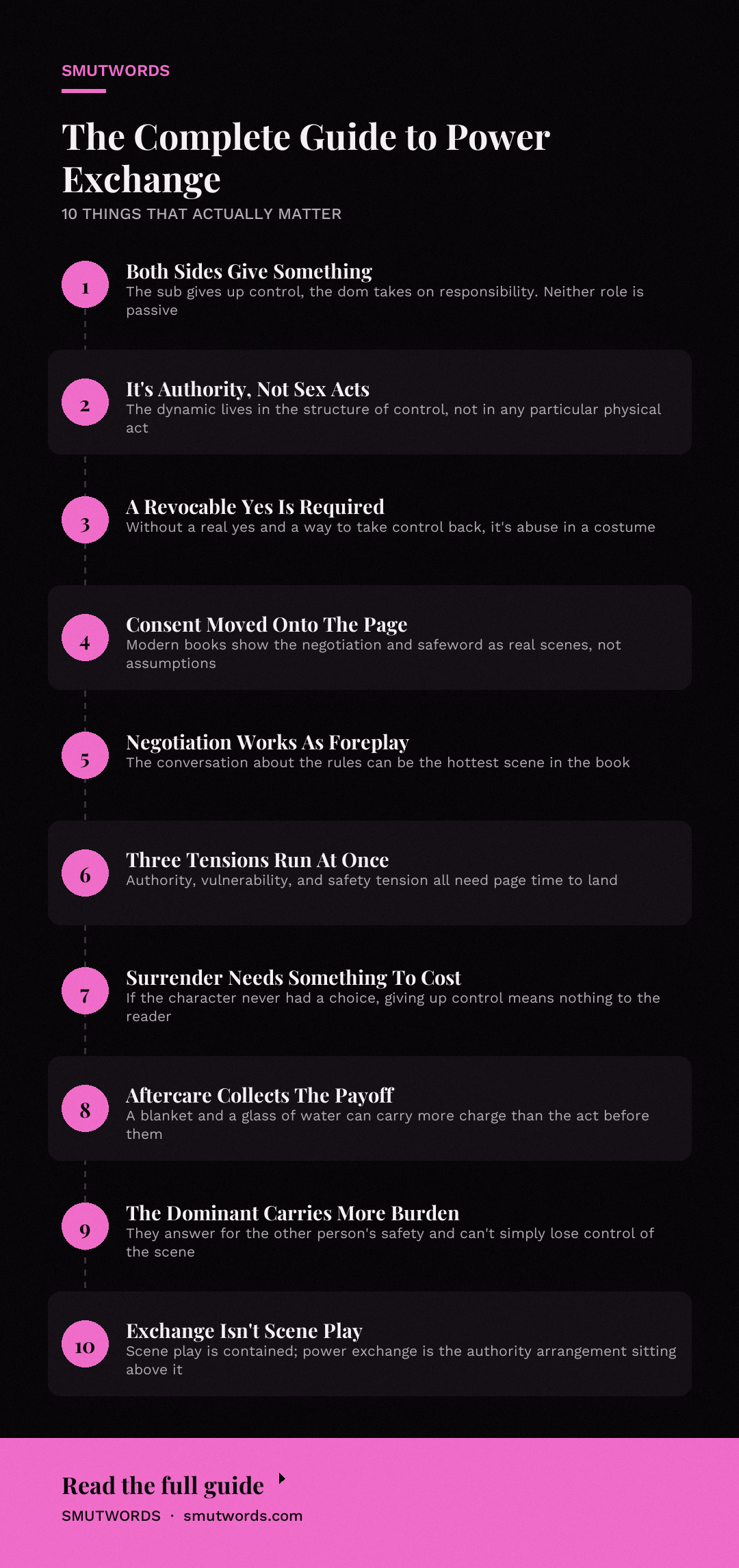
The phrase describes an exchange, which means both sides give something and both sides get something back. The submissive gives up decision-making authority. The dominant takes on responsibility for the other person's experience. Neither role is passive, and neither is empty.
Control is the currency. Attention is the interest. The dominant is not simply getting obedience; they are getting the concentrated focus of someone who has chosen to trust them. The submissive is not simply being told what to do; they are being handled, tracked, and prioritized by someone paying very close attention.
It helps to separate the term from the thing it is most often confused with: kinky sex acts. Power exchange can involve rope and impact play hot enough to warrant a whole conversation about impact play aftercare, and it can also involve nothing more physically intimate than a partner deciding when the other person is allowed to speak. The dynamic lives in the structure of authority, not in any particular act.
What does not count is coercion, manipulation, or a partner who never actually agreed. A power exchange requires a real, revocable yes from the person giving up control, with a clear sense of how to take it back. Without that, it is abuse wearing a costume, and erotica that can't tell the difference writes bad dynamics and worse fiction.
Where Power Exchange Comes From
The phrase grew out of the leather and D/s communities of the mid-twentieth century, where structured authority had long been a core part of practice, and it gained wider currency in the 1970s and 1980s as kink organizers started writing down safety frameworks. The term became a way to name the thing everyone was already doing in different forms.
On the page, though, the dynamic is far older than the label. Submission and command run through the whole history of erotic writing: the Victorian spanking novels, the 1950s paperback domination books sold under the counter, the surge of published BDSM romance that followed Fifty Shades. Erotica writers were dramatizing the trade of control long before anyone called it power exchange.
The bigger shift in recent decades is consent. Early BDSM fiction often treated the dominant's authority as something that happened to the submissive, sometimes without much negotiation on the page. Modern power exchange romance has moved the negotiation, the safeword, and the aftercare into the story as real scenes, because readers started demanding to see how the trust gets built.
A paperback from 1985 and a 2024 release might depict the same collar, but only one of them shows the conversation that came before it. The vocabulary has multiplied too. Total Power Exchange, 24/7 dynamic, protocol-based exchange, service submission, brattiness: these all describe ways of structuring the same underlying trade, and they all show up as the premise of entire subgenres now.
How It Shows Up in Erotica
The craft of power exchange fiction is mostly about making the surrender feel earned. Any author can write a character who obeys. The good ones show you why the obedience costs something and why it's worth the cost.
Common variations authors use:
- Scene-based exchange: the dynamic exists inside a defined window. The collar comes off when the scene ends, and both partners return to their usual footing. This is the easiest version to write well because the book has built-in edges for pacing.
- Total Power Exchange: the control extends into daily life, the calendar, money, clothing, and text messages. The trick of writing TPE is showing how it stays livable rather than becoming pure ornament.
- Service submission: the submissive's satisfaction comes from acts of service rather than pain or humiliation. The pleasure is in being useful and being seen being useful, and the scene earns its heat through meticulous attention.
- Bratting: the submissive tests the rules to provoke the dominant's response. This is a tonal needle; done well it's playful and proves the dynamic is alive, done badly it reads as a character who is simply annoying.
- Protocol: the interaction follows visible rules (how to address the dominant, how to enter a room, what a gesture means). The formality itself becomes the erotic object, so the reader gets charged by small formalities.
Strong versions show negotiation as foreplay. The conversation where two people decide what the rules will be is one of the hottest scenes in the book when an author slows down and lets the tension do its work. The actual consent negotiation becomes dramatic material: what will the submissive agree to, what will they refuse, what does the dominant ask for that surprises both of them? The agreement is the plot.
Weak versions skip that conversation and jump straight to the collar, which means the surrender has no weight. If the character never had a choice, handing over control costs nothing, and the reader feels the lack.
The other place erotica lives or dies is the aftermath. A scene that strips a character down has to put them back together on the page, and the best books treat aftercare as part of the sex rather than an epilogue.
The aftercare is where the emotional payoff gets collected. A blanket wrapped around shoulders and a glass of water can carry more charge than the act that preceded them, because it's the scene where both people admit how much the exchange meant.
Safewords matter here too, and most readers now expect to see them handled on the page rather than assumed. A clear, agreed-upon safeword is the evidence that a character can always stop the scene, and its presence is often what lets an author push the intensity further without losing the reader's trust. If you're writing one, this guide to safewords and how to use them is a good place to understand the mechanics.
What Makes a Strong Version Work
The dynamic works on the page when the reader can feel both sides of the trade. The dominant's attention has to read as actively chosen and executed, not as a convenient way to get obedience. The submissive's surrender has to read as a deliberate act, not as a personality trait that happened to them.
A strong power exchange scene has three separate sources of tension running at once:
- Authority tension: who is in control right now, and how close is the submissive to the edge of obedience? This creates the conversational friction.
- Vulnerability tension: what is the submissive revealing by giving this up? This creates the emotional pull of the scene and the reason the reader cares.
- Safety tension: is the dominant paying attention, and do both of them know how to stop? This is the tension the reader needs to relax into the scene at all.
Books do this through pages of dialogue, restraint, and small physical detail: the pause before a command, the breath a submissive takes, the way a dominant notices what isn't being said. The scene that spends time on all three sources of tension lands harder than one that spends all its page time on visible acts.
The Real-World Mechanics Erotica Should Include
The genre has moved toward depicting real risk management, and readers notice when a writer knows what they're doing. In practice, a responsible power exchange sits inside a framework like RACK, where the participants understand the risk, consent to it, and build the scene around that knowledge.
Safewords and check-ins are the operational side. A scene can be ongoing and intense and still have a pause mechanism, and a dominant who checks in without pulling the atmosphere out of the room is a skilled practitioner. The mechanics of aftercare, including impact play aftercare where physical marking is involved, belong in the book when the scene involves physical intensity; a reader who lands on a page about spanking will want the recovery to make sense too.
Enjoyed this? Get a free book.
Join the list and we will send a complete free story straight to your inbox, plus new releases every week after that. No credit card, no catch.
Humanizing the Concept
The strongest power exchange fiction gets to know the people behind the roles. If a story only ever shows the characters inside the dynamic, the reader never learns what the submissive does away from it. A character who runs a company all day and wants the opposite at night is a richer story than one who only exists inside the bedroom.
For the inverse, look at the popular professor/student romance premise: the power differential is structural, and the best versions hit the point where the characters have to acknowledge that the institutional hierarchy and the sexual one are not the same thing and cannot be treated as interchangeable. That honesty is what the strongest power exchange writing does.
The Physical Context of a Scene
Authors should consider the setting as a character element in the dynamic. Power looks completely different in a room with a locked door than in a masked room where the dominant holds a ceremonial object. Even cupping is often staged as a scene-within-a-scene, where the apparatus and the protocol around it do most of the work.
The point isn't to replicate a dungeon; it's to make the chosen staging mean something about the relationship, and that starts with how the scene is constructed as scene play rather than a single act.
Consent, Misconceptions, and What Readers Want
The most common misconception is that power exchange is one partner "winning" control over another. In the best fiction, the dominant is arguably the more burdened character: they are responsible for the other person's safety and experience, and they can end the scene but cannot simply lose control of it. A dominant who loses control is failing at the job, and the page should show it.
The second misconception is that surrender and strength are opposites. The most convincing submissives in the genre are often the characters with the most agency in the rest of their lives, and the surrender is precisely meaningful because they had the option to refuse it. A character who has never had autonomy cannot gift it away.
Third, readers often expect an explicit, ongoing agreement rather than a one-time declaration. The strongest books revisit the agreement, change it when it stops working, and show what happens when one partner wants to renegotiate. A dynamic that can be revised is more credible than one that was set in stone at the start.
Balance and Daily Life
A big part of the genre's appeal is watching the dynamic function inside ordinary life. Partners who want different amounts of structure, and need to negotiate where the edges are, are inherently dramatic: the tension comes from two people trying to keep one relationship running while one of them wants to hand over more than the other is ready to take.
That tension is the plot of a lot of good books, and it's a good reason to read the vanilla/kink mix relationship as a dynamic rather than a status.
Power Exchange vs Scene Play
These two get used interchangeably by readers, so it's worth drawing the line. Scene play describes the contained, time-limited activity: the rope, the equipment, the planned sequence of events, and it can happen with no ongoing authority at all. A couple can schedule a spanking scene every other Saturday and go back to a completely equal relationship on Sunday.
Power exchange is the authority arrangement that may sit above those scenes. It's what decides who initiates, who sets the rules, and whether there is any submission happening at all outside the activity.
The overlap is huge and in a lot of fiction the two are the same event, but a book that treats them as one thing loses the ability to write a couple whose scene play is kinky and whose daily footing is equal. For anyone who wants to see the sensory side of that distinction, the anticipation play entry makes the point well: the waiting is a practice, and how the couple organizes the waiting is the exchange.
Frequently Asked Questions
What is a power exchange in a relationship?
A power exchange is a consensual arrangement where one partner agrees to give up some measure of control and the other takes responsibility for it. It can be limited to a scene or extend into daily life. The defining feature is agreement and reciprocity, not any specific activity.
What does TPE mean in power exchange?
TPE stands for Total Power Exchange, a version where the authority arrangement covers most areas of daily life rather than being confined to sex or play. In books, TPE is usually written as a negotiated daily structure, with rules, protocols, and regular reviews. It is the most intensive form of the dynamic and requires the most ongoing communication.
Why is the exchange consensual in kink, not just the act?
Consent is the mechanism that turns the surrender of control into a chosen act rather than coercion. The agreement is part of the eroticism: the submissive's power to withdraw changes the meaning of obedience. Readers respond to that dynamic because it signals that the surrender is a gift rather than something taken.
What's the difference between aftercare and power exchange's everyday routine?
Aftercare is the recovery period immediately following an intense scene, focused on physical and emotional care and on returning both partners to baseline. The everyday routine of a power exchange describes how the relationship runs between scenes: the protocols, the habits, and the ongoing structure. One is the crash cart; the other is the household.
Is power exchange always sexual?
No. The dynamic is about authority, not sex, and some arrangements are nearly or entirely non-sexual. Many participants describe service submission and protocol-based relationships as fulfilling without being sexual. Erotica often combines the two, but the category of power exchange is wider than the sex that surrounds it.
How does power exchange show up in romance books?
Usually as the central engine of the relationship arc: one character wants to give up control, the other is either ready or not, and the negotiation drives the plot. The best books show the agreement changing over time. The weakest show the devotee simply deciding to obey.
Final Thoughts
Power exchange is one of the few kinks that can be written without any equipment at all, which is exactly why it's as hard to do well as it is easy to attempt. The collar is easy.
The conversation before it is the part that either earns a reader's trust or loses it, and you can tell which kind of book you're holding within about ten pages. The next time you want one that gets the negotiation, the authority, and the aftermath right, the honest place to start is the ranked list at the bottom of this page. The best entry there will make you feel every single clause of that agreement.






Loading comments…