Omegaverse is the speculative romance subgenre that runs on a biological hierarchy: Alphas at the top, Betas in the middle, Omegas at the bottom, and a set of instincts (heats, ruts, scenting, knotting, mating bites) that override polite society and drag two people together whether they planned on it or not.
It began as fan fiction in the early 2010s, crossed into self-published romance around 2016, and now sustains a whole shelf of books where the body knows what it wants before the mind agrees. If you have seen the tags "A/B/O," "alpha/omega," or "knotting" and wondered what exactly you were looking at, this is the thorough answer.
What Omegaverse Actually Means
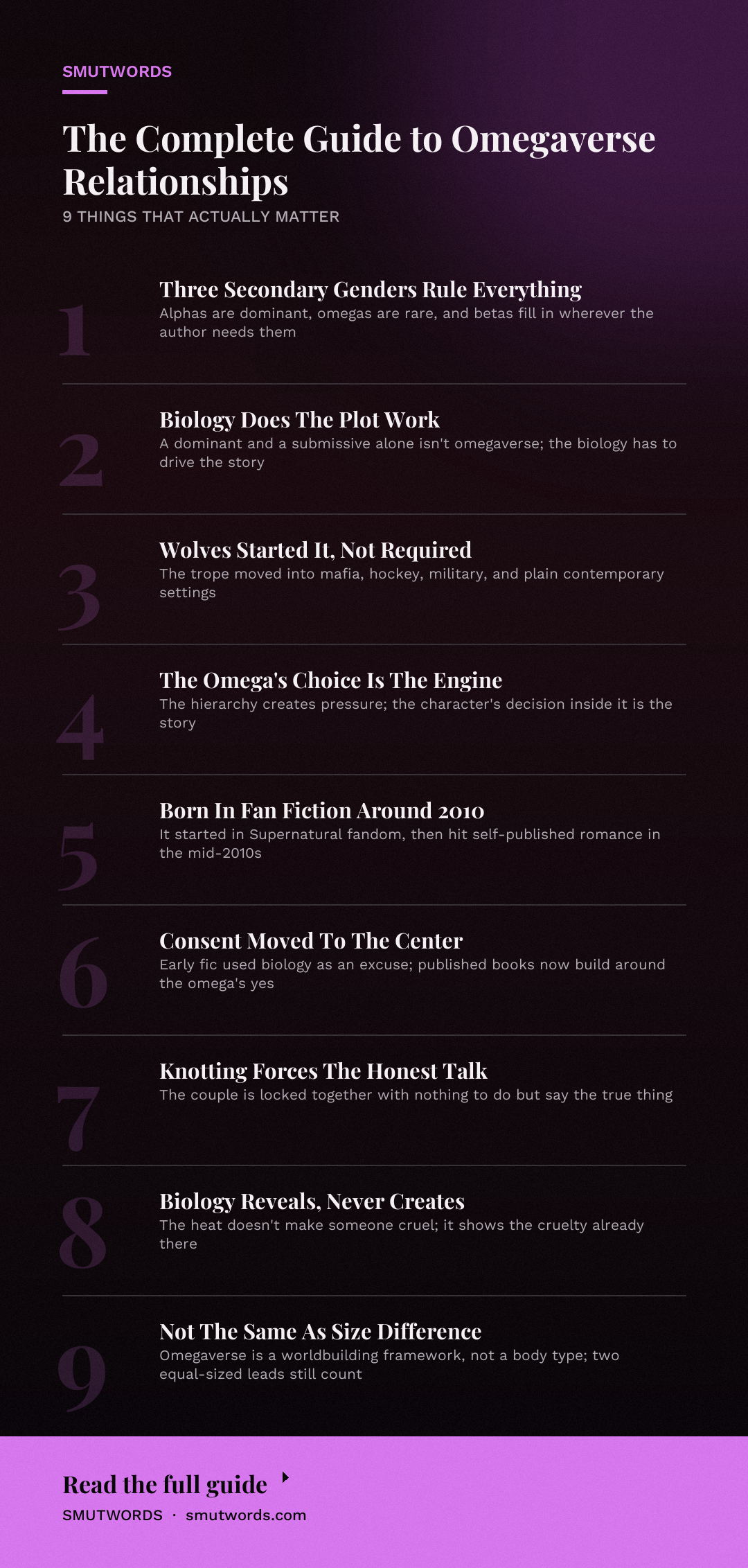
The name is literal: a universe organized around omegas. In the standard build, every character is born into one of three secondary genders that exist alongside (or replace) male and female. Alphas are dominant, physically larger, territorially aggressive, and go into a rut cycle.
Omegas are rarer, often smaller, driven by a monthly or seasonal heat that leaves them desperate for sex and vulnerable to any Alpha nearby. Betas are everyone else, and their role varies wildly by author, from background filler to the only emotionally stable people in the room.
The biological furniture is where the genre gets its charge. Slick is the omega's self-lubrication, produced in heat. Scenting is the ability to read a person's secondary gender, mood, and fertility through smell alone, which means characters know things about each other before anyone says a word.
A knot is a swelling at the base of an Alpha's cock that locks him inside his partner during orgasm. A mating bite on the neck creates a permanent hormonal bond, and a heat can only be fully satisfied by a knot, which is the genre's built-in reason two people have to keep going.
What counts as Omegaverse is broader than the fan-fiction origin suggests. Any world with a secondary-gender hierarchy and instinct-driven mating cycles qualifies, whether it's set in a wolf pack, a corporate office, a spaceship, or a small town where everyone is inexplicably human except for the biology.
What doesn't count: a story that just has a dominant character and a submissive one without the biological framework. Power exchange alone is not Omegaverse. The genre requires the biology to be doing structural work in the plot.
Two misconceptions come up constantly. The first is that Omegaverse is always about wolves. Wolves started it and remain the default, but the trope has migrated into crime families, hockey teams, military units, and straight-up contemporary settings with no animal content at all.
The second is that the omega is passive. In the books that hold up, the omega's choice about who claims them is the entire emotional engine. The hierarchy creates pressure. The character's decision about how to move inside it is the story.
Where Omegaverse Comes From
Omegaverse is unusual among romance tropes because its origin is documented and recent. The first recognizable version appeared in Supernatural fandom on LiveJournal and Tumblr around 2010 to 2011, built by fans who wanted werewolf dynamics with a stronger biological punch.
The Alpha/Beta/Omega framework borrowed terminology from ethology (studies of wolf packs and dominance hierarchies) and from a since-discredited 1970s study of wolf behavior that described pack structure as a strict alpha-to-omega ladder. The science was wrong. The fiction did not care.
Early fic codified the furniture fast: heats, ruts, slick, knots, mating bites, mpreg (male pregnancy, originally a separate kink that Omegaverse absorbed because the biology made it plausible), and scent-marking. "A/B/O" became the shorthand tag, which caused some fandom friction once people noticed the abbreviation read as a slur in Australian slang, and many archives now prefer "omegaverse" spelled out.
The migration from fan fiction to published romance happened in two waves. Around 2015 to 2017, self-published authors on Kindle Unlimited started releasing original Omegaverse novels, often under pen names, often with shifter settings because that was the closest existing shelf.
The second wave, roughly 2019 onward, pulled the trope out of the forest entirely. Contemporary Omegaverse, mafia Omegaverse, and sci-fi Omegaverse proved the biology was portable. You could drop the hierarchy into a New York penthouse and it still worked.
The genre has also shifted in how it handles consent. Early fic leaned hard on biology as an excuse, with heats that overrode refusal and bonds that happened without agreement. The published version moved steadily toward the omega's choice as the central beat.
The heat still takes away control. The character still gets a decision, usually at the worst possible moment, and the book is built around what they do with it.
How It Shows Up in Erotica
The reason Omegaverse works on the page is that it hands an author a machine for generating sexual tension that doesn't require anyone to be stupid. Two people who would never ordinarily touch are trapped in the same room, one of them is days from a heat, and both of them can smell exactly what's about to happen.
That is the same pressure valve that drives forced proximity romance, and Omegaverse just adds biology to the lock on the door. Want another flavor of the same trap? That same principle runs through forbidden affair tropes, minus the pheromones.
Heat sequences are the genre's set pieces and every author runs them a little differently. Some heats are a single brutal night. Some are a week-long haze with the Alpha cycling through knots, water, food, and knots again. Some authors fade to black and let the emotional aftermath carry the weight.
What separates a strong heat scene from a flat one is usually the same thing that separates a strong sex scene anywhere: whether the characters are recognizably themselves inside it. A heat that erases personality reads as choreography. A heat where the buttoned-up omega screams something they'd never say sober reads as character.
Knotting is where the monster cock kink side of the genre lives. The knot is a temporary enlargement that locks the couple together, which means the author gets a built-in forced-stillness beat: nobody can leave, nobody can fidget their way out, and the conversation that happens in those minutes is often the most honest scene in the book.
Enjoyed this? Get a free book.
Join the list and we will send a complete free story straight to your inbox, plus new releases every week after that. No credit card, no catch.
Good knot scenes are usually less about size than about the trap. The couple is stuck together, physically, and there's nothing left to do but talk.
Common variations authors reach for:
- Classic shifter Omegaverse. Wolf packs, Alphas with territories, a hierarchy enforced by scent and teeth. Overlaps heavily with pack dynamics.
- Contemporary or mafia Omegaverse. No animals. The hierarchy maps onto corporate power, crime families, or the military, and the biological rules stay exactly as strict.
- Reverse harem Omegaverse. One omega, multiple Alphas, often a pack of chosen mates rather than a single bond. This is where the pack mates romance structure does the heaviest lifting.
- Mpreg Omegaverse. Male omegas carry pregnancies, which changes the emotional stakes of a mating bond considerably.
- Bonded-against-their-will. The mate bond triggers by accident, or by one party's choice and not the other's, and the book has to work out what that means.
- Heat-suppressant plots. The omega is medicated, the suppressants fail, and the whole book is the fallout.
One craft note worth stating plainly: the strongest Omegaverse writing treats the biology as a condition, not a character. The heat doesn't make someone cruel. It reveals the cruelty they already had. The bond doesn't manufacture love. It removes the option of pretending the love wasn't there. Authors who understand that write books that hold up outside the tag. Authors who don't write heat scenes with a plot stapled to the front.
Pack structure is the other half of the genre, and it's where the trope connects to the broader shifter shelf. A pack in Omegaverse is a political body with rules about who can claim whom, and the pack's reaction to a mating bond is often the actual conflict.
That overlays cleanly with territorial shifter tropes, and it's a big part of why readers who come for the knotting often stay for the hierarchy drama.
If you're new to the tag, the consent question is worth understanding before you start reading, because Omegaverse sits closer to dubious consent (dubcon) than most romance subgenres do, even when the book ultimately resolves toward a clear yes. The heat removes the capacity for sober refusal. The genre's better authors know this and build the resolution into the story rather than ignoring it, which is why the omega's choice became the trope's central beat.
Omegaverse vs Size Difference Romance
The comparison that trips people up most often is between Omegaverse and size difference romance, because the two overlap visually and get tagged together constantly. They are not the same trope.
Size difference is a physical dynamic: one partner is significantly larger or smaller, and the story plays with what that means for sex and for power. It shows up in Omegaverse all the time because Alphas are usually written huge and omegas usually aren't, but size difference also runs happily through contemporary romance, sports romance, and every monster subgenre on the shelf.
Omegaverse is a worldbuilding framework, not a body type. Two characters the same size can be an Alpha and an omega. The hierarchy does the work, and the physical contrast is optional seasoning.
If you're looking for the biological hierarchy, mating cycles, and knotting, you want Omegaverse. If you're looking for a height gap and someone getting lifted against a wall, you want size difference, and you can find it in a dozen other tropes.
Frequently Asked Questions
What does A/B/O mean?
A/B/O is the older abbreviation for Omegaverse, standing for Alpha/Beta/Omega. Many archives and authors have moved away from the abbreviation because it reads as a slur in Australian slang, and "omegaverse" spelled out is now the preferred tag.
Is Omegaverse always about werewolves?
No. Wolves were the original setting and remain the most common one, but the trope has moved into contemporary, mafia, military, sci-fi, and sports settings with no animal content at all. The biological hierarchy is what makes a book Omegaverse, not the fur.
What is knotting, exactly?
Knotting is a sex act where the base of the Alpha's cock swells during orgasm and locks the couple together for several minutes. Authors use the locked-together interval for forced intimacy, honest conversation, and emotional fallout, and it's one of the genre's signature beats.
What is an omega's heat?
A heat is a recurring biological cycle that leaves an omega desperate for sex, producing slick, and intensely sensitive to Alpha scent. Heats usually last several days and can only be fully satisfied by knotting, which authors use to justify the intensity and length of the sex scenes.
What is mpreg in Omegaverse?
Mpreg stands for male pregnancy. Omegaverse uses it because male omegas can carry children in the genre's biology, which raises the stakes of a mating bond considerably and often becomes the emotional center of a book rather than a side detail.
Do Omegaverse books have dubcon?
Often yes, at least in the setup. The heat cycle removes the omega's capacity for a sober yes, and the biological drive creates pressure that reads as coercion. Many published Omegaverse novels resolve toward a clear, chosen bond by the end, but readers who need enthusiastic consent from page one should check tags before starting.
Can Omegaverse work without the sex?
The genre is built around heat and knotting, so a fully sexless Omegaverse novel is rare. That said, some authors write the heat off-page and let the pack politics and mating-bond fallout carry the story, and those books tend to sit comfortably next to urban fantasy romance on the shelf.
Final Thoughts
Omegaverse earned its shelf space by solving a problem every romance subgenre fights with: how do you make two people want each other so badly that neither one can pretend otherwise? The answer the genre found is biology, and the answer it's still working out is consent. The books worth your time are the ones that take both seriously.
Start with a gateway read before you commit. The best entry point for most readers is a single-Alpha, single-omega shifter romance in a contemporary or small-town setting, where the worldbuilding is light, the heat scene is the centerpiece, and the mating bond has to be chosen rather than assumed.
Read two of those and you'll know whether the tag is for you. If it is, the pack-based and reverse-harem variants are where the genre opens up into something much bigger than a wolf pack in the woods.


Loading comments…