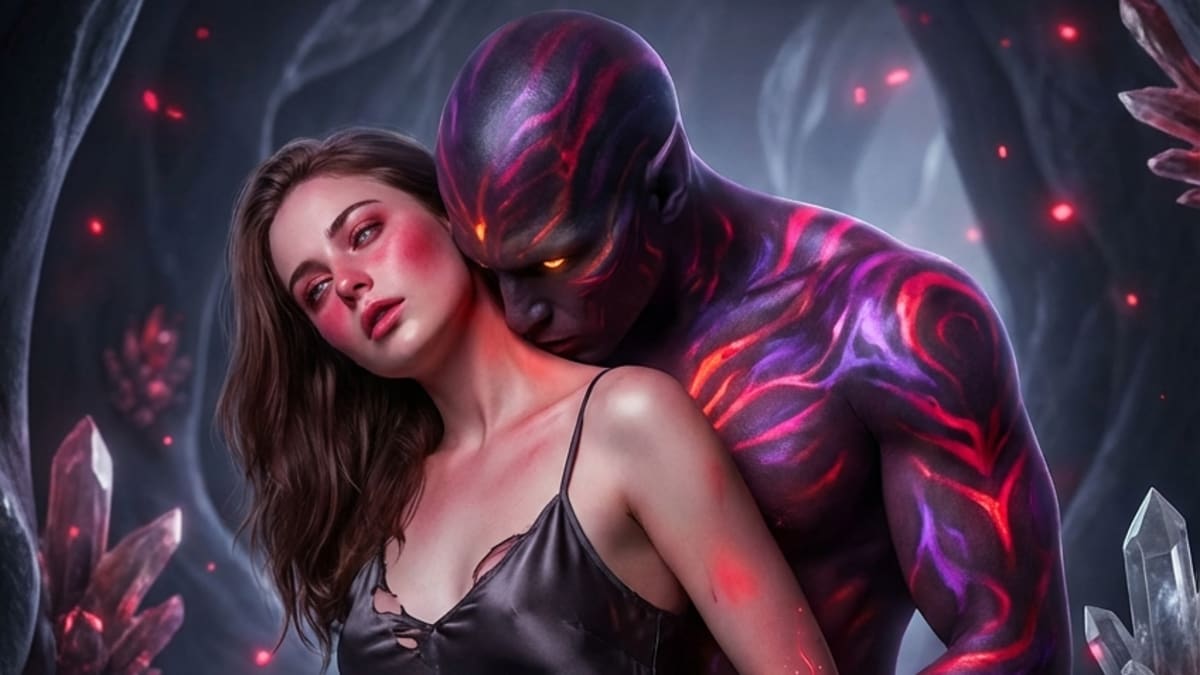
The creature design gets the cover art. The claws, the scales, the tentacle count, the whole monstrous silhouette that tells you immediately this is not a human man. But what actually sells a touch starved monster romance is the moment the monster flinches. The moment he reaches for her and stops himself, hand hovering, because he has spent his entire existence being told that this particular gesture would hurt someone. That specific hesitation is the real draw, and it has nothing to do with how many rows of teeth he has.
You can put a perfectly rendered beast on the cover, give him a tragic backstory, even give him a beautifully written internal monologue about his loneliness. If you don't land the scene where his gentleness costs him something, where being soft with her actively contradicts everything he's ever learned about himself, you've written a monster with a sad biography, not a touch starved monster romance. The distinction matters. The whole genre runs on that friction.
Do Monsters Feel Touch Starvation the Same Way We Do?
Roughly speaking, yes, and the good books make it physically literal. A human character who hasn't been hugged in years will say something like "I miss being touched." A monster character in this genre will describe his skin as being too tight, or his nerve endings as having gone dormant, or his body as a prison he's never once been able to share with another living thing. The writers who get it make the starvation a physical condition, not just an emotional one. He doesn't just feel lonely. His body aches, literally, in ways he's never had language for until she shows up and suddenly he can't stop noticing the weight of every inch of his own hide.
The best part is when the physicality of it contradicts the threat. He could crush her skull with one hand. He knows this, intimately, has probably done worse to things that were trying to hurt him. And yet the whole erotic tension comes from watching him do the math every single time he goes to touch her. How much pressure is safe? How do you hold something fragile when you've only ever held things that were either weapons or enemies? That internal arithmetic is the emotional engine. The tentacles or claws or whatever are just the vehicle that makes the math interesting.
Why "Gentle Only With Her" Carries the Whole Fantasy
Here's the thing about the gentle only with her beat. It works because it's a lie, and the reader knows it, and the monster knows it, and the heroine slowly figures it out. He's not gentle only with her because she's special in some magical way, though the narrative might frame it like that. He's gentle with her because she's the first person who's ever given him the chance to be gentle. That's a different story. That's a story about a creature who has been treated as a weapon his whole life finally getting to find out what else he might be. It's romantic precisely because it's about identity, not just attraction.
You see this done well all over the place in the genre. A monster who's been a jailer, a soldier, a weapon, a curse. Then a woman gets thrown into his path, and instead of screaming or running or trying to kill him, she does something mundane. She says please. She thanks him for something small. She asks his name. And his entire frame of reference shatters, because nobody has ever addressed him like he was a person before. The gentleness that follows is him learning a new language. She's not the only woman in the world who could have taught it to him. She's just the one who showed up first and didn't flinch.
- The language barrier beat: He literally doesn't have words for "soft" or "careful" in his own tongue, so he has to invent the concept through actions.
- The size difference beat: He tries to be delicate and misjudges, breaking something (a cup, a door, a piece of furniture) and then panicking because he scared her for a second.
- The self-imposed quarantine: He's chosen isolation because he genuinely believes proximity is dangerous, and she has to convince him this belief is wrong.
- The first intentional touch: Not the accidental brush, not the necessary grip to save her from a fall, but the first time he deliberately, consciously chooses to put his hand on her because he wants to, and he survives the experience.
Each of those beats gives the writer a chance to make the reader feel the starvation viscerally. The best versions draw out the first intentional touch like a confession. He's been circling it for chapters. He's been watching the way her pulse jumps at her throat. He's been memorizing the distance between them. And then he finally crosses it, and the whole scene slows down, and you realize the monster has never once in his entire existence touched another being for no reason other than wanting to. That's the moment the genre lives for.
The Difference Between Scary and Seductive
A common fumble in lesser versions of this trope is thinking that the monster's danger is what makes him sexy. It isn't. The danger is what makes the gentleness meaningful. If he's just scary, she's just a hostage with a nice interior monologue about Stockholm syndrome. If he's just safe, he's not a monster, he's a regular guy with a fun costume. The genre needs both registers operating at full strength at the same time. He has to remain genuinely threatening to everyone else in the world, and that threat has to be the thing he's most ashamed of when he's alone with her.
Think about how Star Sower: A Captive in the Tentacle Alien Breeding Chamber handles this. The setup is explicitly coercive, she's a captive, there's a breeding chamber involved, the tentacles are very much tentacles. What keeps it from feeling like pure horror is the gradual reveal that the creature running the chamber has never had a willing participant, has never been allowed to find out what he actually wants, and is fundamentally unprepared for the possibility that his captive might start cooperating because she's curious rather than because she's forced. The tentacles are frightening. The thing that makes it erotic is his total inability to handle being wanted.
That's the trick. The monster has to be monstrous enough that his softness is a revelation, and the softness has to be genuine enough that the reader forgets, at certain key moments, to be afraid. Then something happens that reminds you he could absolutely tear her apart, and the whiplash is the whole point. You get the fear and the safety at once, and the tension between them is where the heat lives.
How Physical Touch Writes Its Own Foreplay
Authorities on the subject, meaning people who read a lot of this, will tell you that the best touch starved monster romance scenes don't rush to genital contact. The foreplay is the part where he's finally allowed to touch her body without a specific purpose. Not to save her, not to fight something, not to carry her to safety, but just to feel her. He's got a whole lifetime of missed contact to catch up on. He wants to know what her hair feels like, what the pulse in her wrist feels like, what it's like to run a thumb across her collarbone without the fear that he'll break it. The author who drags out this phase of the story, who lets him savor every inch of skin like it's a miracle, is writing the emotional core of the trope directly. The sex is almost an afterthought. The touching is the point.
This is also where the physical differences between the monster and the human heroine get their real workout. A character with claws has to relearn how to touch. A character with tentacles has to figure out which parts of him are even capable of being gentle. A character with immense strength has to maintain constant conscious control over every single muscle, and the fatigue of that constant vigilance becomes part of the scene. He's exhausted by the effort of being soft with her, and that exhaustion is what makes the reader feel how much it matters. She's not just getting touched. She's getting the only gentle touch this creature has ever given anyone, and he's pouring all his focus into not ruining it.
Books like Extraterrestrial Heat build whole release cycles around this dynamic. The monster in that one is more than willing to be demanding, but the first real intimacy happens when he realizes he has no idea what she actually likes, has never had occasion to ask anyone, and has to learn from scratch how to read a body that isn't his own. The heat isn't just biological, though there's plenty of that. The heat is him figuring out, touch by touch, what makes her respond, and getting completely undone by the fact that she responds to him at all.
Enjoyed this? Get a free book.
Join the list and we will send a complete free story straight to your inbox, plus new releases every week after that. No credit card, no catch.
Why "Feared His Whole Life" Needs to Be Earned
Backstory matters. A monster who's feared his whole life because he's scary looking is one thing. A monster who's feared his whole life because he's actually done terrible things, and knows he's done them, and is carrying that weight is much more interesting. The reader can forgive a lot if the monster knows what he is. The truly compelling versions of this trope have a protagonist who agrees with the world's assessment of him, who believes he deserves to be alone, who has internalized the idea that his touch is a punishment. And the heroine's job, across the course of the book, is not to convince him he's secretly good deep down. It's to show him that what he does with his hands now matters more than what he's done with them before.
That's a more mature emotional arc, and it lands harder. He doesn't get redeemed and suddenly become a safe nice guy. He stays dangerous, stays capable of terrible violence, but learns that he has choices. He can direct that violence at threats. He can protect her with the same hands that have destroyed things. And he can, in private, learn to use those hands in ways that have nothing to do with destruction at all. The first time he touches her gently and realizes it didn't hurt anyone, that the world didn't end, that she's smiling at him, that's the climax of the emotional story. The physical climax is just a formality after that.
Taken by the Celestial King runs this arc beautifully because the king in question has spent an eternity as a figure of worship and terror, never as someone who could just be close to another person. The heroine has to teach him, through sheer stubborn refusal to be afraid, that his hands can do other things. The romance doesn't come from him shedding his nature. It comes from him finding a new use for it. That is the character work the entire trope is built to support.
Common Mistakes That Kill the Fantasy
Not every version of this trope works. The ones that fail usually fail in predictable ways that are worth naming so you can recognize them and skip the disappointment.
The first failure mode is making the monster too human. If he's just a guy with pointy ears and an attitude, there's no real contrast, and the "monster" designation is just a coat of paint. The touch starvation needs an actual physical or psychological reason to exist. He needs to be a creature for whom touch was genuinely impossible or genuinely dangerous before her.
The second failure mode is skipping the hesitation. If he just grabs her and she's fine with it, that could be any romance. The hesitation is the whole show. The scene where he reaches for her and stops, where she has to be the one to close the distance, where she has to verbally give him permission and physically guide his hand to her skin, that's the scene that makes the trope work. Remove it and you have a generic monster romance with a word count.
The third failure mode is making the heroine purely passive. A woman who just lies there and accepts the monster's touch is a prop, not a partner. The best versions of this trope have a heroine who wants. She actively pursues. She's the one who decides she's going to get past his fear, who experiments with him, who tells him what feels good and asks him for more. Planet of Orgasms is a good example of a world where the heroine's desire is the engine that keeps the whole thing moving. She wants, she asks, she receives, and the monster is constantly being floored by that directness.
The fourth failure mode is rushing the payoff. A touch starved monster who gets over his issues in one scene was never really starving. The genre rewards patience. Let him struggle for chapters. Let him mess up and have to apologize, literally, for touching her without checking first. Let him go through a whole crisis about whether he's allowed to use his hands on her at all. The longer the buildup, the better the release. This is one of those rare cases where slow burn is not just preferable but structurally necessary.
Why Readers Come Back to This Trope Again and Again
The touch starved monster romance fantasy offers something that more conventional romance often struggles with. It takes the core concern of intimacy, the fear of being seen and the fear of being too much for someone, and makes it literal. The monster's body is the anxiety. He is too big, too strong, too different, too dangerous, and he has been told his whole life that this makes him unlovable. The heroine's willingness to touch him anyway, to accept the danger and love the creature rather than the idea, is the fantasy. It's a fantasy about being accepted not despite your sharp edges but including them.
Everyone reading romance has felt, at some point, like their own particular sharp edges made them too much for someone. This trope takes that feeling and gives it fangs and scales and a tragic backstory, then lets the heroine win anyway. It's cathartic in a way that a story about two normal people falling in love rarely manages. Worship the Womb leans into this heavily, treating the physical differences between the characters as something to be honored and explored rather than overcome, framing the monster's body as an object of worship rather than a source of shame. That reframe, from dangerous to sacred, is the emotional reward the genre is built to deliver.
The creature design gets the cover art. But the reader who's been here before knows that the real reason to open the book is the moment the monster finally, hesitantly, achingly, touches her with hands he never thought he was allowed to use. That's the story. Everything else is just setting.
Final Thoughts
If you're new to the trope and want one story that shows you exactly what the touch starved monster romance is supposed to feel like when it works, try the one where the monster has spent his entire existence as a weapon and ends up undone by a woman who just wants to hold his hand. For this, Officer's Orders: Breed Her is a solid pick. It keeps the military command structure, keeps the edge of danger, then does the work of showing how a creature trained for domination learns to ask permission. That arc, from force to tenderness, is the whole appeal of the genre in a single story arc. Read it with the lights on and your hand on your own skin, because the whole point is that you deserve touch you're ready to ask for.





Loading comments…