
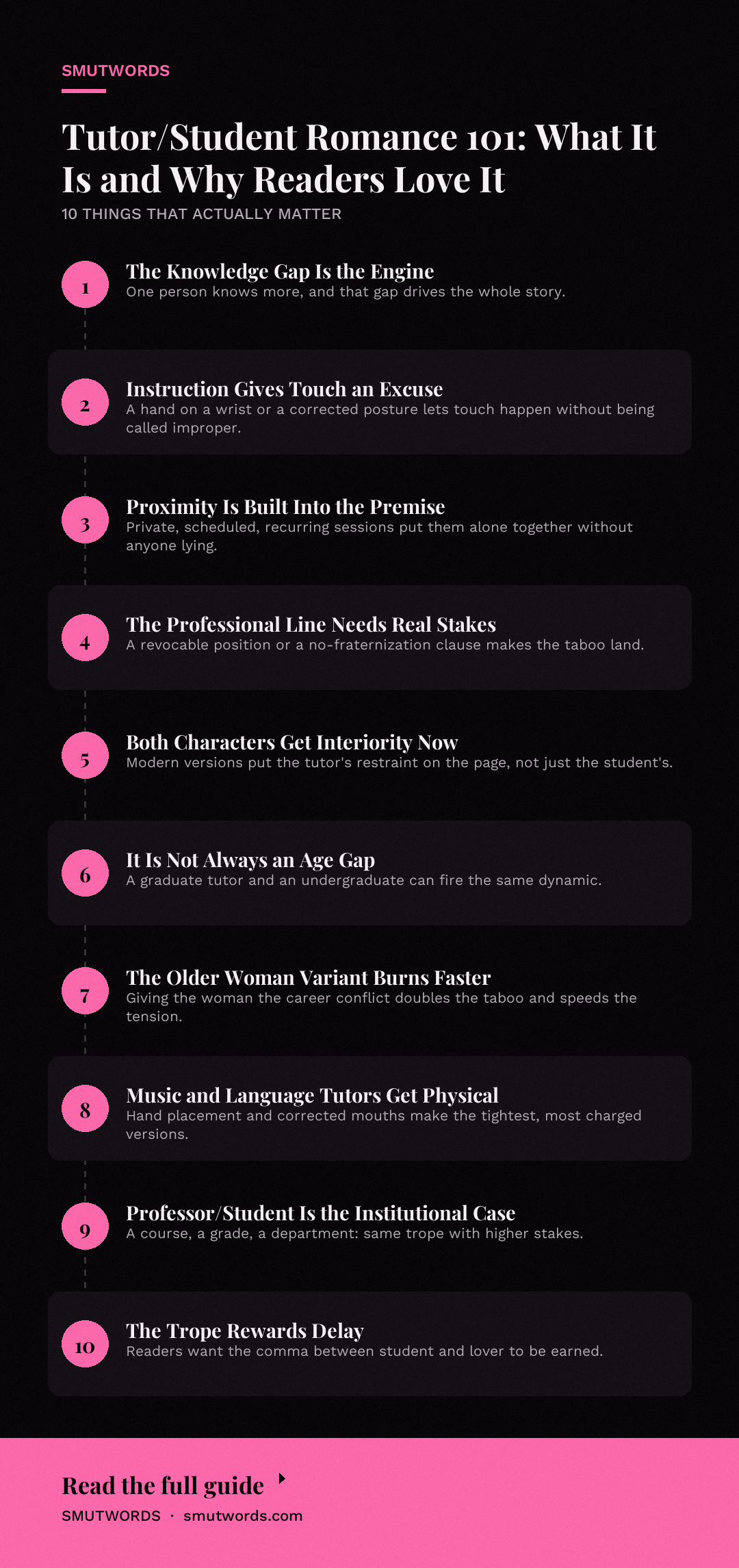
Tutor/student romance is the erotic subgenre built on the charged, closed-door intimacy of instruction: one person knows more than the other, and the gap between them becomes the whole engine of the story. A language lesson, a piano scale, a late-night statistics cram session.
The moment the teaching becomes personal, the book shifts from academics to arousal, and the reader is there for every inch of that shift. It's one of the most reliable slow-burn engines in the genre because the premise hands the author a built-in power differential, mandatory proximity, and a reason for two people to be alone together that doesn't require anyone to lie about why they're in the same room.
What Tutor/Student Romance Actually Means
The name is almost literal: a romance where a tutor and their student fall for each other, and the professional relationship between them is the source of both the tension and the taboo. The tutor holds knowledge the student needs. The student holds the tutor's attention in a way that starts clinical and stops being clinical fast.
The relationship is structured, scheduled, and supposedly temporary. That structure is exactly what makes it hot.
What counts as this trope is broader than a university classroom. Private tutoring sessions, music lessons over a piano bench, language exchange meetups, a hired academic coach, a professor's office hours that run long. As long as one party is formally instructing the other and the attraction grows out of that specific dynamic, it belongs here.
What doesn't count: a student who happens to sleep with someone who is also a teacher but teaches a different subject at a different institution, with no ongoing instruction and no professional risk. That's an age-gap romance with a job title attached. The tutor/student dynamic needs the instructional relationship to be live during the attraction, documented in the scenes, visible on the page.
Common misconceptions worth clearing up. First, the trope is not always older man/younger woman, though the publishing history leans that way. The older woman/younger man tutor variant is one of the most popular configurations in current literary erotica, and the professor/student version is its own distinct tradition in academic-set romance.
Second, the trope is not synonymous with coercion. The best versions handle the power imbalance with real craft and don't pretend it isn't there. The worst versions ignore it, and the reader feels the absence.
Third, the word "tutor" in this context rarely means only an academic role. It functions as a story shorthand for someone who is supposed to be in control of the situation and isn't.
Where Tutor/Student Romance Comes From
The tutor/student dynamic has been part of Western erotica since at least the eighteenth century, when the educated older man instructing a younger, less-experienced woman was a standard setup for seduction narratives. Richardson's Pamela is a servant, not a student, but the structure is identical: a man with authority over a woman's circumstances, an early "no" from her that the plot treats as negotiable, and a slow capitulation rewarded with marriage.
The tutor is a gentler variation on the same architecture, and the genre has been refining it ever since.
In twentieth-century mass-market romance, the trope split along gendered lines. The professor/student version dominated the academic novel and its more commercial cousins, usually with a male professor and female undergraduate, the imbalance of career consequence carried by the woman. The older woman/younger man tutor turned up more often in women's fiction and literary erotica, and its arrival as a named subgenre in online erotic publishing tracks the broader rise of female-authored, female-read romance through the 2000s and 2010s.
The publishing-side shift that matters most is the move from "tutor with an agenda" to "tutor with real interiority." Older versions often treated the tutor as a device, a seduction engine whose own feelings arrived as a plot twist in the final act. Contemporary tutor/student romance puts both characters' point of view on the page, and that symmetry is what modern readers show up for. The tutor's restraint, not the student's naivete, is now the primary source of tension.
The most recent development is the language-tutor and music-tutor micro-genre, which the internet made possible. Language exchange apps, Zoom piano lessons, long-distance tutoring through a screen: the trope has absorbed the new shapes of private instruction, and emerging authors have been fast to use it. The logistics alone (a shared screen, a scheduled call, a lesson that runs long) generate a tight, contained pressure the older classroom setup can't always produce.
How It Shows Up in Erotica
On the page, a good tutor/student scene runs on three engines: instruction, proximity, and the professional line. The instruction engine is the most underused. The physical demonstration of a technique (a hand on a wrist to correct a bow hold, a mouth shaping syllables for pronunciation, a palm flat on a lower back to correct posture) is an excuse for touch that the story never has to call inappropriate.
The scene can be ten pages of pure instruction and still be the hottest thing in the book, because the reader clocks what the characters are refusing to name.
The proximity engine is structural. Tutoring happens in private, repeatedly, and on a schedule. A tutor/student romance that never puts them alone in a closed room for a recurring session is leaving money on the table. The recurring nature is the point: the seventh lesson is more charged than the first, because the reader has watched the line get thinner each time.
The professional line is the third engine, and the strongest versions put an actual consequence behind it. A university position that could be revoked. A student's financial aid tied to the tutor's recommendation. A private contract with a strict no-fraternization clause.
The stakes have to be legible in the plot, not just implied in the premise, or the taboo is decoration. Books that treat the rule as folklore (the tutor's employer "wouldn't like it") feel hollow next to books where breaking the rule would blow up a real career.
Authors use a small set of common variants, and each one has its own flavor:
- Professor/student: The highest-stakes configuration, usually set in a university and weighted by academic hierarchy. Slow-burn dominant, rarely fast. The office-hours scene is a genre staple.
- Older woman/younger man tutor: A popular reversal of the classic male-authority template, and the one that most often foregrounds the woman's own conflicted desire rather than the man's pursuit.
- Language tutor: Built on mispronunciation, corrected mouths, and the intimacy of being taught to speak. Compressed timeline, high sexual tension per page.
- Music tutor: The piano bench is doing enormous structural work in this variant: hand placement, breathing, posture, an instrument that requires the body to be in the right shape. Very physical, very specific.
- Academic coach or admissions tutor: The most contemporary variant, and the one that most often uses a client relationship as its formal frame. Often an older woman/younger man story.
- Mentor/mentee (non-academic): The loosest variant, applied to professional mentors, writing mentors, training mentors. Cross-pollinates freely with the ghostwriter romance structure.
What makes a strong version work is fidelity to the imbalance. The best tutors in these books are not simply dominant. They are careful, sometimes deeply uncomfortable with their own feelings, and they make mistakes.
The best students are not simply naive. They are sharp, aware of the power gap, and sometimes push it deliberately to see what the tutor will do.
Enjoyed this? Get a free book.
Join the list and we will send a complete free story straight to your inbox, plus new releases every week after that. No credit card, no catch.
The scene that carries the whole book usually happens in a space where neither person has an easy exit: a storm, a broken-down car after a lesson, an overseas intensive program, a hotel room that the tutoring session was supposed to end at.
What makes a flat version fail is skipping the work. A tutor/student romance where the two characters fall into bed in chapter two and the employment consequences never land reads like a standard office romance with a coat of chalk dust. The trope rewards delay. Readers are here for the comma between "student" and "lover" to be earned.
The heat level is flexible. Some of the strongest versions are almost entirely slow burn, and the tutoring frame gives the author a legitimate reason to write high-charge scenes where nothing explicit happens for fifty pages.
At the spicier end, the technique becomes overt: showing someone how to use their mouth, their hands, their voice, as though it were a lesson.
The best books in that register keep the instruction language intact even at the peak of the scene, because the language is what the reader came for. If you're into body-worship variants of this dynamic, the SmutWords guide to thigh and breast fetish kinks covers the anatomy of what's going on in the body-focused scenes these books tend to produce, and the leg fetish guide is useful for the piano-bench and posture-heavy music-tutor variant.
Point of view matters more here than in most romance. Alternating POV is almost standard, and it's not decorative: the tutor's restraint is only legible if the reader can get inside it.
A first-person student POV can still work, but the book has to find another way to show the tutor's composure cracking. Many of the strongest single-POV entries do this through the student noticing small, telling slips: a pause before an answer, a hand that stays on the shoulder a half-second too long.
Voice is the last craft lever. The tutor is supposed to be authoritative, but good books in this subgenre give the reader a legible difference between the tutor's professional voice and their true voice. The moment that mask slips is a full emotional beat, often the beat that closes the first act.
Tutor/Student Romance vs Other Authority Tropes
The closest cousin is the au pair romance, which also runs on a formal, live-in relationship of unequal power, private proximity, and a professional line.
The structural difference: an au pair's role is caregiving inside a household, and the romantic tension comes from the home the au pair is inside. A tutor's role is instruction, and the tension comes from the knowledge gap. A book with both (a live-in tutor, for instance) can crossbreed, but the engines are different, and strong versions know which one is driving.
Professor/student, listed above as a variant, is sometimes treated as its own genre, and the confusion is real. The tightest definition: professor/student requires institutional structure (a course, a grade, a department) and typically higher stakes; tutor/student romance can happen outside any institution and often does. Most readers use the terms interchangeably in search, and booksellers sometimes shelve them together. Treat professor/student as the formal, institutional case of the wider tutor/student trope.
The ghostwriter romance is the most under-discussed sibling. It shares the same dynamic (an intimate, scheduled, one-on-one professional relationship in which one person is supposed to serve the other's growth) and the same slow-burn engine. The main difference is the work being produced: a manuscript versus a skill. Books in one flavor are usually readable as the other with the setting swapped.
The comparison that gets overused is older-man/younger-woman age gap, which is a feature of many tutor/student romances and not the same trope. The trope can happen between characters the same age (a graduate tutor and an undergraduate, two students from different years) and the dynamic still fires. Readers looking specifically for the age-gap flavor should search by that tag, because plenty of tutor/student romances don't have an age gap at all.
Frequently Asked Questions
Is tutor/student romance the same as professor/student romance?
Not exactly. Professor/student is the institutional version: a course, a grade, a department, a real career at risk. Tutor/student romance covers that case plus the looser, private-instruction cases (language tutors, music teachers, academic coaches) that happen outside any institution. Booksellers often lump them together, but the looser category is much wider.
Are tutor/student romances always age-gap romances?
No. Many involve an age gap, and the classic configurations tend to. But some of the strongest entries have characters close in age: a graduate tutor and an undergraduate, an older student coaching a younger one for exams, a music teacher a few years ahead of their student. The category is the formal instructional relationship, not the age difference.
What is the appeal of the tutor/student dynamic?
The closed-room intimacy of instruction, the built-in power imbalance, and the slow burn of two people who are supposed to be doing something else entirely. The tutor is supposed to be in control and usually isn't. The student is supposed to be learning and is often the one pushing the pace. Readers like watching both of them lose the professional line they were relying on.
Are there reverse-age-gap tutor/student romances (older woman, younger man)?
Yes, and they're one of the most active configurations in current literary erotica. The older woman/younger man tutor variant gives the woman the conflict (a career, a reputation, sometimes a family to protect) and the man the pursuit, and the resulting dynamic often burns faster than the classic male-tutor version because the taboo is doubled.
What are the most common tutor/student variants?
Professor/student, older woman/younger man, language tutor, music tutor, academic coach, and non-academic mentor. The music and language tutors tend to be the tightest, most physical versions, because the instruction itself requires the bodies to be close. The professor/student versions tend to run longest and slowest, because the institutional stakes are highest.
Is tutor/student romance always explicit?
No. The trope works across the full heat spectrum, from closed-door slow burn to fully explicit. The tutoring frame actually helps the sweeter end of the range, because the instruction gives the author plenty of charged material without requiring a sex scene on the page. Readers looking for maximum spice should search by heat level, not just by the trope tag.
Final Thoughts
The tutor/student romance is one of the most reliably engineered slow burns in the genre. The reason is simple. It hands the author a reason for two people to be alone in a room over and over, working toward something that has nothing to do with how they feel about each other.
The best versions know the tutoring is the foreplay, and they don't rush the lesson. If you want the trope done at full length, with the closed-door intimacy and the professional line drawn in sharp chalk, the SmutWords catalog has a full ranked list of tutor/student titles to work through. Start with the top one and see how long the author makes you wait.




Loading comments…