
Professor/student romance is a love story built on a classroom power imbalance: one character holds institutional authority over the other, and the attraction between them is inseparable from that fact. Most often it plays out on a college campus, with the professor tenured or tenure-track and the student an adult, usually in their twenties. The forbidden charge comes from the rules the relationship breaks and the career risk involved.
The best examples use that tension as the engine of the whole book, not background flavor. If you searched for this term wondering whether the subgenre has range or just the same older-man-younger-woman setup repeated, the honest answer is both: a reliable formula, and a handful of writers who have done genuinely interesting things with it.
What Professor/Student Romance Actually Means
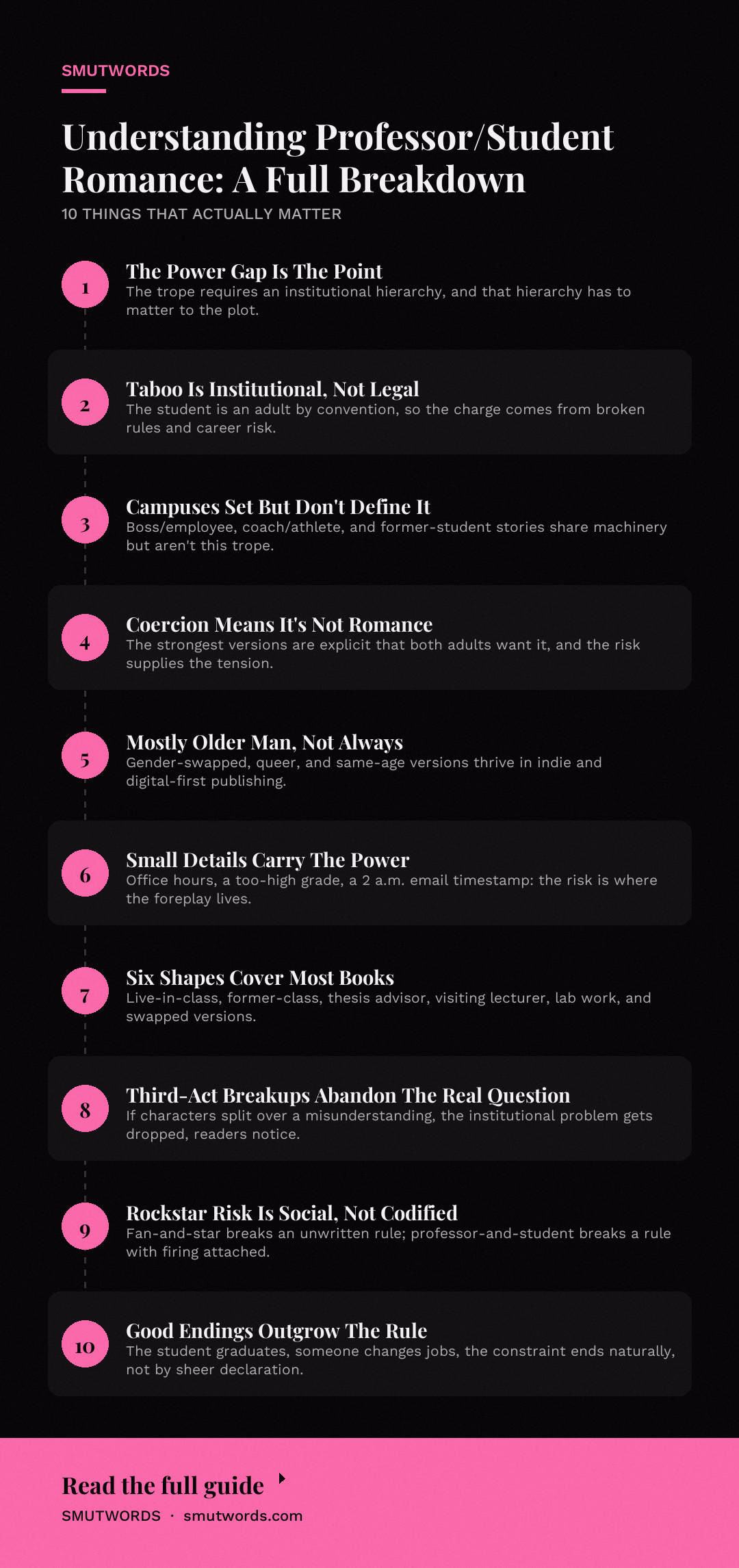
The name describes the relationship dynamic first and the setting second. A professor/student romance requires two things: an institutional hierarchy between the leads, and that hierarchy mattering to the plot. Take away either one and you're reading something else with a campus backdrop.
Adult status for the student is the working convention. The overwhelming majority of published professor/student romances set the student at eighteen or older, often in college or graduate school, and plenty of authors specify early that both parties are adults. This is partly about reader comfort. It's also about how the fantasy works: the taboo needs to be institutional, not legal.
What doesn't count, or barely does:
- Coach/athlete or boss/employee stories where the power gap is real but the academic framing is gone. Similar machinery, different trope.
- One-scene campus flings where the professor and student aren't in any ongoing professional relationship. That's a meet-cute, not the dynamic.
- Former-student romances where the relationship starts years after the class ended. Those can be excellent, but the tension of the live power imbalance is gone.
- Tutor/student setups with no institutional authority behind the tutoring, like a family friend helping with exam prep. Close, but softer.
The core misconception is that this trope is automatically about coercion. The strongest versions are explicit that both adults want it, and the tension comes from the rules and the risk. A romance where the professor is genuinely pressuring an unwilling student isn't this trope functioning as romance. It's something darker published under a different label, or a badly written entry in the category.
Another misconception: that the student is always the younger woman and the professor the older man. Most published entries match that pattern. Not all. Gender-swapped, queer, and same-age versions exist, and they turn up in indie and digital-first publishing far more than in print.
Where Professor/Student Romance Comes From
Academic settings have carried erotic charge in fiction for a long time. What matters for this trope is the twentieth-century explosion of the modern university as a mass institution. Once huge numbers of young adults spent years inside a hierarchy of faculty and students, with office hours, closed doors, and dormitory life, a specific kind of story became possible.
Mid-century campus novels used the professor's affairs as a symbol of intellectual ambition and moral compromise, usually with a judgmental tone. That shifted, starting in the 1970s and accelerating in the 1980s, when category romance discovered the trope's romantic potential. The forbidden quality could be a feature rather than a cautionary device.
The genre history runs through several recognisable phases:
- The older-man era (roughly 1980s to mid-1990s): brooding professors, sheltered heroines, heavy power fantasy, very little page time given to professional consequences.
- The self-aware era (mid-1990s to 2000s): heroines who know the rules and choose anyway, professors who agonize, more explicit discussion of what could go wrong.
- The indie boom (2010s onward): digital-first publishing let authors write the trope hotter, weirder, and more varied. Graduate-student heroines, queer professors, gender-swapped versions, and older students all became viable.
- The current wave: much more diversity in who gets to be the professor, and far more willingness to show the student as the more calculating party. A popular reversal has the student initiating, sometimes with the professor as the one fighting their own attraction hardest.
One thing has stayed constant: the trope's publishing viability, since it reliably converts. Campus settings are cheap to set up, the conflict is built into the premise, and readers who like it tend to read widely within it.
That reliability is why you find it in nearly every romance subcategory that touches contemporary life. You can find the same institutional-power enjoyment in soldier romance, where rank does similar work, and the same close-proximity tension in ghostwriter romance, where a private working relationship gets uncomfortably intimate.
How It Shows Up in Erotica
Here's where the trope earns its keep or falls flat. The professor/student dynamic lives or dies on how well the author makes the power imbalance feel real, specific, and productive.
What a Strong Version Does on the Page
A good professor/student scene puts the institutional power into small concrete details. Office hours that are the only time the student can get away with it. A grading rubric the professor promised not to manipulate. A letter of recommendation that could die if the relationship comes out. An email timestamped at 2 a.m. that could be read two ways.
When those details are present, the dialogue does the work of the whole trope. Half-finished sentences. Questions that are technically about academic content and obviously about something else.
Silences that earn more page time than the sex. The best authors know that in this subcategory the foreplay is the risk of getting caught.
Take the mechanic of the grading. A well-written scene may include a very short exchange where the student sees a grade they know is too high, and the professor refuses to explain it. That exchange is the whole relationship in miniature, and it's doing far more work than sex scene ten could.
Common Variants Authors Use
Read widely in the subcategory and you start to recognise a structural set of shapes. The trope is defined by the power gap, but the gap itself can be arranged dozens of ways. The variants below cover most of what you'll find in current releases:
- The live-in-class version: the professor is actively teaching the student's class throughout the book. Maximum tension, because the professional stakes update every week.
- The former-class version: they met in a semester that ended before the book begins. Softer conflict, more room for the romance to develop without a constant risk of discovery.
- The thesis-advisor version: graduate student and dissertation chair. The stakes are years of work rather than a single grade, and the power is much harder to walk away from.
- The visiting-lecturer version: the professor is at the university for a term. The relationship has a built-in deadline, and both parties know it.
- The hard-science version: research labs, bench work, and shared projects that require extended one-on-one time. The power gap is partly about access to equipment and authorship.
- The gender-swapped and queer version: female professor and male student, female professor and female student, male professor and male student. The institutional logic stays the same; the power fantasy shifts.
The variant a book chooses tells you what kind of heat it's going for. The live-in-class version is for readers who want the risk to stay high from page one. The former-class version is for readers who want to watch a relationship build before the taboo is placed on top of it.
If you're looking for the same live-in-proximity intensity in a very different setup, rockstar romance and motorcycle club romance both run on tight-knit professional worlds where an outsider doesn't fit neatly. The writers making it work in those subgenres tend to borrow the same craft moves: institutional detail, one-on-one scenes, secrets that don't stay secrets.
Where It Goes Wrong
The flat version of this trope is easy to spot. It uses academic trappings as wallpaper and then tells you about the power imbalance without putting it in the scene.
Enjoyed this? Get a free book.
Join the list and we will send a complete free story straight to your inbox, plus new releases every week after that. No credit card, no catch.
The professor is described as intimidating. The student is described as overwhelmed. Those are summaries, not scenes.
Another common weakness: a third-act breakup that resolves through something outside the central conflict. The relationship's real problem is the institutional power gap. If the characters break up because of a communication misunderstanding or a parent's disapproval and then get back together by declaring their love, the reader can feel the real question abandoned.
The strong versions know what the real question is. Either "how does a person with power handle wanting something they can't have without using their power to take it" or "how does a person with less power pursue something they want without being compromised." Some books run both at once. When they do, the intimacy has stakes far beyond who finds out.
One small craft note: a scene rarely works if the age gap carries more weight than the institutional one. An age-gap romance with a college setting is a different trope. A professor/student romance should always keep the professional relationship load-bearing. If you removed the classroom dynamic, the book would collapse, and that's a sign the trope is being used rather than decorated.
Professor/Student Romance vs Rockstar Romance
These get compared because both are subcategories of contemporary forbidden romance with a high-status public figure and a less established partner. They differ in what creates the risk.
The rockstar romance prohibition is social: the fan and the star. The explicit rule is about parasocial distance and lifestyle mismatch. A professor/student romance prohibition is institutional: a codified professional rule with a formal consequence (grade changes, committee reviews, firing, litigation).
The rockstar story can plausibly end with the couple going public and being cheered. The professor/student story cannot plausibly go public in most settings without one or both of them losing something concrete.
That's why the endings feel different. Rockstar romance tends toward public declaration and a life in the spotlight.
Professor/student tends toward discretion, a jointly agreed transition (the student graduates, the professor changes jobs), and a quieter end state. Both are satisfying. They scratch different itches.
Frequently Asked Questions
Is professor/student romance always an age-gap romance?
No. Age gaps are common but not required. Graduate-student and thesis-advisor versions often feature leads who are less than a decade apart, and some books deliberately close the gap to keep the institutional power as the real tension. The power gap does the work that the age gap does in other subcategories.
Does the professor have to be older and male?
Not as a rule, though most published versions still follow that pattern. Gender-swapped, queer, and older-student versions are increasingly common in digital-first and indie publishing. The consistent element is institutional authority, not age or gender.
Can the student be the one who initiates?
Yes, and increasingly that's the version readers get. A student who pursues deliberately and a professor who tries to hold the professional line is a popular structure because it keeps the professor sympathetic and the student agentive. The well-written versions are careful to keep the professor's refusal believable in the moment.
What's the difference between professor/student romance and tutor/student romance?
Tutor/student removes or softens the institutional hierarchy. A private tutor who isn't on faculty has less formal power over the student's academic future and less to lose professionally.
That makes the forbidden quality weaker and the story usually lower-stakes. Both are legitimate. The professor/student version runs hotter because the rule is real.
How do the better books resolve the professional conflict?
The strongest ones resolve it structurally. Someone changes schools or jobs. Enrollment ends.
A committee assigns a co-advisor. A thesis is submitted. Resolution by sheer mutual declaration feels thin because it abandons the real problem the premise creates. Look for endings where the rule isn't repealed by love, but outgrown by life changes.
Is it normal to like this trope if the real-world version is unethical?
Yes. The trope is a fictional container for a real attraction most readers would never act on, and it isn't unusual to enjoy that container without endorsing its real-life equivalent. Fiction is often where adult readers play with power and risk neither wants in the real world. That's ordinary, and the trope's popularity reflects it.
Final Thoughts
Professor/student romance is at its best when the institutional details are specific and load-bearing. The trope's readers aren't asking for a campus skin on a generic love story; they want to feel the grade check, the email at 2 a.m., the closed office door, and the rule that makes every glance a decision.
If you want a starting point, look for a book that keeps the student in the professor's class through most of the story and lets the professional stakes do the emotional work. The transition from classroom to kitchen table, done well, is the whole trope in one arc.
Readers who like the professional-power side of this trope tend to enjoy it in other setups too. Prince/princess romance runs a similar dynamic with protocol instead of syllabi, and secret baby often shares the same "what happens if this comes out" engine. If you're drawn to the risk more than the classroom, the subcategory is doing its job.





Loading comments…