
Rancher romance is the subgenre built around a working ranch and the people who run it, usually with a cowboy, cattleman, or landowner at the center of the love story. The chores are real, the weather is a character, and the hero has calluses. If you have ever finished a book and immediately wanted to know the difference between a stock horse and a cutting horse, you have probably been reading one.
The category overlaps heavily with cowboy romance and Western romance, though not every Western is set on a ranch and not every rancher book bothers to get the boots right.
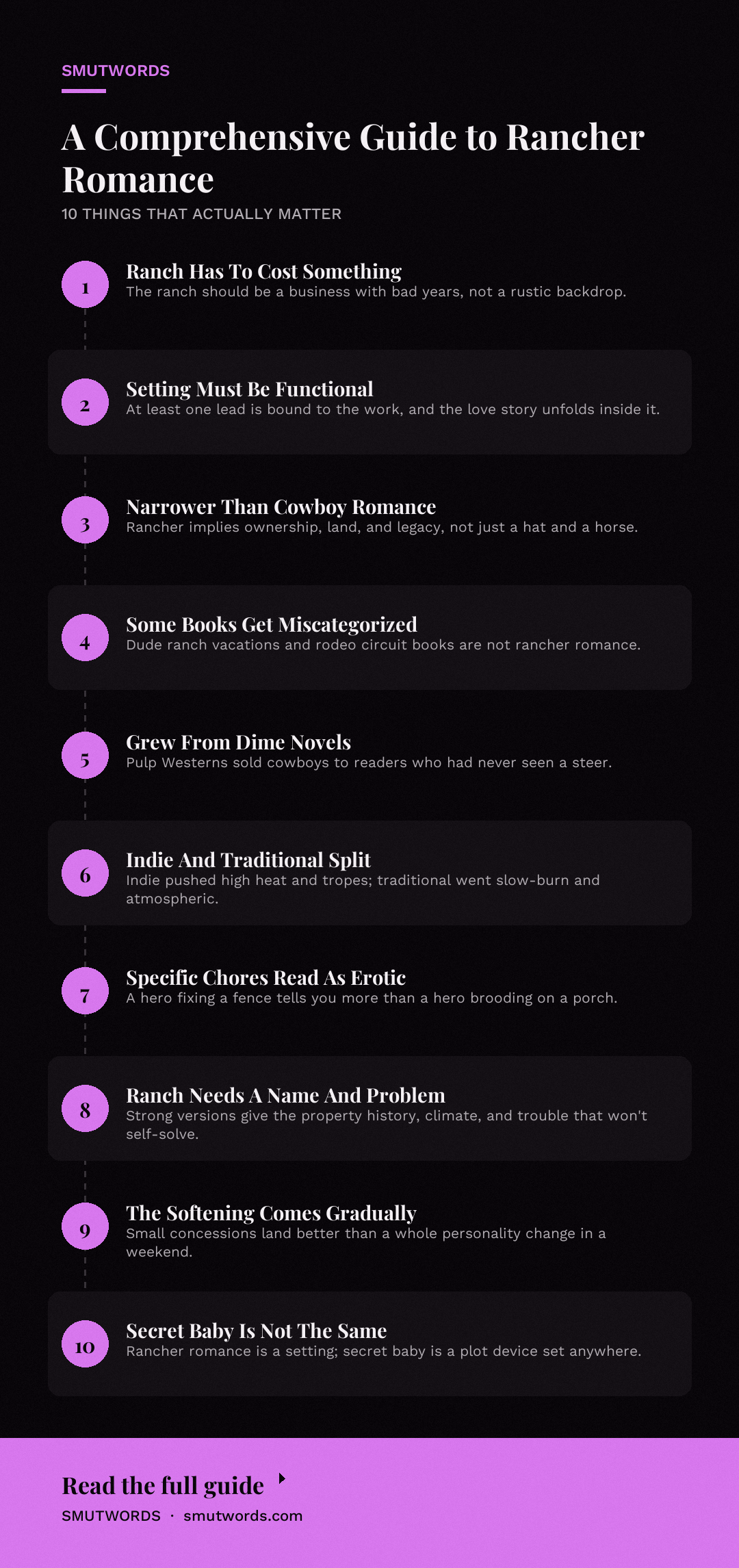
What separates a strong rancher romance from a paperback with a hat on the cover is commitment to the place. The ranch has to cost something. It has to be a business with bad years, a family with grudges, and a protagonist whose identity is tangled up in whether the place survives. The romance runs alongside that fight rather than replacing it.
What Rancher Romance Actually Means
The term describes a romance novel set on a working ranch where at least one lead is a cowboy, rancher, ranch hand, or someone otherwise bound to rural Western life. The definition hinges on two things: the setting has to be functional, and the love story has to unfold inside the rhythms of that work. A billionaire who owns a ranch as a tax write-off and never visits does not count.
The label "rancher romance" is narrower than "Western romance," which can cover historical frontier stories, wagon-train sagas, and anything set west of the Mississippi. It is also narrower than "cowboy romance," a term publishers use loosely for rodeo books, bull riders, and ranch hands who never touch a ledger. Rancher romance implies ownership, land, and the weight of keeping something alive across generations.
Several things get miscategorized as rancher romance when they are not:
- Dude ranch vacations. A city heroine who spends a week learning to ride is a fish-out-of-water story, and it can be excellent, but the ranch is a backdrop rather than a stake.
- Rodeo circuit books. These follow competitors from arena to arena. Great for adrenaline, thin on land and livestock.
- Historical frontier romance. Related, sometimes overlapping, but the economics and technology are entirely different. A book with a cattle drive in 1870 and a book with a herd and a bank loan in 2024 are doing separate work.
- Small-town romance with a farm cameo. If the protagonist sells jam at a farmers market and the ranch appears twice, it is a small-town book.
The name itself is a marketing convenience rather than a term with a single inventor. Publishers and reader communities settled on it to signal a specific promise: land, labor, and a man who smells like horse and cedar.
Where Rancher Romance Comes From
The genre's roots sit in the American dime novel and the pulp Western, which sold cowboy heroes to readers who had never seen a steer. Those early stories were adventure first and romance second, with the love interest often a schoolteacher or a rancher's daughter providing a reason for the hero to hang up his guns. The romance was the reward at the end of the trail.
The modern rancher romance as a distinct publishing category took shape in the paperback boom of the 1970s and 1980s, when category romance lines realized Western settings sold reliably and cheaply. Covers featured a shirtless man in a Stetson and a woman in a torn blouse, and the plots ran on forced proximity, land disputes, and the occasional arranged marriage to save the property.
The 1990s brought longer single-title Westerns and a shift toward family sagas. Ranching dynasties became a subgenre of their own, with multi-book series following brothers or cousins across a sprawling acreage, each installment pairing one of them off. This structure gave readers the pleasure of returning to a known place with new tension each time.
The 2010s and 2020s pushed the category in two directions at once. Indie publishing flooded the market with high-heat cowboy romance, often serialized quickly and priced low, which pulled the subgenre toward explicit sex and dramatic tropes like secret baby and surprise inheritance. Traditional publishing moved the other way, emphasizing atmospheric, slower-burn stories with literary prose and a strong sense of place.
What has not changed is the core fantasy. Readers want competence, land, and a man whose gruff exterior cracks for exactly one person. The setting has evolved; the promise has not.
How It Shows Up in Erotica
On the page, rancher romance does its best work when the labor is specific. A scene where the hero fixes a fence is more erotic than a scene where he stands on a porch looking brooding, because the fence tells you who he is. The best authors in this space write chores the way other authors write foreplay: with attention to sequence, physical effort, and the small humiliations of working outdoors.
Heat levels vary enormously, from closed-door inspirational Westerns to explicit cowboy erotica with graphic sex across multiple chapters. The tropes below show up repeatedly across that range.
- City girl, country land. A woman arrives from somewhere dense and fast, often to settle an estate or take a temporary job, and is thoroughly unprepared for the physical reality of ranch life. The friction is practical before it is romantic: she does not know how to drive a stick shift, she underestimates the cold, she wears the wrong boots.
- Ranch inheritance. Someone dies and leaves the property to a person who has no business running it. The will often comes with a condition, such as living on the land for a year or sharing management with a hostile foreman. This is the engine behind a huge share of the subgenre.
- Mail-order bride. A historical variant that has been revived in contemporary settings through dating apps and marriage-of-convenience arrangements. Two strangers agree to marry for practical reasons and discover attraction in the middle of calving season.
- Ranching dynasty. Multi-book family sagas where siblings or cousins each find love while the family fights over water rights, inheritance, or a development deal. These books reward readers who want a long stay in one world.
- Second chance at the homestead. A couple who split years ago is forced back together by a shared obligation to the land. The unresolved history gives the reunion real weight, and the category overlaps steadily with marriage in trouble when the couple is still married.
- Grumpy foreman, sunny newcomer. The classic hate to love structure, transplanted to a bunkhouse. The foreman resents the outsider, the outsider refuses to be run off, and the animosity curdles into something else around chapter twelve.
What makes a rancher romance land versus fall flat comes down to a few craft decisions.
The ranch has to be a character. Flat versions treat the setting as wallpaper. Strong versions give the property a name, a history, a specific climate, and a problem that will not solve itself. Readers should be able to draw a rough map by the end.
The work has to be competent. Readers in this subgenre include people who have actually mucked stalls, and they notice when an author gets haying season wrong. A little research goes a long way, and the payoff is trust.
The hero needs a life beyond the heroine. The rugged, self-reliant man is the core appeal, and that self-reliance has to be visible. He has opinions about the herd, a truck he maintains himself, and a reason he has not left. When the heroine becomes his entire world too early, the fantasy collapses.
Enjoyed this? Get a free book.
Join the list and we will send a complete free story straight to your inbox, plus new releases every week after that. No credit card, no catch.
The softening has to be gradual. Readers want the hero's walls to come down, but the walls should come down for reasons that would convince anyone watching. A man who has never let anyone close does not change his whole personality in a weekend. The best versions show him making small, specific concessions: letting her drive the truck, asking for her opinion on a sale, admitting he is tired.
The sex should feel like it belongs outdoors. High-heat rancher romance uses the environment: hay lofts, truck beds, tack rooms, cold-water plunges after a long day. The physicality of ranch work translates naturally into physical intimacy, and authors who lean into that get a lot of mileage.
This subgenre shares DNA with other blue-collar and rural fantasies. The lumberjack romance runs on the same competence-and-timber fantasy in a different forest, and the soldier romance borrows the same disciplined, stoic-hero template for a very different setting. Readers who like one often like all three.
Pace and Conflict
Rancher romance tends to sit in deliberate contrast to big city romance, whose conflicts arrive fast and loud. A ranch book earns its emotional payoff through accumulated small moments: shared coffee before dawn, a long drive to a livestock auction, an argument about a broken pump that turns into something else.
Graft fast-paced city conflict onto a rural setting and the result usually reads as mismatched, the same way a couple can end up with wildly different desires and needs. There is a useful parallel in this piece on mismatched desire: the problem is rarely the pace itself, it is whether the two parties are honest about what they want.
Rancher Romance vs Secret Baby
Readers often search for these together because they frequently appear in the same book, but they are different things. Rancher romance is a setting and structure; secret baby is a plot device where one parent conceals a child from the other, usually with a dramatic reveal late in the story.
In rancher romance, the secret baby structure fits naturally because the land gives the reveal a physical anchor. The child exists, the ranch exists, and the hero discovers both exist at once.
The overlap is so common that some readers assume the two are the same subgenre. They are not, and a rancher romance does not need a hidden child to work, while a secret baby book can be set anywhere. For a closer look at the plot device on its own terms, the breakdown of the breeding farm trope covers how closely related setups get flattened into a single label.
Frequently Asked Questions
What is a rancher romance novel?
A romance novel set on a working ranch, where at least one protagonist is a cowboy, rancher, or someone tied to rural Western life. The love story unfolds alongside ranch work, land disputes, and family history. The setting is central to the plot rather than a backdrop.
What is the difference between cowboy romance and rancher romance?
Cowboy romance is the broader, looser term used for anything featuring a cowboy hero, including rodeo competitors and ranch hands who do not own land. Rancher romance implies ownership, legacy, and the survival of a specific property. Many books are both, but a rodeo circuit novel is not a rancher romance.
Are rancher romances always high heat?
No. The subgenre spans closed-door inspirational Westerns, moderate-heat contemporary romance, and explicit cowboy erotica. Readers searching for a specific heat level usually check the publisher and tags before buying, because the label alone does not signal how explicit a book will be.
Why do readers like the city-girl-meets-cowboy setup so much?
It provides built-in conflict through practical incompetence and mismatched expectations, then gives the heroine a visible arc as she learns the place. The hero gets to teach without being condescending, and the reader gets the pleasure of watching someone fall in love with a way of life at the same time they fall in love with a person.
Do rancher romances need an accurate ranch?
Readers in this subgenre reward accuracy because many of them know what haying season looks like. A book can survive small errors, but getting the rhythm of ranch work wrong breaks the spell. Authors who research well earn a loyal readership that trusts them with the setting.
What tropes appear most often in rancher romance?
Ranch inheritance, mail-order bride arrangements, grumpy foremen falling for newcomers, second-chance reunions forced by land obligations, and family dynasties told across multiple books. Secret pregnancy plots also show up often, alongside hate-to-love structures and marriage-of-convenience setups.
The wider genre surrounding this subgenre covers far more ground, from the revenge romance plot to the cyberpunk romance setting, but the appeal of the ranch book stays remarkably consistent. Readers want a place worth fighting for and a person worth staying for.
Final Thoughts
Start with a book that treats the ranch as a real business with real problems, not a rustic backdrop for a photoshoot. Look for authors who know the difference between a heifer and a steer, who give the hero a reason to be difficult, and who let the land matter as much as the love story.
If you want one recommendation to begin with, pick up the first book in a ranching dynasty series and read it in one sitting. The structure rewards the commitment, and by the time you finish the first volume you will have opinions about the family's water rights.





Loading comments…