Spanking is one of the oldest, simplest, and most reliably charged acts in erotic fiction: one person bent over, one open hand landing on bare skin, and a whole power dynamic expressed in a handful of seconds. In kink terms, spanking is the act of striking the buttocks with an open hand (or an implement) as erotic play, punishment, or a physical expression of dominance and submission.
It shows up in historical romance, contemporary BDSM novels, monster romance, and everything between. This guide covers what the term means, where the trope came from in publishing, how authors actually write it well, and the practical details that separate a hot scene from a clumsy one.
If you landed here from a glossary entry, you already know the one-line version. What follows goes further: the mechanics of a good scene, the variants authors use, the language that works and the language that flops, and the real-world safety notes any honest treatment of spanking has to include.
What Spanking Actually Means
At its most literal, spanking is percussive impact delivered to the buttocks. A hand, a paddle, a hairbrush, a belt, a ruler. The skin is usually bare or thinly covered.
The receiver is often positioned over the giver's lap, bent across furniture, or standing against a wall. The strike is deliberate, repeated, and rhythmic.
What makes it erotic spanking, rather than a random smack, is the frame around it. Consent, intent, and the relationship between the two people carrying it out.
A playful swat during sex is spanking. A formal punishment scene with a set number of strokes is spanking. A dominant ordering a submissive across their knee is spanking. The category holds all of it.
The word itself is plain and old, coming from the same root as "span" and referring to the flat of the hand. It has been in English for centuries, and its erotic connotation is just as old. What has changed is how explicitly fiction writes it.
What counts as spanking
Broadly, any repeated impact to the buttocks with erotic or disciplinary intent. The defining features are rhythm, position, and the dynamic between the people involved. A single hard slap during rough sex is a cousin, not the whole thing.
What doesn't count
A one-off smack with no follow-through, no buildup, and no relational context is impact, not spanking as a trope. Likewise, spanking that has nothing to do with arousal or power exchange (a parent smacking a child, a comedic beat in a sitcom) sits outside the kink entirely.
Common misconceptions
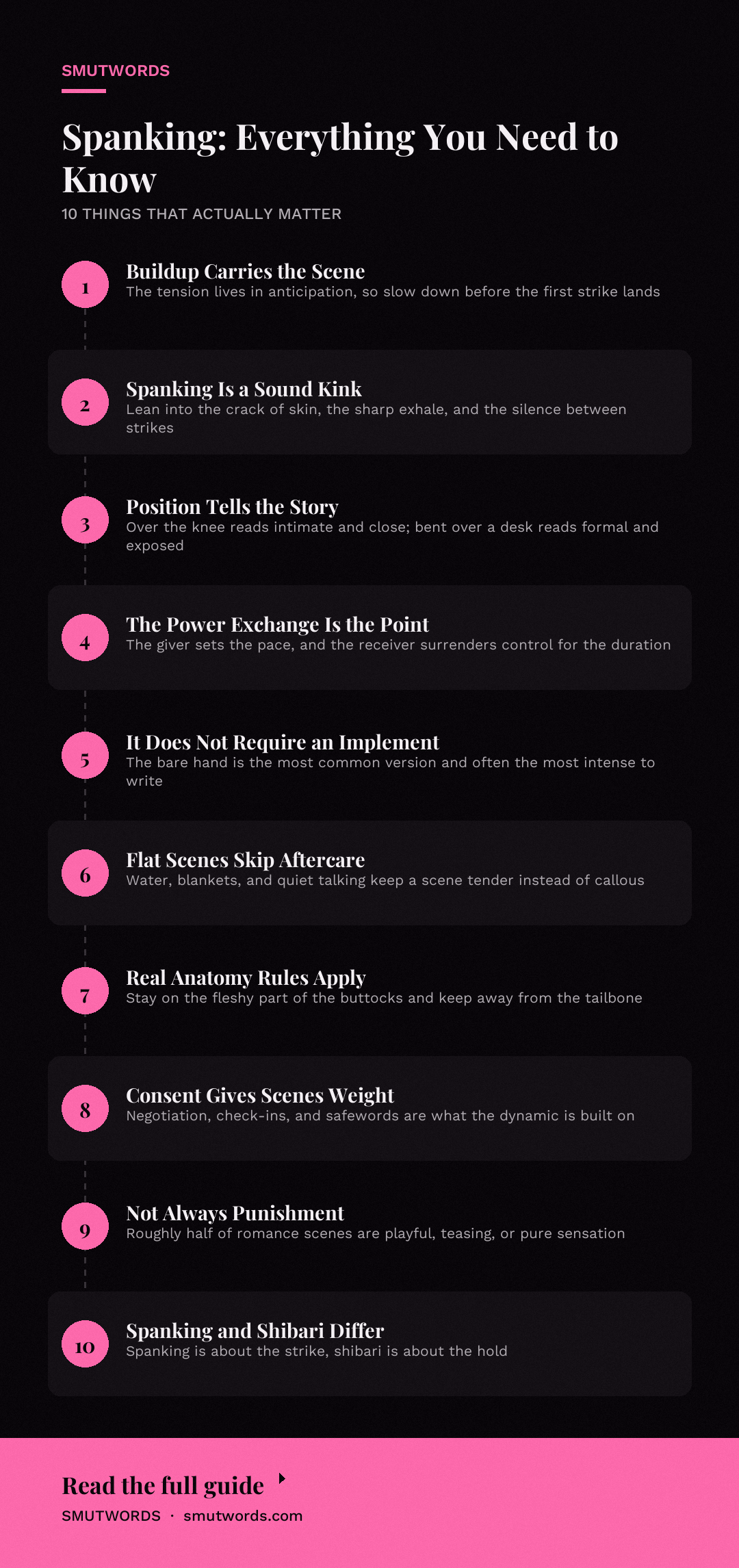
The biggest one is that spanking is always punishment. In erotica, roughly half the spanking scenes are playful, teasing, or purely sensation-driven, with no discipline frame at all. Another misconception is that it requires an implement. The bare hand is the most common version by a wide margin, and often the most intense to write because the giver feels every strike.
A third misconception: that spanking is a beginner kink and therefore low-stakes. It's accessible, yes, but the physical and emotional intensity can be significant. Authors who treat it as a throwaway beat tend to produce the flattest scenes.
Where Spanking Comes From
Spanking as a recognizable erotic trope in English-language publishing goes back at least to the eighteenth century. Flagellation erotica circulated widely in Britain and France, and the eighteenth-century novel Fanny Hill includes birching scenes that were read as erotic by contemporaries. The Victorian era produced a substantial underground market for spanking and flagellation literature, much of it published anonymously and sold quietly.
The twentieth century moved spanking into mainstream genre fiction through a few channels. Mid-century pulp paperbacks used spanking as a reliable shock beat. The 1950s and 60s saw the rise of dedicated fetish magazines, and by the 1970s spanking had a distinct publishing subculture with its own zines and small presses.
The bigger shift came with romance publishing. As BDSM romance grew into a recognized category through the 1990s and 2000s, spanking became one of the standard entry points. Easy to write, physically legible on the page, and it carried a power dynamic without requiring elaborate equipment or setup.
The Fifty Shades effect
The 2011 publication of Fifty Shades of Grey pushed spanking into mass-market romance in a way nothing before it had. Suddenly, spanking scenes appeared in books that were not marketed as BDSM at all: small-town romance, sports romance, paranormal romance. The trope became a shorthand for "this hero is dominant" without the author having to do much work.
The result was a flood of scenes that were, frankly, mediocre. Many used spanking as a signal rather than a scene. The hero spanked, the heroine gasped, and the book moved on.
Readers noticed. The bar rose.
The contemporary era
Since the mid-2010s, the best spanking scenes in romance and erotica have moved in two directions. One is toward greater realism: accurate negotiation, safewords, aftercare, and emotional complexity. The other is toward greater specificity: particular implements, particular positions, particular rituals, and particular dynamics rather than generic dominance.
Dark romance pushed spanking into punishment territory with more intensity. Contemporary BDSM romance pushed it into explicitly negotiated scenes with check-ins. Monster and paranormal romance adapted it to non-human anatomies and instincts, which is part of how feral play entered the vocabulary. The trope isn't going anywhere, but it has more range now than it did fifteen years ago.
How It Shows Up in Erotica
Spanking is one of the most versatile beats in erotic writing because it works at nearly every heat level and in nearly every subgenre. What separates a strong scene from a flat one comes down to a handful of craft moves.
The buildup is the scene
The best spanking scenes spend as much time on the moments before the first strike as on the strikes themselves. The order. The hesitation. The slow walk to the position. The way the giver takes their time arranging the receiver.
A scene that jumps straight to the impact almost always reads cheap. The tension lives in the anticipation.
Great authors slow down. They describe the sound of a belt coming loose, the cool air on bare skin, the moment the receiver realizes they're actually going to go through with it. By the time the first strike lands, the reader has been waiting long enough that anything delivers.
Sensation and sound
Spanking is a sound-heavy kink on the page, and the writers who do it well lean into that. The crack of skin on skin. The sharp exhale. The sound of a paddle's flat surface. Silence between strikes.
Temperature matters too. Skin warms. The receiver feels the heat building throughout the scene.
A good writer tracks that progression: cool at first, then warm, then hot, then sore. The physical arc mirrors the emotional one.
Position as character
Where the receiver is matters. Over the knee is intimate and close, with the giver's hand resting between strikes on the small of the back. Bent over a desk is formal and exposed.
Enjoyed this? Get a free book.
Join the list and we will send a complete free story straight to your inbox, plus new releases every week after that. No credit card, no catch.
Across a bed is casual and domestic. Standing against a wall is urgent and often angry.
The position tells the reader something about the relationship. Over the knee is the most common in romance because it stages the dynamic perfectly: the receiver is physically smaller, off-balance, and held in place by the giver's body. That image does a lot of narrative work with very little effort.
The power exchange
Spanking is one of the clearest physical expressions of D/s available on the page. The giver sets the pace and decides when it ends. The receiver surrenders control over their own body for the duration. That surrender can be erotic, frightening, freeing, or all three.
Authors use spanking to explore consensual power exchange in ways that don't require a complete lifestyle commitment. You can submit to a spanking without identifying as a submissive. A character can spank without identifying as a dominant. That flexibility makes the kink accessible to readers who want a taste of the dynamic without the full protocol.
Emotional beats
Spanking carries an emotional payload that pure impact doesn't. Tears, anger, arousal, shame, relief, exhaustion, tenderness. A strong scene usually hits more than one of these, often in sequence.
Some of the most effective spanking scenes in contemporary romance are structured around a confession. The receiver has done something they feel guilty about or has been carrying a burden they haven't spoken out loud. The spanking becomes the release valve. This is where spanking overlaps most clearly with the dynamics explored in sadomasochism, where pain and emotional release are linked by design.
Common variations authors use
- Bare-hand spanking: The default. Intimate, immediately available, and often the most intense because the giver feels every strike.
- Over-the-knee: The classic posture. Staged, formal, and highly photogenic on the page.
- Punishment spanking: Framed around a specific transgression. Common in dark romance, historical romance, and domestic-discipline fiction.
- Playful spanking: Light, teasing, and often part of foreplay. Common in contemporary romance and friends-with-benefits setups.
- Paddling: A paddle, a hairbrush, or a wooden implement. Sharper sensation, less intimacy, more formality.
- Hairbrush spanking: A specific domestic-discipline trope. Often paired with role-play or age-play themes.
- Impact play extended: Spanking as one part of a wider scene that includes belts, floggers, or crops. Related to the broader impact-play category.
What makes a strong scene versus a flat one
A flat spanking scene usually has three problems: no buildup, no character interiority, and no aftermath. The strike lands, the receiver reacts, and the scene ends. A strong scene gives the reader time before, during, and after.
Interiority is essential. What is the receiver thinking as they bend over? What is the giver thinking as their hand comes down? A scene that stays only on the physical surface leaves the reader cold.
Aftercare matters. In strong BDSM romance, the scene doesn't end with the last strike. There's tenderness, water, blankets, quiet talking, an acknowledgment of what just happened. Skipping aftercare is one of the fastest ways to make a scene feel callous rather than erotic.
If you want to see this done well, cases where mismatched desire between partners becomes part of the negotiation are useful, because they force the author to write real communication around the scene instead of glossing over it.
The consent layer
Even in dark romance, where consent is often complicated, the best books handle it honestly. The receiver has safe words or some equivalent signal. There is a discussion before or after the scene. The giver checks in at least once.
A book that stages spanking without any acknowledgment of consent reads as either careless or intentionally dark. Both are valid choices, but they are choices, and the writing has to reflect that. Kink scenes without a consent frame usually feel thin because they skip the negotiation that gives the dynamic its emotional weight.
Real-world safety notes
Fiction has enormous latitude, but spanking is a real practice and some of the physical risks are real. Authors who write it well usually know this even if they don't stop to explain it in the scene.
- Consent and communication: Negotiation before a scene, check-ins during, and conversation after. Safe words, and a nonverbal signal for anyone who might go silent under stress.
- Anatomy: Avoid the lower back and tailbone entirely. The safe zone is the fleshy part of the buttocks. Strikes that land too high or too close to the spine can cause real damage.
- Intensity: Warm up gradually. Start lighter than you think you need to. Increase slowly.
- Implements: Anything with a hard edge or narrow surface (canes, thin belts, paddles with sharp corners) concentrates force and needs more caution than an open hand.
- Aftercare: Water, rest, tenderness, and check-ins. Skin should be examined after a hard scene.
These notes are as relevant to the reader as to the writer. If you're taking spanking from the page into real life, this is basic groundwork. If you're just reading it on the page, it's the texture that separates a good scene from a decorative one.
Spanking vs Shibari
The comparison comes up mostly because both are among the most recognizable physical expressions of D/s in modern romance. They are very different kinks.
Spanking is impact-based. The erotic charge comes from sensation, the sound of skin on skin, and the surrender of control over duration and intensity. Shibari is restraint-based. The charge comes from immobility, aesthetic beauty, and the visual spectacle of the body bound.
The overlap is in the power exchange: both put one person in a position of total control over the other's body during the scene. Some books combine them, with the bonds holding the receiver in place for the spanking. That combination is one of the more common two-kink scenes in literary BDSM.
One line to distinguish them: spanking is about the strike, shibari is about the hold. They can coexist, but they are not interchangeable, and writing them as if they are tends to flatten both.
Frequently Asked Questions
Is spanking a form of BDSM?
Yes. Spanking falls under the BDSM umbrella as a form of impact play and a physical expression of power exchange. It can be as light as a playful swat or as intense as a formal punishment scene, but the category is BDSM.
What is the difference between spanking and impact play?
Impact play is the broader category: any consensual activity where one person strikes another for erotic reasons. Spanking is one specific version, always targeting the buttocks. Flogging, caning, and slapping are other forms of impact play that can happen alongside or instead of spanking.
Why do readers like spanking scenes so much?
Because the trope delivers vulnerability, control, and physical sensation in one scene with almost no setup. The receiver is exposed and physically held in place. The giver sets the pace. The reader gets the tension of the buildup, the heat of the impact, and the tenderness of the aftermath, all within a few pages.
Is spanking always punishment in romance?
No. Roughly half the spanking scenes in contemporary romance are playful, teasing, or purely sensation-driven. Punishment framing is more common in dark romance and domestic-discipline fiction, where there's a specific transgression to answer for.
What is the safest place to spank?
The fleshy part of the buttocks. Avoid the lower back, the tailbone, and the kidneys. Warm up gradually, use an open hand first, and only move on to implements once the skin is warm. Check in with your partner throughout.
Do I need special equipment for spanking?
No. The open hand is the most common and often the most intense version because the giver feels every strike. Paddles, hairbrushes, and belts are optional variations. Many scenes in fiction use only a hand and a lap, which is part of why the trope works in so many subgenres.
Final Thoughts
Spanking endures in erotica because it's the shortest distance between power exchange and a page-turning scene. No equipment required, no elaborate setup. Just two bodies, a position, and a rhythm.
Written with buildup, interiority, and real aftermath, it earns its place in nearly any subgenre. Written as a signal, it reads like one.
So watch how the first mention gets handled. If the author slows down, you're in good hands. If the hero's hand comes down by the second chapter and nobody has thought about it since, you can probably guess the rest.





Loading comments…