Overstimulation is the kink of pushing a partner past the point of one orgasm and into the shaky, oversensitive, pleading territory beyond it, usually through forced or prolonged orgasms until their body stops cooperating with their mouth. In erotica it's a power-exchange kink first and a sensation kink second: the appeal lives in watching someone who thought they were in control of their own body find out they aren't.
The short version: overstimulation is about the giving partner's persistence and the receiving partner's surrender. The physical detail (the twitching, the begging, the wet sheets) is how that surrender gets rendered on the page.
What Overstimulation Actually Means
The word itself is borrowed from engineering and physiology, where it describes a system flooded past its functional range: too much signal, and the response degrades. Applied to sex, overstimulation means deliberately driving sensation past the body's comfort threshold, usually after orgasm, when nerve endings are at their most raw and touch that felt incredible thirty seconds ago suddenly feels like too much.
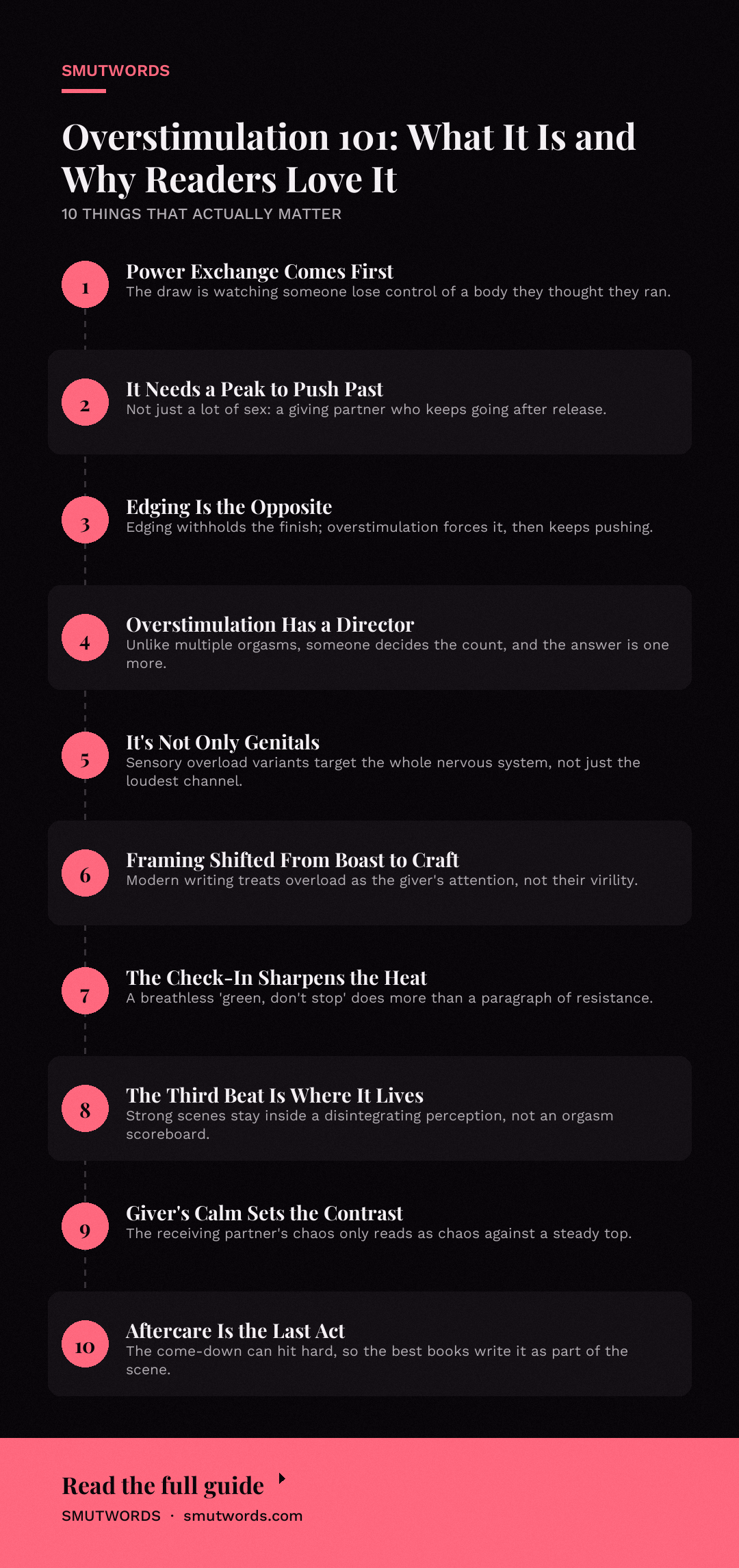
What counts as overstimulation is narrower than "a lot of sex." It requires a receiving partner who has already peaked, or is being kept at a peak, and a giving partner who keeps going. The gap between "that was amazing" and "I can't, I can't, please" is the entire genre.
Three things commonly get mistaken for it:
- Edging. Edging withholds release. Overstimulation forces it, then keeps pushing. They're opposites with the same vocabulary, which is why you see "edging to overstim" as a variant label.
- Multiple orgasms. Multiple orgasms can be mutual and undisciplined, both people chasing as many as they can get. Overstimulation has a director. Someone is deciding how many, and the answer is one more than the receiving partner thinks they can take.
- Rough sex generally. Intensity of force and intensity of sensation overlap, but rough sex can be a single hard fuck with no orgasm play at all. Overstimulation is specifically about the refractory window and the assault on it.
The other misconception is that overstimulation is only about genitals. Sensory overload variants widen it: ice, feathers, vibrators held in place, a mouth that won't stop, hands that keep circling a clit that has already come twice. The target is the whole nervous system. The genitals are just the loudest channel.
Where Overstimulation Comes From
As a named kink, overstimulation is young. The term spread through internet kink communities and fanfiction tagging in the 2010s, where "overstimulation" and "forced orgasm" became distinct enough tags that readers could filter for exactly the flavor they wanted. AO3's tag wrangling did more to standardize the vocabulary than any single book or manifesto.
The underlying fantasy is much older. Victorian and mid-century erotic writing is full of the "she begged him to stop and he did not" scene, usually coded as ravishment or "she could take no more."
What changed is the framing. Older versions treated the receiving partner's overload as evidence of the giver's virility. Modern overstimulation writing treats it as evidence of the giver's attention. The kink moved from a boast to a craft.
The publishing shift matters more than the bedroom history here. Overstimulation became a recognized trope in dark romance and why-choose romance around the same time those subgenres exploded on Kindle Unlimited, and it traveled with them. It shows up constantly in harem romance, where the math of multiple partners makes overstimulation the obvious narrative payoff: five men, one woman, and a scene where she loses count.
That structure was always latent in the genre. The tag just gave it a name readers could search.
The consent framing has shifted most of all. A decade ago, overstimulation scenes in published romance often skipped the negotiation entirely, treating the safeword as an inconvenience to the fantasy.
Contemporary writers increasingly write the check-in into the scene, and it turns out the check-in doesn't kill the heat. It sharpens it. The giver asking "color?" and getting a breathless "green, green, don't stop" does more work than a paragraph of resistance. Get a feel for how the negotiation and the edge play fit together on the page in this guide to sadomasochism.
How It Shows Up in Erotica
The signature overstimulation scene has a shape. First orgasm: relief, pleasure, the partner relaxing. Second: the giver doesn't stop, and the receiving partner realizes the rules have changed. Third and beyond: the body keeps responding while the mind is somewhere else entirely, and the dialogue degrades into the short, raw vocabulary the kink is famous for.
That third beat is where the writing lives or dies. A flat overstimulation scene narrates the orgasms like a scoreboard. A strong one stays inside the receiving partner's disintegrating perception: the ceiling they can't focus on, the hand pressing their hip down, the way every word has been reduced to "please" with no object attached.
Enjoyed this? Get a free book.
Join the list and we will send a complete free story straight to your inbox, plus new releases every week after that. No credit card, no catch.
Common variations authors reach for:
- Forced orgasm. The giver decides the count. Often framed with restraints, which is where shibari and other bondage come in: the rope isn't decoration, it's what makes "one more" non-negotiable.
- Orgasm denial inverted. Long edging sessions that end in a forced string of releases. The denial sets the sensitivity ceiling; the overstimulation collects on it.
- Use kink adjacent. The receiving partner is treated as a thing to be worked until they're spent, which shades into use kink territory. The overlap is real and worth knowing if you like one but not the other.
- Sensory overload. Multiple simultaneous inputs rather than one relentless one: blindfold, vibrator, mouth, hands. Common in orgy and group scenes, where the receiving partner is outnumbered.
- Primal framing. No tools, no rope, just a partner who won't let up, often with the biting, pinning, chase energy of primal play. The overstimulation is instinctive rather than deliberate, and the giver's own hunger is the motor.
What makes the strong versions work is the giver's steadiness. Overstimulation is a top's kink as much as a bottom's, and the books that nail it write the giver as patient, controlled, unhurried, a little amused. The receiving partner's chaos only reads as chaos against that calm.
The weak versions share a failure: they describe the orgasms but not the erosion. The good scene is about a person losing their grip on language, composure, and time. If you can count the orgasms and the receiving partner can too, the scene hasn't committed.
For readers who want the real-world texture to line up with the fantasy, it helps to know the practical shape of the kink. Overstimulation needs an agreed safeword system (color words work well) and a giver who watches for cramping and genuine distress rather than trusting the fantasy version of "stop."
It also needs a real aftercare plan, because the come-down from that much nervous-system input can hit like a truck. The best books write aftercare as the last act of the scene, not a footnote.
Frequently Asked Questions
Is overstimulation the same as forced orgasm?
Forced orgasm is the most common method of overstimulation, so the terms overlap heavily in tagging, but they aren't identical. Forced orgasm refers to the giver dictating release; overstimulation refers to pushing past the point of comfort, which can also happen through prolonged sensation without any orgasm at all. Some readers use them interchangeably, and you'll find both tags on the same books.
What's the difference between edging and overstimulation?
Edging keeps someone right at the edge and denies the finish. Overstimulation starts where edging ends: after release, continuing past the point the body wants to stop. They're often written as a sequence (long edging, then forced multiples), but as standalone kinks they sit on opposite sides of the orgasm.
Why do readers like overstimulation so much?
The power exchange is the draw. One character loses control completely while the other stays composed enough to keep deciding, and the receiving partner's raw, unfiltered reactions (begging, shaking, swearing, crying) read as intimacy stripped of performance. It's vulnerability rendered in physical detail.
Where can I find overstimulation in romance novels?
It appears most often in dark romance, why-choose and harem romance, and BDSM-centered contemporary. The tag is common in fanfiction as well, where it sits alongside forced orgasm and multiple orgasms. If a book has a controlling, attentive love interest and any scene involving restraints, check the content notes before you commit.
Is real-life overstimulation safe?
It can be, with clear safewords, an attentive giver, and a hard stop the moment the receiving partner signals genuine physical distress. Overstimulation carries real risks: soreness, cramping, and emotional drop afterward. Aftercare (water, warmth, quiet, reassurance) is part of the practice for many couples, and books that skip it are writing fantasy, not a how-to.
What's the difference between overstimulation and sensory overload?
Sensory overload is a broader variant that routes the intensity through multiple senses at once, using tools, textures, and simultaneous touch rather than focusing on orgasm count. Overstimulation usually centers the genitals and the refractory period. In practice, writers blend them freely, especially in group scenes.
Does overstimulation always involve multiple orgasms?
No. Multiple orgasms are the most recognizable engine, but overstimulation can run on one orgasm followed by relentless continued sensation, or on prolonged intensity with no orgasm at all. The requirement is the push past the threshold, not a specific tally.
If the push-pull between partners is what gets you, mismatched desire is the same dynamic playing out in a much quieter register, and it's worth a read.
Final Thoughts
Overstimulation earns its popularity because it turns the simplest possible scene (two people, one bed, one of them who won't stop) into the most intimate kind of power exchange. The books worth keeping give the receiving partner a voice inside the chaos and give the scene an afterward, and those two things do more for the fantasy than any orgasm count ever will.





Loading comments…