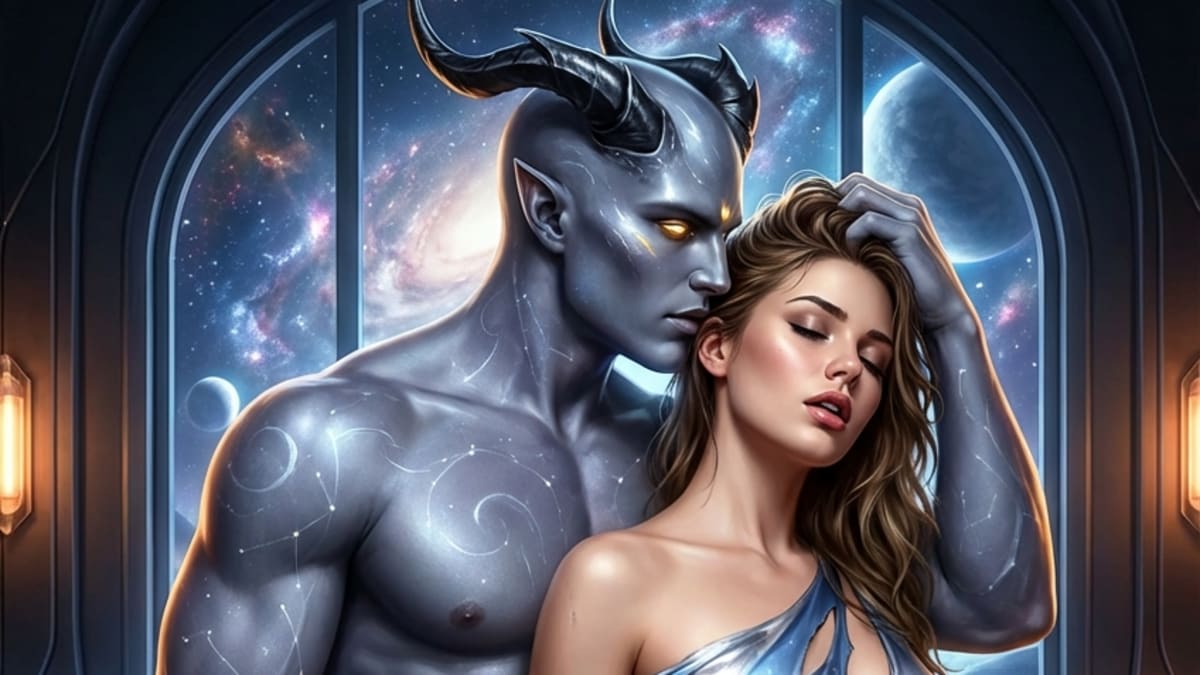
Destined lovers are two characters the story has already married off in the cosmos before either of them has said a word to the other. The prophecy names them. A bond snaps taut the first time their eyes meet. Every rival, war, or inconvenient fiancé between them exists mainly to be survived.
The trope runs on inevitability, and erotica runs on the moment inevitability becomes physical. What makes the category durable is the certainty underneath it: whatever these two do to each other, however far apart the plot throws them, the union is already settled somewhere the characters cannot argue with.
What Destined Lovers Actually Means
The short definition gets the shape right and misses the mechanics. A destined lovers story is built on a bond that predates the characters' choices and outranks them. The prophecy, the cosmic design, the centuries-old curse, the mark that burns when the other one is near: all of these are ways of saying the universe has already voted, and the vote counts more than anything the characters want.
What counts:
- A force outside the couple's control that has already decided they end up together. Gods, fate, bloodlines, a spell, a debt owed in a past life.
- Recognition, usually physical and usually involuntary. A pull, a mark, a scent, a name that surfaces in dreams before it surfaces in conversation.
- Inevitability with friction. The bond does not remove the obstacles. It makes them expensive to maintain and pointless in the end.
- At least one character resisting, at least for a while, because a destiny nobody argues with has no drama in it.
What does not count: two people who are obviously perfect for each other and simply have not met yet. That is a meet-cute with good casting. Destiny requires a third party with authority. A goddess, a family curse, a bond that exists whether or not anyone consented to it.
Where the Name Comes From
"Destined lovers" is the plain-English umbrella, and the variants underneath it are not interchangeable. Soulmates emphasizes that the pairing is right, spiritually and temperamentally. Fated mates is the term-of-art in paranormal and omegaverse romance, where the bond is often biological, sometimes involuntary, and frequently consummated before either party is fully on board.
Predestined pair and destined one lean on prophecy. Cosmic bond leans on scale: not just two people, but two people the galaxy has opinions about.
The distinctions matter more in marketing than in reading. A fated mates shifter book and a time-crossed historical both deliver the same core promise, which is that the reader does not have to worry about whether these two end up together. They will. The question is what it costs.
Common Misconceptions
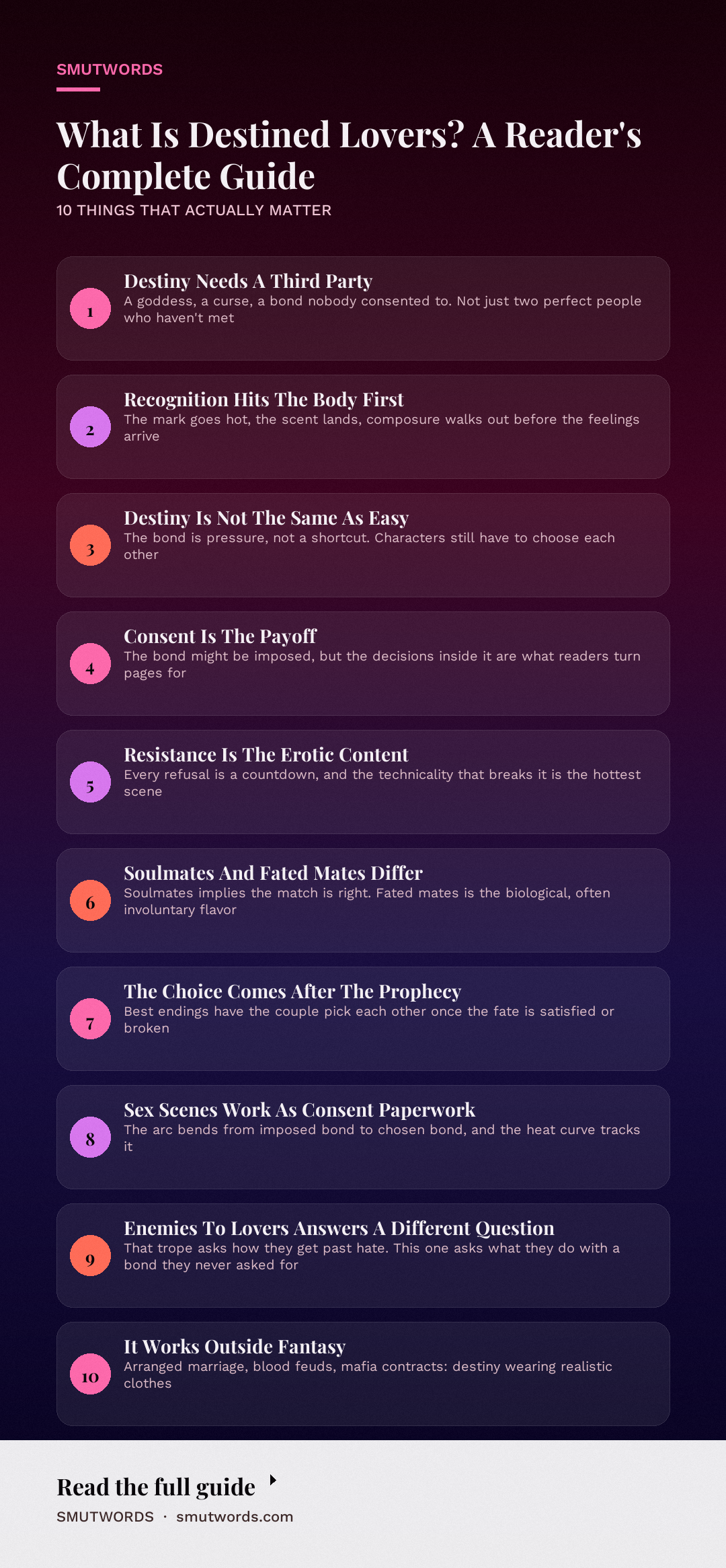
The biggest one is that destiny equals easy. It does not. A well-built destined lovers story uses the bond as pressure, not as a shortcut. The characters still have to choose each other in a way that reads as a choice, or the ending feels like paperwork.
The second misconception is that destiny cancels consent. In the strongest books, it does the opposite. The bond might be imposed, but the characters keep making decisions inside it, and those decisions are what the reader is actually turning pages for. The cosmic decree is the setup; the consent is the payoff.
The third is that this trope only lives in fantasy. Destined lovers shows up in small-town romance, sports romance, and mafia romance wearing street clothes. Two families with a blood feud and an arranged marriage nobody can wriggle out of is destiny with the serial numbers filed off.
Where Destined Lovers Comes From
The honest answer is that destined lovers is older than the novel. Cupid and Psyche, Tristan and Iseult, Romeo and Juliet: the West has been writing couples the universe has already paired off for as long as it has been writing couples at all. Fate as a matchmaker predates the printing press, and it will outlast whatever replaces the ebook.
The trope's history as a genre phenomenon is more useful, because it tracks how publishing has used it. In twentieth-century category romance, destiny was often framed as love at first sight wearing a wedding ring. The heroine and hero lock eyes, something clicks, and the book spends two hundred pages proving the click was correct. The cosmic machinery was implied rather than built.
Paranormal romance changed that in the 1990s and 2000s. Shifter, vampire, and witch romances started naming the bond outright, giving it rules, and putting it on the page as a physical event. The mate bond became a plot device with mechanics: it could be resisted, severed, faked, or used as a weapon. Once the bond had rules, authors could break them, and the trope got a second life.
Omegaverse pushed the idea further by making the bond biological and sometimes involuntary, which foregrounded the consent question that destiny had always been dodging. Around the same time, the explosive growth of fan fiction gave destined lovers a testing ground where writers could pair the trope with enemies to lovers and see what happened when the cosmos and the characters disagreed about the same relationship.
Romantasy's recent boom brought the trope back to the center of the market and pushed it toward parallel universe and time-crossed structures: same souls, different lifetimes, the reader watching the bond reassert itself across centuries. The machinery got bigger. The emotional promise did not change.
How It Shows Up in Erotica
On the page, destined lovers is a pacing engine. The bond tells the reader the ending. Everything else in the book is texture around that fixed point, and the sex scenes are where the texture gets its sharpest edges.
The Recognition Scene
Almost every book in this trope has one, and it is load-bearing. The first touch, the first breath of the other person's scent, the mark going hot: something happens that neither character planned and neither can dismiss. A strong recognition scene does two things at once. It confirms the bond and it takes something from the character, usually composure, sometimes control, occasionally the entire plan they walked into the room with.
Weak versions announce the bond and then move on. Strong versions let the recognition scramble the character physically before it scrambles them emotionally, so the reader understands that this is happening to a body first and a heart second.
Resistance as Foreplay
The middle of a destined lovers book is almost always one or both characters refusing what their body already agreed to. He stays away. She takes the job in another city. One of them marries somebody else and the bond goes quiet, then loud, then unbearable.
The resistance is the erotic content, because every refusal is a countdown. Authors who write this well make the refusals escalate. First she avoids his calls. Then she stands close enough to smell him and leaves anyway.
Enjoyed this? Get a free book.
Join the list and we will send a complete free story straight to your inbox, plus new releases every week after that. No credit card, no catch.
Then she lets him touch her once, on a technicality, and the technicality is the hottest thing in the book. The plot is a series of doors closing that the reader knows are going to open.
Common Variants
- Fated mates. Paranormal or omegaverse. The bond is biological, sometimes involuntary, often consummated before either character has decided they want it.
- Prophecy pair. Fantasy or romantasy. An oracle, a scroll, a dying seer names them, and the plot becomes about whether a named future can be avoided.
- Reincarnation romance. Same souls, multiple lifetimes. The couple keeps finding each other and keeps getting killed before they can finish what they started.
- Arranged destiny. Contemporary or mafia. No magic, just families, contracts, and a marriage neither party chose.
- Bonded rivals. The two people fated to destroy each other turn out to be fated to want each other instead. This is where the trope overlaps hard with hate to love, and the overlap is usually the point.
What Separates a Strong Version From a Flat One
The flat version treats the bond as a substitute for chemistry. The characters are destined, so the author skips the part where the reader gets to watch them become interested in each other. The result reads like an arranged marriage between two people who are polite about it.
The strong version treats the bond as an accelerant and then still does the work. The characters are fated, and the author makes the reader feel it in specific, physical, unglamorous details: the way she sleeps after he leaves, the places he almost says her name, the way the bond shows up in their bodies before it shows up in their choices.
A second marker is whether the characters get to make a real decision at the end. The best endings in this trope have the couple choosing each other after the prophecy is satisfied or broken. The choice is technically redundant and emotionally essential. Without it, the book ends with a cosmic shrug.
Where the Trope Goes in Bed
Destined lovers sex scenes tend to run hotter and faster than the book's other scenes, because the bond supplies the desperation that would otherwise take fifty pages of setup. The first time usually reads as an event that neither character fully authored. Later scenes usually get slower and more deliberate, because the story needs the shift from being taken by fate to taking each other on purpose.
The strongest books in the trope use the sex scenes as consent paperwork. By the time the couple has slept together three times, the reader has watched them agree to the thing the cosmos already assumed. The arc bends from imposed bond to chosen bond, and the heat curve tracks that bend.
Destined Lovers vs Enemies to Lovers
The two tropes get confused constantly because they show up in the same books, sometimes on the same page, and the confusion is worth clearing up because the fix is the same in both cases.
Enemies to lovers is built on opposition. The characters start on opposite sides of something real and the story is about friction turning into heat, then heat turning into trust. The arc moves from antagonism to intimacy.
Destined lovers starts somewhere else. The characters are already on the same side, cosmically speaking, whether or not they know it or want it. The arc moves from imposed union to chosen union. The friction is not between the two of them so much as between the two of them and the fate that has already paired them off.
When a book runs both, the enemies layer usually handles the first half and the destiny layer takes over the second. The hate to love version of the same pairing can be even sharper, because the bond has to work against an active grudge rather than a neutral distance.
Destiny also pairs easily with heavier plots. A soldier romance can run on a bond that survived a war and got papered over with deployment orders. A redemption arc romance can use the bond as the reason the redeeming character bothers to try. A motorcycle club romance can dress destiny as a club charter and a patch nobody can take off.
The key distinction to remember: enemies to lovers answers the question "how do these two get past hating each other." Destined lovers answers the question "what do these two do with a connection neither of them asked for."
Frequently Asked Questions
Is destined lovers the same as fated mates?
Fated mates is a specific flavor of the trope, usually paranormal or omegaverse, where the bond is biological and often involuntary. Destined lovers is the larger category and includes prophecy, reincarnation, and arranged-marriage stories where no magic is involved. Use the terms interchangeably at your own risk in a shifter group chat.
Does destiny kill the tension?
Only when the author lets it. If the bond does all the work and the characters do none, the reader gets bored around chapter six. The tension comes from the cost of the bond: what a character has to give up, who gets hurt, what it takes to accept something they did not choose.
What is the difference between destined lovers and soulmates?
Soulmates usually implies the match is correct, meaning the two people are genuinely suited to each other. Destined lovers only implies the match is fixed, which leaves room for a pairing that is cosmically required and emotionally difficult. The overlap is enormous, and most books use both frames.
Why is fated mates so common in omegaverse and shifter romance?
Because those subgenres already run on biology as destiny. A mate bond gives the author a built-in biological clock, a scent trigger, and a reason for characters to act against their own stated plans. It also gives the reader a reliable promise of a happy ending, which is why the subgenres sell.
Can a destined lovers book still have a satisfying slow burn?
Yes, and the best ones do. Slow burn works when the characters are the obstacle, not the cosmos, so the bond can be confirmed early while the emotional and physical consummation stays on the far side of several chapters. The reader knows the ending; the fun is in watching the couple take the long way there.
Does destined lovers work outside fantasy?
Constantly. Arranged marriage, blood feuds, small towns where everybody has been waiting for these two to figure it out, mafia families with a contract nobody can break: all of those are destiny wearing realistic clothes. The cosmic machinery is optional. The inevitability is not.
Final Thoughts
Destined lovers is the trope that tells the reader, up front, that this one is going to work out because the universe has already signed off on it. The good books in the trope use that promise as a floor and then build a real relationship on top of it, one where the couple ends up choosing each other for reasons the prophecy never bothered to specify.
If you want a book that does the whole arc properly, start with a fated mates shifter romance and pay attention to the resistance. The best ones in the catalog will show up ranked below this page, and the difference between a great one and a flat one is usually visible by chapter three: whether the bond is doing all the work, or the characters are.






Loading comments…