
Food play is the use of something edible as part of sex: feeding a partner by hand, drizzling honey down a sternum, painting a body with melted chocolate and licking it clean. It can be a five-minute detour in the kitchen or the entire architecture of an evening.
On the page, food play is one of the most sensory, low-equipment, high-intimacy things a writer can put down. That's exactly why it keeps showing up in romance and erotica when an author wants a scene to feel decadent, generous, and a little bit ridiculous in the best way.
The practice has real texture, real cleanup, and real risks, and the strongest writing about it knows all three. Below is everything worth knowing: what the term covers, where it came from, how good sex writing actually stages it, and the practical bits that keep a scene from turning into an allergic reaction or a ruined mattress.
What Food Play Actually Means
The short version from the glossary is accurate but thin. Food play, sometimes called feeding kink when the emphasis falls on giving and receiving rather than smearing, is any erotic or sensual activity in which food and drink are used as tools, props, or the medium of contact itself. The food is the medium; the point is still touch, taste, and attention.
The name is plain English, and unlike a lot of kink vocabulary, it arrived as a descriptive label rather than a coded one. It covers a wide church. At the mild end: a partner feeding you a strawberry while you keep your hands behind your back. At the far end: whole-body dessert rituals, cream poured from a height, someone eating a cake off another person's chest.
What counts as food play and what doesn't is mostly a question of intent. Eating a meal together is not food play. Being fed by a partner who refuses to let you touch the fork, or who licks a smear of frosting off your lower lip and then keeps going, is. The food is doing erotic work.
What doesn't count
Food play is not the same as an inflation fetish, though the two can be confused by the noun "food." Inflation fetish centers on the sensation or idea of a body being filled and distended; food may or may not be involved, and when it is, the food is almost incidental. Food play is about flavor, temperature, and texture on skin.
It's also not the same as merely eating suggestively, and it's not a body fluid kink. Bodily fluids are produced by the body; the entire premise of food play is that the play is with something brought in from outside, and edible. That distinction matters more for craft than for categorization, because the two hit different notes on the page.
Common misconceptions
The biggest one is that food play is a joke. It can be funny, and good writing lets it be, but the appeal isn't novelty. It's sensation and care, and a lot of readers come to these scenes for the tenderness, not the comedy of a whipped cream can.
The second is that it requires a lot of money or equipment. It doesn't. The entire toolbox is whatever's in your fridge. This is one of the cheapest, most accessible kinks in the whole catalog, which is a big part of why writers lean on it for characters who wouldn't own a single piece of leather.
The third is that it's exclusively a foreplay thing. It can be the whole event.
Where Food Play Comes From
The honest answer is that food play has a long, slightly embarrassing shelf life as a trope in Western erotic art and a shorter, much more documented life as a genre category in modern erotica and film.
Food and flesh have been tangled up for as long as humans have painted and sculpted. The Roman and Greek symposium is one long dinner party where the food and the bodies on the cushions blur together, and the association runs right through centuries of painting: grapes, bowls of milk, spilled wine, a reclining figure who might as well be dessert.
In twentieth-century visual culture, the association got explicitly erotic. The whipped-cream imagery of mid-century pin-ups, the classic food-fight comedies, the famous cake sequence in 9½ Weeks (1986), which is probably the single most cited mainstream erotic food scene in English-language pop culture. After that movie, the price of a can of whipped cream was briefly a joke, and a whole generation of readers had a reference image for the entire concept.
The specialized vocabulary arrived separately and mostly through the fetish-fandom scene. Sploshing, the term for the specific sub-practice of getting messy with food, has its own long history in adult film and the internet's early fetish communities, and it carries a wetter, sillier, more theatrical edge than the intimate two-person dessert that most romance novels mean. You can read the house definition at sploshing.
How the genre's use of it shifted
In early category romance, food play was mostly one-liner foreplay: a kiss in the kitchen, a shared dessert, a glass of champagne. It was almost never the headline. The food was a signifier for luxury or for hunger, and the actual eating was metaphorical.
That changed as explicit erotica got more confident about sensual honesty. In the last twenty years of self-published and indie romance, food play became a legitimate scene type of its own: the elaborate dessert, the kitchen counter, the market scene where the hero buys fruit and then uses it. Contemporary authors are a lot less coy about logistics than their predecessors; if a character is going to pour something over someone, the prose deals with the jug and the towel.
Online kink communities also gave writers a vocabulary. Terms like feeding, sploshing, and food as aftercare trickled up into fiction, and readers who already knew the words were the early adopters.
How It Shows Up in Erotica
Food play is one of the rare scenes where the writing is doing actual sensory work. Taste is the hardest sense to write on a page, and texture is the second-hardest, so a scene that gets them right reads as unusually vivid. The good ones are specific and unhurried; the bad ones sound like a menu.
The common variants you'll see
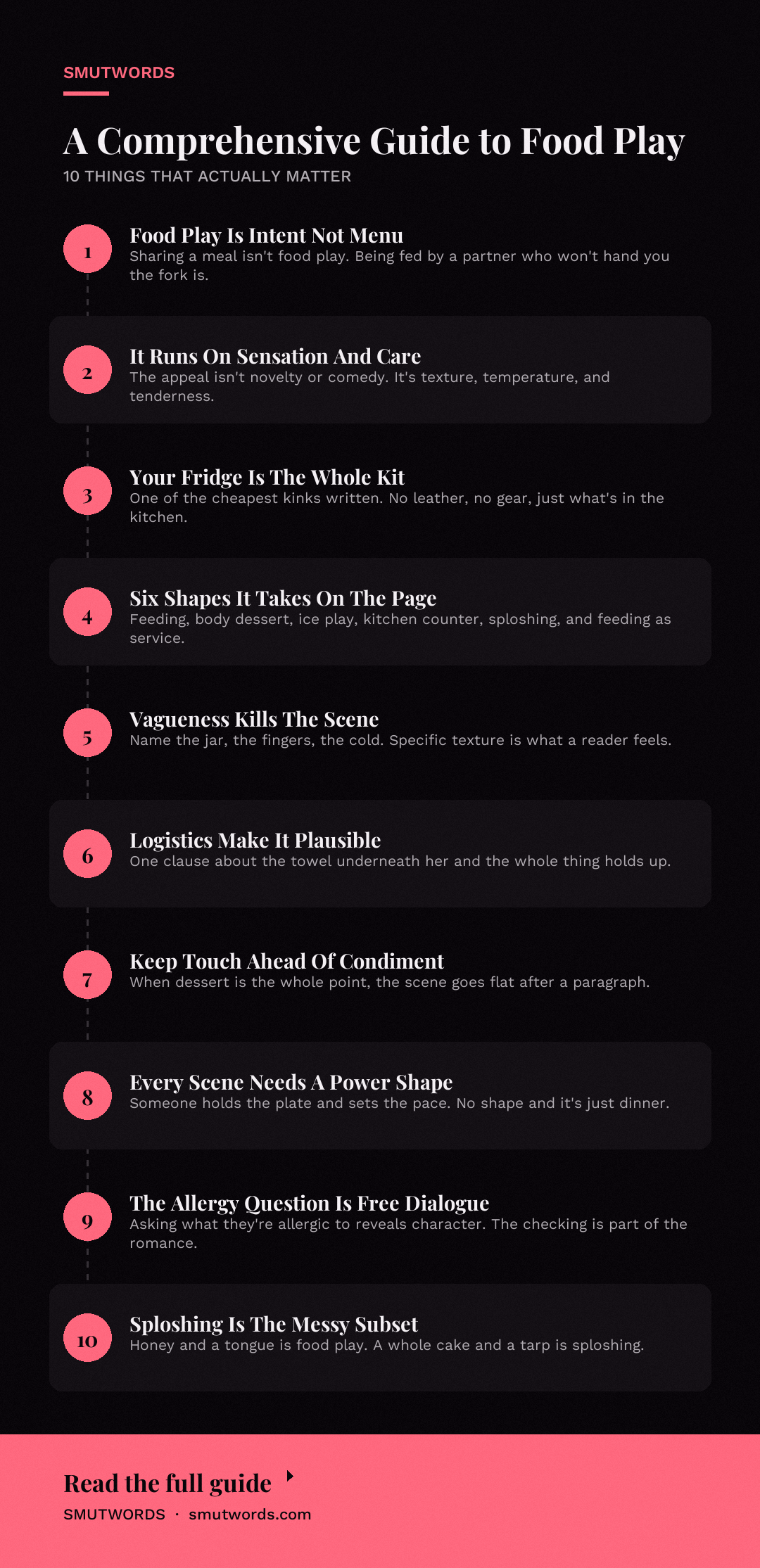
- The feeding scene. One partner feeds the other by hand, from a plate, sometimes blindfolded, sometimes with hands cuffed or held. This is the most intimate and least messy version, and a lot of the strongest scenes in contemporary romance are this one. The food does almost nothing; the hand does everything.
- Body dessert. Whipped cream, chocolate, honey, or jam painted onto skin and licked off. Usually the body is the plate, usually the smearing is deliberate, and the pace is slow. This is the version most readers picture.
- Ice play. Ice cubes traced along skin, held in a mouth before a kiss, dropped where the pulse is. Cold is sharper than heat, harder to get right, and more fun for a writer who wants visible reactions. It pairs comfortably with any temperature taboo or power exchange.
- The kitchen counter scene. Half-cooking, half-fucking. Food is incidental and present at once: a body pushed against the counter beside a chopped onion, a character being eaten out while the sauce is still on the stove.
- Sploshing. The overtly messy, theatrical version: pies, cream poured from height, a whole body covered. It's a comedy register and a fetish register at once, and it overlaps with a wet and messy fetish, which makes it the messiest flatmate of the whole category.
- Feeding as service or worship. One person makes or chooses the food and offers it, and the feeding is the act of care. This version connects to service submission, where a character's pleasure lives in being useful, and the food is the vehicle for that.
What makes a strong scene versus a flat one
The single biggest tell of a flat food play scene is vagueness. "He spread something sweet on her stomach" is a scene nobody remembers. "He unscrewed the jar of marmalade, dipped two fingers, and drew a slow line from her navel to her sternum, pausing where she flinched at the cold" is one a reader feels.
Enjoyed this? Get a free book.
Join the list and we will send a complete free story straight to your inbox, plus new releases every week after that. No credit card, no catch.
Second tell: an author who ignores the logistics. A strong scene knows where the food came from, what it's in, what's under the body. It can be a single clause ("the towel already underneath her") and the whole thing gets more plausible.
Third tell: the food does too much work. A scene where dessert is the whole point gets flat after a paragraph. What makes food play good is how it lets two people be close. The food is a tool for touch, and the strongest authors keep the touch ahead of the condiment.
Fourth tell, the big one: the scene has a power shape. Even with two evenly balanced characters, food play lets one of them hold the plate and decide the pace. The person being fed, or licked, or painted, is the one whose reactions the camera stays on. If a scene has no shape, it's just dinner.
And note how many other fetishes dovetail with it. The texture of a glove across a chest; the taste of leather at the wrist; a cream-slick thigh visible through lace. The leather fetish and lingerie fetish pages are useful cross-reads for anyone writing a food scene that wants a harder, more costume-y edge to it. A food scene set at a black-tie dinner writes differently from one in a kitchen at 2am, and the clothes are half of why.
Writing the trust on the page
Food play is one of the few kinks where the safety discussion is basically free dialogue. A partner asking "what are you allergic to" before they put anything near another person's mouth is a warm, specific, character-revealing line. Actors and good authors both use it. The answer tells the reader more about someone than three pages of backstory.
Use it. Readers love it. The checking is part of the romance.
Food Play vs Sploshing
These two get confused because they share a condiment aisle. The difference is intimacy versus spectacle. Food play is the broad category. Sploshing is the specific sub-genre where getting messy is the whole point, usually with more volume, more cleanup, and a deliberate comedy-of-abundance register.
A scene with a spoonful of honey and a tongue is food play. A scene with a whole cake and two bodies and a tarp is sploshing. Both can be hot, but they're doing different work in a story, and the one you'd use in a quiet motel-room scene is probably not the one you'd use in a comedic party scene.
There's a separate comparison worth making with body fluid kink, and here the line is clearer than it looks. Bodily fluids come from the people involved; food comes from a shop. The overlap is textural and sits in the broad "wet and messy" family. A reader who likes one often likes the other, but the ethical and practical rules differ enough that the terms are not interchangeable.
Frequently Asked Questions
Is food play a real kink or just a romance trope?
Both, and the overlap is extensive. Feeding, body desserts, and sploshing all have long lives in adult film and dedicated fetish communities, well before they turned up in mainstream romance. The fictional version is usually more romanticized and less logistically messy than the real thing, which is what fiction is for.
Is food play safe?
It can be, with care. Confirm allergies and intolerances before anything approaches a mouth, and be extra careful with nuts, dairy, and shellfish. Keep food out of and away from sensitive areas: genitals, the urethra, the rectum, the eyes. Some foods (chili, citrus, garlic, anything very acidic) burn on contact, and sugar in the vagina or on the vulva can upset the natural flora.
What foods work best for food play?
Whipped cream, chocolate sauce, honey, jam, fruit, ice cubes, and anything that's soft, sweet, room-temperature or cold, and easy to wipe off skin. Honey and jam are messier than whipped cream; ice is the cleanest and the most intense. Avoid anything with chili, high acid, sharp edges, or a tendency to stain deeply.
How do you write a food play scene without it being gross or silly?
Keep the food secondary and the touch primary. Get specific about texture and temperature and let the banter do the comedy, if there's going to be comedy. The silliness survives when a character acknowledges it; it survives less well when the prose is trying to play the whole thing straight.
Is food play the same as sploshing?
No. Food play is the broader practice, and sploshing is the specific, more theatrical sub-genre of getting heavily messy with food, usually for the mess itself. Sploshing is a subset of food play, not the whole thing.
Do I need special equipment for food play?
Almost nothing: a towel or a washable sheet, a bowl, maybe a drop cloth or a plastic sheet for the messier versions, and whatever's in your kitchen. Sploshing is the version that genuinely wants a tarp and a plan. The rest of food play is often a single plate and a good hand.
Final Thoughts
Food play earns its place in the catalog because it does the thing romance is best at: two people noticing each other, slowly, with their hands. It also lets a scene be funny and dirty and tender at once, which is a hard combination to write and a joy to read.
If you want to see a genuinely great feeding scene sitting in the middle of a service-driven power dynamic, pick up Service Submission Explained: Pleasure in Being Useful. Food play is one of the most common shapes that kind of submission takes on the page, and it's the best place to watch what the dynamic looks like when it's written with the care it deserves.
For a colder, sharper heat, pair it with our Complete Guide to Blood Play, another kink that lives or dies on the trust negotiation happening on the page before anything touches skin.








Loading comments…