
The touch her and die trope is the moment a story stops pretending the hero is reasonable. Someone threatens, bruises, or even looks too long at the woman he's decided belongs to him, and he makes it plain that the cost of touching her is his full, unhurried violence. The threat lands like a vow.
The touch her and die trope turns possession into a promise: the most dangerous person in the room has chosen her, and everything he can do is now pointed outward at anyone who would harm her. It runs through dark romance, mafia romance, fantasy, paranormal, and romantic suspense, and it's one of the most reliable engines the genre has.
The line itself rarely appears word for word. What appears is the glare, the low voice, the hand at her waist, the sentence that doesn't need finishing because everyone in the scene already knows what happens next.
What the Touch Her and Die Trope Actually Means
Strip it to its bones and the trope is a public declaration of consequence. The hero has some capacity for harm. The heroine is threatened. He announces, explicitly or through action, that the person responsible will not survive it.
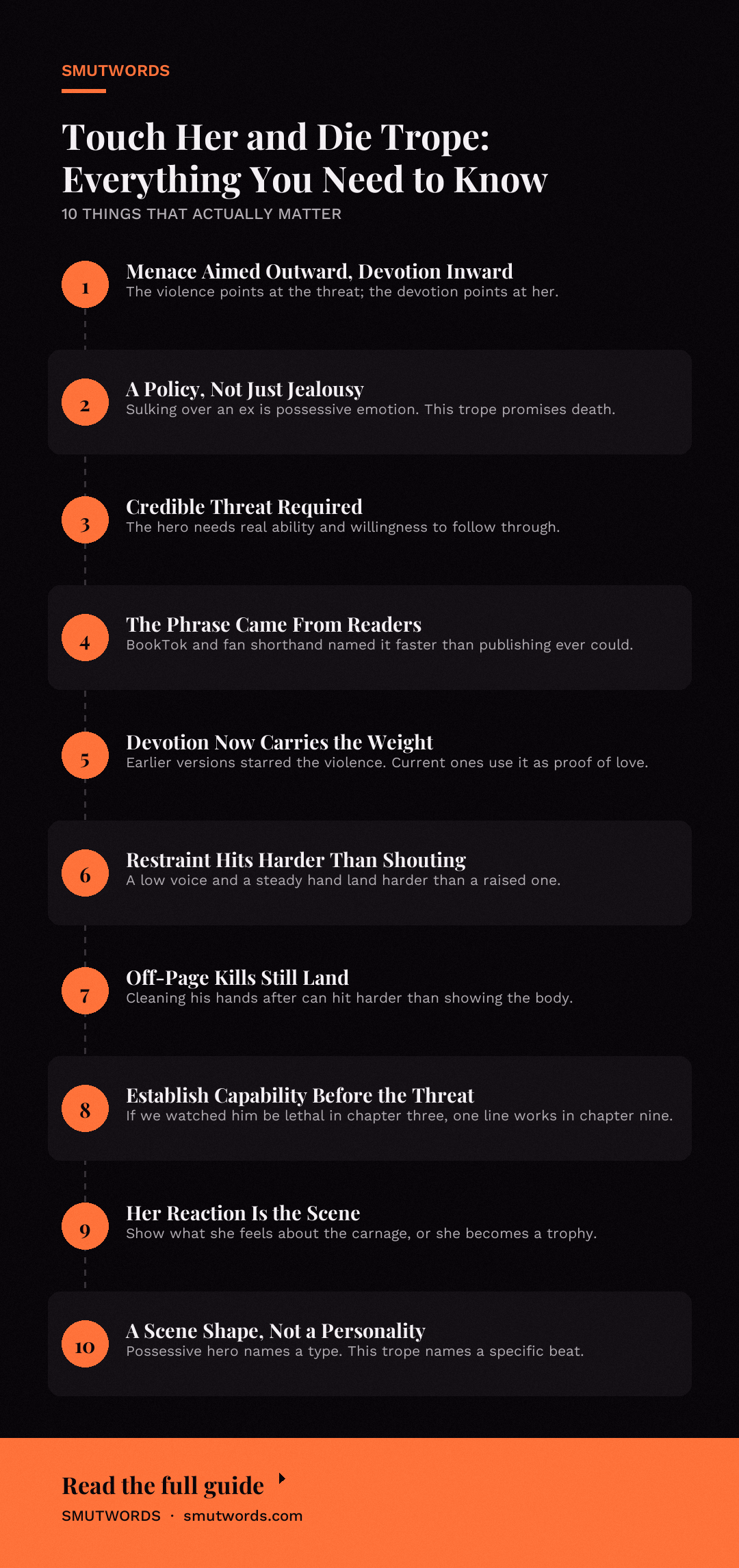
The menace is directed at the threat, and the devotion is directed at her. The name comes from reader culture more than publishing. Fans and BookTok creators started using the phrase as shorthand for a specific flavor of possessive hero, and it stuck because it described the beat so precisely. It has since become a marketing tag, a content warning, and a personality type, sometimes all at once.
What Counts and What Doesn't
A lot of possessive behavior gets folded into this term carelessly. The distinction matters, because the trope has a specific emotional logic that gets diluted when everything gets the same label.
- It counts when there's a credible threat. The hero needs real ability and real willingness to follow through. A blustering man who couldn't hurt anyone isn't this trope; he's a puppy in a leather jacket.
- It counts when the threat is aimed at someone else. The violence is pointed outward, at the person who hurt her. The moment it turns on the heroine, it's a different, much darker story entirely.
- It doesn't count as generic jealousy. A hero who sulks because she talked to her ex is possessive, but he hasn't promised anyone's death. Jealousy is an emotion; this trope is a policy.
- It doesn't count if she asked him to stand down. If she says she can handle it and he backs off with respect, that's a healthy relationship, and it's not the trope. The trope lives in the tension between what she wants and what he'll allow when her safety is on the line.
Common Misconceptions
The biggest one is that the trope is about control over the heroine. It reads that way to people who skim the summary, but the strong version has the hero's aggression pointed entirely at third parties. His possessiveness expresses itself as protection, and any controlling behavior toward her becomes a separate conflict the story has to answer for.
The second misconception is that it requires physical violence. Many of the best executions never show the killing. A sentence, a look, or a phone call that leaves the outcome to the reader's imagination can hit harder than a body on the floor.
Where the Touch Her and Die Trope Comes From
Protective menace is ancient material. The core idea, that a powerful man will destroy the world for one woman, runs through ballads, folklore, and epic poetry for centuries. That's the deep root. The recognizable modern form belongs to genre fiction and its readers.
The Publishing History
Old-school historical romance had its share of fierce, possessive heroes, but they were usually titled and constrained by manners. The threat tended to be social ruin rather than bloodshed. The mafia romance wave of the 2000s and 2010s changed the available toolbox. Heroes could be actual criminals, and the story could treat that as romantic rather than ruinous.
Paranormal and fantasy romance pushed further. Shifters, fae, and vampires had instincts, mates, and territorial compulsion built into their natures, so possessive violence came with a biological excuse. Dark romance then stripped the excuse away and left the raw dynamic exposed for readers who wanted it without the fantasy costume. For a different kind of obsessive insistence, see our guide to undercover marriage, where the binding force is a shared cover story rather than a body count.
How It Became a Named Trope
The phrase itself is a reader-culture invention, and its spread tells you a lot about how tropes get named now. Community shorthand, listicles, and social media posts drove it into mainstream use far faster than any trade publisher could have. Authors began tagging their books with it directly because readers were searching the term.
The evolution since has been a shift in emphasis. Earlier versions leaned on the threat, with violence as the star. Current versions lean on the devotion, treating violence as the proof of it.
Heroines have also gained more agency inside the trope: she often gets to approve of or reject the carnage, and modern books increasingly let her prove she can protect herself too. A useful comparison point is the revenge romance, which shares the permission for righteous violence but aims it at story stakes rather than at one person's claim.
How It Shows Up in Erotica
The trope is a heat engine because it fuses danger with devotion in the same breath. Fear and arousal share a nervous system, and a scene that puts both on the page at once can hit readers harder than either alone. Here's how strong books actually build it.
Variations Authors Use
- The quiet promise. Low voice, no raised hand, no weapon. The hero states what will happen and everyone in the room believes him. Cold menace reads as more dangerous than shouting.
- The aftermath. The violence happens off the page and we only see the hero cleaning his hands, or the fear on the attacker's face at the next encounter. Restraint adds weight.
- The restrained hero. He's a soldier or enforcer by training, so his calm is itself a threat. His stillness is what makes people back away. This version pairs well with a soldier romance setup, where the discipline is part of the appeal.
- The reversal. The hero is the gentle one, sweet and soft-spoken, until someone hurts her and the temperature drops. Readers love this version because the contrast does the work.
- Mutual version. She's just as dangerous, and they take turns. Both claim each other with matching threats, and nobody in the story is safe.
- The impossible witness. The threat is aimed at someone the hero can't touch: a prince, a rival, a member of his own family. The story becomes about how badly he wants to break that rule.
- The reclaimed protector. A hero with a dark past uses his capacity for harm in her defense, which doubles as his own redemption. That strain runs naturally through a redemption arc romance, where the violence becomes the thing that finally makes him useful instead of dangerous.
What Makes It Work and What Makes It Flat
Strong versions establish the hero's capability before the threat lands. If the reader has watched him be lethal in chapter three, a single sentence in chapter nine can carry the whole scene. If the reader has only heard he's dangerous, the line thuds.
Strong versions pair the menace with real tenderness, so the reader sees both sides of him in the same scene. The hand that just delivered a warning is the same hand that tucks her hair back. That contrast is most of the appeal.
Flat versions mess up in predictable ways. The threat is overused, so it becomes a catchphrase rather than a moment. The violence happens to a character the reader barely knows, so there are no stakes.
Enjoyed this? Get a free book.
Join the list and we will send a complete free story straight to your inbox, plus new releases every week after that. No credit card, no catch.
Worse, the hero is cruel to the heroine and the story treats that as romance, which is a different trope with a different set of warnings. Readers can usually tell when the tag is doing the work the writing should have done.
There's also a structural issue. The threat depends on the heroine being in danger, which means her experience of the scene matters. A strong author shows her reaction: disgust, satisfaction, fear, arousal, or some combination the story then deals with honestly. A flat version turns her into a trophy the hero collects with his body count.
That's also where craft lines blur across genres. The one-bed trope creates intimacy through forced proximity; here, the forced proximity is danger. Both ask what the characters do when the situation strips their options away.
Heat, Tension, and the Sex Scene
When the trope turns physical, the sex often carries the same charge: rough, intense, urgent, with relief and possessiveness in roughly equal measure. A scene that includes the promise without the earlier tension struggles. The line works best when the reader has seen enough of the character's restraint to know what just snapped.
For a sense of the kind of intensity the current dark romance scene builds, our guide to the complete guide to blood play covers how authors write dangerous intimacy on the page. Not every touch-her-and-die book goes there, but the craft principles are the same: establish the stakes, let the reader know the character's capacity, and trust them to feel the heat.
Touch Her and Die vs Possessive Hero and Protective Alpha
These terms get swapped constantly, and the confusion is real. "Possessive hero" and "protective alpha" describe personality types. The touch her and die trope describes a scene shape. A possessive man may never threaten anyone, and a hero can deliver a death threat without being possessive at all.
The most useful neighbor for comparison is marriage in trouble. Both put danger and devotion in the same room, but that trope tests an existing bond through crisis, while this one announces a bond through the threat of violence against anyone who violates it.
One asks whether a relationship will survive. The other asks how far a man will go to protect what he already claims. If you're tagging a book, choose based on what the story's central engine actually is. The threat is the beat; the possession is the personality behind it.
Frequently Asked Questions
What does the touch her and die trope mean?
It's a romance trope where a powerful, often dangerous hero makes it known that anyone who harms or threatens the heroine will face his full, lethal anger. The line functions as a declaration of protection and possession at the same time. It's common in dark romance, mafia romance, and fantasy romance.
Is the touch her and die trope the same as a possessive hero?
Not exactly. "Possessive hero" describes a character type, while the trope describes a specific scene or pattern: a threat, a promise of violence, and a display of devotion through menace. A possessive hero might never threaten anyone. The two often appear together but they're not interchangeable labels.
What are common alternative names for the touch her and die trope?
Readers and authors also call it the possessive hero trope, the protective alpha trope, "mine alone," and the deadly protector trope. The vengeance angle overlaps with revenge romance when the book's plot is driven by payback rather than protection.
Is the touch her and die trope only found in dark romance?
No. It shows up in mafia romance, fantasy and paranormal romance, romantic suspense, and even some contemporary novels with a protective hero who happens to be a former operative. The common factor is a hero with dangerous capability and a heroine who becomes his priority.
What should readers know before picking up a touch her and die romance?
Expect on-page danger, threats, and often violence, usually aimed at third parties rather than the heroine. Check the author's content warnings; many books in this space include off-page violence or an on-page killing, and some include protective jealousy that borders on control. Readers who want a hero who never threatens anyone should look for lighter, less dangerous builds.
Does the touch her and die trope require the hero to actually kill someone?
No. The strongest versions often keep the killing off the page or leave it implied. What matters is that the reader believes the threat is real and the hero is capable of following through. A single line delivered with the right restraint can land harder than a full action sequence.
If you like the protective instinct but want the danger on a completely different stage, our cyberpunk romance guide covers heroes who guard their people in neon-lit, high-surveillance cities, and the prince/princess romance section handles what happens when the possessive protector is bound by a crown.
Final Thoughts
The touch her and die trope earns its popularity because it gets to the oldest wish in the genre: to matter so much to someone dangerous that the world rearranges itself around your safety. A strong version makes that wish feel earned, with a hero capable enough to mean it and writing careful enough to make the promise land.
If you want a book that wires the threat up to real stakes and then delivers, start with one of the ranked picks below.






Loading comments…