The grumpy hero soft for her trope runs on a single, reliable mechanic: a man who treats the entire world like an inconvenience meets one woman who somehow gets a different version of him. He's short with the barista, dismissive of his brother, allergic to small talk, and then she walks in and he's pouring her coffee without being asked.
Readers keep coming back to that gap between how he treats everyone else and how he treats her because it's the closest thing the genre has to a guaranteed payoff. The question worth asking is which books actually earn that softening, and which just hand you a rude man and call it romance.
The grumpy hero soft for her trope is the genre's most dependable fantasy, and also its most frequently botched. Read enough of these and you start to see the fault lines clearly: the ones where the grump is genuinely soft underneath versus the ones where he's just an asshole in a henley who apologizes once and gets rewarded.
What the Grumpy Hero Soft for Her Trope Actually Promises
The fantasy isn't really about the grump. It's about being the one person who gets through. The hero lives in a closed system of his own rules, and the heroine is the exception that proves the system can open. That's why readers tolerate so much scowling and clipped dialogue: they're waiting for the first crack in the armor.
A good version of this trope gives you a specific kind of scene. He remembers how she takes her coffee without being told. He growls at his own dog for waking her up and then apologizes to the dog. He tells the room to leave, and then his tone drops three octaves when he asks if she's cold.
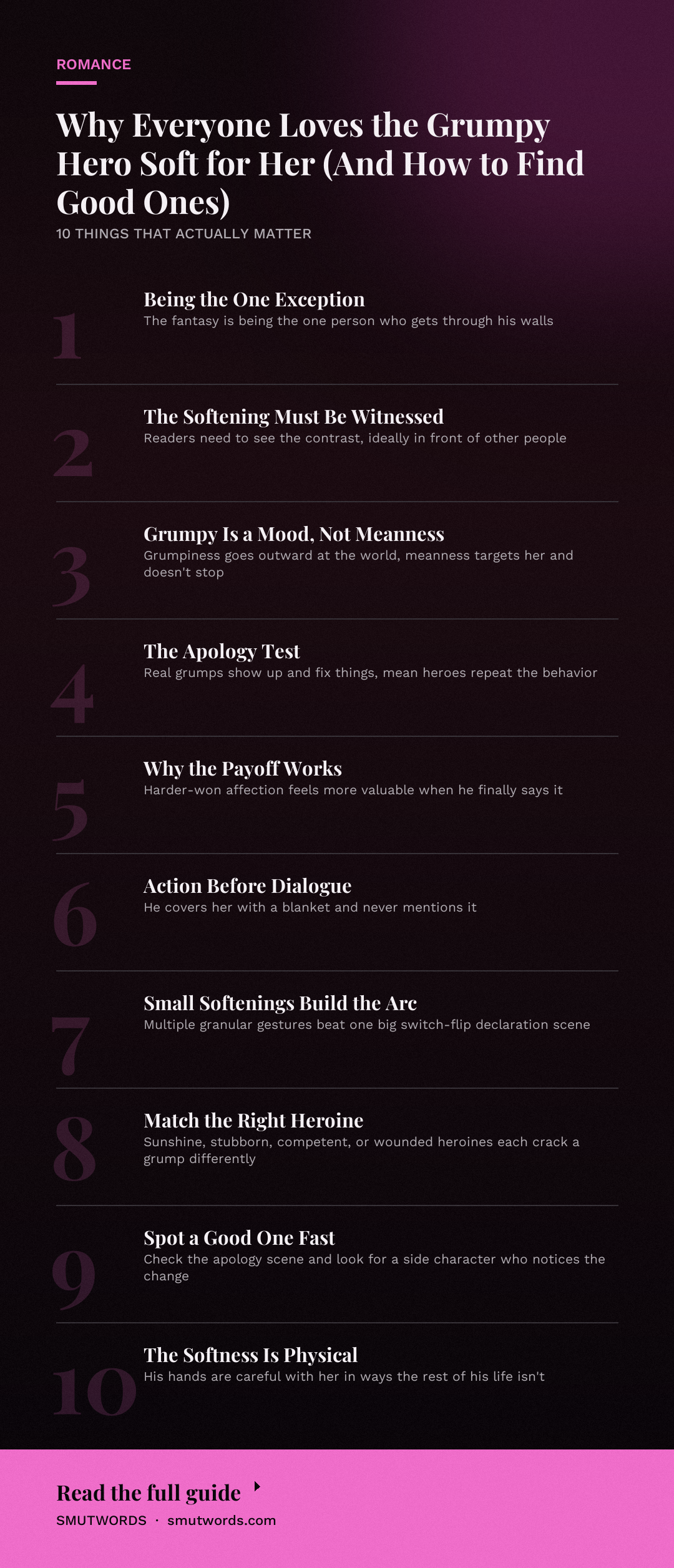
The softening has to be witnessed. It doesn't work if he's just secretly nice and she happens to benefit. Readers want to see the contrast, ideally in front of other people.
The brother who's known him for thirty years does a double take. That reaction is doing real structural work.
The one-person exception as the engine
Every strong version of this trope isolates the heroine as a special case. He's rude to his business partner, dismissive of the pretty neighbor who keeps orbiting him, and then his voice goes quiet and careful when she walks into the room. The exclusion is the point. It's a soldier romance staple for exactly this reason, where the hero who can't relax around anyone somehow can't stay tense around her.
The tricky part is that the special-case treatment has to be earned within the story, not just asserted. If she hasn't done anything except exist, the softening feels arbitrary. The best books build in a reason: she sees through him, she doesn't flinch, she does something competent that impresses him before he decides to like her.
Grumpy vs. Mean: The Line That Decides Whether the Book Works
This is where most mediocre grumpy hero books fall apart. Grumpy is a mood. Mean is a behavior. Readers will forgive a mood almost indefinitely; they will not forgive sustained cruelty, and they shouldn't have to.
Grumpiness is directed outward at the world. Meanness gets directed at her, specifically, and it doesn't stop once he's decided he wants her. The difference shows up in what happens after he's hurt her.
- Grumpy hero: has a sharp, humorless default and a flat affect with strangers. Softens specifically for her and shows it in actions before words.
- Mean hero: uses her vulnerability as a target, withholds information as punishment, and never actually changes the way he treats her when he's upset.
- Grumpy hero: apologizes in his own language. He doesn't say "I'm sorry" easily, but he shows up, fixes the thing, remembers what she said.
- Mean hero: apologizes with a grand gesture and then repeats the exact behavior by chapter nineteen.
- Grumpy hero: guards his own emotional life like a vault, and readers understand why after a chapter or two of backstory.
- Mean hero: is rude for no stated reason, and the author is relying on the reader to find that sexy without evidence.
A quick test: if the hero's rudeness makes you wince in a way that isn't resolved by the end of the scene, the book is on the wrong side of the line. Good ones give you a rescue within a page or two. Bad ones let the discomfort linger for chapters and call it tension.
Why Readers Keep Coming Back to the Grumpy Hero Soft for Her Trope
The appeal breaks down into a few honest strands.
The first is the protective payoff. A man who is dismissive of everyone around him is, by implication, capable of firing on all cylinders when something threatens her. The touch her and die trope is the grumpy hero genre's favorite cousin, and the two overlap constantly. A grump who will gut anyone who looks at her wrong is a very specific flavor of reassuring.
The second is the fantasy of being trusted. A guarded man who lets one woman inside the walls is offering intimacy as a privilege. Readers like that.
The third is the quieter one, which is that a grumpy hero's affection feels harder-won and therefore more valuable. When he finally says the thing out loud, it lands because you've watched him swallow it for two hundred pages.
That said, the payoff only works if the hero has somewhere to go. A man who's already soft but pretending not to be is a much harder book to write than a man who's actually closed off and gets pried open.
The Softening: Action Over Dialogue
The single biggest tell of a good grumpy hero soft for her book is that the softening happens through action long before it happens through words. He does something for her. He changes his routine. He lets something slide that he'd never let anyone else get away with.
Consider the shape of a scene: he comes home from a work trip and finds she's asleep on his couch. He doesn't wake her. He covers her with the throw that's normally folded in the linen closet and makes a point of remembering which one it is so he can put it back exactly right in the morning.
That's the fantasy. Nobody says anything.
Enjoyed this? Get a free book.
Join the list and we will send a complete free story straight to your inbox, plus new releases every week after that. No credit card, no catch.
When the dialogue finally comes, it should be limited. Grumpy heroes are not verbose. The speech that works is short and slightly awkward. A well-earned "I'd burn it all down for you" in forty pages is worth a thousand words of sappy confession.
Where the softening breaks
Plenty of books fail at this exact point. The hero either softens all at once in a big declaration scene, which reads as a switch flip, or he never softens at all, and the author asks you to believe the epilogue is romantic because he bought her a house.
The fix in good books is granular: multiple small softenings across the story, each one slightly bigger than the last, all witnessed by someone else in the room. The reader tracks progress. That's the whole game.
Pairings That Make the Grumpy Hero Land
Some heroines are better suited to crack a grump than others. The pattern is consistent enough to be useful.
- Sunshine heroine: relentlessly cheerful, unbothered by his silence, does not take his rudeness personally. She's the sunshine in the sunshine/grumpy pairing, and she works when she's genuinely optimistic rather than a doormat.
- Equally stubborn heroine: meets his growl with a raised eyebrow. The softening becomes a contest of who breaks first, which is why books with the only one bed trope pair so well with this dynamic, because forced proximity puts the contest on a timer.
- Competent heroine: does the job well enough that he has to respect her before he can like her. Grumps are often competency snobs.
- Wounded heroine: comes with her own armor, which means his softening mirrors hers. Mutual unclenching is a much more satisfying arc than one-sided defrosting.
Watch what the heroine is actually doing in the first three chapters. If she's apologizing for existing, the book has already told you who he is going to be and how she's expected to respond.
How to Spot a Good Grumpy Hero Book Before You Buy It
Blurbs lie. Reviews don't, but they're sometimes written by readers who love a mean hero and call it grumpy. There are a few quick filters that catch most bad versions before you've paid for a full book.
- Read the sample scene where he's rude to someone else. If the heroine watches and thinks it's cute, that's a sign the author has confused bullying with chemistry.
- Check the apology scene. Skim to the point where he's meant to have fucked up. If the apology is a grand gesture and the behavior repeats after, the book isn't really a grumpy hero soft for her story.
- Look for a secondary character who notices the change. A brother, a best friend, a coworker. That witness is a strong signal the author knows what they're doing.
- Search the reviews for "he was just mean" versus "grumpy but wonderful." Readers will tell you exactly which side of the line a book sits on if you give them a paragraph or two to complain.
- Confirm there's a reason for the grump. Backstory, burn scars, a dead sibling, a war. A grump with no reason is a personality defect, not a character.
One more signal: the good books are usually quiet about the softening. The marketing copy will pitch "billionaire alpha with a soft spot," but the actual writing has him putting her bag in the car without being asked. Read the sample for the small gestures.
Grumpy Heroines and the Reverse Dynamic
The trope works in reverse too, and the reverse version is often tighter. A grumpy heroine who softens for one man has a different set of stakes, because the culture has already given her a hundred reasons to keep her guard up. The praise kink crowd tends to love this version, because the softening happens verbally, in the form of her letting someone compliment her for the first time in years without deflecting.
If you want to branch out of the standard heterosexual grump dynamic, some of the best versions live in prince/princess romance, where the guard has been up since childhood and the softening is political as well as romantic. The grump in those books is a public figure, and the exception is a private one, which raises the stakes on every small gesture.
The Softening Is Physical, Not Just Emotional
Good grumpy hero books bring the softening into the body. He touches her differently than he touches other people. His hands are careful in ways the rest of his life isn't. That physical shift is often what readers remember, more than any declaration.
The tension scene where he finally kisses her should feel like a controlled demolition: he's been holding back for the entire book, and the first contact reads as relief.
The best authors spend equal care on what he does to her after, because a grump who's soft in bed for one woman is the fantasy in its purest form. Some books lean into the verbal end of that, and that's where the difference between monster breeding romance and a straightforward contemporary becomes clear, because the softness has to be translated into a register where the guards aren't human-standard in the first place.
Where the Trope Crosses Into Specific Kinks
The grumpy hero shows up in a lot of other genres because the softening mechanic is portable. Where it lands really well is in stories where the hero's restraint is central to the kink, and food play is a good test case: he feeds her before himself, carefully, and the entire dynamic is about control being offered rather than taken. The softer version of that scene is what you're here for.
The opposite also exists. Books where the grumpy hero is rude, then the bedroom is where he lets his tongue loose and everything he's been holding back comes out in a much less tender direction.
That's a valid read for readers who want the verbal degradation side of the fantasy, but it's a different book. The marker is whether the degradation is expected, negotiated, and part of a dynamic where the grump is still fundamentally protective. A hero who's mean on the page and mean in bed is not a grumpy hero. He's a mean hero.
The Grumpy Hero's Soft Spot Is the Whole Book
The best grumpy hero soft for her books are, at heart, studies in restraint. They give you a man who's carefully not saying a hundred things and then let you watch him say one. The scene where he breaks is short, specific, and earned. That's the moment you close the book and immediately hand it to someone.
If you're loading up a reading list and want the version where the hero's tightness pays off in the form of a slow, considered unraveling, look for books where the softening is measured in small gestures rather than grand statements. Save the grand gestures for the epilogue. The good stuff happens in the middle, in a kitchen, at 2 a.m., with nobody saying anything.
Final Thoughts
Start with a book that respects the line between grumpy and mean, and where the softening is action first, speech second.
Ice Cold Hero, Warm Heart is the cleanest example of the trope I've read this year, and it earns the final scene because the hero has been quietly doing unasked-for things for two hundred pages before he ever says a word that could be called romantic. If it doesn't hit for you, you'll at least know where your line is, and that's the thing worth knowing before you buy the next one.







Loading comments…