
A nylon fetish is an erotic fixation on the look, feel, sound, and scent of nylon stockings and pantyhose. It usually centers on legs, feet, or the act of putting them on and peeling them off. It sits inside the broader world of hosiery and legwear desire, but it has its own texture, literally and figuratively.
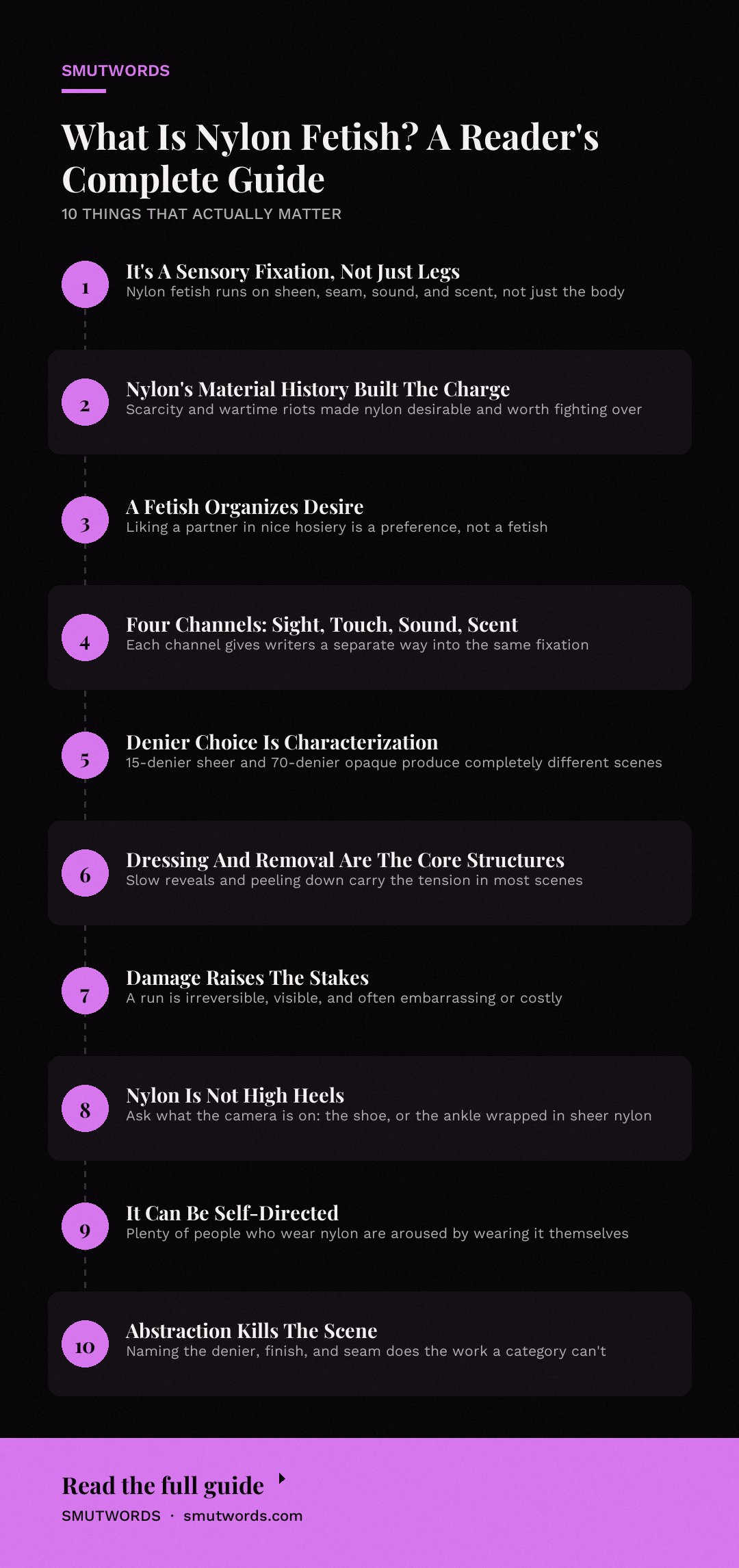
The nylon fetish crowd is not just into legs. They are into the sheen, the seam, the whisper of fabric sliding over a calf, the way a run starts at the ankle and climbs. If you have ever found yourself more interested in what someone is wearing on their legs than in anything else in the room, you already understand the basic charge.
What Nylon Fetish Actually Means
The word nylon names a synthetic polymer family first produced commercially in the late 1930s, and its arrival changed both fashion and erotic imagination. Before nylon, stockings were silk, cotton, or wool. Nylon was cheaper, sheerer, stronger, and it clung. The material's specific physical qualities, its shine and its grip and its near-invisibility, are the foundation of the fetish.
A nylon fetish is a sensory and often sexual fixation that can operate on several channels at once. It goes well past an appreciation of hosiery as clothing. The visual channel covers sheen, opacity, color, seam placement, and the way light travels down a thigh. The tactile channel covers slickness, tension, and the roughness of a reinforced toe or heel.
The auditory channel covers the soft friction of nylon on nylon or nylon on skin. The olfactory channel covers the particular scent of new hosiery, of worn hosiery, or of the skin underneath.
What counts as a nylon fetish is broad. Some people are aroused by the garment alone, independent of who wears it. Some are aroused by the body inside it, with nylon acting as a frame. Some are fixated on a specific moment, like the roll-on process, the removal, or the discovery of a run.
Some are drawn to the way nylon changes the sensation of touch for the person wearing it. That makes it a shared experience rather than a spectator one.
What does not count, or counts as something adjacent, is worth naming. A general preference for a partner in nice hosiery is not a fetish in the clinical or community sense. It is a preference.
A fetish implies a recurring, often necessary element in someone's erotic life, something that organizes desire rather than merely decorating it. There is no hard line here, and most people fall somewhere on a spectrum, but the distinction matters when you are reading or writing about it.
Common misconceptions cluster around shame and triviality. The first is that this is a niche oddity. In practice, hosiery desire is one of the most widely represented fixations in erotic media, so common that it often goes unlabeled because it reads as mainstream styling.
The second is that it is inherently passive or male-gaze-only. Plenty of people who wear nylon are aroused by wearing it, and the fetish can be self-directed rather than about looking at someone else.
Where Nylon Fetish Comes From
The history of nylon as an erotic object starts with its material history, and that history is genuinely strange. When nylon stockings were introduced in 1940, demand was so intense that the material was diverted to military use during the Second World War, and women reportedly drew lines up the backs of their bare legs to simulate seams. After the war, the rush on hosiery was so aggressive it produced actual riots in stores.
That is not fetish history, but it is the origin of the garment's cultural charge: nylon arrived as something scarce, desirable, and worth fighting over.
In erotica and romance specifically, the nylon fetish has a clear lineage through mid-century pin-up art, pulp magazine illustration, and the long tradition of "stocking" imagery in men's magazines. Those images standardized certain conventions that are still with us: the seam down the back of the leg, the garter belt as a frame, the reveal of a stocking top against bare skin.
Those conventions did not come from nowhere. They came from the specific visual grammar of a garment designed to end at mid-thigh.
The shift from stockings to pantyhose in the 1960s changed the fetish's imagery. Pantyhose offered continuous coverage, which some found less charged and others found more so, because it removed the visible boundary at the thigh in favor of a seamless prison of nylon from waist to toe. The control-top era added a new element: compression, restriction, and the concept of the garment as something that holds the body in a specific shape.
In online erotica, the fetish found a natural home in the 1990s and 2000s, first in Usenet groups and specialized forums, then on image boards, and eventually across every platform with a search bar. This migration matters because it shaped the language.
The community developed its own vocabulary, including "sheer," "denier," "seamed," "cuban heel," "fully fashioned," and the shorthand distinctions between stockings and pantyhose that authors now deploy as characterization. That vocabulary is now standard in written erotica that features the fetish, and readers notice when an author gets it wrong.
A notable shift in recent publishing is the move away from nylon as pure visual object and toward nylon as sensory experience. Contemporary writers spend more time on the sound and the texture than earlier eras did. The tactile and auditory channels that used to be implied are now foregrounded. This tracks with a broader shift across fetish writing toward texture-first description, the same shift you can see in how the glove fetish moved from accessory styling to second-skin sensation.
How It Shows Up in Erotica
On the page, a nylon fetish scene lives or dies on specificity. The generic version, where a character is simply described as wearing stockings, does almost nothing, because it offers the reader a category instead of an experience. The strong version names the denier, the finish, the seam placement, the way the fabric behaves under tension.
A 15-denier sheer and a 70-denier opaque produce completely different scenes, and an author who knows this can use the choice as characterization. A character who chooses fully fashioned seamed stockings is telling you something about themselves that a character in plain black tights is not.
The most common structural move in nylon fetish fiction is the dressing scene as a slow reveal. The garment goes on piece by piece, and each step is an opportunity for sensory detail and for tension. The roll of nylon up a calf, the adjustment at the thigh, the final smoothing at the waist.
This structure works because it aligns the reader's attention with the character's attention. Both are focused on the same small, specific events.
Enjoyed this? Get a free book.
Join the list and we will send a complete free story straight to your inbox, plus new releases every week after that. No credit card, no catch.
A second common structure is the removal scene, which is often more charged than the dressing scene because it implies a transition from presentation to vulnerability. The peeling down, the moment the fabric leaves the skin, the discovery of a run or a damp patch. Removal scenes frequently carry an element of ritual, and they pair naturally with power dynamics. The person who removes the hosiery, or the person who orders it removed, is making a claim about access.
A third structure, less common but often the most distinctive, centers on the nylon itself rather than the body. This is where the fetish tips toward object fixation, and it can be handled with real craft. The garment is purchased, examined, worn alone, laundered, repaired. The narrative interest is in the life of the object and the caretaking rituals around it.
This is the same terrain that lingerie fetish writing occupies, but narrower, because nylon is a single material rather than a category of garments.
Authors who write this well tend to draw on a few specific techniques:
- Named specifications. Denier counts, sheerness, seam type, heel style, and whether the garment is stockings or pantyhose. These details do the work of atmosphere and characterization at once.
- Sound detail. The shush of nylon on nylon, the snap of a garter, the small friction sounds that most writers ignore and that readers of this fetish specifically notice.
- Scent detail. The particular smell of new hosiery out of the package, of worn fabric, of skin under compression. Handled carefully, scent is the most intimate channel available. This is close to what gives petrichor kink its hold, a fixation on a sensory signature rather than a visual one.
- Consequence. A run, a snag, a ladder. Damage to the garment is one of the most reliable tension generators in the genre because it is irreversible and often embarrassing or costly, which raises the stakes of every touch.
- The garment's opinion. Strong scenes treat the nylon as an active element with behavior, not as a costume. It clings, it slips, it catches, it resists removal.
What makes a flat version of this fetish is abstraction. If the text tells you the character is aroused by stockings without ever describing the stockings with any precision, the reader gets a premise instead of a scene.
Nylon is a material, and material writing requires material detail. The authors who understand this write hosiery the way other authors write food. They describe temperature, texture, and the specific physical response of the body encountering it. That is the same craft principle that makes food play work on the page, and it is not a coincidence that the two genres often share an interest in texture and mess.
Variants within the fetish give writers a lot to work with. The most established include:
- Seamed stockings. The classic variant, with a visible line up the back of the leg and often a Cuban or Manhattan heel. The seam is a directional cue and a focal point, and it pairs naturally with vintage settings.
- Sheer pantyhose. Continuous coverage from waist to toe, frequently with a control top. Less about boundaries and more about an unbroken second skin.
- Opaque tights. Heavier fabric, more coverage, often coded as younger or more casual, and frequently used in colder settings where the garment is a practical layer that becomes something else.
- Fishnets. Open structure that emphasizes the grid over the surface. Fishnets read as more overtly sexual and are often used to signal a character's deliberate presentation.
- Compression and support styles. The garment as restriction, which connects to broader restriction and confinement dynamics.
- Worn or vintage nylon. The fetish applied to garment history, including authentic vintage stockings with their specific construction and scent.
Adjacent fetishes are worth keeping distinct. Nylon overlaps with the high heel fetish, since the two are frequently worn together, but they are not the same fixation. Heel desire is often about silhouette, arch, and stride.
Nylon desire is about the fabric and the leg, and a scene can feature one without the other. There is also overlap with leather fetish writing, but leather and nylon produce opposite sensations. Leather is rigid, opaque, and structural. Nylon is sheer, pliable, and concealing by way of transparency rather than coverage.
Nylon Fetish vs High Heel Fetish
These two are frequently conflated because they co-occur so often, and the confusion is worth clearing up. A high heel fetish centers on footwear: the shape of the shoe, the elevation of the arch, the sound of a heel on a hard floor, the act of walking in heels.
A nylon fetish centers on the legwear: the fabric, the sheerness, the seam, the way the garment sits on the foot and ankle. You can have a fully developed nylon fetish with no interest in shoes at all, and you can have a heel fetish that is indifferent to what the foot is wearing. When both are present, they compound, which is why so much erotic imagery pairs them.
When you are reading or writing, the useful test is simple. Ask what the camera is on. If it is on the shoe, it is high heel fetish territory. If it is on the ankle wrapped in sheer nylon, or on the way a seam runs up a calf, it is nylon.
Frequently Asked Questions
Is a nylon fetish the same as a pantyhose fetish?
They overlap heavily but are not identical. Pantyhose fetish is a subset of nylon fetish that focuses on the one-piece garment specifically. Nylon fetish includes stockings, tights, knee-highs, and sometimes other nylon garments like gloves and bodysuits. Most people who identify with one also identify with the other.
Is a nylon fetish common?
It is one of the most commonly represented fetishes in erotic media, though many people who have it never use the label. Because hosiery is a standard element of mainstream styling and fashion, the fixation often reads as ordinary preference rather than a distinct fetish, which keeps it underreported.
What is it about nylon specifically that makes it fetishized?
The material is sheer, clingy, and synthetic, which means it changes the appearance of the skin underneath without hiding it. It also produces distinctive sound, scent, and texture. Those sensory qualities are what the fetish attaches to, and they are difficult to replicate with other fabrics.
Can you have a nylon fetish without being into feet?
Yes, and this is common. Many people with a nylon fetish focus on legs, thighs, or the dressing and undressing ritual rather than feet. Foot fetish and nylon fetish frequently overlap, but neither requires the other.
What denier is most common in nylon fetish writing?
It ranges widely, but sheer styles in the 10 to 20 denier range are the most frequently described because they maximize the visibility of skin under fabric. Opaque styles in the 40 to 80 range appear often in cold-weather settings or scenes involving concealment and restriction.
Do people with a nylon fetish need a partner to wear it?
Not necessarily. The fetish can be self-directed, meaning the person who has it also wears the garment. It can also be object-focused, with the garment itself as the center of interest. Partner-based scenes are the most common in erotica, but they are not the whole picture.
How do you write a nylon fetish scene without it feeling generic?
Get specific about the garment. Name the denier, the finish, the seam, the heel type.
Describe the sound and the scent, not just the look. And give the nylon behavior: let it slip, catch, or run. Abstraction is the enemy of this particular fetish, because the whole appeal is material.
What makes a run or a tear so effective in these scenes?
Damage is irreversible and visible. A run converts the garment from a controlled presentation into a problem that has to be dealt with, often in front of someone else. That produces embarrassment, exposure, and a shift in power, all of which are reliable sources of erotic tension.
Final Thoughts
Nylon fetish is one of the rare fixations where the material itself carries the entire charge, and the writing that handles it best treats hosiery the way a good scene treats any object of desire: with precise, unhurried attention to what it actually feels and sounds like. If you want a single next read that handles the sensory side of this fetish with real craft, start with the top pick in the recommended list below.







Loading comments…