
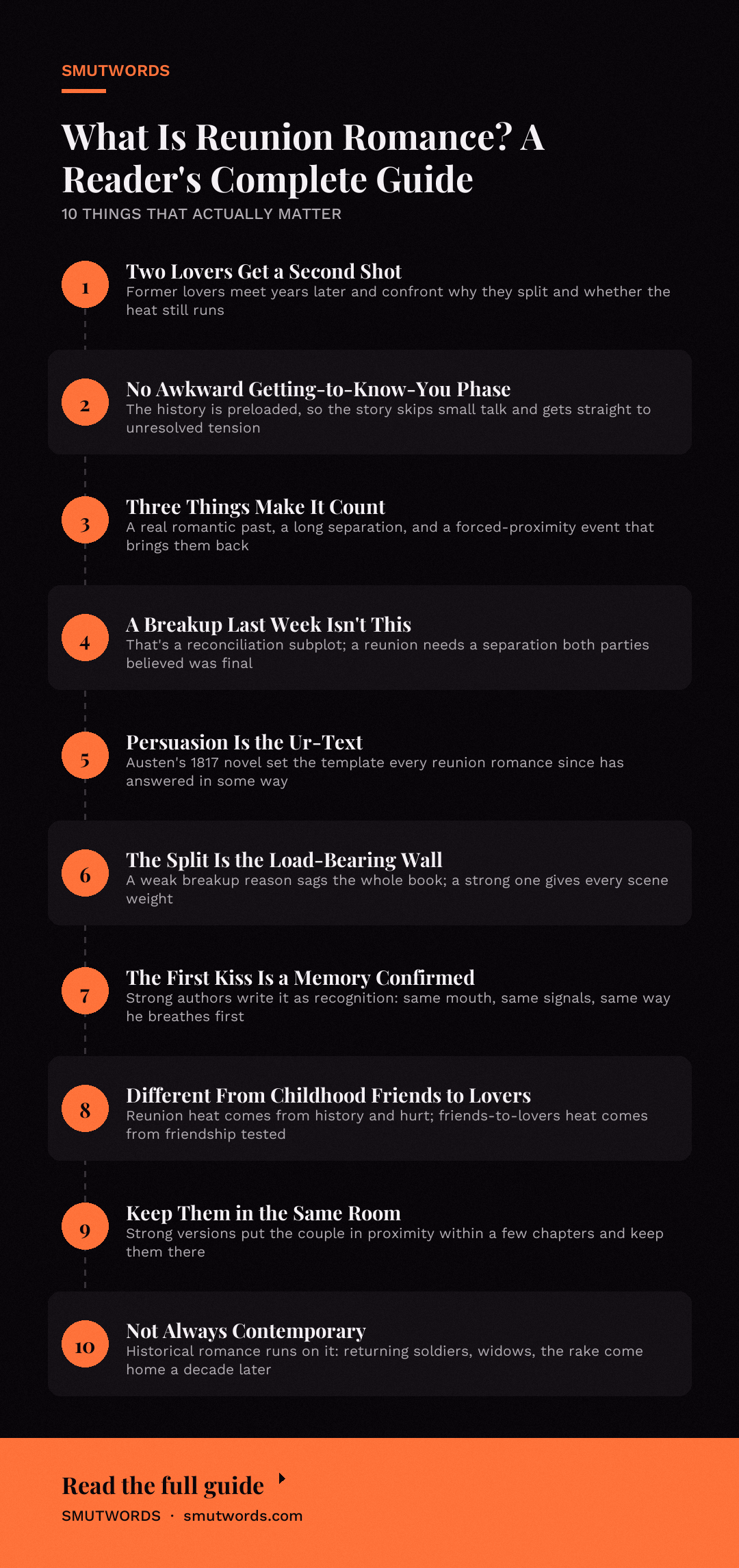
Reunion romance is the trope where two people who already loved each other, and already lost each other, get a second shot at the same bed. Former lovers meet again after years apart, usually at a wedding, a funeral, a hometown return, or some crisis that puts them in the same room with no polite exit. The book spends its length forcing them to confront why they split and whether the old heat still runs hot.
The history is preloaded. There's no awkward getting-to-know-you phase, no blind-date small talk, just two people who know exactly what the other sounds like in the dark and have to decide what to do about it now.
What Reunion Romance Actually Means
The name is plain and descriptive, which is rare in a genre that loves a cute label. It says what the book does: two former lovers reunite. That's the whole engine. The "romance" half signals the guaranteed ending, and the "reunion" half signals the obstacle, which is time, distance, and whatever unfinished business drove them apart in the first place.
A reunion romance needs three things to count. A shared past that was genuinely romantic or sexual, not just a crush or a friendship. A real separation, long enough and final enough that both parties believed it was over. And a forced proximity or forced contact event that brings them back into each other's orbit for the length of the story.
What doesn't count: a couple who broke up last week and get back together by chapter four. That's a reconciliation subplot, not a reunion romance. Neither does a story where one character never got over the other but they were never actually together. That's unrequited love with a delayed payoff, related but distinct.
The category also gets called second-chance romance, exes to lovers, old flame reunion, high school sweethearts (when the origin story is teenage), or "the one that got away" (when one party spent the intervening years pining). Publishing uses these interchangeably. Readers searching "reunion romance" want the same thing under all of them: the specific ache of a love that already happened once and might happen again.
Two misconceptions worth clearing up. The trope isn't cheating, even when one or both parties have partners when they reconnect; the strong versions resolve the outside relationship before the physical line gets crossed. And it isn't automatically angsty. Plenty of reunion romances are warm, funny, and low-conflict, especially in small-town settings where the whole cast is delighted to see the exes circling each other again.
Nor is it exclusively contemporary. Historical romance runs on this trope constantly: widowed heroines, soldiers back from war, the rake who returns to the county a decade later and finds the wallflower he left behind is now the woman everyone wants.
Where Reunion Romance Comes From
This trope is older than the modern romance genre, and its erotica lineage is long enough to be respectable. Jane Austen's Persuasion, published in 1817, is the ur-text: Anne Elliot and Captain Wentworth, eight years apart, still raw, still furious, still in love. Every reunion romance since has been in some kind of conversation with it, knowingly or not.
The trope's explosion as a named, marketed category is more recent. Through the twentieth century, second-chance plots lived inside broader category romances and family sagas, and readers knew the pattern even without a label for it. Harlequin and Mills & Boon published variations of it constantly from the 1970s onward, and the "old flame" hook appeared on so many back covers it became its own shorthand.
The real shift happened in the 2000s and 2010s, when digital publishing and indie romance turned subgenre tags into discoverable search terms. "Second chance romance" became a browseable category on every retailer and review site. Small-town romance and its prodigal-child-returns framework pushed it further, because the small-town structure almost demands a returning character and a past relationship waiting for them.
The erotic end of the market followed the same curve. Explicit reunion stories moved from isolated short fiction into full-length, tag-sorted novels once readers could filter by "second chance" and "explicit." The trope works exceptionally well for erotica because the history is built into the setup, which means a book can start closer to the heat instead of spending sixty pages on the meet-cute. That economy is a big part of why it keeps getting written.
How It Shows Up in Erotica
The craft question with a reunion romance is always the same: what happened the first time? The split is the load-bearing wall. If the reason the couple broke up is weak (a misunderstanding one phone call could clear up) the whole book sags. If it's strong (class, geography, a family obligation, a deployment, a secret one of them was carrying) then every scene afterward has real weight under it.
Strong versions of this trope do three things with the page. They let the couple reference their shared history in specific, sensory details instead of general nostalgia. They make the present-day obstacle genuinely harder than the past one. And they give the couple at least one scene where they have to be physically near each other with no possibility of privacy, which is where the heat actually builds.
The heat itself is distinct from other tropes. In a reunion, the first kiss is a memory being confirmed. A strong author writes it as recognition: the same mouth, the same unspoken signals, the same way he breathes before he leans in. That familiarity is the erotic engine, and it's why so many reunion scenes work even when the plot around them is thin.
Common Variations Authors Use
- High school sweethearts reunited. The couple that got together at seventeen, split at college, and find each other again at a class reunion, a family wedding, or back in the hometown. The suspense is about whether they've changed enough to fit together as adults.
- The one that got away. One party spent the intervening decade pining and the other didn't know, or did and pretended not to. This version leans hard into grovel and mutual pining.
- Wartime or military split. A soldier romance structure where the couple's first separation came from a deployment, a war, or a posting, and the reunion happens years later with one of them changed. See our soldier romance page for how the military specifics work.
- Career split, glamorous reunion. The couple broke up because one of them went off to chase fame (a band, a film, a fortune) and the reunion happens years later with both parties established and the question of who gave up what on the table. A rockstar romance can pull this off with a returning band member, and a ghostwriter romance can do it with a reclusive writer who turns out to have a history with the person sent to write his memoir.
- Royal or titled reconnection. The couple was separated by class or family approval and the reunion happens under a prince/princess romance structure, where a royal or noble title is exactly the barrier that split them.
- Crisis-triggered reunion. A funeral, a shared friend's wedding, a family emergency, or a natural disaster brings them together. The reunion is not chosen, which raises the stakes.
- Forced-pretend reunion. The couple has to pose as a couple again for a week (a wedding, a family weekend, a conference) and the pretending starts functioning as rehearsal for something real.
What a Flat Version Looks Like
The most common failure in the trope is a book that treats the reunion as a reason for things to happen rather than as the actual subject. The plot needs to be about the reunion, not happening around it. If the couple spends most of the book on separate errands and the reunion is just a backstory detail, readers feel cheated.
Enjoyed this? Get a free book.
Join the list and we will send a complete free story straight to your inbox, plus new releases every week after that. No credit card, no catch.
Flat versions also tend to make the split too easy to forgive. When the original breakup is a contrived misunderstanding, and the reunion consists of the couple meeting and getting back together within twenty pages, the story has no arc. The best reunion romances make readers actually doubt, mid-book, whether these two should be together now.
The heat is another failure point. Reunion sex scenes can go soft, because authors lean on "we don't need to discuss it, we know each other's bodies" instead of showing what's hot about that particular familiarity. The best explicit scenes in this trope put memory and discovery in direct tension: this is the same thing he used to do, and it still destroys her, and there's something new about it too.
Reunion Romance vs Childhood Friends to Lovers
These two get confused constantly, and it's worth separating them because the emotional machinery is different. A childhood friends to lovers story is about two people crossing from platonic intimacy into romantic and sexual intimacy for the first time. The heat comes from the friendship being tested by the new stakes.
A reunion romance is about two people who've already crossed that line once and got burned. The heat comes from the established romantic and sexual history, plus the unresolved hurt. You can absolutely have a story that's both (high school sweethearts who were best friends first, split, and reunite), but the moment the couple becomes lovers, the book stops being childhood-friends-to-lovers and starts being reunion.
The cleanest test: if you deleted the romantic history and just left the friendship, would the story still work? If yes, it's friends-to-lovers. If the story falls apart without the shared heat, it's a reunion.
Frequently Asked Questions
What is a reunion romance?
A reunion romance is a romance novel where two former lovers reconnect after a significant separation and have to confront why they split. The trope is sometimes called second-chance romance or exes to lovers. The key ingredients are a real shared romantic or sexual past, a long separation, and a present-day situation that forces the couple back into contact.
What's the difference between reunion romance and second-chance romance?
Nothing, in practice. The two terms are used interchangeably across publishers and reviewers. "Reunion romance" emphasizes the present-day meeting, while "second-chance romance" emphasizes the emotional theme, but the book the reader is buying is the same.
Why is reunion romance so popular with readers?
Because it's efficient and satisfying. The established history lets the story skip the awkward introductions and get straight to the unresolved tension, which makes the reconnection feel both inevitable and dangerous. Readers get the thrill of a first kiss with the payoff of a relationship that was already significant.
Does reunion romance always involve a breakup?
No, but it usually involves a separation caused by something equivalent. Some versions feature a couple who never officially broke up because one of them disappeared, was deployed, or was presumed dead. Others feature a couple who split because one of them moved away, and the relationship simply faded. As long as the separation is real and the lack of closure is driving the current reunion, the trope applies.
What's the difference between reunion romance and a reconciliation subplot?
The book's central engine. In a reunion romance, the entire plot is built around the couple coming back together and deciding whether to try again. A reconciliation subplot is a secondary arc inside a book about something else (a marriage-in-crisis novel, a family saga) where the reconciliation is one thread among several. In a true reunion romance, removing the reunion leaves no book.
Can reunion romance have a happy ending if the couple's first split was really bad?
Yes, and the badness of the original split is the whole point. The best reunion romances make the original breakup genuinely hurtful, and the reconciliation genuinely earned. Readers want the couple to deserve the second chance. What they don't want is for the split to be waved away as a misunderstanding that one honest conversation could have fixed.
What's a common mistake in reunion romance writing?
Keeping the couple apart too long. A reunion romance thrives on proximity, so the strong versions get the couple in the same room, the same town, or the same job within the first few chapters and keep them there. Books that string the reader along through separate-lives montages for half the novel lose the whole advantage of the trope.
Is reunion romance always contemporary?
No, and historical romance runs on it heavily. Persuasion is the template, and every era since has produced its own variations: returning soldiers, widows, returned colonial officials, the local rake come home a decade later. Reunion romance is a structural pattern that fits almost any setting, including a cyberpunk romance where a former partner resurfaces years after disappearing into the grid.
Final Thoughts
The reunion romance hands the reader two things most tropes make you choose between: the charge of a first encounter and the weight of a relationship with years on it. Every author who's pulled it off started from the same question. What actually happened the first time? Get that right and the second time writes itself.
If you want to see the trope handle its own history with real heat and real stakes, start with the ranked list below. Pick the reunion setting that hits hardest for you (a wedding, a hometown, a funeral, a job) and watch what happens when the book takes the split seriously.




Loading comments…