Nobody agrees on what "why choose" means, and that's before we get to its cousin, reverse harem. Spend ten minutes in a romance reader group and you'll watch the same fight play out. Someone recommends a book as why choose, someone else says it's reverse harem, and a third person insists they're the same thing.
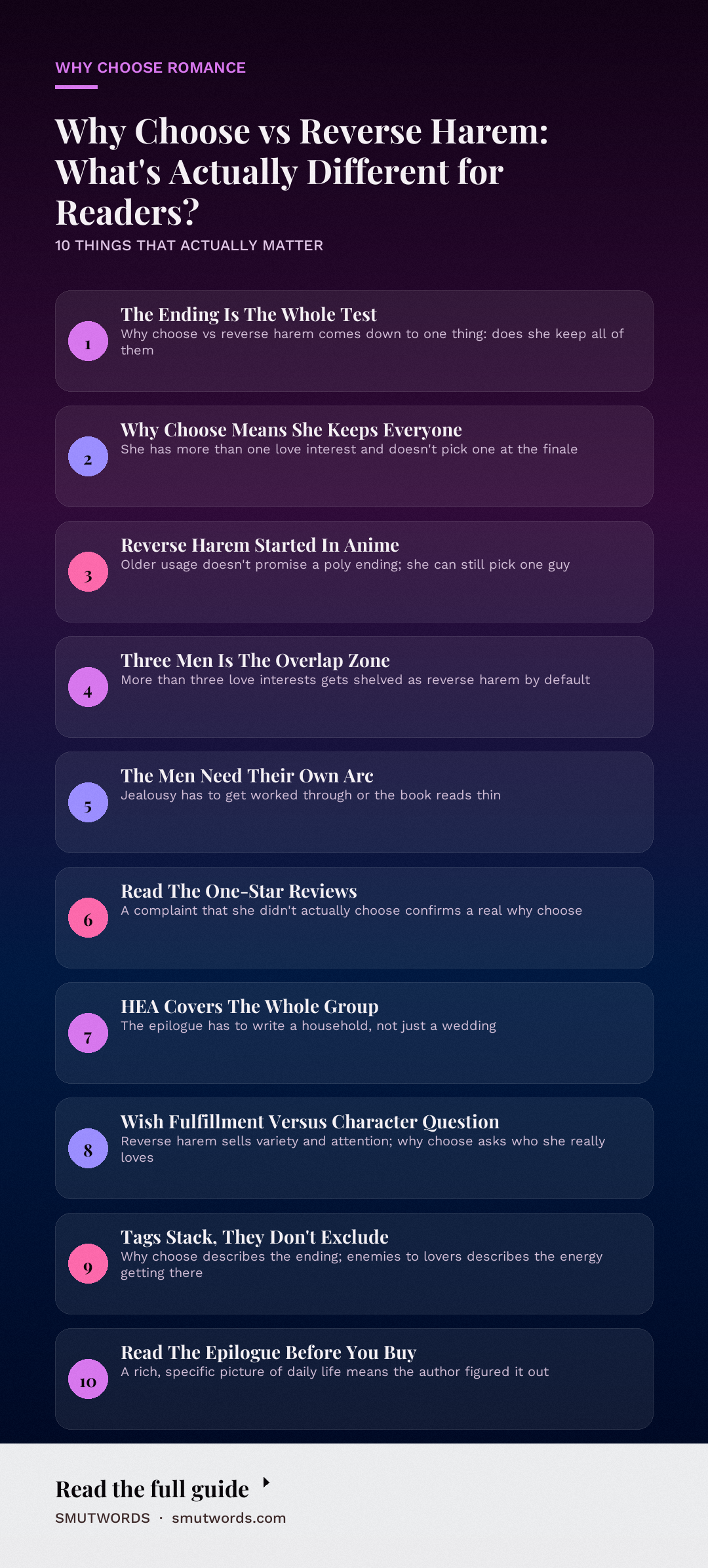
They aren't. If you want the honest distinction, why choose vs reverse harem comes down to whether the heroine ends up with one partner or all of them. That's the whole argument in miniature.
Everything else (the cover art, the "why choose" tag on the bookstore listing, the marketing copy screaming about "multiple love interests") is downstream of that single choice the author makes about the ending. Get the ending structure clear and you can stop arguing in the comments and start picking your next read.
What "Why Choose" Actually Means
The term is borrowed from the meme of a couple at a crossroads deciding whether to split up, and the joke answer is "why not both." In romance, why choose is a structural label: the heroine has more than one serious romantic interest, and by the end she doesn't have to pick one and mourn the others. She keeps them.
That's it. Why choose is defined by the non-monogamous endpoint, not by the number of hot men on the cover. A book can have three gorgeous love interests and still not be why choose if she chooses one at the finale and the other two cheer her on. The ending is the test.
Which means why choose as a category tells you almost nothing about tone. You'll find sweet contemporary why choose with two husbands and a bakery. You'll find dark why choose where everyone's covered in blood by chapter forty. The tag describes structure, so the genre inside it can be anything.
The word "why choose" is a marketing umbrella, not a genre
Some authors slap it on to signal "multiple men, no choosing," some use it as a softer alternative to reverse harem because they think harem carries a lingerie-and-tiaras connotation they don't want. Publishers treat them as interchangeable more often than they should, and that's how a reader ends up buying the wrong book.
What actually stays the same across every why choose
The heroine's emotional arc can't be about narrowing down. It has to be about expansion: learning to hold more than one attachment without feeling like she's betraying any of them. The men usually need their own arc too, often from rivalry or possessiveness toward some working truce. If the book skips the jealousy work and just hands her three devoted boyfriends, it reads thin.
What Reverse Harem Actually Means
Reverse harem is older as a term and started in manga and anime fandom, where "harem" meant one protagonist surrounded by a cast of love interests. "Reverse" simply flipped the genders: one woman, many men. Strictly, the older usage doesn't promise a polyamorous ending. Plenty of classic reverse harem anime end with the protagonist picking one guy and the rest staying friends.
Romance publishing has slowly tightened the term, so in most current book discussions reverse harem does mean she keeps all of them. Here's the trap: some readers still use the old definition and some use the new one, and neither group is wrong on their home turf. That's exactly why the two labels get confused when they walk into the same Facebook group.
The bigger difference is texture, not structure. Reverse harem tends to promise a specific fantasy package: a large cast (four, five, six men), each with a distinct role.
The cold one. The golden retriever. The dangerous one. The one who's secretly soft.
You know the lineup. Why choose is often a smaller, tighter group, and it doesn't have to advertise itself with that recognizable roster.
Reverse harem math
There's an unofficial rule that if there are more than three love interests, the book gets shelved as reverse harem by default. Three men is the overlap zone, where either label fits and readers will call it whatever they prefer. Two committed partners is almost never reverse harem, and it just barely counts as why choose.
Where the fantasy lives
Reverse harem is closer to wish-fulfillment furniture. It's built to deliver variety, attention, and being the center of a devoted group. Why choose is more often a character question: what if she genuinely loves two people and doesn't want to amputate one half of her own life? Different reading experiences, same structural bones.
The Real Difference: Does She Commit to One or All?
So the answer to why choose vs reverse harem, for practical purposes, is: does the heroine choose a single partner and end monogamous, or does she end the book with everyone? In current usage, both labels trend toward "everyone," but the older reading of reverse harem allows a single pick, which is where the confusion lives.
When you're scanning tags and blurbs, these are the signals that actually tell you what you're getting:
- "Why choose" on the cover or listing. Near-certain the ending is non-monogamous. Safe bet.
- "Reverse harem," no "why choose." High chance she keeps all of them, but a real chance of a single-partner ending, especially if the book is older or leans litfic.
- "RH." Same thing, abbreviated.
- "Multiple love interests," "MFMM," "MFMMM." Confirms the headcount but not the ending. Check the reviews for "dies alone" or "she ends up with all of them" before you buy.
- "Menage" or "MFF." Usually a single scene, not the whole structure. Different thing entirely.
- No tag, lots of shirtless men on the cover. Could be a love triangle. Love triangles make her choose. That's the opposite of what you're here for.
One more tell: read the last review from a one-star reader. If it complains that "she didn't actually choose anyone" or "why is everyone okay with this," you've found a genuine why choose or current-usage reverse harem. If it complains that "the other two were wasted," you've found a love triangle, or an old-usage reverse harem with a single ending. Reviewers accidentally do your tagging work for you.
HEA Expectations: Why the Ending Rules Everything
This is the part that determines whether the book will leave you satisfied or furious.
Traditional romance expects the HEA, and an HEA means the central love story ends committed. If there's one central pairing, that pair has to be together and happy at the end, or the reader feels robbed. Readers who read mostly monogamous romance bring that expectation to every book. Hand them a why choose and their first instinct is to wait for the choosing, then panic when it doesn't happen.
Why choose inverts that. The HEA is the whole group. The romance genre's promise (committed, permanent, both parties happy) gets stretched to cover three or four people instead of two.
Enjoyed this? Get a free book.
Join the list and we will send a complete free story straight to your inbox, plus new releases every week after that. No credit card, no catch.
And the epilogue has to work harder because of it. You can't just write a wedding. You have to write a household.
Readers want to see the logistics: who sleeps where, how the men get along when she isn't in the room, what the rich one does with the money, whether the dangerous one stays dangerous. A why choose epilogue that just says they were all in love and it was fine reads like the author ran out of pages.
Reverse harem strips it down further. The expected ending is "she's with all of them" and typically the men are also fine with each other, sometimes already a family or pack or found siblinghood before she arrives. The joy is everybody wins. The failure mode is a reverse harem where the men never developed any relationship with each other, so the finale feels like four roommates tolerating a party.
How each structure handles the "pick one" itch
Readers who genuinely want to watch the heroine choose get served by love triangles, not either of these labels. That's a separate shelf. A love triangle heroine has to pick. A reverse harem heroine almost never does, and if she does, the reader who wanted the harem probably leaves a bad review.
If you're in the mood for the tension of choice, look for a love triangle that's tagged honestly. If you're in the mood for the tension to evaporate by chapter twenty and stay gone, pick up a why choose.
Which One Should You Pick?
Decide based on what you want to feel at the last page, not what you want to see on the cover.
Choose why choose if you want:
- An emotional arc about learning to love more than one person without shame
- Smaller castles, usually two to four men, each with real page time
- Jealousy that gets worked through on the page instead of instantly resolved
- The word "we" doing heavy lifting in the epilogue
Choose reverse harem if you want:
- A bigger cast and the pleasure of a distinct role for each man
- The center-of-attention fantasy, where the heroine is the axis everyone orbits
- A faster, lighter read where the paperwork of how this works gets hand-waved
- The recognizable lineup of tropes (the grump, the golden retriever, the morally grey one)
If you want enemies-to-lovers dynamics inside that structure, you can have both. The enemies to lovers arc plays beautifully across three or four men who each hate her for a different reason before they soften.
The single biggest mistake readers make is assuming one tag excludes the other. They stack. Why choose describes the ending, and enemies to lovers describes the energy getting there.
If your taste runs to harder edges, MC reverse harem is its own micro-genre: the chapter as family, the men bonded before the heroine ever shows. A lot of marriage in trouble arcs also land differently in a why choose setup, because the "fixing it" doesn't mean fixing one relationship, it means rebuilding the whole arrangement from scratch.
The Epilogue Problem
Here's the thing nobody warns you about. Because why choose and reverse harem both end with the group, the epilogue carries an unreasonable amount of weight, and most authors get it wrong. A two-person HEA needs one moment: the couple choosing each other. A four-person HEA needs four pairwise arcs resolved, one group dynamic resolved, and some gesture that promises permanence for all of it at once.
The books that nail this almost always show something ordinary. Grocery lists. A shared calendar. One man doing the dishes while another reads to her.
Details that prove these people actually live together instead of just sleep together. When an epilogue gives you a throne room and a declaration, it's hiding the fact that the author never figured out how the household works day to day.
So when you're deciding, read the epilogue first. You can usually find it in the sample or a spoiler review. If it's a rich, specific picture of a life, buy the book. If it's a vague paragraph about how everyone was happy, you already know how the rest of it goes.
How the Labels Got So Muddy
Blame the collapse of the two terms in bookstores and fanfiction archives around the same time. "Why choose" arrived from meme culture and fit romance marketing because it sounded cheeky and modern. "Reverse harem" arrived from anime fandom and fit the same books because the cast size matched. They got used for the same titles, the definitions bled, and now we have readers needing a spreadsheet to buy a paperback.
The good news is that the murkiness is finally shrinking. More authors are tagging their endings explicitly ("why choose, HEA, all four end up together" is becoming common), and more readers are checking before they one-click. The bad news is that a huge backlist is still mislabeled, which is why you should always read the reviews before trusting the tag.
For those chasing a specific kink inside either structure, the fandom overlaps constantly. A rockstar romance why choose about a band works because the men are already a unit, and throwing a secret baby into a reverse harem reframes the whole "who's the father" question into something the group has to solve together. The structure changes how every trope around it behaves. That's why getting the label right matters.
Final Thoughts
Stop arguing about why choose vs reverse harem and start reading the epilogue, because the ending is the only place the answer actually lives.
If you want a book that does the "everyone gets kept" structure with a real, lived-in household at the end, start with a why choose where the men have relationships with each other before the heroine ever arrives. An MC or band setup works well here, since the group already exists and she's the one slotting in, not the one holding it together.
Pick one where the tag says "why choose" and the reviews don't mention anyone choosing, and you'll get exactly what you came for.







Loading comments…