
Small town romance is a love story set in a tight-knit rural or suburban community where gossip travels faster than a Wi-Fi signal and the couple's happiness gets tangled up with local traditions, nosy neighbors, and the constant pull between leaving and staying. The town isn't wallpaper. It has opinions, memory, and a long reach. That's the whole engine of the subgenre.
What Small Town Romance Actually Means
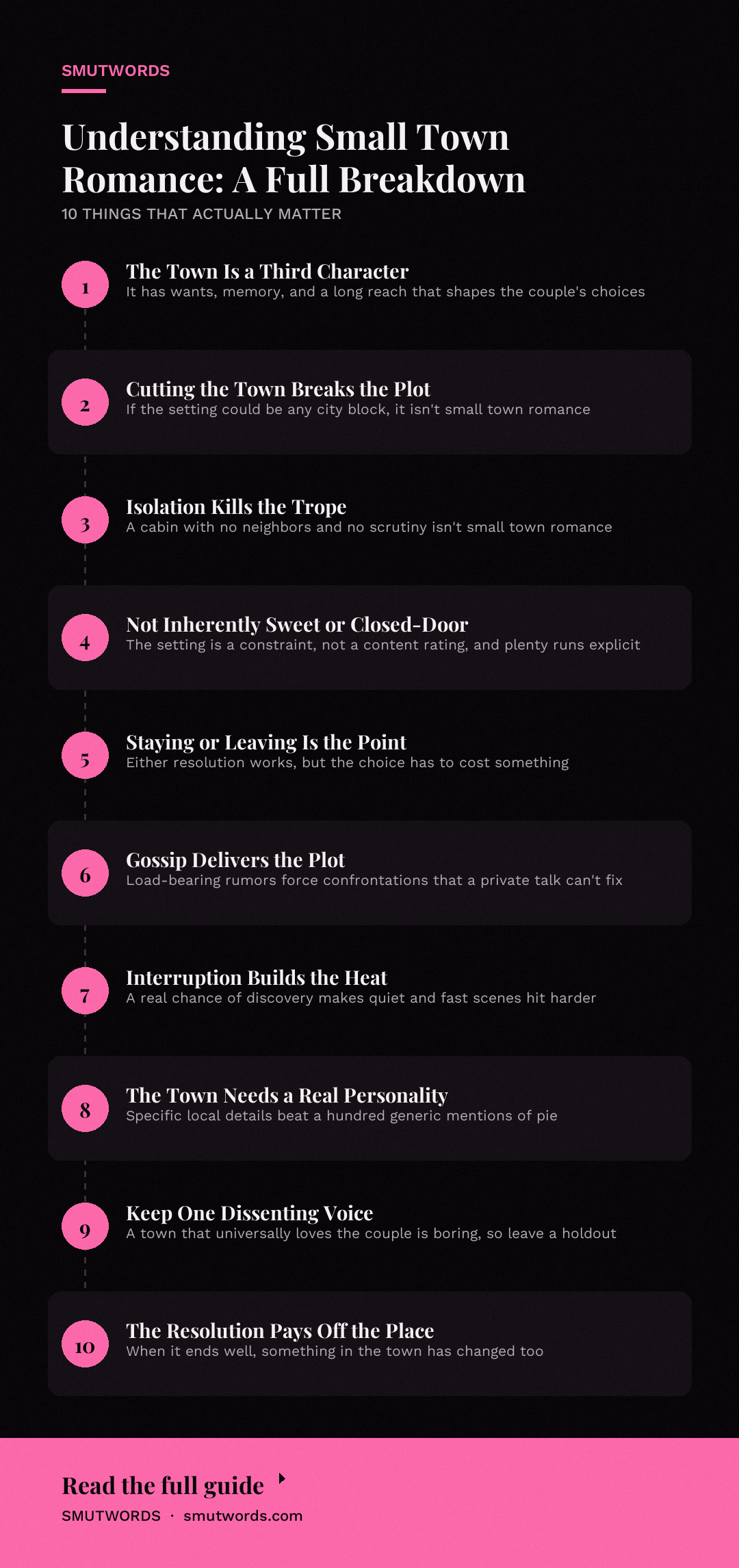
The label describes a romance where the community is a load-bearing part of the plot. A book can be set in a village and not be small town romance. The subgenre requires the town to exert pressure: on who the characters date, what they're allowed to want, and whether their relationship survives public scrutiny.
Think of the setting as a third main character with its own wants. It wants the couple together. It wants them apart. It wants the diner preserved, the grudge buried, the family farm saved.
Because the town has desires, the couple can't resolve their conflict in private. Every fight has witnesses. Every reconciliation has an audience.
The term itself is a marketing category more than a literary one. Publishers noticed readers returning to the same emotional register (cozy, familiar, low-glamour) and gave it a name. The name stuck because it tells you exactly what you'll get: intimacy with an audience.
What Counts
A romance qualifies when the community actively shapes the relationship. If the town could be replaced by any city block and nothing changes, it's not small town romance. If cutting the town out would break the plot, it is.
What Doesn't Count
A cabin in the woods with no neighbors isn't small town romance. Isolation kills the trope. Neither is a story where the town exists only in two establishing scenes before the couple flees to a city for the real emotional work.
Common Misconceptions
New readers assume small town romance means sweet, closed-door, and low heat. Plenty of it is filthy. The setting is a constraint, not a content rating.
Others assume the couple always stays. The staying-or-leaving tension is the point, and either resolution can work. What matters is that the choice costs something.
A third misconception: that the subgenre is inherently conservative. In practice it's one of the most flexible formats going, because tight communities generate every kind of conflict: class, religion, old money, new money, grudges, inheritances, and who slept with whose brother in 2009.
Where Small Town Romance Comes From
The honest history here is a publishing history, not a kink history. Small town romance grew out of the mid-century American romance and women's fiction traditions, where regional settings carried moral weight. The town stood in for society. Getting the town's approval mattered because the heroine's place in it was the stakes.
Through the 1980s and 1990s, category romance lines churned out hometown reunion stories by the hundreds. The formula hardened: a woman returns, a man stayed, a misunderstanding from high school sits between them for eleven chapters. Readers ate it up because the emotional math was clean.
The 2000s brought the contemporary small town boom, the era of long-running series set in fictional towns with recurring casts. Suddenly the town had a phone book. Readers followed siblings, cousins, bartenders, and the one grumpy mechanic across a dozen books. Series loyalty replaced standalone reading, and the fictional town became a brand.
Two shifts happened after that. First, heat levels rose. Writers who grew up on the cozy version started writing explicit versions for the same audience, and the market rewarded it.
Second, the demographic widened. Small town romance stopped defaulting to straight white ranching families and started including queer couples, Black and Latine communities, immigrant families, and towns where the local industry isn't cattle but a cannery or a dying mall.
The digital publishing era finished the job. Self-published series set in invented towns (map included in the front matter, family tree in the back) built massive readerships because readers could binge six books in a weekend. The trope's real history is a history of binge reading.
How It Shows Up in Erotica
On the page, small town romance does specific mechanical work. Here's what a strong version actually handles.
The Town as Pressure Source
Every scene has a chance of being interrupted. That's the craft gift of the format. The couple's first kiss happens in a feed store parking lot where three people they know can see it. The morning after gets announced by a casserole on the porch.
Strong small town romance uses this interruption deliberately. Heat scenes get better when there's a real chance of discovery, and the anticipation that builds when the couple has to be quiet, careful, or fast is half the appeal. For a longer look at why waiting and tension do so much heavy lifting, see Why Anticipation Is the Best Foreplay.
The Gossip Engine
Gossip is the subgenre's plot-delivery system. It spreads information the couple hasn't shared yet, forces premature confrontations, and creates misunderstandings that can't be solved by a private conversation because the town already has a version of events.
Weak versions use gossip as decoration: a busybody at a bake sale, a whisper at church. Strong versions make gossip load-bearing.
The rumor changes the timeline. Somebody's mother hears before the heroine does. The ex finds out from a hairdresser.
Common Variations Authors Use
- Fish out of water: A newcomer arrives and misreads everything. Great for exposition, since the reader learns the town alongside them.
- Second chance in hometown: Two people who already burned it down once. The history is built in, so the author can start the heat early.
- Returning prodigal: The one who left comes back, usually for a funeral, a sale, or a sick parent. Everyone has a memory of their departure and an opinion about their return.
- Small town vs big city: The romantic rival isn't a person, it's a ZIP code. One character's life is elsewhere and the plot has to answer for it.
- Seasonal small town: Christmas, harvest, summer festival. The calendar forces deadliness onto the romance.
- Wedded to the town's future: The couple's love is tied to saving something: the bar, the orchard, the family name. Love and civic duty braid together.
What Makes One of These Work
The town needs a real personality, not just a list of quirks. Specific local details do more than a hundred mentions of pie. A dealership that only sells used trucks. A bridge everyone calls by a dead man's name.
Enjoyed this? Get a free book.
Join the list and we will send a complete free story straight to your inbox, plus new releases every week after that. No credit card, no catch.
The couple needs a conflict only the town can create. If their problem is basically a generic miscommunication, the setting is wasted.
The community needs at least one dissenting voice. A town that universally loves the couple is boring. One holdout (a mother-in-law, a rival, a pastor) gives the story friction.
And the resolution has to pay off the place, not just the pair. When a small town romance ends well, something in the town has changed too.
A shop reopens. An old feud dies. A road gets a new name.
For the romance arc itself, many small town books borrow the Redemption Arc Romance structure, since returning characters usually have something to atone for. Others lean hard into Hate to Love dynamics, with the grudge from years ago doing the same job that unfamiliarity does in Enemies to Lovers, or the slow history-heavy burn of Childhood Friends to Lovers.
Where It Goes Wrong
The two common failures: the town is sentimental wallpaper, or the couple is too cozy for the conflict to land. If everyone in the book is kind and charming, there's no heat and no risk, and the reader finishes with nothing to hold on to.
The opposite failure is a hostile town with no warmth, which makes the couple's choice to stay or leave feel arbitrary. The best small town romances hold both: a place worth defending and a place that has hurt these specific people.
Heat and Tone
Small town romance supports the whole spectrum. Plenty of books run sweet and closed-door. Plenty run explicit. The heat level has to match the mechanics: a slow-burn small town romance can spend fifty pages on a kiss in a barn, while a high-heat version might open the book with the couple already tangled up and the town finding out on page five.
Dirty talk that leans on shared history ("remember what you did on the Fourth of July") hits harder in this subgenre than generic dirty talk, because in small town romance, both people have receipts.
Small Town Romance vs Celebrity Romance
The two can look similar on a back cover (underdog protagonist, public scrutiny, big life change), but the mechanism is opposite. In small town romance, the pressure comes from being known too personally by too few people. The community is small and the intimacy is intense.
In Celebrity Romance, the pressure comes from being known by millions of strangers. Nobody in a small town romance is replying to a comment section. The exposure is personal, not industrial.
Same for Secret Baby. A secret pregnancy is nearly impossible in a place where the pharmacy clerk is your cousin. Authors often play with this on purpose, since the small town setting makes secrecy its own plot problem.
Frequently Asked Questions
What are the most popular small town romance tropes?
Second chance, returning prodigal, fish out of water, and small town vs big city dominate. Seasonal versions built around Christmas or summer festivals are the fastest growing category, because the calendar gives the story a built-in deadline.
Is small town romance always sweet and closed-door?
No. Heat levels run from sweet to explicit, and the subgenre has a strong tradition of high-heat installments in series. The setting constrains the plot, not the spice level.
Why do readers love small town romance so much?
Familiarity and stakes. The town is cozy, but the couple's choices are public and consequential, which makes the romance feel grounded compared to stories where the setting could be anywhere. Readers get warmth and real tension in the same book.
Can small town romance have enemies to lovers or hate to love dynamics?
Constantly. Grudges last longer in tight communities, so a small town romance can run the same friction as Enemies to Lovers while skipping the meet-cute, because these two have known each other since third grade.
What is a "returning prodigal" or "hometown reunion" variation?
One character left and comes back, usually for a funeral, sale, or family crisis. The other stayed. The book's tension is whether the past can be rebuilt under local watch, and whether either of them still has a life here.
Do the couple always end up staying in town?
No, and that's part of the genre's flexibility. Some couples leave together, some stay, some renovate a house and settle in. What matters is that the choice is paid for, not that it's settled in a specific direction.
Final Thoughts
Small town romance works because the place asks the couple a question no private bedroom can answer: who do you want to be, in front of people who remember you at your worst?
When the town is built well, that question has real teeth. When it isn't, the story slides into wallpaper.
The way to find out which kind you're holding is to read one that leans into the mess. Try a book where the diner gossip has already decided the wedding date before the main characters have finished their first fight. If you want more dynamics that live in close quarters, the Childhood Friends to Lovers guide covers the history-heavy end of the spectrum.







Loading comments…