
Mafia romance is a subgenre of dark romance where the love interest holds real power inside organized crime: a boss, a capo, an enforcer, an heir being groomed to run the family business. The romance unfolds inside that criminal world, and the stakes are never just emotional.
A breakup can start a war. A wrong word at dinner can get someone killed.
The heroine is usually an outsider pulled into the family through marriage, debt, protection, or plain bad luck. The central fantasy is a man who is merciless to everyone on earth except her.
That contradiction is the engine of the whole subgenre. Readers are not there for accurate depictions of money laundering. They are there for a man whose capacity for violence and whose capacity for devotion run on the same wire, and for a heroine who has to decide whether she can live inside that wire with him.
What Mafia Romance Actually Means
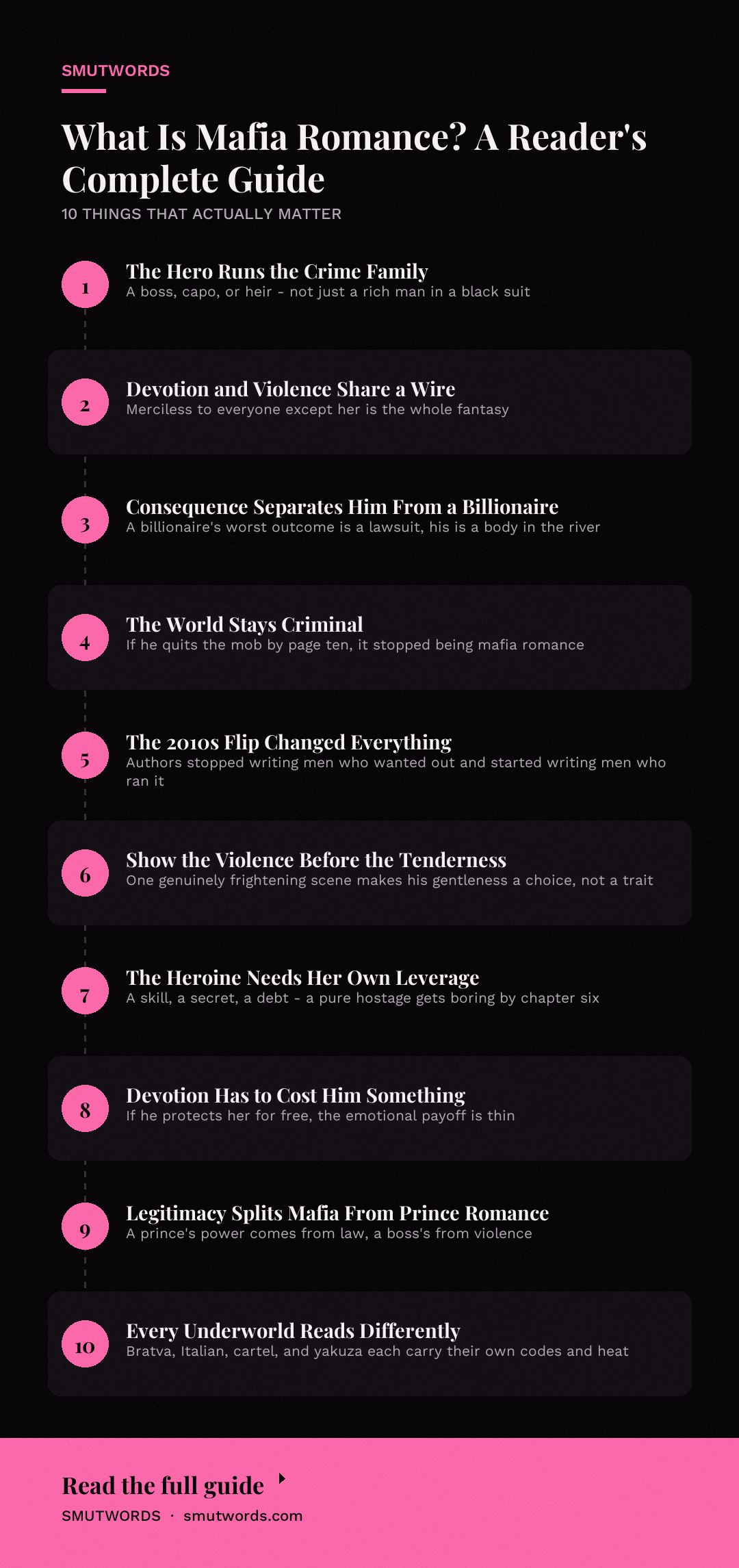
The term gets used loosely, so it helps to draw the lines clearly. A mafia romance needs three things working at once: a love interest embedded in a criminal organization with a hierarchy and rules, a relationship that develops under the pressure of that world, and a tone that treats the danger as part of the appeal rather than a problem to be solved by the end of chapter three.
What counts: the hero is a made man, a don, a bratva pakhan, a cartel lieutenant, an Irish mob enforcer, a yakuza wakagashira. The heroine may be a civilian, a rival family's daughter, a nurse who treated his wound, an accountant who found the discrepancy, or a woman raised inside the life herself.
What also counts is the world staying criminal. If the hero leaves organized crime on page ten and becomes a furniture restorer, most readers will tell you it stopped being a mafia romance around page eleven.
What does not count: a hero who is simply rich and rude. There is a real and common confusion here. A billionaire who owns a shipping empire and treats his assistant badly is not a mafia hero, no matter how many black suits he owns.
The difference is consequence. A billionaire's worst outcome is a lawsuit. A mafia boss's worst outcome is a body in the river.
Another common misconception: mafia romance is not the same thing as a book about the mafia that happens to include a love story. The romance has to be the spine. If the crime plot could survive the couple being removed from it entirely, you are reading a crime novel wearing a romance jacket.
A third misconception is that the subgenre is monolithic. It is not. Russian Bratva romance reads differently from Italian-American family saga romance, which reads differently from cartel romance, which reads differently from yakuza romance. The codes, the violence, the family structures, and the heat levels all shift depending on which underworld you're standing in.
Where Mafia Romance Comes From
The publishing history here is interesting because it does not start with romance at all. It starts with crime fiction. Mario Puzo published The Godfather in 1969, and the film adaptation in 1972 cemented the American public's mental image of the mafia: family dinners, loyalty oaths, brutal reprisals, and a man who kisses his wife on the cheek before ordering someone's death.
Those movies and books built the visual and emotional vocabulary the subgenre still borrows from today.
The dark suits. The cigar smoke. The wedding scene that doubles as a business meeting. The kiss on the forehead before the violence.
The romance publishing industry started pulling from that vocabulary in a serious way in the 1990s and 2000s, mostly through romantic suspense. Books in that era treated the mob as a setting the couple fled from. The hero was often an undercover agent or a man trying to get out. The fantasy was escape.
That flipped sometime around the early 2010s, and the flip is the single most important shift in the subgenre's history. Authors stopped writing men who wanted out and started writing men who ran the whole operation. The reader no longer wanted the heroine to save the hero from the life. The reader wanted the hero to hand her the life and dare anyone to touch her.
Two things drove that shift. First, indie publishing gave authors the freedom to write much darker, much more explicit books than traditional publishers would touch, and mafia romance became one of the genres that benefited most. Second, the rise of Russian Bratva romance specifically gave the subgenre a new visual and tonal palette: cold wealth, Moscow rooftops, tattooed knuckles, and a brutality that felt less nostalgic than the Italian-American version.
Since then it has splintered fast. Irish mob romance, cartel romance, yakuza romance, and even mafia-adjacent motorcycle club stories have all carved out their own readerships. The genre has also gotten more self-aware. Modern mafia romance authors write heroines who negotiate, plan, and sometimes run operations themselves, which was rare fifteen years ago.
One more publishing note worth knowing: the subgenre has an unusually high tolerance for dark content warnings, and it helped normalize the practice of authors listing them at the front of the book. If you've noticed those lists getting more common across romance generally, mafia romance is part of why.
How It Shows Up in Erotica
Craft-wise, mafia romance lives or dies on one thing: making the reader believe the hero would actually do it. Not that he's tough. That he's capable. If the threat of violence is decorative, the whole fantasy collapses, because the fantasy depends on the reader knowing the devotion is costly.
Enjoyed this? Get a free book.
Join the list and we will send a complete free story straight to your inbox, plus new releases every week after that. No credit card, no catch.
Here is what strong versions do that flat ones don't:
- Show the violence early and off the heroine. The reader needs one scene where the hero is genuinely frightening to someone else before he's tender with her. Without that scene, his gentleness is just a personality trait instead of a choice.
- Give the organization real rules. The best books establish what the family will and won't tolerate, then make the couple violate something. Rules create the pressure. Pressure creates the plot.
- Let the heroine have her own leverage. A heroine who is purely a hostage gets boring by chapter six. A heroine with a skill, a secret, a debt, or a family connection the hero needs stays interesting for three hundred pages.
- Use the forced proximity honestly. Mafia marriage of convenience and forced proximity mafia are two of the most common setups in the subgenre, and they work best when the confinement is genuinely inescapable rather than a contrivance the heroine could solve with a phone call.
- Keep the sex in the power dynamic. The best scenes in these books are negotiations. Who undresses whom, who gives the order, who obeys and why. The heat comes from the same place the plot does.
- Give the devotion a cost. If the hero can protect the heroine without giving up anything, the emotional payoff is thin. The memorable books make him choose, publicly, and pay for it.
The most common variation is the marriage-of-convenience setup, where the heroine is traded, sold, or contracted into the family to seal an alliance. It works because it puts the intimacy and the politics in the same room. Every dinner scene is also a negotiation scene. Every touch has a treaty behind it.
A second major variation is the enemy-family romance, which overlays a hate to love structure onto the crime plot. She's the daughter of the man who killed his brother. He's the man her father wants dead. The attraction is treason on both sides, and that gives every kiss a consequence.
A third variation is the redemption arc, where the hero is trying to get out, or trying to be less of a monster for her sake. These books lean hard on redemption arc romance mechanics, and the best ones are honest that he does not become a good man. He becomes a man who is good to her, which is a different and more interesting thing.
Then there's the crossover zone. Mafia romance sits close to motorcycle club romance in tone and readership, and it overlaps with soldier romance whenever the hero is ex-military muscle for the family. If you like the protective-obsessive dynamic in one of those, you'll probably like it in all three. The same obsessive-protector wiring shows up in childhood friends to lovers, just with a decade of shared history standing in for the crime family.
Where these books go flat is almost always the same failure: the hero is described as dangerous but never shown being dangerous to anyone the reader has spent time with. Or the heroine is written as clever but only ever reacts. Or the third-act conflict is a misunderstanding that a two-minute conversation would resolve, which is a betrayal of a world where people solve problems with guns.
One craft note on tension specifically: the best mafia romance authors understand that waiting is the whole game. The look across the table at the meeting. The hand at her back before the vote. If you want to understand why that works, the mechanics are the same ones covered in our piece on anticipation as foreplay, just with higher stakes attached.
Mafia Romance vs Prince/Princess Romance
These two get compared constantly because they share a surface: a powerful family, arranged marriages, formal dinners, a heroine pulled into a world with rules she didn't grow up with. The difference is legitimacy. A prince's power is granted by law and enforced by institutions. A mafia boss's power is granted by violence and enforced by the same thing.
That difference changes the emotional texture of the whole book. In prince/princess romance, the conflict is usually duty versus desire, and the worst outcome is scandal. In mafia romance, the conflict is survival versus desire, and the worst outcome is someone dies. Readers who love one often love the other, but they are reading for different kicks.
There's also a practical difference in heat and darkness. Prince romance skews sweeter and more restrained because the institution the hero serves is respectable. Mafia romance skews explicit and violent because the institution he serves isn't. If you're choosing between the two, that's the honest dividing line.
Frequently Asked Questions
What is mafia romance in simple terms?
It's a romance where the love interest is a criminal boss, enforcer, or heir, and the relationship develops inside the world of organized crime. The danger is part of the fantasy rather than an obstacle the couple escapes from by the end.
Is mafia romance the same as dark romance?
No, though they overlap heavily. Dark romance is a broader category covering any romance with morally dark leads and content that pushes past conventional comfort. Mafia romance is a setting-based subgenre. Most mafia romance is dark romance, but plenty of dark romance has nothing to do with organized crime.
What's the difference between Bratva romance and Italian mafia romance?
Setting, tone, and aesthetic more than structure. Bratva romance tends toward colder, more brutal men and Russian settings, with tattoos carrying specific meaning. Italian-American mafia romance leans harder on family dinners, loyalty oaths, and a nostalgia the Bratva version doesn't bother with. Both follow the same emotional blueprint.
Do mafia romances always have a happy ending?
Almost always. The subgenre is still romance at the core, which means an emotionally satisfying ending for the couple is expected. What varies is how much the couple has to lose getting there, and how much blood is on the way.
Can the heroine be part of the mafia herself?
Yes, and it's become more common. Heroines raised inside the family, daughters of dons, or women who take over operations themselves are a growing share of the subgenre. These books tend to have less of the outsider-pulled-in dynamic and more of a power-couple structure.
Is mafia romance realistic?
No, and it isn't trying to be. Real organized crime is not populated by gorgeous, monogamous men with impeccable tailoring. The subgenre borrows the aesthetic and the stakes of crime fiction and rebuilds them around a romantic fantasy of total devotion.
Final Thoughts
Mafia romance works best when it takes its own world seriously: real rules, real consequences, and a hero whose capacity for violence is the same thing that makes his devotion meaningful. If you've never read one, start with a Bratva book, since that branch tends to commit hardest to the tone, and pay attention to how the author handles the first scene where the hero is genuinely frightening.
That scene tells you whether the rest of the book will earn its fantasy or just describe it.






Loading comments…