
A yes no maybe list is exactly what it sounds like: a long menu of sexual and kink-adjacent acts, each one marked yes (I want this), no (never, or not now), or maybe (curious, unsure, conditionally interested). You and a partner each fill one out, then compare. That's the whole mechanic.
What makes it work isn't the worksheet. It's the conversation the worksheet forces you to have.
Most couples operate on guesswork and vibes. One person floats an idea, the other hedges, and both walk away unsure whether that was a real no or just surprise. A yes/no/maybe list replaces the hedging with actual data. It also catches the stuff neither of you would have brought up out loud, because writing "maybe" next to something is far less terrifying than saying it to someone's face.
What a Yes/No/Maybe List Actually Is
The format has been around in kink communities for decades, long before anyone put it on a website. You take a big inventory of activities, everything from holding hands in public to heavy impact play, and you rate each one. Three columns, three verdicts.
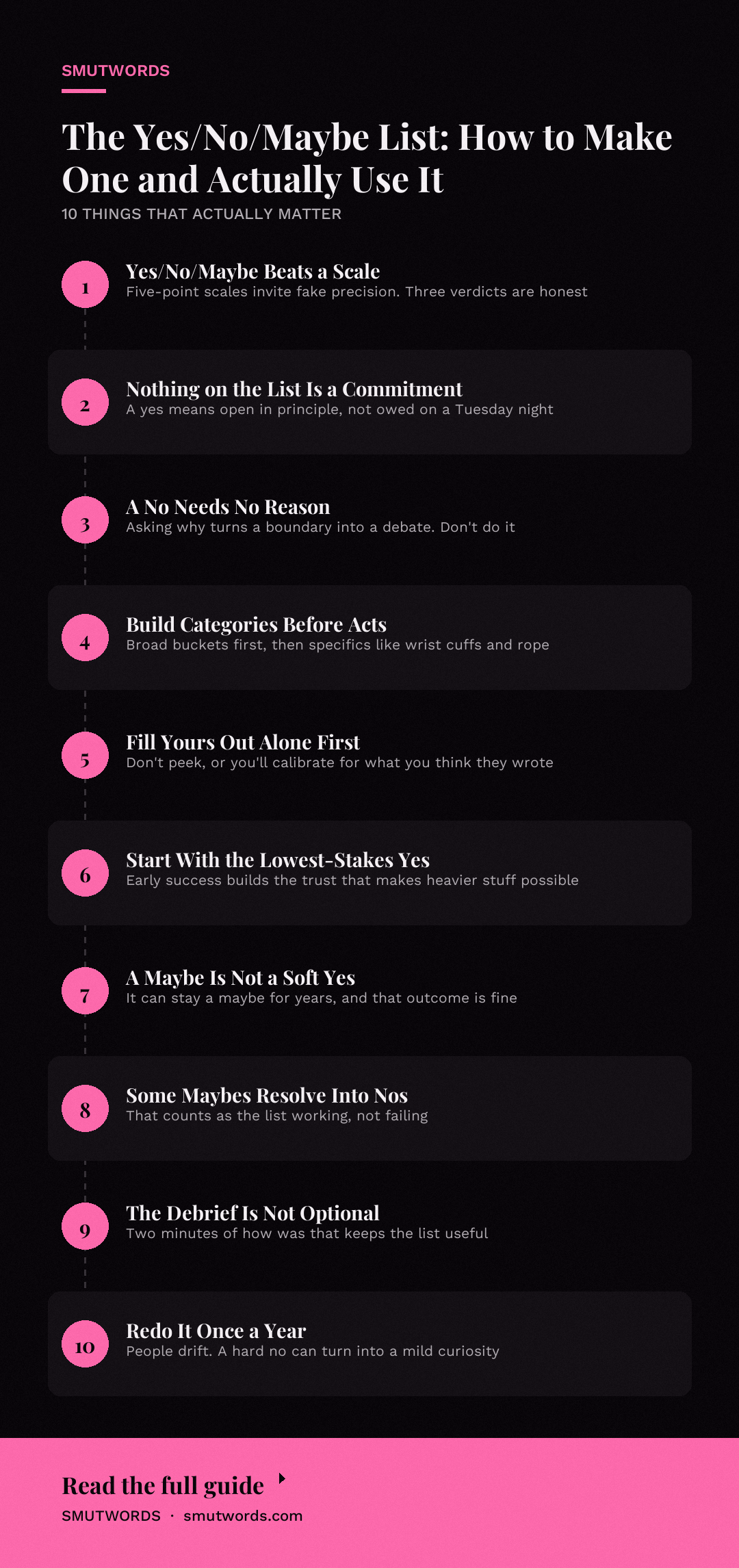
Some versions use a 1-to-5 scale. Ignore those if you're new to this.
Five-point scales invite agonizing over whether something is a 3 or a 4, and the precision is fake anyway. Yes, no, and maybe are honest. A number is a hedge dressed up as data.
Two rules make the list function correctly:
- Nothing on the list is a commitment. A "yes" means you're open to it in principle, not that you owe anyone anything on a Tuesday night. Consent is per-event and revocable.
- A "no" needs no justification. You don't have to explain why. "Not interested" is a complete answer, and a good partner treats it as one.
That second rule is where a lot of couples quietly fail. If your partner marks no on something and your first move is to ask why, you've turned a boundary into a debate. Don't.
Why Couples Actually Like Doing This
The obvious benefit is discovery. You find out your partner has been thinking about something for six years and never mentioned it. That happens constantly.
The less obvious benefit is permission. Plenty of people want things they've been taught not to want, and a box on a form is a low-stakes way to admit it.
Checking "maybe" next to a hate to love style dynamic, or next to something rougher than you'd ever say out loud, costs nothing if it turns out your partner isn't into it. You were just curious. Nobody has to be embarrassed.
A third benefit: it surfaces the gaps. Couples assume they already know each other's limits, and they're usually right about 80% of the time. The other 20% is where the surprises live, in both directions.
You might find out your partner has a hard no you didn't know about, which is useful. You might find out they've been waiting for you to ask about something for years, which is also useful.
Where to Get One (and How to Build Your Own)
There are hundreds of templates online, ranging from tame to genuinely exhaustive. Any of them will work as a starting point. The catch with a generic template is that it'll include twenty things you've never heard of and miss the one thing that actually matters to you.
Build your own if you want it to fit. The method:
- Start with categories, not individual acts. Sensation, restraint, roleplay, power exchange, toys, oral, penetration, watching, being watched, dirty talk, outfits, locations. Broad buckets first.
- Under each category, list specifics. Not "restraint" but "wrist cuffs," "rope," "being held down," "blindfold." Specificity is what makes the list useful later.
- Leave blank rows at the bottom of every section. Someone will think of something the template missed, usually at 11pm three weeks later.
- Include the soft stuff. Cuddling after, being told you're good, morning sex, being woken up, showering together. It's easy to build a list that's all escalation and forget that half of what people want is tenderness with a specific shape.
One practical note on format. If you and your partner are doing this separately, fill yours out alone and don't peek at theirs first. The whole point is an honest snapshot, and you can't produce one if you're already calibrating for what you think they wrote.
How to Bring It Up With a Partner
This is the part people get stuck on. The list is easy. The asking is hard.
Don't spring it mid-sex, and don't hand it over like a performance review. Pick a neutral moment, ideally one where you're both relaxed and neither of you has somewhere to be.
The opener matters less than you think. Something like: "I found this thing couples use to compare what they're into. I want to fill one out with you. No pressure on any of it."
Then be prepared for the answer to be no. Some people find inventories clinical and would rather talk it out loose. That's a legitimate preference. If your partner is one of those people, the list isn't a failure, it's just the wrong tool, and you can run the same conversation verbally with the same three categories in your head.
If your partner is nervous, lower the stakes. Suggest doing five items each instead of the full sheet. Or do it as a text exchange rather than face to face, which gives both of you time to think before answering. There's a real case for this: anticipation built through texting and teasing often loosens people up more than a sit-down conversation does, precisely because it removes the eye contact.
Some people will need a couple of days. Let them. The list will still be there.
What to Do With the Yeses
Compare lists and find the overlap. That's your starting pool.
Work through it slowly, one thing at a time, and start with the lowest-stakes item on the shared yes list, not the most exciting one. If you both said yes to blindfolds and yes to something considerably more involved, blindfolds go first. Early success builds the trust that makes the heavier stuff possible later.
Enjoyed this? Get a free book.
Join the list and we will send a complete free story straight to your inbox, plus new releases every week after that. No credit card, no catch.
A few things to agree on before you try anything from the list:
- A safeword, or a safeword system. One word that stops everything, plus optionally a "slow down" signal for when you want to adjust rather than stop. If you're doing anything involving the mouth, agree on a physical tap-out signal too, since a gagged person can't say a word.
- A check-in phrase. Something like "color?" with green/yellow/red answers takes two seconds and lets you both recalibrate mid-scene without breaking the mood.
- What happens after. Who initiates the debrief, when, and whether either of you needs physical aftercare first. Some people want to talk immediately. Some need twenty minutes and a glass of water. Know which one you each are before you find out the hard way.
That last point isn't a soft add-on. The debrief is where you find out whether the thing you tried actually landed, and a lot of couples skip it because they're embarrassed or tired. Don't skip it. Two minutes of "how was that for you, anything you'd change" is the difference between a list that stays useful and a list you never touch again.
What to Do With the Maybes
The maybes are the interesting column, and also the one most couples mishandle.
A maybe is not a soft yes. It's not a challenge. It's a genuine "I don't know yet, and I'd need more information or more trust before I could answer." Treat it as an open question rather than a puzzle to solve, and treat it as stable. A maybe can stay a maybe for years and that's a fine outcome.
For each maybe, ask one question: is this a maybe because I don't know if I'd like it, or because I don't know if I trust the situation? Those need different handling.
If it's curiosity, you can gather information. Read about it. Talk to someone who's done it. Try a very mild version and see how your body reacts.
If it's trust, you don't need information, you need time and evidence. The answer is usually to do nothing with that maybe for now and revisit it in six months. If it's still a maybe then, it stays a maybe.
And some maybes resolve into nos, which is a completely successful outcome. The list did its job. It helped you find out that something you were curious about isn't for you, without having to find out the hard way.
The Risk Side, Stated Plainly
Some of what shows up on a full list carries real physical risk, and a good list should tell you which items those are rather than treating everything as equally casual.
Anything that restricts breathing, including choking, is genuinely dangerous and can cause brain injury or death even when it has gone fine dozens of times before. It is not a beginner activity, it is not safe with an inexperienced partner, and a yes/no/maybe list is not the right venue to greenlight it.
Heavy restraint carries its own risks: nerve compression, circulation problems, panic responses, and the practical hazard of being unable to communicate once you're immobilized. If you're both interested in rope or cuffs, learn from someone who teaches it, keep the first attempts short, and never leave a restrained person alone in a room.
Impact play, including the face slapping kink that shows up on a lot of these lists, has a specific set of no-go zones and techniques. Slapping a face isn't the same as slapping a thigh, and the margin for error is much smaller. Learn the anatomy before you learn the fantasy.
None of this means don't put those items on the list. It means mark them accurately. A yes to something risky demands more preparation, not less, and a partner who respects a maybe on rope is a better bet than one who pushes.
How Often to Revisit the List
Once a year at minimum, and again after any significant life change.
People shift. Bodies change, medications change, kids happen, jobs happen, therapy happens.
Something that was a hard no in 2023 can turn into a mild curiosity in 2025, and something that was a favorite can quietly stop working. Neither of those is a problem. It's just drift.
Good times to redo it:
- Once a year, like a checkup. Put it in the calendar if you need to.
- After any big life event: a move, a job change, a pregnancy, a health scare, a long stretch apart. Couples doing the long distance romance thing tend to need this more often, because a lot of the list becomes logistics.
- After a scene that didn't land. Not to relitigate it, but to update what's on the sheet.
- Anytime one of you feels like the list no longer sounds like you.
Revisiting doesn't mean starting from scratch. Pull up the old one, read through it together, and ask what's changed.
Most items will stay put. A few will move, in one direction or the other. That movement is the whole point of doing this more than once, and it's usually where the best conversations happen.
One more thing: comparing doesn't mean matching. If your partner has ten things in the yes column and you have three, that's not a deficit. It's a map of where you overlap and where you don't.
The overlaps are where you play. The rest is information, and information is cheap next to the alternative, which is finding out the hard way that you assumed wrong.
Final Thoughts
Fill one out with your partner this month, and if you want a running start, read something like monster breeding romance together and mark what surfaces. Fiction is a low-stakes way to notice what you'd never say out loud, and a lot of the maybes on the sheet started as something somebody read at 2am and couldn't stop thinking about. That's not an accident. It's how most people find the edge of their own list.







Loading comments…