
The breeding farm trope is a story in which one character is kept, usually somewhere rural or isolated, for the express purpose of producing offspring. The setup varies. A working farm with stalls and schedules, a research facility, a secluded estate, a compound run by people who treat conception as inventory management.
What holds steady is the premise. Reproduction is the job, the body is the asset, and the person in charge decides when and with whom. The breeding farm trope turns fertility into a plot engine and a power structure at the same time, and that double function is why it grips readers who would never touch a romance about a normal arranged marriage.
The setting matters as much as the premise. Farms imply land, distance from anyone who might object, and a labor logic where animals and people get handled by the same schedule. That isolation is what makes the dynamic plausible enough to sink into, and it is also why the trope carries obvious coercion baked into its frame. The best versions know this and use it deliberately.
What Breeding Farm Trope Actually Means
The name is borrowed from livestock management, and the trope does not sand that off. Terms like stud, broodmare, and breeding stock get used on the page, sometimes as insults and sometimes as job titles. The word "farm" signals scale and routine: this is not a single forced encounter but a system with repeat procedures, records, and a person whose role is to oversee output.
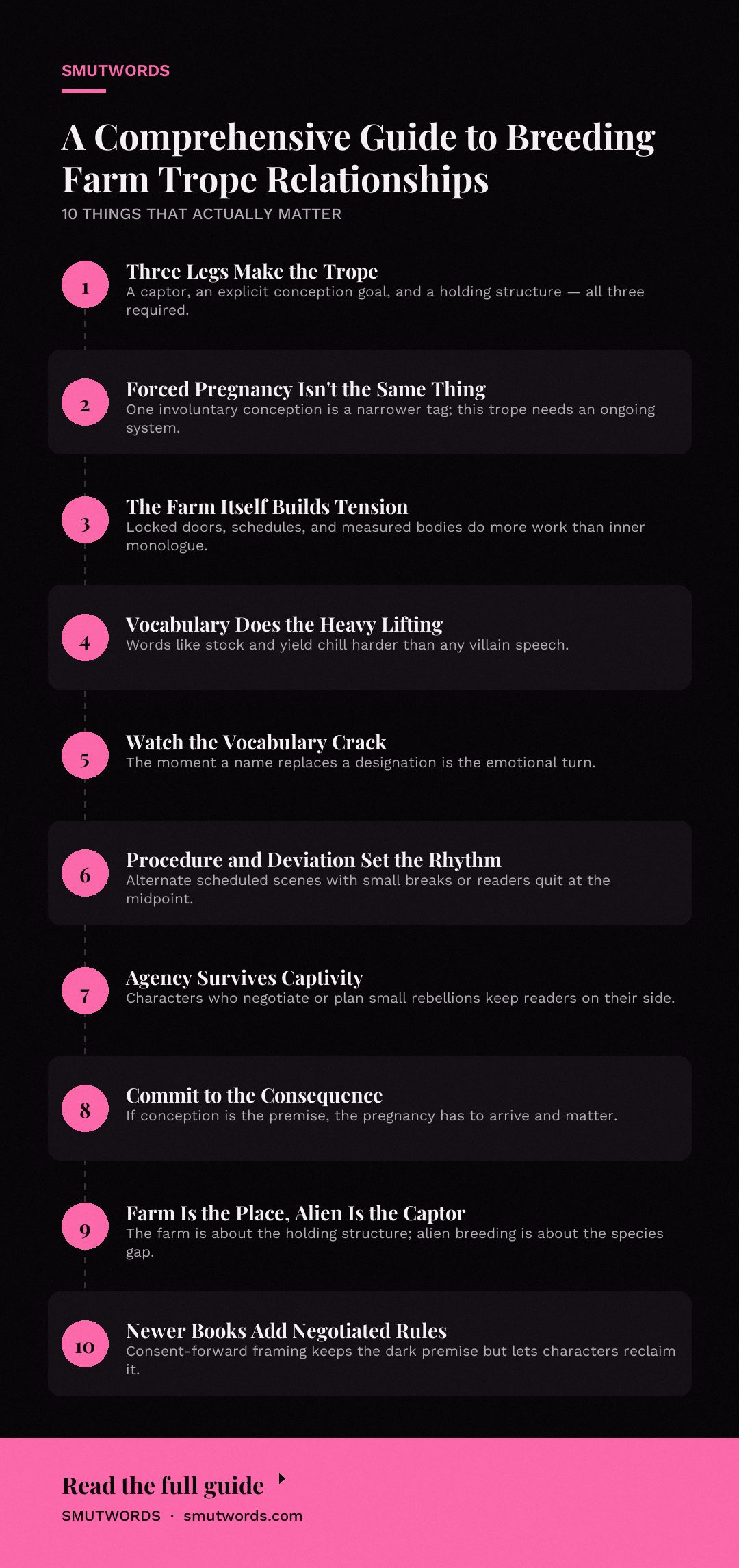
Three elements need to be present for the label to fit. First, a captor or authority holding the reproductive character in place. Second, an explicit goal of conception rather than sex for its own sake. Third, some structure around it, whether that is a contract, a cage, a breeding schedule, or a market where offspring are traded.
Take away the structure and you have a captivity story. Take away the goal and you have a forced proximity romance. The breeding farm trope needs all three legs.
What does not count is worth spelling out, because readers use these labels loosely. A single scene where a character is impregnated under duress is forced pregnancy, a related but narrower tag. A story where a couple is trying for a baby with no captivity element is fertility romance and belongs somewhere else.
A pack or shifter story where someone gets claimed during a heat is only this trope if there is an actual holding structure. The Alpha/Beta/Omega Dynamics glossary entry covers heat-driven reproduction, which overlaps heavily with this trope without being identical to it.
Common misconceptions cluster around tone. New readers assume the trope is uniformly grim, and some of it is. But a large share of breeding farm stories are dark romance with a possessive arc, where the captor's fixation curdles into something the narrative treats as love. Whether that lands depends entirely on how honestly the book handles the coercion it built its premise on.
Where Breeding Farm Trope Comes From
The honest history here is mostly a publishing history. Reproductive captivity has deep roots in myth and in dystopian fiction, but the specific packaging readers now call the breeding farm trope crystallized in online erotica communities, particularly in the 2000s and 2010s on serial fiction platforms and in shifter romance. Those spaces let writers post chapter by chapter, gauge response in real time, and iterate fast.
The farm frame grew popular there because it gave readers a self-contained world with rules, which is exactly what a serial needs to keep momentum week to week.
Paranormal romance pushed it further. Shifter and werewolf fiction supplied a biological justification for the whole apparatus: packs that need genetic diversity, females who are scarce, an instinct that overrides manners. The Pack Mates Romance glossary entry covers that subgenre's mating logic, which breeding farm stories borrow constantly even when no wolf appears on the page.
The dystopian wave of the 2010s gave the trope a second engine. Novels built around fertility crises and governments that assign women to men made reproductive control a political premise, and erotica authors ran with it because it justified the holding structure on a societal level rather than a single villain's whim. Around the same time, alien romance started using breeding programs as a first-contact device, which the Alien Breeding Trope entry covers in full.
The shift over the last decade has been toward consent-forward framing. Many newer books keep the dark premise but add negotiated rules, safe words, or a twist where the reproductive character reclaims the arrangement on their own terms.
Readers who want the intensity without the moral queasiness now have a whole shelf of options, and the genre has gotten better at writing the captor as a person with a reason rather than a flat monster. The trope also absorbed some of the tenderness-first sensibility of Soulbond fiction, borrowing its device of a biological tie that forces intimacy and then has to earn the emotional version.
How It Shows Up in Erotica
On the page, the breeding farm trope runs on procedure. A strong opening scene usually establishes the physical plant: the room, the schedule, the nameless staff, the way the reproductive character's body is measured and tracked. Authors who skip this worldbuilding and jump straight to the sex produce flat books, because the farm itself is what generates tension. A hallway with a locked door does more work than any paragraph of inner monologue.
The second engine is vocabulary. The best writers in this trope are precise about language, letting words like stock, yield, and term do the heavy lifting. A captor who refers to a person as a successful breeding is chilling in a way no villain speech can match.
Watch for the moment the vocabulary cracks, when the captor slips and uses a name instead of a designation. That crack is the emotional turn most books in this trope build toward.
Proximity does the rest. Because the reproductive character and the person in charge share a confined world, small domestic acts take on enormous weight: a blanket brought without being asked, a meal made by hand, a decision to delay a procedure. These gestures read as romance only because the baseline is so bleak, which is the trope's central trick.
Enjoyed this? Get a free book.
Join the list and we will send a complete free story straight to your inbox, plus new releases every week after that. No credit card, no catch.
The scene where the captor starts making exceptions to the schedule is almost always the point where readers commit to the book.
Common Variations Authors Use
- The institutional facility. A lab, government program, or corporate operation with paperwork and oversight. The villain is a system, which makes the individual captor more sympathetic and easier to redeem.
- The rural working farm. Barns, mud, weather, and hired hands. Physical labor and simple settings ground the story in animal reality, and isolation is built into the geography.
- The pack arrangement. A shifter community assigns a reproductive partner for the group's survival. Overlaps heavily with omegaverse and Hybrid Shifter Romance, where the breeding question gets tangled with species identity.
- The alien program. Off-world captors who need compatible genetics. The distance from Earth removes the reader's normal moral framework and lets the story run wilder.
- The contract version. The reproductive character signs on, sometimes under economic pressure, and the story tracks a legal arrangement turning personal. The most flexible variant for authors who want less explicit captivity.
- The stud inverse. A male reproductive character is kept and used, which is far less common and often sharper because the power inversion catches readers off guard.
Strong versions share a trait: they give the reproductive character agency even when they have no freedom. A character who negotiates, withholds information, chooses a moment, or plans a small rebellion keeps the reader on their side. Flat versions make them purely passive, and a passive protagonist in a long book becomes exhausting fast.
Strong versions also commit to the consequence. If the premise is conception, the pregnancy has to arrive and matter, the aftermath has to be addressed, and the captor has to answer for the arrangement. Books that end before any of that happens feel like a scene rather than a story. The trope works best when the author treats reproduction as a plot event with real weight, not as an aesthetic backdrop for other kinks.
One more craft note: pacing. The breeding farm trope has a natural rhythm of procedure and deviation. Writers who alternate scheduled scenes with small breaks in routine keep the tension alive for hundreds of pages.
Books that run one long stretch of grim captivity without variation lose readers around the midpoint. Give the reader a window, then close it.
Breeding Farm Trope vs Alien Breeding Trope
These two get confused constantly because so much of their machinery overlaps, and the distinction is worth making for anyone searching for the right shelf. The breeding farm trope is about the holding structure: a farm, a compound, a facility, a system that owns reproduction. The Alien Breeding Trope is about the species gap: a nonhuman captor needs a human body for genetic reasons, and the story centers on biological incompatibility and the alienness of the resulting intimacy.
A story can be both, and many are. An alien facility full of human captives is a breeding farm run by off-worlders, and it satisfies both definitions at once.
Think of the farm as the place and the alien angle as the kind of captor. If you want the power structure, scheduling, and institutional horror, you want the farm. If you want the strangeness, anatomy, and first-contact stakes, you want the alien side.
A related question runs through Merman Romance, where a nonhuman species raises the same compatibility issue in a far gentler register, and through Kraken Romance and Dinosaur Romance wherever a human body meets something that was never designed to share it.
Frequently Asked Questions
Is the breeding farm trope the same as forced pregnancy?
No. Forced pregnancy is a single involuntary conception event, sometimes one scene inside a larger story. The breeding farm trope requires an ongoing holding structure and an explicit reproductive purpose. Forced pregnancy can appear inside a breeding farm story, but the farm label describes the whole setup rather than one moment.
Why do readers like breeding farm books when the premise involves coercion?
The appeal is the extreme version of submission and being wanted for something fundamental. Readers also come for the possessiveness that develops, where a cold captor turns fixated and protective. Fiction lets readers explore that intensity in a controlled space, which is different from wanting it in real life.
What is a broodmare in this kind of story?
Broodmare is an in-world term borrowed from horse breeding, used to label a female reproductive character. On the page it is almost always loaded, working as a dehumanizing designation or a reclaimed title. When a writer uses it sparingly, it lands harder.
Do these stories always have a dark ending?
No. The genre splits roughly three ways: bleak endings that honor the premise's cruelty, dark romance endings where the captor is redeemed or the relationship persists under a negotiated arrangement, and escape arcs where the reproductive character reclaims their life. Read the content warnings before choosing one, because the range is wide.
Is it always a female character being bred?
Most commonly, yes, because the trope's history grew out of fertility-crisis and shifter fiction built around female scarcity. The stud inverse variant does exist, and male breeding captivity has grown more common in m/m and alien romance, where genetics rather than gender drives the premise.
How does consent work in a trope built on coercion?
As fiction, the trope explores coerced situations that readers choose to visit and can leave at any time. Any real-world version of the dynamic runs on full consent, negotiated rules, and ongoing check-ins. Real roleplay that borrows the language of a breeding farm should have safe words, limits discussed in advance, and the option to stop at any point.
Final Thoughts
The breeding farm trope endures because it puts reproduction at the center of a power struggle and then makes the reader care about both people caught in it. The coercion is the engine, but the reason people finish these books is the crack in the captor's system, the moment a name replaces a designation.
If you want a version that takes the premise seriously, with real consequences and a captor who has to answer for what he built, start with Breeding Program and let the catalog list below guide the rest of your reading. Pick carefully. The trope has a louder reputation than it deserves, and the good versions are better than that reputation suggests.






Loading comments…