
Most writers fumble aftercare the same way. The scene hits its peak, someone comes, and then the prose panics and reaches for a blanket and a glass of water like a medic arriving at the scene of an accident.
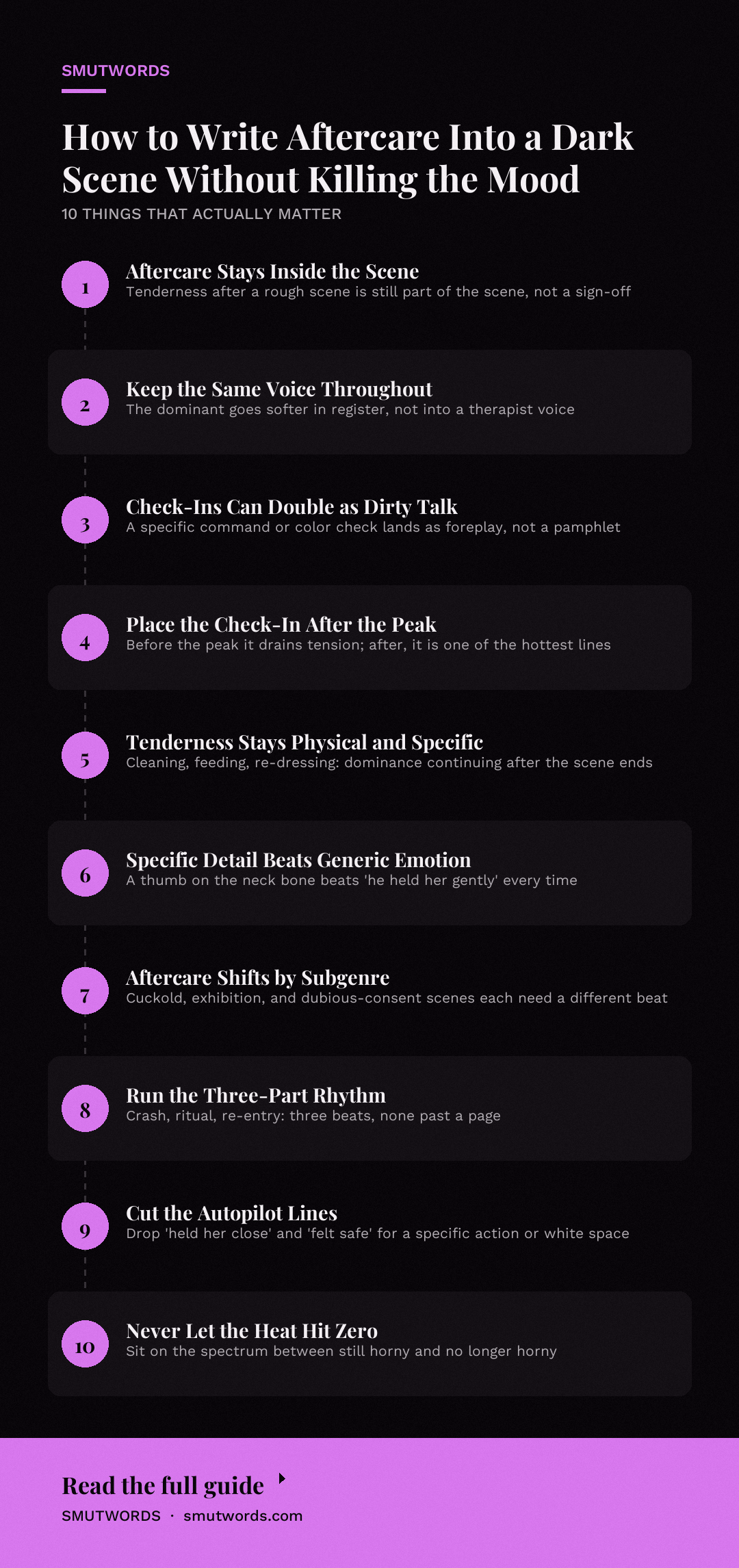
The heat dies on the page and the reader, who was two paragraphs ago gripping the book with one hand, sets it down. Learning how to write aftercare in erotica is mostly about understanding that the tenderness after a rough scene is still part of the scene. The mood doesn't have to break when the whip comes down.
When it works, the check-in carries heat. When it fails, it reads like a liability waiver.
Why Aftercare Belongs Inside the Scene, Not After It
The reason so many drafts deflate at the recovery beat is that the writer treats aftercare as a separate genre. The smut happens, then the responsible adult shows up to sign off. Readers can feel that seam from a mile out, and a lot of them close the book at exactly that seam.
Aftercare that lands stays in the same voice as the rest of the scene. The dominant character who spent forty pages being cold and exacting doesn't suddenly become a therapist. He becomes the same person, in a softer register, doing the same things to the other character's body (holding, cleaning, feeding) that he was doing to it a page earlier.
The physical intimacy continues. The power dynamic keeps running even if it's now pointed at comfort instead of humiliation.
A good example of this is the scene logic in He Paid Him to Fuck Me, where the transactional heat doesn't evaporate the second the money changes hands. The characters stay in the same charged register while the aftercare happens. The reader stays hot. The book stays honest.
The Check-In That Doesn't Kill the Mood
A mid-scene check-in has to be written as dialogue that sounds like the characters, not like a consent pamphlet. "Are you okay?" is the worst version of this. It's generic, it throws the fourth wall, and no dominant character in the history of the genre actually talks like that in the middle of the thing.
Better options:
- Change the register of the same command. "Say it again. Slower." (checking whether the sub can still form sentences.)
- Offer a specific exit. "You say stop, I stop. You've got three seconds."
- Ask a specific question that has a specific answer. "Where are you? Give me a color."
- Physical read. A hand cupped around a jaw, thumb pressed to the pulse, eyes doing the actual asking so the mouth doesn't have to.
- Use the scene's private language. If the characters built a code word thirty pages ago, use it now. It's the payoff.
The trick is that all of these double as dirty talk when the timing is right, and the good writers know it. A check-in at the wrong moment is intrusive. The same line at the right moment is foreplay.
When to place the check-in
Place one after the peak, not before. Before the peak, the check-in drains tension. After the peak, the check-in can become one of the hottest lines in the scene because the reader is still coming down and everything is sensitive. The window between "she came" and "he pulls out" is where the aftercare dialogue does its best work.
Tenderness Beats That Deepen Instead of Deflate
The mistake is thinking tenderness means sweetness. It doesn't. Tenderness after a hard scene can be extremely hot if it stays physical, specific, and slightly invasive. Here are the tenderness beats that actually work in a dark erotic scene:
- Cleaning the other person up as an extension of ownership. The dominant character wipes blood, cum, or tears off the sub's face with a specific cloth. Description matters. Rough washcloth or expensive linen, warm water or cold.
- Feeding. Water bottle, chocolate, orange slices, a cigarette. The sub is too spent to do it themselves so the dominant does it for them. That's dominance continuing to operate after the scene "ends."
- Re-dressing. Putting the sub's clothes back on, button by button, the way a Victorian valet dresses his gentleman. Physical intimacy as ritual.
- Holding that isn't sex. The dominant character drags the sub onto his chest and stays there. He doesn't talk. The narrative doesn't either. Two paragraphs of just breathing in the same room.
- The specific line that means something to these characters. Not "I love you" but the phrase they use only after a hard scene. Give it history.
Why the specific detail matters more than the emotion
"He held her gently" is dead prose. "He held the back of her neck the way he had when he'd first pushed her face into the pillow, only slower now, thumb working along the bone" is doing the actual work.
It ties the aftercare to the earlier scene. It reminds the reader what just happened. It keeps the heat on the back burner.
The same principle applies in high-heat fantasy or kink scenes, like the ones in Lured by the Lizard Beast, where the tenderness after the monster/beast encounter has to be written physically because the character can't speak. A hand on a flank. A low rumble that the reader interprets as comfort. The description substitutes for dialogue, and the scene doesn't lose temperature.
Writing Aftercare for Different Kinds of Dark Scenes
Aftercare doesn't look the same across subgenres. The tenderness beat that works in a humiliation scene will read totally wrong in an enemies to lovers smut book, and the aftercare in a hotwife story is basically a different craft problem from the aftercare in a cuckold story. Here's how the beat changes by scenario:
- Cuckold and hotwife stakes. The aftercare belongs with the partner who was excluded. The tenderness is a re-assertion of primary partnership after the other party leaves. See Permission Slip: A Cuckold Erotic Short Story for how to keep the humiliation hot while the reclamation is happening.
- Exhibition and sharing. The aftercare is often about privacy. Getting the character covered up. Getting them home. Getting them out of the audience's sight, and only then letting the trembling start. Shared Without Shame handles this well by keeping the tenderness away from the other men.
- Anon and voyeuristic scenarios. If the scene involves surveillance or an unknown audience, the aftercare is the moment the character realizes how exposed they are. See how the tenderness in The AI Wants to Watch hinges on being performed for an unseen viewer, so the aftercare still has to include the viewer in the room.
- Pure-consent play. Aftercare is the debrief. Cold water, calories, the color check, the specific reassurance that the scene was what was negotiated.
- Dubious-consent and darker spaces. The tricky one, and I'd argue the one where aftercare matters most. The character's recovery is the emotional proof that the scene was survivable.
The Three-Part Rhythm of a Good Aftercare Scene
If you want a structure rather than a vibe, here's the rhythm that actually works on the page. Break the aftercare into three beats and don't let any one of them run past a page.
Beat one: the crash
The character's body gives out. Crying, shaking, freezing, sweating, dissociation, whatever fits the specific scene. Do not rush this. The reader needs to see the physical aftermath, and the writing should be specific to what happened.
Enjoyed this? Get a free book.
Join the list and we will send a complete free story straight to your inbox, plus new releases every week after that. No credit card, no catch.
If the scene involved breath play JOI, the aftermath is the character gasping and the partner counting breaths. If it involved double penetration, the aftermath is the physical comedy of one person trying to find a position that doesn't hurt and the other two trying to help. Specificity is everything.
Beat two: the ritual
The dominant character does the thing. The specific, repetitive, sometimes slightly humiliating thing that's specific to this couple.
Hands in the hair. A particular blanket. A shower on a schedule. A piece of jewelry taken off or put back on.
This is where the tenderness lives and where the reader gets the payoff for having paid attention through the scene.
Beat three: the re-entry
One or two sentences that return the character to the ordinary world. The guy who pops back into the hotel room. The phone lighting up. The dog scratching at the door.
The reason this beat matters is that it tells the reader the scene is truly closed, and the emotional arc is complete. Skip it and the scene floats. Overdo it and it becomes a chapter in a different book.
The re-entry also lets you drop a hook for the next scene without a cliffhanger. A single specific object (the rope coiled on the dresser, the hotel key card, the ring) plants the info without spoiling the closing beat.
Sentences To Cut From Your Aftercare Draft
This is the paragraph that will save your draft. There are a handful of lines writers reach for on autopilot in aftercare and every one of them signals "the author stopped paying attention." Cut all of these on sight:
- "He held her close."
- "She felt safe for the first time in her life."
- "They lay there, satisfied."
- "He was gentle with her now."
- "A single tear rolled down her cheek."
- "The world outside didn't matter."
Replace each one with a specific physical action, a specific piece of dialogue, or nothing at all. White space works better than a filler sentence. If the reader can't tell what happened physically in the last ten minutes, the scene wasn't specific enough, and the aftercare can't fix that.
Why Some Subgenres Give You Aftercare for Free
Every trope has a built-in aftercare shape. If you know it, you're not writing from zero.
- A soldier romance hands you a returning-from-deployment tenderness beat whether you want it or not, because the character has been through something and the body still remembers.
- A motorcycle club romance gives you the clubhouse aftercare scene: the brother who puts the club jacket back on the character, the woman who nurses the wounds, the group ritual of protection.
- A marriage in trouble story lets aftercare double as reconciliation, so the tenderness is also a plot move.
- A redemption arc romance runs almost entirely on aftercare beats: the formerly terrible character proving they've changed by how they treat the person they hurt.
- A soft trope like insta-love actually flips the problem: the aftercare has to arrive earlier than the reader expects, and it becomes a signal that yes, this really is love, not a kink scene.
If you're already working inside one of those tropes, don't invent aftercare from scratch. Find the aftercare beat the trope wants and make it specific.
How to Keep the Aftercare Hot When the Scene is Finished
The last trick, and the one that separates the writers whose aftercare lands from the writers whose scenes deflate, is refusing to let the heat drop to zero. There's a spectrum between "still horny" and "no longer horny" and the aftercare scene should sit somewhere on that spectrum rather than snap to the far end.
Some ways to keep the temperature up:
- The dominant character gets hard again while cleaning the sub up. He doesn't do anything about it. The not-doing-anything is hotter than the doing.
- The sub stays slightly aroused and embarrassed about it. That embarrassment is a live wire the whole aftercare scene can run on.
- A second, softer round is offered and declined, or offered and accepted, but either way the offer is a running current.
- The tenderness continues to be physical, invasive, and specific. It doesn't become abstract reassurance. It stays bodies-touching-bodies.
For an example of this on the page, look at Free Use Casino, where the recovery beat after the scene is very much in the same register as the scene itself. The characters don't step out of their roles to debrief. They stay inside them and do the tenderness from within the role, and the heat holds.
If you want a masterclass in weaving stocking details, texture, and specific garments into every beat of the scene including the recovery, What Is Stocking Fetish? A Reader's Complete Guide covers how a single fetish object can carry the aftercare as well as the peak.
Final Thoughts
If you want a single book that puts the whole aftercare rhythm on the page cleanly enough to study, start with Shared Without Shame: A Hotwife Exhibition & Sharing Fantasy. Watch where the tenderness goes after the scene, and watch who's allowed to be in the room when it happens. That's the whole craft in miniature.








Loading comments…