
A forbidden boss romance is a love story between an employee and the person who signs their paycheck, their performance review, or their termination letter, conducted in secret because the rules, the hierarchy, or the stakes make it dangerous. The boss is the obstacle and the object at once.
Every closed-door meeting, every late-night email, every hand that lingers a second too long carries the knowledge that discovery would cost one or both of them something real. That doubled charge, desire plus jeopardy, is the engine of the whole trope.
It's one of the most reliably popular setups in contemporary romance and erotic fiction, and it's also one of the most frequently done badly. This guide is the long version: what the term covers, where it came from, how skilled authors build the pressure, and how to tell a strong forbidden boss romance from a limp one.
What Forbidden Boss Romance Actually Means
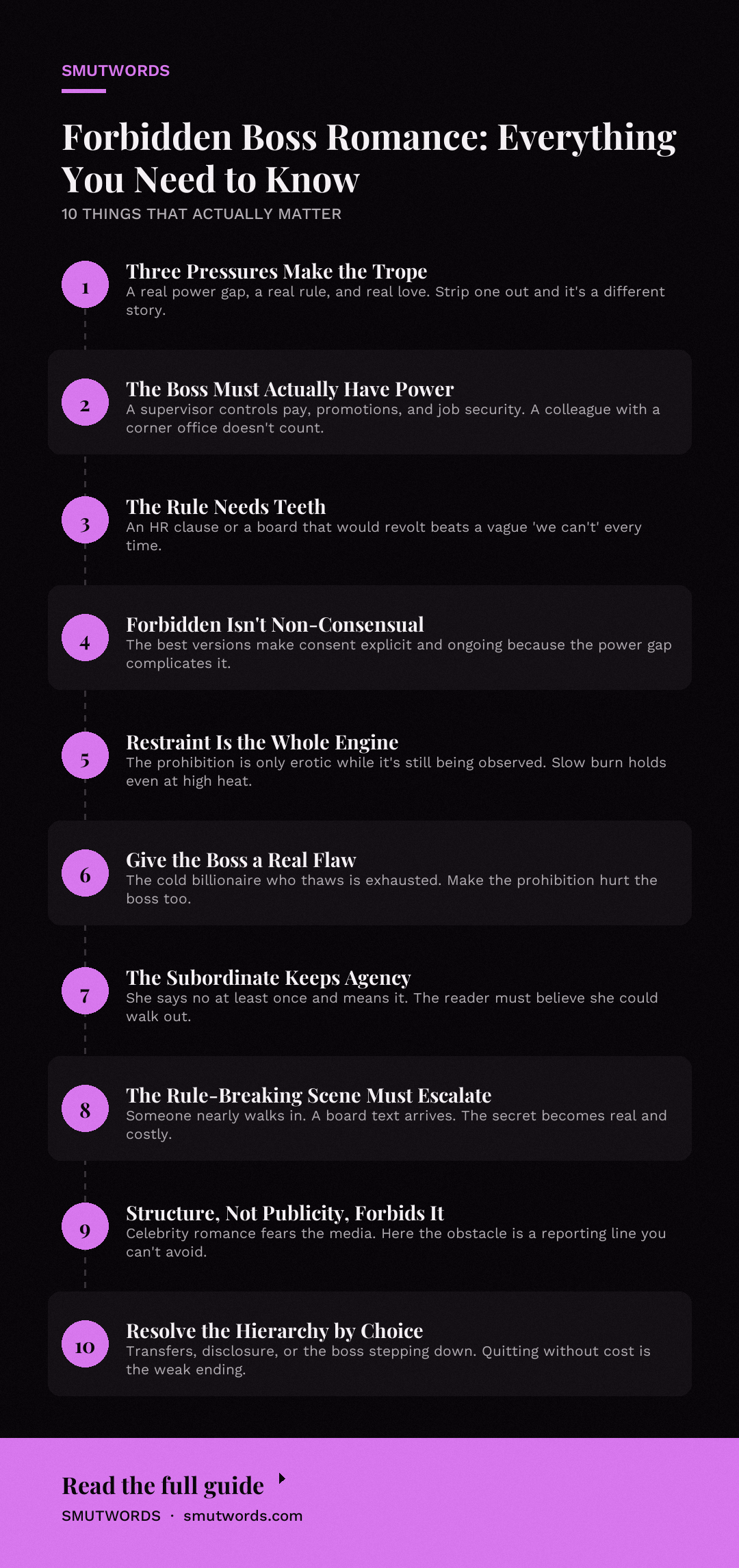
The phrase combines three separate pressures, and a story only really earns the label when all three are present. The first is the boss: a genuine power differential, not a colleague with a corner office. The supervisor controls assignments, promotions, pay, and job security, and both characters know it.
The second is the forbidden: an explicit rule against it. Maybe it's an HR policy, a non-fraternization clause, a board that would revolt, a family company where the protagonist's job was a favor, or a public scandal waiting to happen. The prohibition has to be concrete enough that breaking it is a decision with consequences.
The third is the romance: actual emotional attachment, mutual and developed, not just attraction that gets consummated and forgotten. Strip out any one leg and you have something else.
No real power gap and you've got a plain office romance. No rule and you've got a workplace flirtation. No love and you've got a power-play vignette.
What doesn't count
A one-night stand with the CEO before the protagonist discovers who he is can open a forbidden boss romance, but the trope proper begins when the hierarchy becomes known and the secret has to be kept. A boss who technically outranks the protagonist but has no actual authority over their job, salary, or future is a weaker version at best.
It also doesn't count when the "forbidden" element is purely internal hesitation. If the only thing standing between them is one character's fear of commitment, that's a different story with a different engine. The prohibition in this trope is external and enforceable.
Common misconceptions
- "It's just the billionaire boss trope with a different cover." There's overlap, but a billionaire boss romance can happen anywhere and often does. The forbidden boss romance depends specifically on the workplace hierarchy and the rule against it; the money is optional.
- "It's always the man in power." Plenty of these books flip the genders or pair two women or two men. The structural element is the reporting line, not the sexes.
- "Forbidden means non-consensual." The opposite. The best versions make consent explicit and ongoing precisely because the power gap makes it complicated.
- "It has to end with someone quitting." A common resolution, but not the only one. Transfers, restructuring, disclosure to HR, and the boss stepping down all appear.
Where Forbidden Boss Romance Comes From
The workplace has been romance's favorite pressure chamber for well over a century. The industrial novels of the nineteenth century put mill owners and workers in the same building and let the tension do its work, and the mid-twentieth-century category romance industry built an entire commercial engine on doctor-nurse and secretary-executive pairings. Harlequin and Mills & Boon churned out boss-and-assistant stories by the hundreds from the 1950s onward. The formula got so reliable it became shorthand for the whole genre.
Those early versions were shaped by the office as it existed then: typing pools, dictation, a mostly male executive floor and a mostly female clerical one. The hierarchy was so visible it barely needed explaining. The heroine's competence was the point of tension, and the hero's authority was usually softened by the end into a partnership.
What changed this trope more than almost any other was the arrival of Fifty Shades of Grey in 2011 and the boom in erotic romance that followed. Suddenly the power differential and the secret both got more explicit on the page. Contemporary forbidden boss romance absorbed that inheritance and got dirtier, more direct about the sex, and more interested in the psychology of the imbalance rather than treating it as scenery.
Around the same time, the rise of the billionaire boss variant shifted the setting from corporate middle management to private jets, tech startups, and family empires. Then self-publishing, and later Kindle Unlimited and the rise of dark romance, pushed the trope into harder territory: mob bosses, contract marriages for the sake of a merger, explicit power exchange negotiated alongside the employment contract.
And there's been a recognizable shift in how the heroine (or the subordinate partner of any gender) is written. Where the old category romance often made her passive and the boss's authority unexamined, the modern version usually insists on her competence, her agency, and her right to walk away. The boss who respects that is the one readers root for. The one who doesn't is the antagonist.
How It Shows Up in Erotica
Here's where it gets interesting for anyone who reads this stuff seriously. The forbidden boss romance is a machine for generating restraint, and restraint is what makes the eventual sex land. The best authors understand they're writing a slow-burn structure even when the heat level is high, because the prohibition is only erotic while it's still being observed.
The craft problem
The central craft challenge is this: how do you keep two adults who want each other from just doing it on page three? The answer is pressure from three sources at once. The rule has to be credible and enforced. Each character has to have something personal to lose, not just the job.
And the attraction has to grow faster than either can talk themselves down from. When any of those three weakens, the story stalls into repetition.
Strong versions use hate to love friction as fuel. If the boss is a nightmare to work for, the desire gets complicated and the scenes get sharper. Weak versions lean on "I shouldn't" as a mantra repeated until the reader stops believing it. One telling detail beats ten paragraphs of internal agonizing.
Common variations authors use
- Billionaire boss: the largest subcategory. Private jets, family empires, a board of directors ready to pounce. The money raises the stakes on the secret since a scandal has public consequences.
- Age gap boss: the older superior and the younger subordinate. The power differential doubles as a generational one, and the "they'll think I'm being used" fear becomes part of the conflict.
- Forced proximity: business trips, late-night deadlines, a storm that strands them, a shared hotel room at a conference. The workplace becomes the world for a few chapters and the rules get harder to hold.
- Secret relationship: the "we're together but nobody can know" phase. This is where most of the tension lives and where editors do most of their pruning.
- Power exchange: explicit kink negotiated alongside the professional hierarchy. Sometimes the workplace authority and the bedroom authority are aligned, sometimes deliberately inverted for the surprise.
- Merger marriage: a contract marriage or arrangement to save the company, with the boss as the spouse. Merges cleanly with the marriage in trouble arc in later books.
- Second chance at the office: a former lover turns out to be the new supervisor, or the boss the protagonist left years ago. Reunites the trope with childhood friends to lovers when the shared history goes back that far.
What separates a strong version from a flat one
Three things, and an editor can spot them in the first chapter.
1. The rule is specific and has teeth.
"We can't" is nothing. "The company handbook has a clause and HR has already investigated one other couple" is a rule. The reader has to believe discovery would actually cost someone.
2. The boss is a character, not a type. The cold-eyed billionaire who's only cold until the right woman warms him up is exhausted. Give the boss a real flaw, a real fear, a reason for the secrecy that isn't just "I don't mix business with pleasure." The strongest versions make the prohibition hurt the boss too.
3. The subordinate keeps agency. The best of these stories let the protagonist choose, again and again, to participate, knowing the stakes. She (or he, or they) says no at least once and means it.
Enjoyed this? Get a free book.
Join the list and we will send a complete free story straight to your inbox, plus new releases every week after that. No credit card, no catch.
The reader needs to believe she could walk out the door and would be fine.
Flat versions collapse into a power fantasy with no friction. The subordinate gets swept up, the boss sweeps, and the rule against it evaporates the moment the clothes come off. It's a functional fantasy, but it doesn't earn the label. What makes the forbidden boss romance work is that the two of them are choosing it in full knowledge of what it costs, and the page respects the cost.
The other pitfall is the resolution. Too many books end on "we quit and live happily ever after" without any cost. A stronger ending lets the boss step down, or discloses to the board, or the subordinate transfers to a different department and the relationship survives on new terms. The hierarchy gets dissolved by choice, and the choice is what makes it a romance.
The scene the trope lives or dies on
Nearly every forbidden boss romance has one pivotal scene: the moment the rule breaks. It usually happens in the boss's office after hours, or on a business trip, or in a parking garage. This scene is where the craft gets tested.
Done well, it's earned, and the reader has been waiting with the characters. Done badly, it feels like a checkbox.
The best versions of this scene don't just break the rule, they escalate the cost. Someone nearly walks in. A text from the board arrives. One of them says something they can't take back.
The scene ends with the secret now real and its consequences now live. From that point forward, the story is about managing the secret, and managing it together.
For readers who like this structure with an extra layer, the ghostwriter romance is a close cousin, with a named author and an unnamed one trading confessions on the page instead of performance reviews.
Forbidden Boss Romance vs Celebrity Romance
Readers mix these up more than they should, because both involve a public figure whose career is on the line if a private relationship becomes known. The distinction is where the prohibition comes from.
In a celebrity romance the obstacle is the public eye: fans, media, a carefully managed image, the fear of a scandal. The pair can, in theory, just be together and weather the noise.
In a forbidden boss romance the obstacle is structural. There's a reporting line, a policy, a person who can fire the other. The rule is inside the workplace, and the workplace is unavoidable.
Where they truly overlap is when the boss is also famous, or when the protagonist gets famous by association. In those cases the story often works both angles at once, and the strongest versions do.
Two further notes on common confusions. A soldier romance shares the rank-and-forbidden element but puts the prohibition in military regulations instead of an HR handbook, and the stakes (career, command, sometimes a court-martial) are higher. A monster breeding romance can borrow the "my superior, but not human" setup, though the dynamic and the stakes are so different it's rarely confusing in practice.
Frequently Asked Questions
What is a forbidden boss romance in simple terms?
A love story between an employee and the person who supervises them, kept secret because of a workplace rule, a power imbalance, or the threat to one or both careers. The tension comes from the rule being real and the characters choosing each other anyway.
Is a forbidden boss romance always a billionaire romance?
No. The billionaire boss is the largest subcategory, but plenty of forbidden boss romances are set in ordinary companies with ordinary salaries. What makes the trope work is the workplace hierarchy and the rule against the relationship, not the size of the boss's bank account.
Does the boss have to be male and the subordinate female?
No. Modern versions flip the genders, pair two women, pair two men, and set the romance between a younger supervisor and an older subordinate. The structure is a reporting line, and the reporting line can point any direction.
How do these books usually resolve the power imbalance?
Most commonly the hierarchy gets dissolved by a deliberate choice: the subordinate transfers, the boss steps down, or the relationship is formally disclosed to HR or the board. Some books take the merger marriage route and dissolve the professional hierarchy by turning it into a spousal one. The choice itself is the resolution.
What is the difference between a forbidden boss romance and a workplace romance?
All forbidden boss romances are workplace romances, but not all workplace romances are forbidden boss romances. A workplace romance can be between colleagues with no power gap and no rule against it. The forbidden boss romance needs a real hierarchy and a real prohibition.
Can a forbidden boss romance include kink or power exchange?
Yes, and often does. Some versions align the workplace hierarchy with a bedroom one, others invert it deliberately. The strongest of these make consent explicit and ongoing precisely because the power gap outside the bedroom makes the negotiated consent inside it more important.
Final Thoughts
The forbidden boss romance earns its spot at the top of contemporary romance because it puts love and consequence in the same room and refuses to let either one blink. Read one that takes the rule seriously, honors the subordinate's agency, and makes the boss a person instead of a type.
If you're building a reading list, start with the ones that resolve the hierarchy by choice, not by accident. Those are the ones readers come back to.







Loading comments…