
Workplace rivals is the romance trope where two people chase the same professional prize (a promotion, a client, a corner office, a company) and spend the book trying to wreck each other's careers. Somewhere between the sabotage and the late nights they decide they'd rather wreck each other's clothes. The workplace rivals dynamic runs on a specific engine: competition that reads as foreplay, antagonism that keeps the dialogue sharp, and a power struggle the eventual surrender has to actually resolve.
It's one of the most reliable setups in contemporary romance, because it hands the author two things every hot book needs and most books struggle to manufacture. First, a reason for the characters to be in each other's faces constantly. Second, a legitimate, plot-level obstacle standing between them and the happily ever after.
What Workplace Rivals Actually Means
The name is almost self-explanatory, which is why people undersell it. Two colleagues, or a boss and a subordinate, or two people from competing firms, want the same finite thing. Only one of them can have it. The attraction is the problem neither of them budgeted for.
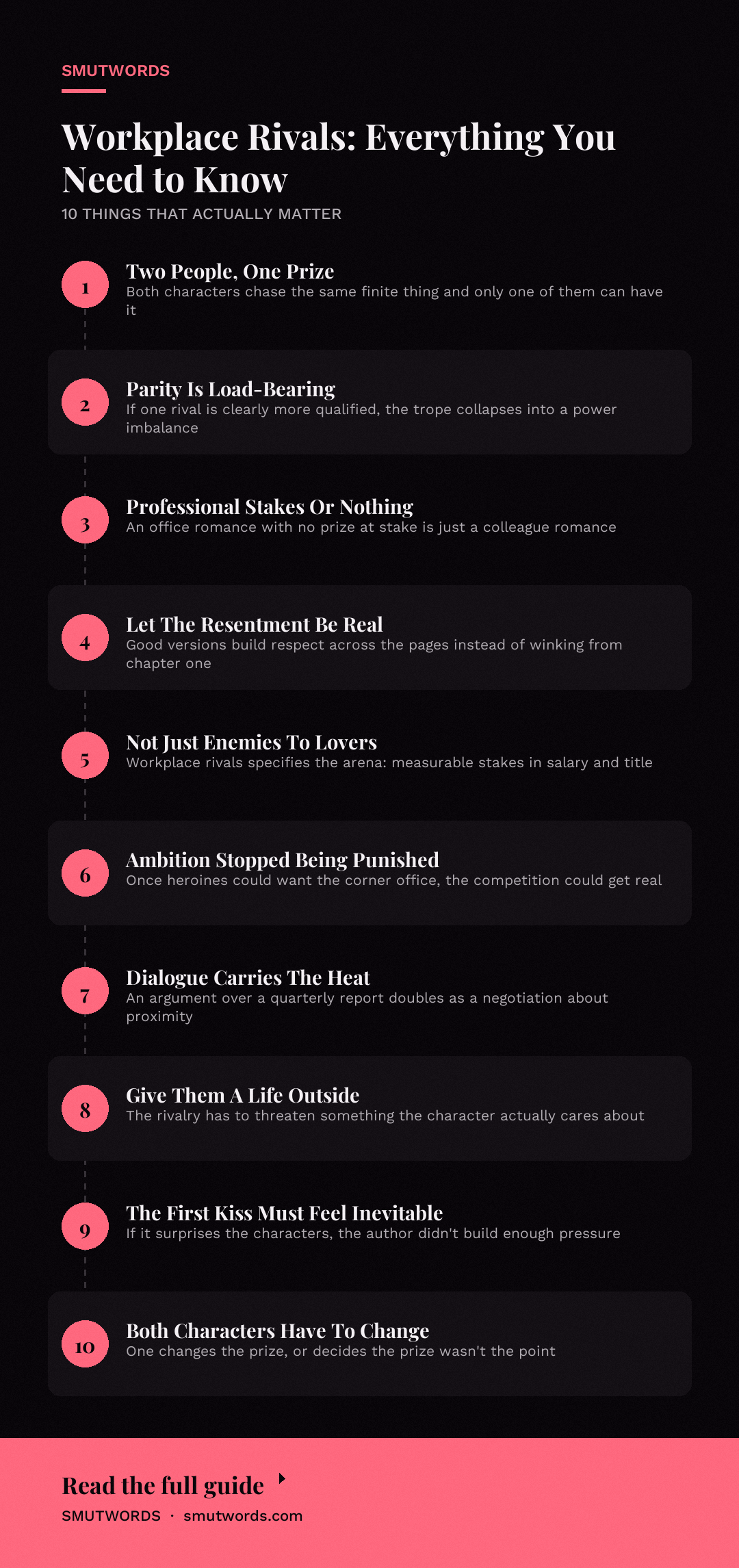
What separates workplace rivals from a hundred other office-set romances is the parity. Both characters are genuinely good at the job. Both have a real claim on the prize. If one of them is obviously more talented, more senior, or more deserving, the rivalry collapses into a power imbalance and the trope stops working.
The competition has to be fair enough that the reader can't pick a winner and feel righteous about it. That discomfort, the sense that you're rooting for two people who can't both be happy, is the whole point.
A few things that don't count, even when they happen in an office. An office romance with no prize at stake is just a boss romance or a colleague romance. A hate to love story where the mutual loathing has some other root cause (he was rude at a wedding, their families feud, she thinks he's a snob) is not workplace rivalry even if they share a floor.
The professional stakes are load-bearing. Remove them and the book changes genre. What's left is two people who happen to work near each other.
The common misconception is that these two secretly respect each other the entire time and the argument is theater. Good versions let the resentment be real.
She genuinely thinks he didn't earn the account. He genuinely thinks she's reckless. The respect builds across the pages; it isn't a wink at the reader from chapter one.
Another one: readers assume workplace rivals is a euphemism for enemies to lovers. It's a subtype, and a narrow one. The term specifies the arena. The conflict lives in the building where they both work, and the stakes are measurable in salary and title, not in past trauma or a misunderstanding.
Where Workplace Rivals Comes From
This trope's history is publishing history, so start with the category that built it. In the nineties and early two-thousands, category romance lines (Harlequin, Silhouette, Mills & Boon) published office-set books by the hundreds. The boss-secretary dynamic dominated, but a parallel thread of colleague-versus-colleague stories grew out of the broader cultural fixation on corporate ambition that peaked alongside books like The Firm and the movies that followed it.
Those early versions were tamer than what circulates now. The rivals were frequently in different departments and the intimacy happened after hours, in hotels and restaurants, with the workplace functioning mostly as a weather system rather than a battle. Career stakes were often softened so the heroine could be won without losing.
The trope sharpened as contemporary romance split off from category lines and started letting women be openly ambitious without the narrative punishing them for it. Once heroines could want the corner office on the page, the competition could be real. The 2010s brought an avalanche of books where the heroine's professional success and the romance were no longer in conflict with each other but in conflict with her, specifically, because the man she wanted also wanted her job.
Digital publishing blew the doors open between roughly 2015 and 2020. Self-published romance authors, working at a speed traditional publishing couldn't match, figured out that readers wanted the rivalry turned up. More rivalry meant more sabotage, more sabotage meant hotter fights, and hotter fights meant the eventual sex had to justify all of it. The "we can't stand each other but the tension is unbearable" chapter became a genre fixture.
The most recent shift is toward real structural parity. Contemporary workplace rivals increasingly features two people who own competing businesses, or two co-founders, or two people who are both qualified and both watching the other one get picked. The corporate hierarchy flattened on the page because readers got tired of the heroine being outgunned by a person she couldn't plausibly defeat.
How It Shows Up in Erotica
Craft level, workplace rivals does most of its work before the characters touch each other. The dialogue carries the heat.
An argument over a quarterly report doubles as a negotiation about how close they're standing. A comment about who stayed later gets a second reading. Authors who understand the trope build the sex into the professional exchanges. By the time someone says something genuinely filthy, the reader has been waiting eighty pages for it.
Here are the variations you'll find, roughly ordered from soft to scorching.
- Promotion rivals. One position, two applicants, both of them excellent. The book often opens with them being told in the same meeting, which forces a conversation and establishes the entire next three hundred pages in one scene.
- Competing firms, same client. Rivalry through proposal decks and client dinners. The intimacy happens over drinks after a pitch, or in the hotel bar between the presentation and the verdict.
- Co-CEOs and hostile takeovers. The board seats the two of them together on purpose, to their mutual horror. There is a whole subgenre where the hostile takeover romance turns out to be a merger the characters have been negotiating physically the entire time.
- Rival agents and ghostwriters. Variants where the professional goal has a strange intimacy built into it, like two writers competing to land a memoir contract or auction a manuscript. A ghostwriter romance fits this structure unusually well because the job itself involves getting inside someone's story.
- Competing heirs to a family business. The prize is the company itself. Tends to run higher stakes and darker, sometimes tipping into revenge romance territory when one of them is the reason the other's parent lost their job.
- Rival soldiers. Two officers competing for a command, though this leans more toward the setups you find in a soldier romance than a corporate one.
What makes the strong versions work is almost always the same small piece of machinery: the author decides early what both characters actually want outside of work, then lets the rivalry threaten that thing. Nobody reads for the promotion.
They read because he promised his daughter he'd be at her recital and the late meeting is going to blow it up. Without that layer, the competition is just a stick the characters use to avoid being in a room alone with each other.
Weak versions make three mistakes, in order of how often I see them.
The first is a fake rivalry. One character turns out to be underplaying their hand the whole time, or the other is secretly angling for a job they don't want. The tension deflates the instant the reader realizes it was never real.
The second is a rivalry without cost. Both characters are so well-off and so comfortable that losing the promotion would mean nothing. The book is supposed to be about a job, and the stakes feel decorative.
Enjoyed this? Get a free book.
Join the list and we will send a complete free story straight to your inbox, plus new releases every week after that. No credit card, no catch.
The third, and the one that really hurts, is an uneven first kiss. If the first kiss or first sex scene arrives as a surprise to the characters, the author hasn't built enough tension. Workplace rivals need the moment to feel inevitable. Both characters have spent so long circling the fact that when it finally happens, they're doing something they've been fighting to avoid, not something new.
There's also an unspoken rule about how the conflict resolves that authors ignore at their peril: both characters have to change. If she learns he's actually not so bad and he gets exactly the job he wanted, the reader will feel cheated even if the ending is technically happy.
Structural parity in the setup demands structural sacrifice in the ending. One of them changes the prize, or one of them decides the prize wasn't the point. The best books do both, and find a professional arrangement neither of them could have imagined at the start.
A different but related problem is the boss question. If the workplace rival is also the boss, the book drifts into forbidden boss romance territory and picks up all of that subgenre's complications. HR, the optics of the relationship, whether the subordination undermines the consent.
Some readers love the stacking of obstacles. It's worth knowing the trope is doing double duty when the hierarchy isn't flat.
One more thing, because it separates the trope from a lot of its cousins. Workplace rivals is unusually good at generating aftercare problems. These characters fight hard before they touch, so the aftermath of a scene that follows a professional blowout is charged with emotional risk. If you're writing into that, there's real craft advice in this piece on how to write aftercare into a dark scene without killing the mood.
Workplace Rivals vs Hate to Love
These two get conflated because the surface looks similar, and it's worth being clear because the distinction changes what the author has to do on the page.
Hate to love is a broader term. The hatred can come from anywhere: a history between them, a fundamental values clash, a first impression gone sideways. The hatred is the core dynamic, and the rivalry, if any, is the setting it happens to be playing out in.
Workplace rivals requires the professional competition as its engine. The characters' antagonism is professional before it's personal. They don't hate each other because of chemistry; they hate each other because there's one job and two applicants.
The practical difference is what the reader is buying. A hate-to-love book promises the pleasure of watching hostility dissolve into affection, unfiltered. A workplace rivals book promises something narrower and sharper: the pleasure of watching a fight they both have a stake in, with the fight itself generating the heat.
In the best version, the professional scoreboard is the operating system the whole book runs on. The ending has to settle that score deliberately. Not "they're together now." A specific resolution to the specific competition the book opened with.
Some books are both. A workplace rivalry growing out of an old personal grudge is one of the more satisfying combos in contemporary romance, and it lets the author stack two obstacles into one storyline.
But if you have to pick which label best describes what you're reading or writing, ask where the tension is generated. If it's the situation (workplace, one prize), it's workplace rivals. If it's the emotion (they can't stand each other), it's hate-to-love.
Frequently Asked Questions
What is the workplace rivals trope in romance?
Two characters compete for the same professional prize while an attraction builds underneath the antagonism. The competition has to be genuine (both characters are qualified, and the stakes matter) and the ending has to resolve both the professional scoreboard and the romantic one.
Is workplace rivals the same as enemies to lovers?
It's a subtype. Enemies to lovers covers any antagonistic dynamic, and workplace rivals specifies the source of conflict as professional competition. The distinction matters because workplace rivals books usually resolve with a decision about the job, not just a declaration of feeling.
Why do readers love workplace rivals books so much?
The dialogue. Two smart, competitive people who are also into each other generate better conversation than almost any other setup in the genre, because every professional exchange has an unspoken second meaning. The rivalry also gives the author a built-in excuse for constant proximity, which is the hardest thing to manufacture in a romance plot.
Can workplace rivals include a boss and a subordinate?
Yes, and it's common, though the book then picks up the extra complications of the boss-romance subgenre. If the hierarchy isn't flat, the author has to address the imbalance of power, whether the character who reports to the other is genuinely free to say no, and how the workplace reacts when the relationship becomes known.
What makes a workplace rivals romance fail?
Three things turn up again and again. A fake rivalry where one character was never actually a serious contender. Stakes so low that losing the job would cost nothing. And a first kiss or first sex scene that arrives as a surprise to the characters instead of a relief, which usually means the author didn't build enough pressure before the release.
What are other names for workplace rivals?
Readers and authors also call it "enemies at the office," "rival agents," "co-CEOs in competition," and "hostile takeover romance." The alt names usually point at a specific setting the rivalry is taking place in, but the underlying mechanic is the same.
Final Thoughts
The office meeting becomes foreplay. The quiet late-night exchange becomes the whole book. That's the trick workplace rivals pulls off, and it's why the trope keeps selling: it gives two people a reason to be in each other's space every single day, with a ticking clock over their heads the entire time.
And the eventual decision, about the job and the person and which one they choose, lands harder than almost any other ending in the genre.
If you're looking for a place to start, pick up a book with the co-CEO or hostile takeover framing. It compresses the trope to its sharpest version: two people forced to sit across a boardroom table from each other, writing the terms of a merger neither of them intended to sign. The list of books below has the specific titles readers keep coming back to for exactly this reason.







Loading comments…