
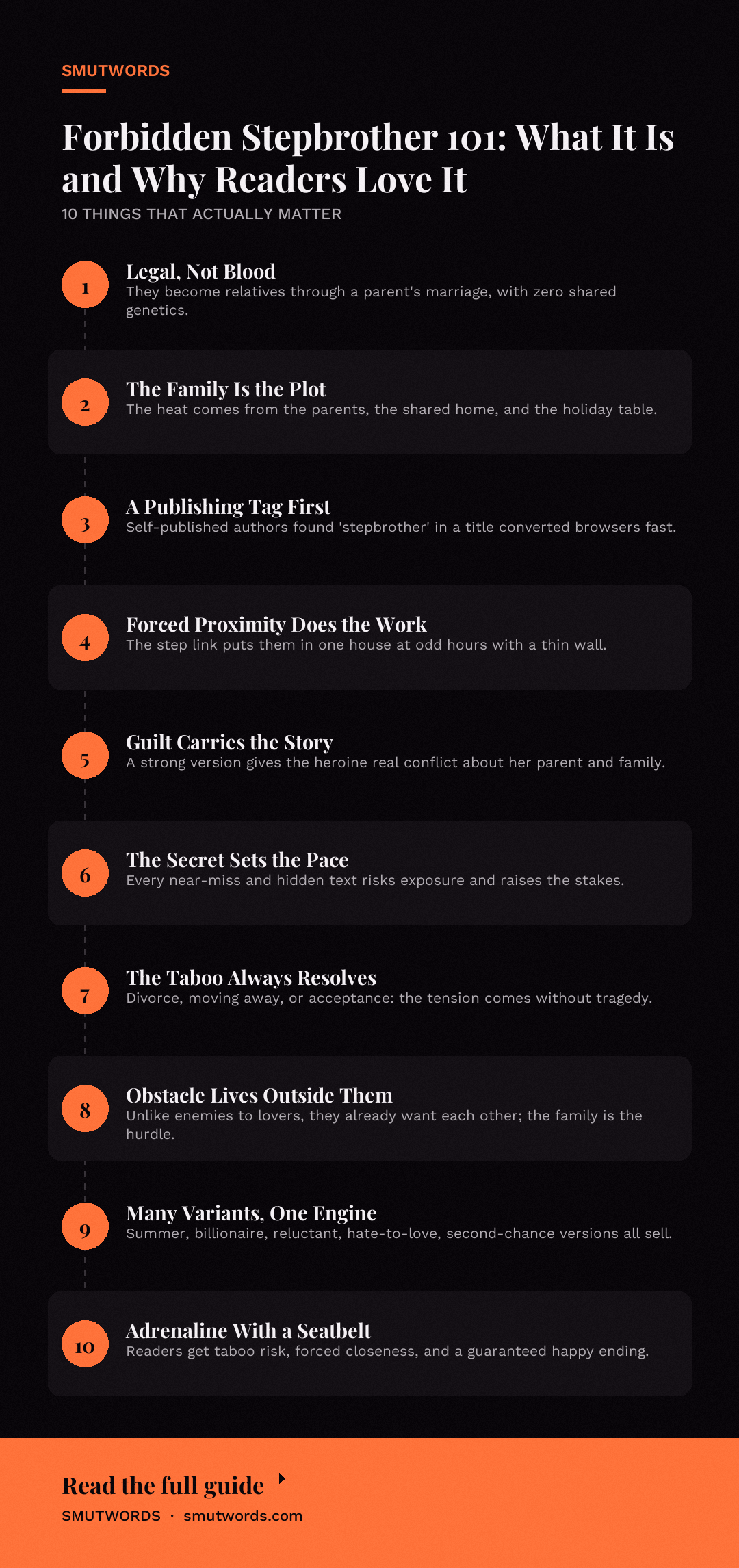
The forbidden stepbrother trope runs on one clean idea: two adults who share a last name and a set of parents, and nothing else, want each other badly enough to risk the family dinner. No blood binds them. What binds them is a marriage certificate signed by their respective mother and father, which makes the desire technically off-limits and emotionally explosive.
He's the guy who moved into the spare room the summer your dad remarried. She's the stepsister who shows up at Christmas in a dress he can't stop staring at. A forbidden stepbrother romance takes that arrangement and turns up the heat until the household rules start to crack.
Readers come to these books for the friction between what a family is supposed to look like and what two people in it actually want. The step relationship supplies closeness, forced proximity, and a taboo that costs nothing real to break. That combination has made the trope one of the most reliable engines in contemporary romance and erotica for going on two decades now.
What Forbidden Stepbrother Actually Means
The term describes a romance or erotic plot where the hero and heroine become stepsiblings when one of their parents marries the other's. They are legal relatives. They are not blood relatives. The prohibition they're violating is social and familial, and that distinction matters enormously to how the trope works.
Nobody in a well-constructed forbidden stepbrother story is committing a crime. The heat comes from the reaction of everyone around them: the parents who chose each other, the extended family, the shared home, the obligation to sit at the same table on holidays and pretend nothing is happening. That pressure is the plot.
This is also where the subgenre overlaps with the wider world of open relationship vs swinging taboos, which run on a similar question of who gets to decide what's acceptable.
What does not count: actual incest, blood siblings, or any pairing involving a minor. Those belong to entirely different categories, largely illegal ones, and reputable publishers don't touch them. The forbidden stepbrother is a specific adult dynamic built on a legal or ceremonial link and zero shared genetics.
Where the name comes from
The label is a publishing tag before it's anything else. "Stepbrother" as a marketable word in romance titles exploded in the early 2010s, when self-published authors discovered the phrase converted browsers into buyers at a rate that bordered on absurd. Before that, the step-sibling subplot existed in older category romance and soap opera, but it wasn't a branded subgenre.
The word "forbidden" got tacked onto the front because it signals the flavor. It tells a reader there will be guilt, secrecy, a scene where the parents nearly find out, and a resolution that lets the couple keep their dignity and their family. The full phrase functions as a promise: taboo-adjacent, but safe, and ending with both people happy.
A few common misconceptions worth clearing up now. First, these books are not about actual sibling incest dressed up in legal language, whatever the outrage threads claim. Second, they don't require the stepsiblings to have grown up together. Most of the time they meet as teenagers or adults and spend years circling each other before anything happens.
Third, the "forbidden" quality is nearly always resolved, sometimes by the parents' divorce, sometimes by the couple moving away, sometimes simply by the family accepting it. The taboo provides tension; it doesn't provide tragedy.
Where Forbidden Stepbrother Comes From
Step-sibling attraction is old material. It appears in Victorian serial fiction (half-siblings, mostly, which was a slightly different kettle of fish), in mid-twentieth-century soap opera storylines, and in category romance from the 1980s onward, where a stepbrother was a convenient way to put two young, attractive characters in close quarters under one roof.
The publishing phenomenon, though, is a digital-era story. Around 2014 and 2015, self-published authors started seeing massive returns on titles that announced "stepbrother" in the cover text. Amazon's algorithms rewarded the click-through rate. Readers who wouldn't have picked up a book called "Forbidden Family" clicked on "My Stepbrother, the Billionaire" without hesitation.
The trope went from a background device to a marketing category in maybe eighteen months.
What happened next is the interesting part. The early wave (2014 to roughly 2017) leaned hard into the billionaire stepbrother, the recovering bad-boy stepbrother, the one-night-stand stepbrother. The prose was often short and fast, more setup than depth, and the taboo was the entire point.
Nobody asked hard questions about the parents' feelings. The happy ending arrived with a bow.
Then the trope migrated into mainstream traditional publishing and matured. By the late 2010s, established romance authors had figured out that the step connection could power a full-length novel with real emotional stakes, and the "forbidden" quality moved from titillation into genuine character conflict. The current era favors more developed relationships, more attention to the family fallout, and a broader range of stepbrother archetypes: the Marine veteran, the small-town mechanic, the musician.
The genealogy of the trope runs through the enemies to lovers smut book engine in many of these books, since the couple's natural friction before they give in is the same friction those tropes run on.
The spike in its popularity also mirrors the broader boom in taboo-driven romance that gave us motorcycle club romance, mafia romance, and the entire dark romance category. Stepbrother fiction found readers in the same audience, and the two genres have always overlapped in their appetite for a rule that gets broken on the way to the bedroom.
How It Shows Up in Erotica
This is where the trope earns its keep. On the page, a forbidden stepbrother story is a machinery of proximity, secrecy, and guilt, and how well an author runs that machinery separates a book that keeps you up late from one you forget by Tuesday.
The first thing to notice is the setup. Nearly every strong version puts the two characters in the same house or the same orbit before the desire surfaces.
Summer at the family cabin. A shared apartment during the holidays. A road trip home for a wedding.
Forced proximity is the trope's fuel. The stepsibling link is convenient because it hands the author a reason for these two specific people to be near each other, at odd hours, with a thin wall between their bedrooms.
The second element is the secret. The best forbidden stepbrother books make the secret active: a text thread neither parent knows about, a hand under the table, a near-miss kiss in the kitchen that both siblings replay in their heads for a hundred pages.
Enjoyed this? Get a free book.
Join the list and we will send a complete free story straight to your inbox, plus new releases every week after that. No credit card, no catch.
The secret also gives a natural pacing device. Every encounter risks exposure. Every exposure raises the stakes. The reader is constantly checking over their shoulder alongside the characters.
The third element is the guilt, handled honestly or not. A flat version of this trope pretends nobody feels bad about anything. A strong version gives the heroine a moment of real conflict: the loyalty to her parent, the fear of being judged, the feeling that she's ruining the family she's finally gotten.
That guilt is the story. Without it, you're reading a step-sibling hookup with the taboo printed on the cover and nowhere in the prose.
Then there's the breakthrough, which is where the physical writing tends to peak. A good forbidden stepbrother scene takes its time. The first real kiss usually arrives after a hundred pages of buildup, and it should feel like the fuse finally catching.
Because the forbidden stepbrother trope often sits inside a broader family-drama frame, the couple's private scenes also share space with the family's public ones. Holiday dinners, weddings, Sunday lunches, the moment the stepmother walks in. Authors who can pace a scene to end two seconds before a parent opens a door have figured out what these readers actually want: not just sex, but the risk of getting caught.
Common variants to know
- The summer stepbrother. A season of shared proximity at a lake house or family vacation home. Usually lighter, sunnier, and more nostalgic than other versions.
- The billionaire stepbrother. The early self-publishing archetype. He has money, power, and a step connection he didn't ask for. Dominant energy, high stakes, a lot of contrast between his lifestyle and hers.
- The reluctant stepbrother. Trades the alpha swagger for reluctance and slow burn. He resists, resents the attraction, and gives in late and reluctantly.
- The hate-to-love stepbrother. They resent the marriage that put them in the same house, they snap at each other, and the contempt turns to heat. This variant borrows most directly from the hate-to-love template, and when it's done well it's one of the most satisfying versions in the catalog.
- The forbidden family. A looser step-family dynamic that extends beyond the immediate step-sibling pairing to cousins, step-cousins, and in-laws. Pay attention to what the family is actually doing in the plot; the term can be a marketing umbrella.
- The second-chance stepbrother. The couple had a moment years ago, went separate ways, then the parents' marriage forces them back together as adults.
What makes a strong version work
Specificity in the relationship. The most electric versions ground the attraction in something concrete about the other person.
His dry humor. Her stubbornness. The two of them being the only people in the family who know what it's like to grow up in a house that fractured and rebuilt.
Honest guilt. If a character is going to feel bad about what they're doing, the writing needs to commit. Wishy-washy moral hand-wringing drains a scene; real conflict gives it a body. The reader should understand what's at stake if the parents find out.
Real consequences. A well-written forbidden stepbrother novel doesn't stop at pretending the parents will just be fine with it. It shows the fallout of the reveal, whether it's messy, delayed, or surprisingly warm. The resolution should feel earned.
An actual HEA (happily ever after) that the reader can believe. The whole appeal is that this is taboo with a safety net. The couple gets to keep their family, their relationship, and each other. Anything that undercuts that payoff undercuts the trope.
Forbidden Stepbrother vs Enemies to Lovers
Readers confuse these two constantly, and the confusion is fair, because many books run both at once. The difference is the source of the obstacle. In an enemies to lovers smut book, the two people are working against each other's hostility and pride.
In a forbidden stepbrother story, they mostly already like each other, or at least want each other, and the obstacle sits outside them, in the family and the legal paperwork. The couple's relationship is the problem the book has to solve with other people.
There's overlap because a hate-to-love dynamic and stepbrother friction run on the same engine: resentment that catches fire. A stepbrother couple who start out despising the marriage that put them together are effectively running both tropes, and the best authors in this lane use one to amplify the other.
The other nearby term is revenge romance, which attaches when the stepbrother connection is also a setup for payback and the heroine has a score to settle with his family or he with hers. It happens enough in this lane that the two get confused. The distinction: revenge romance makes the motive the center of the plot. Forbidden stepbrother makes the relationship the center and lets the forbidden quality carry the tension.
Frequently Asked Questions
Is the forbidden stepbrother trope the same thing as incest?
No. In these stories, the characters share no genetic material; they become relatives through a parent's marriage, usually as teenagers or adults. The taboo is social and legal, not biological. Publishers and readers of the trope draw that line sharply, and books that cross it into actual blood relation fall into a different category entirely.
Do they usually end with a happy ending?
Almost always. That's part of the reason readers pick up forbidden stepbrother books: the guarantee that no matter how messy the middle gets, the couple ends up together. The "forbidden" element creates tension; it isn't a setup for tragedy.
What's the difference between the forbidden stepbrother and the forbidden stepsister?
The terms describe the same dynamic from different angles. "Forbidden stepbrother" is the tag most often used in the title and marketing for a story where the male step-sibling is the love interest, but the relationship is the same one. The "stepbrother romance" label is broader and covers the whole category.
Why do people like stepbrother romance books?
Readers describe the appeal as a safe way to explore taboo desire. The forbidden quality provides risk and pressure without any actual harm, the step connection provides forced proximity, and the happy ending guarantees the relationship works out. It's adrenaline with a seatbelt.
Can I read these books as a standalone, or do I need to read the whole series?
Most forbidden stepbrother novels function as standalones even when they're shelved in a series, because each book follows a different couple. Check the reading order listed on the retailer page if the books share a family or town, since crossovers are common in the subgenre. If you want to see how another dark subgenre handles continuity, the guide to writing aftercare into a dark scene covers similar pacing concerns.
Is a stepbrother romance the same as a family romance?
"Forbidden family" and "family romance" are marketing umbrellas that can include step-sibling stories along with broader in-law, step-cousin, and blended-family plots. A book tagged only as forbidden family might contain a stepbrother relationship, but it might also center a different forbidden connection, so read the blurb to be sure.
How explicit are these books?
That ranges widely across the category. Some forbidden stepbrother titles are closed-door romance with kissing only, while others are full erotica with detailed sex scenes. Every major retailer lets you check the heat level through reader tags and reviews before you buy, so you can find the level you're comfortable with.
Final Thoughts
The forbidden stepbrother trope is one of the most durable engines in the genre because it applies real family pressure to real desire and still promises a way out. If you're new to the lane, start with a full-length version that commits to the guilt, the secret, and the fallout, and skip anything that treats the taboo as a cover sticker. Once you've read a good one, you'll know exactly why this subgenre refuses to die.






Loading comments…