Cozy fantasy romance is the subgenre where the stakes are a burnt pie, a meddling neighbor, and whether the shy baker will finally hold hands with the blacksmith. There's no apocalyptic war to stop. It's a full-length novel with a guaranteed happy ending, set in a fantastical world that feels like a warm hug rather than a battlefield.
If you want romance without the threat of death around every corner, and fantasy without the grimdark politics, this is the corner of the bookstore you have been missing.
What Cozy Fantasy Romance Actually Means
Cozy fantasy romance is a blend of two distinct genres. The "cozy fantasy" half promises a low-stakes, optimistic setting: a magical bakery, a traveling bookshop, a small village at the edge of an enchanted forest. The "romance" half guarantees a central love story that ends in a committed, happy relationship.
The combination means the plot focuses on community, personal growth, and the slow build of affection, with the fantastic elements acting as seasoning rather than the main dish.
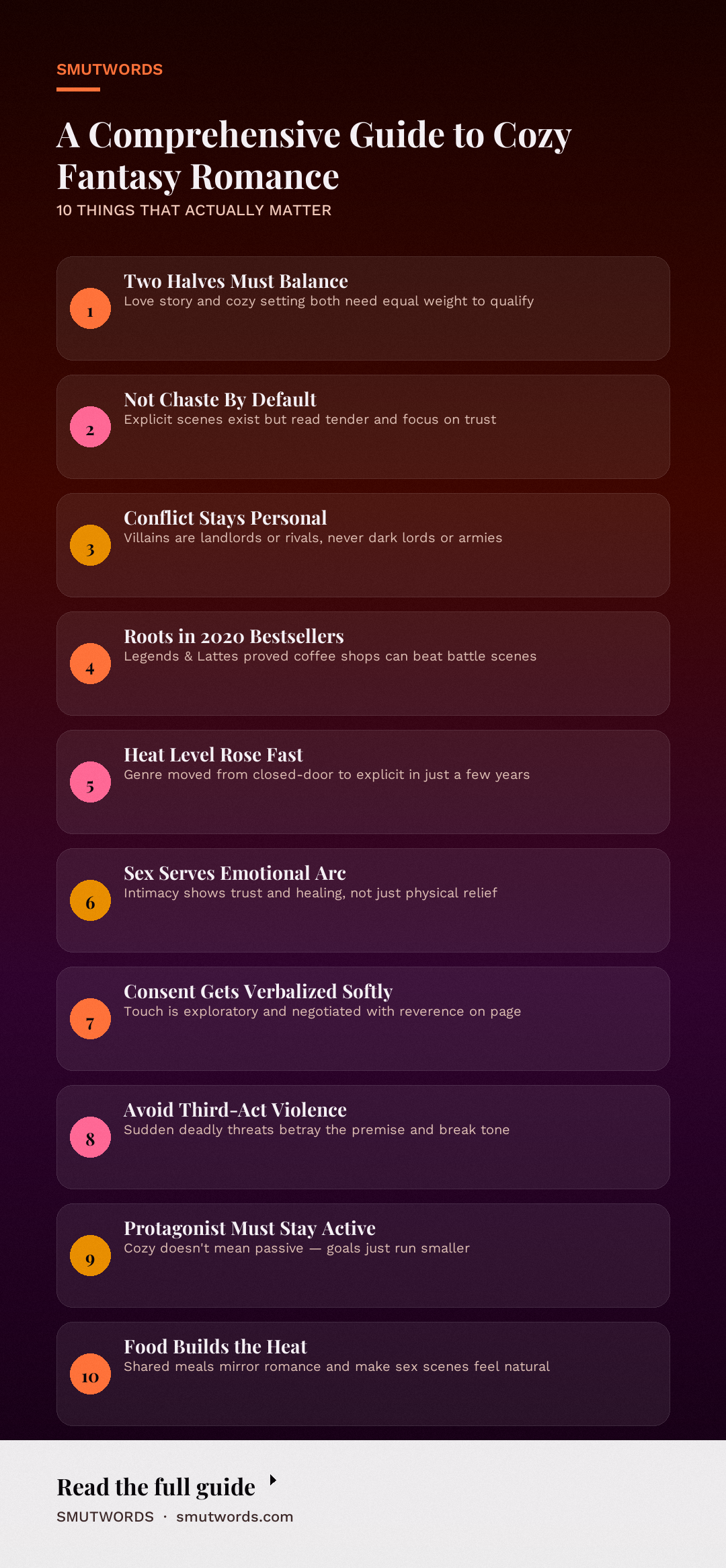
What does and doesn't count as this trope can be surprisingly strict. A book can have a gentle tone but fail the romance test if the love story is a subplot. A book can have a passionate love affair but fail the cozy test if the city is actively being sacked by orcs. Both halves must be present and balanced to qualify.
The magic system rarely poses a lethal threat. The villain is often a greedy landlord or a jealous rival rather than a dark lord. And the sex scenes, when present, tend to emphasize intimacy and emotional connection over athletic dominance.
Common misconceptions abound. The biggest is that cozy fantasy romance is asexual or chaste. These books often feature explicit sex, but the flavor differs from a high-octane possessive sex scene. The heat reads as tender, focused on mutual discovery and safety rather than ownership or conquest.
Another misconception is that "cozy" means "boring." The genre has conflict, misunderstandings, and obstacles.
But the resolution always circles back to the couple and their community finding a way forward together.
Where Cozy Fantasy Romance Comes From
The term "cozy fantasy" gained traction as a publishing category in the early 2020s, but its roots run deeper. Readers trace the sensibility back to works like The Hobbit for its pastoral comfort or the Discworld series for its humanist humor. The romantic half is a more recent fusion.
In the 2010s, the romance genre saw a surge in "sweet" and "low-angst" contemporary titles. Independently, fantasy readers began burning out on grimdark narratives that punished every character choice. The two currents met around 2020, when titles like Legends & Lattes by Travis Baldree proved that a book about an orc opening a coffee shop could dominate bestseller lists without a single battle scene.
The romance publishing industry noticed the demand. Traditional houses and indie authors alike began producing genre-blended titles that centered relationships in cozy settings. This marked a shift away from the high-adventure romance of the 2000s and 2010s, where couples often fell in love while fleeing assassins or navigating political coups. The pandemic played a role: readers sought comfort, and the genre delivered a reliable promise of safety and sweetness.
The evolution continues. Early cozy fantasy romance leaned heavily on European-inspired villages and fae or dragon shifters. Current iterations are expanding into other cultural mythologies, urban settings with a cozy small-town feel, and more diverse casts.
The heat level has also risen. What started as a mostly closed-door subgenre now has explicit titles sitting comfortably next to their sweeter counterparts on digital shelves, proving that comfort and carnality are not opposites.
How It Shows Up in Erotica
When cozy fantasy romance crosses fully into erotic territory, it does not abandon its core ethos. The sex scenes serve the relationship's emotional arc. Authors use physical intimacy to demonstrate trust, healing, and the removal of emotional armor, not just physical relief.
A common scene structure involves the couple sharing a domestic task, like kneading dough or chopping herbs, before the tension snap leads to a slow, deliberate undressing. The language prioritizes sensory warmth: the crackle of a hearth, the scent of rain on thatch, the weight of a woolen blanket.
The craft of writing a strong cozy fantasy romance sex scene differs sharply from writing a scene in a high-angst Motorcycle Club Romance. In the latter, sex might be rough, immediate, and tied to dominance hierarchies. In cozy fantasy romance, the touch is exploratory, and consent is often verbalized with a softness that borders on reverence.
The barrier to intimacy is rarely physical resistance. It's emotional vulnerability. The characters fear being laughed at, being left, or being seen as monstrous.
Enjoyed this? Get a free book.
Join the list and we will send a complete free story straight to your inbox, plus new releases every week after that. No credit card, no catch.
What makes a strong version of this work on the page is consistency of tone. If the author establishes that the world holds no mortal danger, the conflict must spring from character flaws or external nuisances like a meddling mother or an upcoming village festival. The couple's problems must be solvable through communication.
A flat version betrays the premise by introducing a sudden, violent threat in the third act that feels transplanted from a darker novel. Another failure mode is making the protagonist passive. Cozy does not mean inert; the hero or heroine must actively pursue their goals, even if those goals are modest, like fixing the roof or convincing the local baker to sell a special pastry.
Variations on the trope keep it fresh. Some authors lean into the "found family" element, where the sex scene is bookended by the couple tiptoeing past sleeping friends. Others incorporate magical mishaps during intimacy, like accidental truth-telling spells that lead to awkward confessions. Monster romance overlaps here frequently, with gentle orcs, minotaurs, or gargoyles who read as cuddly rather than terrifying.
The key differentiator remains the emotional register of the story, which stays optimistic with a steady pulse of warmth from the first page to the epilogue featuring a wedding and a new pet.
A notable sub-variation is the tie to Forced Proximity. A blizzard trapping two rivals in a magical cottage, or a shared quest to retrieve a lost heirloom, creates the isolation needed for intimacy to flourish without making the world itself feel dangerous. The forced proximity trope works beautifully here because it strips away the couple's social obligations and leaves them alone with their feelings, often leading to a first kiss over a shared pot of stew.
Cozy Fantasy Romance vs Prince/Princess Romance
The most common point of confusion for new readers is mixing up cozy fantasy romance with Prince/Princess Romance. The two can overlap, but the distinction lies in focus. A prince or princess romance centers the burdens of royalty: court intrigue, arranged marriages, assassination attempts, and the weight of a crown.
A cozy fantasy romance might feature a royal visiting an ordinary village, but the story will deliberately minimize the political stakes in favor of personal ones. The princess is more likely worried about whether she can learn to churn butter than about who sits on the neighboring throne.
The other frequent comparison is to Tutor/Student Romance, particularly when the fantasy element involves magical education. Both tropes generate intimacy through close instruction, but the power dynamics diverge. In cozy fantasy romance, the teacher-pupil dynamic often dissolves quickly into partnership, with both characters learning from each other.
In a pure tutor/student romance, the inequality of knowledge and status remains a central friction point throughout the narrative. The cozy version prefers peers-in-the-making, while the tutor/student version often lingers on the taboo of the dynamic itself.
Frequently Asked Questions
Is cozy fantasy romance always explicit?
No. The heat level ranges from closed-door "fade to black" to fully explicit. The romance genre has a heat scale from sweet and chaste to erotic, and cozy fantasy romance occupies every rung. Check reviews or content notes, which are common in the genre, to find the level you prefer.
What is the typical length of a cozy fantasy romance?
Most titles run between 60,000 and 90,000 words. This is longer than a novella but shorter than an epic fantasy doorstopper. The shorter length suits the intimate scope of the plot, which covers a season or a single year in a character's life rather than a generation-spanning saga.
Can there be sex scenes that are kinky in a cozy fantasy romance?
Yes, but the tone adapts. Light bondage or spanking can appear, but the emotional context is affirming and negotiated. The submissive partner in a cozy scene often verbalizes their desire for care during the act, making the kink read as an expression of deep trust rather than a punishment or a power struggle.
Why do these books focus on food and baking so much?
Food is a universal shorthand for comfort, care, and community. Describing a shared meal allows the author to develop the setting and the relationship simultaneously without dialogue. The sensual detail of tasting, savoring, and feeding a partner also mirrors the intimacy of a romantic connection, making the eventual sex scenes feel like a natural extension of the relationship's existing heat.
Is there conflict if the stakes are low?
There is always conflict, but it comes from character flaws and community friction. A heroine might struggle with self-doubt about her magical gifts. A hero might resist committing because of a past betrayal. The villain is usually a person, not a cosmic force, whose schemes complicate but never permanently harm the couple or their town.
What if I like high fantasy and dark romance? Will I hate this?
Not necessarily. Many readers use cozy fantasy romance as a palate cleanser between intense series. The genre offers a reliable emotional payoff without the adrenaline drain. If you want a break from watching beloved characters be tortured for a thousand pages, the genre sits on the shelf waiting with a cup of tea and a soft blanket.
Final Thoughts
Cozy fantasy romance is the literary equivalent of a weighted blanket: it presses down gently, holds you steady, and promises that everything will turn out fine. If you want to see how authors build heat through domestic intimacy rather than dangerous exploits, pick up a copy of Can't Spell Treason Without Tea by Rebecca Thorne for a thrilling slow burn set in a bookshop. Let the hearth fire crackle and the pages turn.






Loading comments…