Criminal romance is a love story built on the wrong side of the law. One or both leads run heists, launder money, move product, ride with a club, or answer to a family boss. The relationship grows in the middle of all of it. The crime shapes every date, every argument, every choice about who lives and who gets buried.
Readers come to criminal romance for the specific charge of watching someone who has broken every rule find one person worth breaking pattern for. The danger raises the stakes on every kiss. The moral gray lets you root for people you would cross the street to avoid in real life.
What Criminal Romance Actually Means
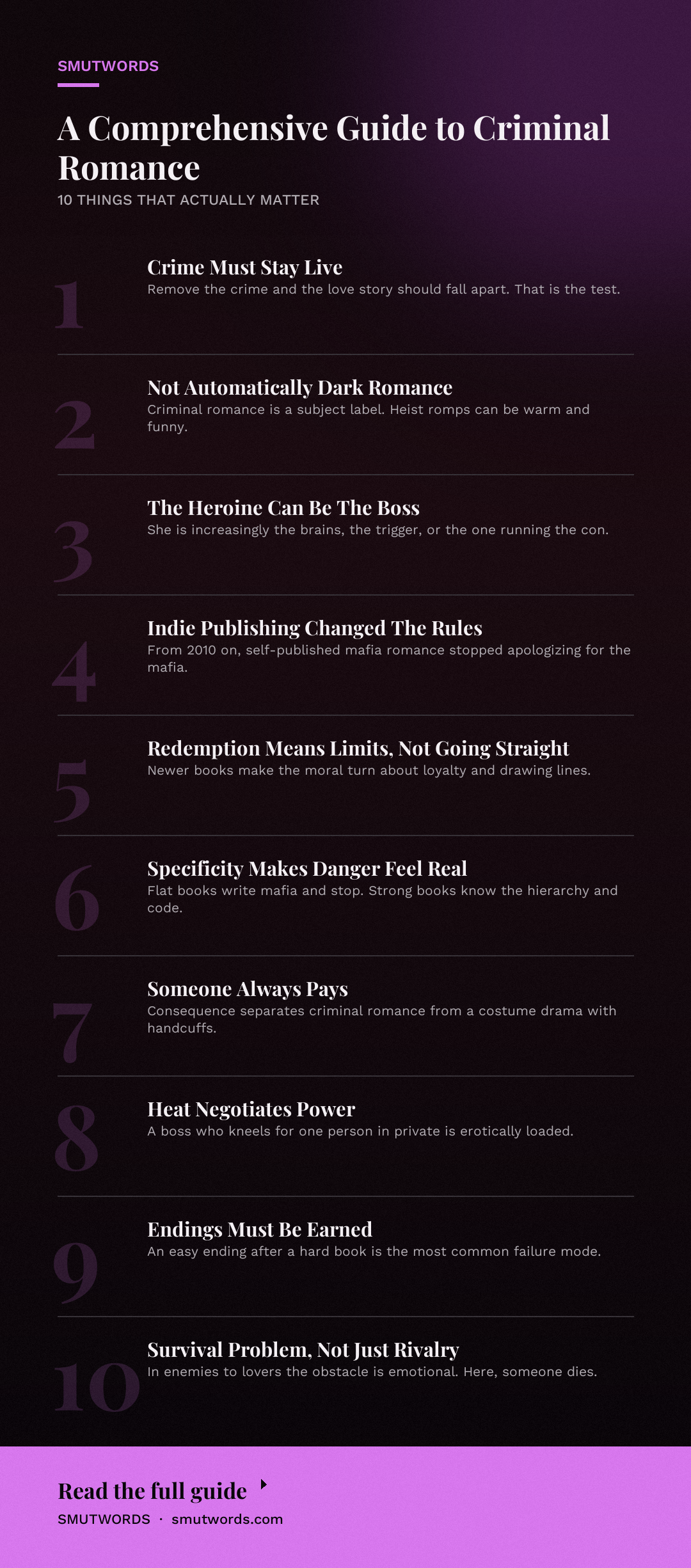
The name covers a wide shelf. At its core, criminal romance requires three things: a lead whose income, loyalty, or survival depends on illegal activity; a love story that could not happen if the crime were removed; and a plot where the relationship and the criminal enterprise keep interfering with each other. Take away the crime and the book falls apart. That is the test.
What counts: mafia capos, cartel lieutenants, getaway drivers, forgers, jewel thieves, hackers running cons, outlaw motorcycle club members, arms dealers, and the occasional assassin with a conscience. It also counts when the lead is the accountant who discovers the books are fake, the nurse who patches a gunshot wound off the books, or the civilian who gets pulled in as a pawn and stays by choice.
What does not count: a love interest who happens to have a criminal past but is fully reformed by chapter two and never touches it again. A bad boy with a leather jacket and a parking ticket. A story where the "crime" is a misunderstanding cleared up by the midpoint. The genre needs the illegality to stay live, pressing on the couple through the final act.
Two misconceptions show up constantly. The first is that criminal romance is automatically dark romance. The overlap is large, but plenty of criminal romance is funny, warm, and light on the page (heist romps, con-artist capers, grumpy enforcer meets sunshine baker).
The second is that the woman is always the innocent. Increasingly she is the brains, the trigger, or the boss, and the man is the one trying to keep up. The category has widened a lot in the last decade.
One more distinction worth naming early: the crime can sit in the past, the present, or the future. A man out of prison trying to stay out, a woman mid-heist, a couple planning the job that will set them free. All three are criminal romance. The tension just lives in different tenses.
Where Criminal Romance Comes From
The honest history here is a publishing history, not a kink history. Criminal romance grew out of two older streams that ran side by side for most of the twentieth century: the crime novel and the gothic romance. Mid-century paperbacks gave us brooding men with guns and women in peril, and the two genres kept borrowing each other's furniture without ever fully merging.
The merger happened in category romance. Through the 1980s and 1990s, publishers tested "bad boy" heroes with actual rap sheets, and the books sold. Silhouette and Harlequin lines ran mafia-adjacent heroes, undercover cop plots, and reformed-thief stories with respectable numbers.
These were usually written so the hero's criminality resolved by the last page: he was really an agent, or he turned state's evidence, or the Family was actually a legitimate business with one bad apple. The genre wanted the thrill of the outlaw without the commitment.
Then indie publishing changed the math. From roughly 2010 onward, self-published authors could write mafia romance that never apologized for the mafia, and readers rewarded them for it. The market split into distinct sub-shelves fast: Italian mafia romance, Russian Bratva romance, outlaw MC romance, cartel romance, and heist romance. Each developed its own conventions, its own cover language, its own reader communities.
The biggest shift in how the trope is portrayed is the moral one. Older category romance almost always converted the criminal into a law-abiding citizen by the epilogue. Contemporary criminal romance more often does the reverse. The heroine joins the life, or the couple builds a code of their own.
What the newer books refuse to do is pretend the violence was noble. The redemption, when it comes, is usually about loyalty and limits rather than about going straight.
A second shift: women moved from prize to player. Early examples cast the heroine as collateral, a debt, a witness to be silenced. Modern criminal romance regularly makes her a hacker, a rival boss's daughter with her own agenda, a forensic accountant running her own con, or the one who pulls the trigger when the hero hesitates. The dynamic is far less lopsided than it used to be, and the books are better for it.
How It Shows Up in Erotica
On the page, criminal romance runs on a specific engine: high stakes plus enforced intimacy plus a countdown. The job has a date. The rival has a timeline. Someone is always about to find out.
That pressure cooker is what makes the sex land harder than it would in a quiet contemporary. It is close cousin to forced proximity, except the trap is usually built from obligation rather than weather.
Here is how the common shapes actually play out.
- Mafia romance. The lead is a made man, a capo, or the heir. Marriage is often arranged or forced for alliance, which hands you instant proximity and instant conflict. The tone runs from lush and operatic to brutal and spare. Power is the erotic currency: who can protect whom, who can order whom, who kneels.
- Outlaw biker romance. The club is the family, the rules are the law, and the heroine is usually an outsider walking into a closed world. Loyalty is the whole game. A lot of the heat comes from the heroine learning the code and then choosing to uphold it.
- Heist romance. The couple is planning a job together, which means long nights, tight quarters, and a shared secret. The ticking clock does the work. Heist books tend to be funnier, faster, and more plot-driven than mafia books, and the sex often lands right before or right after the score.
- Con artist romance. Both leads are running something, and at least one of them is running it on the other. This is the most natural home for enemies to lovers energy, because the deception is mutual and the attraction is a liability for both sides.
- Thief and victim. The lead robs the other lead, or tries to. The power imbalance is the point, and the book has to work hard to make the target interesting enough that you believe the thief stays.
- Criminal redemption. The relationship becomes the reason a character starts drawing lines: no more civilians, no more kids, no more killing for free. A romance that runs on redemption arc romance usually puts the moral turn in the third act, triggered by a choice the love interest forces.
What separates a strong criminal romance from a flat one comes down to specificity. Flat versions write "mafia" and stop there: dark suits, cigars, a guy named Tony. Strong versions know the structure.
What does the family sell? Who is the boss, and what happens if he dies? What is the penalty for talking? A reader does not need a glossary, but the author needs one in their head, because the details are what make the danger feel real.
The second marker is consequence. In a flat criminal romance, the violence is decorative and nobody the reader cares about pays a price.
In a strong one, someone always pays. A friend gets killed. A hand gets broken. A deal falls through and the couple loses the money that was going to buy their way out. Consequence is what separates a criminal romance from a costume drama with handcuffs.
Enjoyed this? Get a free book.
Join the list and we will send a complete free story straight to your inbox, plus new releases every week after that. No credit card, no catch.
The third marker is heat tied to power. Criminal romance readers expect the sex to negotiate who is in charge and who is choosing to yield. A boss who kneels for one person in private is erotically loaded in a way no other trope quite matches.
This is also where dubious consent sometimes enters the picture, particularly in arranged-marriage mafia books where the heroine's consent is contractual before it is personal. Authors handle that line very differently, and it is worth checking the content notes before you start a book in this category.
The fourth marker is the ending. Criminal romance has to answer a question most romance does not: can these two people actually have a normal life? Some books say yes, and the couple walks away clean. Some say no, and the couple builds a life inside the life.
Some say the only way out is a body in the ground. Whichever route the author takes, the ending has to feel earned by the stakes the book spent 300 pages building. An easy ending after a hard book is the most common failure mode in the whole category.
Common pitfalls worth naming, from an editor's chair:
- Crime as set dressing. If you could swap "mafia" for "golf club" and the plot survives, the crime is decoration.
- Toothless danger. A lead who threatens to kill people and then never does reads as a cosplayer.
- The instant reform. A character who has been running a criminal enterprise for twenty years and changes their whole moral framework because of one conversation loses the reader's trust.
- The helpless heroine. Even a civilian love interest should have agency; she should be choosing to stay, choosing to leave, or choosing to fight, at every turn.
- Research by vibe. Real criminal organizations have hierarchies, territories, and codes, and readers who know the subgenre can smell approximation from page one.
Worth noting: criminal romance shares DNA with several neighboring tropes without being any of them. A criminal lead who wears leather and plays guitar is a different animal entirely, so do not confuse this with rockstar romance just because both run on charisma and bad decisions.
The same goes for men with money and guns who work inside the law. The line is legality, not attitude. For a closer neighbor, see our guide to urban fantasy romance, where the criminal underworld often comes with fangs.
Criminal Romance vs Enemies to Lovers
These two get mixed up constantly, because a lot of criminal romance is also enemies to lovers, and vice versa. The distinction is what is actually at stake.
In enemies to lovers, the conflict is a relationship problem. Two people who dislike each other, or who are on opposite sides of a professional rivalry, learn to see each other. The obstacle is internal and emotional, and it usually resolves once both parties admit the truth.
In criminal romance, the conflict is a survival problem. If the wrong person finds out about the relationship, someone dies. That external threat does not go away when the couple admits their feelings; it sharpens. The protagonists might dislike each other, or they might like each other from the start and be furious about it.
Worth knowing: a mafia-adjacent romance does not automatically qualify. Several billionaire books gesture at "shady business" and stay entirely inside legal limits. If the ledger is clean, it is not this trope, no matter how dark the boardroom is.
Compare it to a straight billionaire romance where the lead's ruthlessness is all in the boardroom. The charge is different, and readers know the difference. Some books sit at the intersection (a billionaire who is also a crime boss) and those often end up filed on both shelves, which is fine and usually accurate.
Frequently Asked Questions
Is criminal romance the same as dark romance?
No. Dark romance is a tone and content label, and criminal romance is a subject label. Plenty of criminal romance is light, funny, and low on the page (heist capers especially), and plenty of dark romance has nothing to do with crime. The overlap is big because violent crime tends to push a book darker, but they are separate axes.
What is the difference between mafia romance and Bratva romance?
Mostly setting and cultural texture. Mafia romance usually means Italian-American organized crime, often New York or Chicago. Bratva romance means Russian organized crime, often with a Brooklyn or Moscow setting, and usually leans harder on the codes of the vor (the criminal brotherhood). The plot shapes are similar; the worldbuilding details and power structures read differently.
Do criminal romance novels always have a happy ending?
They are romance, so the central couple almost always ends up together. What varies is what "together" looks like.
Some couples walk away clean with new identities. Some take over the organization. Some build a quieter criminal life. A subset of the category leans into dark romance endings where the couple stays in the life with its violence intact.
Can the heroine be the criminal in these books?
Yes, and she increasingly is. Female bosses, female con artists, female hackers, female getaways, and female assassins all headline books now. The trope is not gender-locked, and some of the sharpest books in the subgenre put the woman on the criminal side and the man on the outside looking in.
How much violence should I expect?
It varies by sub-shelf. Heist and con-artist books usually keep on-page violence low and suspense high. Mafia, cartel, and outlaw MC books often include on-page beatings, torture, or murder, and some include sexual violence or its threat. Most authors list content notes, and it is worth checking those before you start a book you are not sure about.
Is criminal romance realistic?
The research quality varies enormously. The best books get the hierarchy, the code, and the day-to-day of criminal enterprise right enough that the danger feels credible. The weaker ones use "mafia" as a vibe word. If realism matters to you, look for authors who clearly know the subculture they are writing, whether that is the Bratva, an outlaw club, or a crew of professional thieves.
Final Thoughts
Criminal romance works because it takes the oldest love-story question (can this person be trusted?) and puts a gun on the table next to it. The crime gives the relationship weight; the relationship gives the crime a cost. When a book gets both halves right, every stolen hour feels like it might be the last one.
If you want a starting point in the sub-shelf that hits the sweet spot between heat and plot, the ranked list below this guide is built for exactly that. Also worth reading alongside it: our piece on forbidden affair tropes, which maps why off-limits relationships carry so much weight, and our breakdown of forced proximity. Both pair naturally with the criminal shelves where the wrong man is the entire point.




Loading comments…