
Best friend's brother is the romance trope where the heroine falls for the one man who has been sitting at her best friend's kitchen table for years: the brother. He's the guy who drove them to prom, who ate the last of the birthday cake, who she has seen in pajama pants and knows entirely too much about.
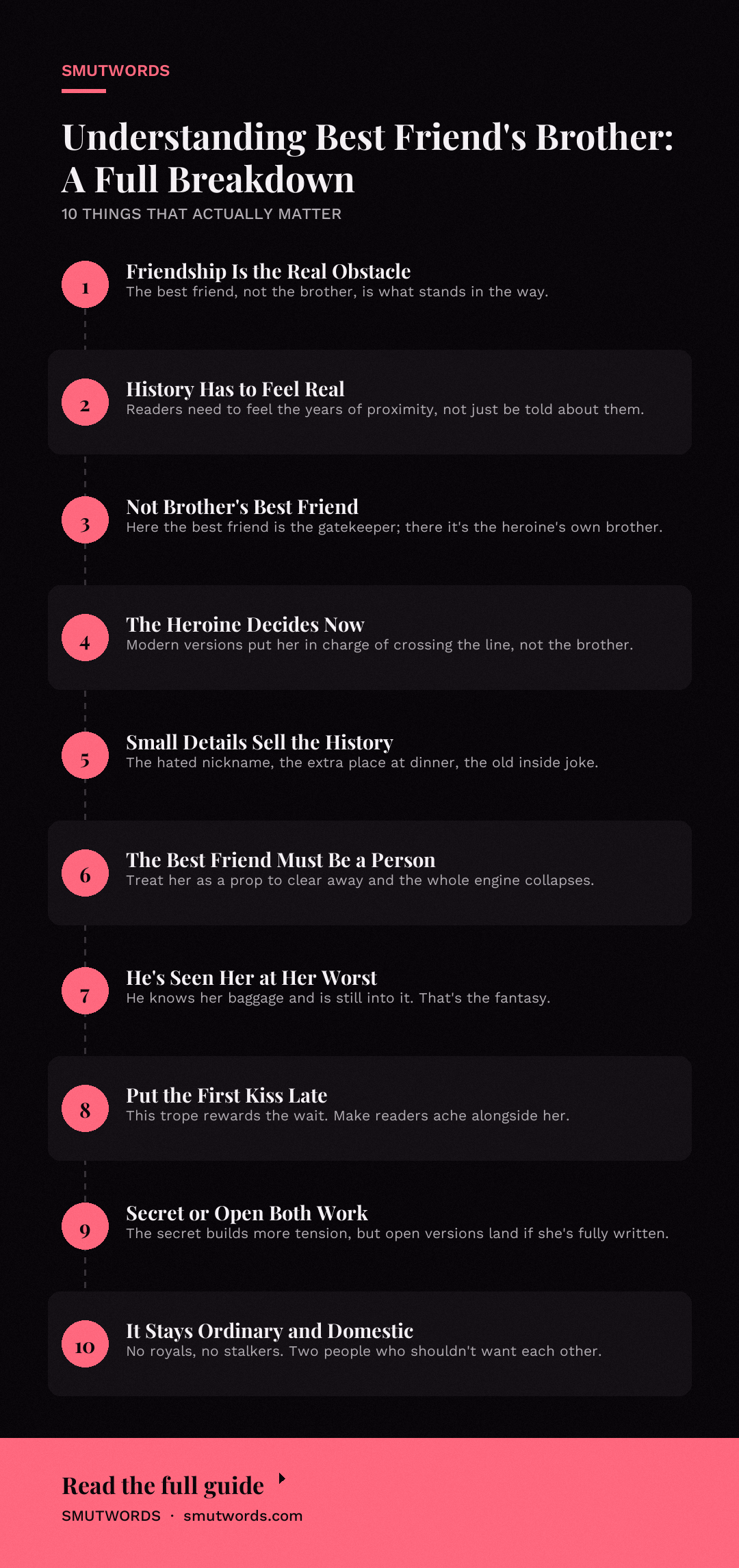
The trope works because the history is already there and the obstacle is a person she loves. Every step toward him is a step that could cost her the friendship, and that tension is the whole engine.
The short definition gets you the setup. What it doesn't get you is why this trope has become one of the most reliably searched, most reliably reordered premises in contemporary romance, or what separates a version that crackles from one that reads like filler between the spicy scenes. That's what this guide is for. We've read hundreds of these books, and there are patterns in the ones that work.
What Best Friend's Brother Actually Means
The name describes the relationship configuration precisely. The point-of-view character (usually the heroine, though not always) is best friends with a woman. That woman has a brother.
The heroine and the brother have known each other, in some capacity, for years. The romance is the shift from "my friend's brother" to "the man I want."
What counts: a genuine, established friendship between the two women. The brother needs to be someone the heroine has real history with, even if that history is mostly mild indifference or low-grade annoyance. The friendship has to matter enough that losing it is a real threat. And the brother has to be off-limits in the heroine's own mind, whether because of an explicit promise, an unspoken rule, or just the social weight of the situation.
What doesn't count: a heroine who meets her best friend's brother for the first time at a wedding and falls into bed with him that night. That's a blind date romance with a family connection stapled on. The trope requires proximity over time. The reader needs to feel the years.
Another common misconception: that best friend's brother is the same as brother's best friend. It isn't. In brother's best friend, the heroine's own brother is the gatekeeper, and the hero is the one who has been off-limits because of a bro code. Here, the heroine's best friend is the gatekeeper, and the brother is the one who was always underfoot.
The point of view and the person whose disapproval matters both change. It's a different book.
The gender-flipped version, best friend's sister, exists too, and swaps the roles again: the hero falls for the sister of his own best friend. Same architecture, different furniture.
Where Best Friend's Brother Comes From
This trope has been a recognizable feature of romance publishing for at least four decades, though its name and packaging have shifted. In category romance of the 1980s and 1990s, the setup appeared under titles like "her best friend's brother" or "the brother next door," often in series lines where the heroine and hero had known each other since childhood. These were frequently sweet romances where the conflict was gentler and the physical heat was implied rather than shown.
The trope's modern iteration owes a lot to two publishing shifts. First, the explosion of contemporary romance as a category in the 2000s and 2010s gave writers room to set stories in realistic small towns and friend groups where this configuration naturally occurs. Second, the rise of indie and self-publishing in the 2010s meant authors could write the steamier, more explicit versions that traditional publishers had sometimes softened or declined, and readers responded fast.
What has actually changed isn't the premise. It's the heat level and the heroine's agency. In older versions, she often spent the book resisting and the brother pursued. In current versions, she is usually the one who decides to act, and the story tracks her internal negotiation between desire and loyalty.
The brother's role has shifted too: he's less the aggressive pursuer and more the man who has been quietly waiting, which changes the emotional texture of the whole thing.
The trope has also gotten a boost from the broader cultural appetite for stories where the love interest is already known and trusted rather than a stranger. That shift runs through a lot of contemporary romance, and it shows up here with particular clarity because the trust is both the appeal and the problem.
How It Shows Up in Erotica
Craft-wise, this trope is a slow-burn machine if you use it right. The reader already knows the chemistry is plausible, so the writer's job is to make the years of proximity feel earned and then light the fuse at exactly the right moment. Here's what that looks like on the page.
The strongest versions build the reader's sense of shared history in small, specific details: the childhood nickname she hates, the way his mother still sets a place for him at Sunday dinner, the inside joke the three of them have had since high school. Those details do double duty. They establish the friendship as real and they establish the brother as someone the heroine has catalogued without meaning to.
By the time the first sexual scene arrives, the reader should be able to feel the weight of every year she didn't look at him that way.
Common variations authors use:
- The off-limits promise. The best friend has explicitly told the heroine hands off. This creates a forbidden edge that runs through every scene, sometimes shading into something close to hate to love if the best friend becomes a source of conflict.
- The secret that isn't secret for long. The heroine and brother start something quietly, and the tension is in waiting for the best friend to find out. The discovery scene is often the emotional climax of the book, even if the physical climax came earlier.
- The one-night-stand aftermath. The first physical encounter happens before either of them has processed the consequences, and the rest of the book is them trying to figure out whether it was a mistake while not being able to stay away from each other.
- The slow-burn long game. The brother has wanted her for years and she's only now noticing. This version leans hardest on the ache of mutual almost, and it's where the trope overlaps most with childhood friends to lovers, though the friendship is hers and the brother is adjacent rather than primary.
- The family-friend version. Sometimes the connection is looser. He's not literally her best friend's brother but the brother of a family friend, or the friend's cousin who grew up in the same house. The social pressure is similar and the trope reads much the same.
What makes a strong version work versus a flat one comes down to three things. First, the best friend has to exist as a full character with her own feelings about her brother, not just as a prop who shows up to be upset. Second, the heroine's internal conflict has to be genuinely costly: the reader should feel that she would actually lose something real.
Third, the brother has to be someone who has seen her at her worst and likes her anyway, because that's the emotional promise of the trope. He knows her baggage, he's watched her cry over smaller things, and he's still into it. That's the fantasy.
Enjoyed this? Get a free book.
Join the list and we will send a complete free story straight to your inbox, plus new releases every week after that. No credit card, no catch.
The flat version happens when the writer treats the friendship as a plot device to be cleared away so the couple can get together. The moment the best friend becomes an obstacle to be managed rather than a person to be honored, the tension collapses and the book starts to read like any other forbidden-love story.
A strong version also understands pacing. The trope rewards the kind of patient scene-building that lets sexual tension and slow burn do their work before anything physical happens. The best ones put the first kiss late, sometimes past the halfway point, and make the reader wait for it alongside the characters. That wait is the point.
Writers sometimes reach for heat-adjacent flourishes that don't fit, like a stalker romance dynamic or something borrowed from a prince/princess romance setup. Those can work when the trope is genuinely blended with another premise, but they can also muddle the social-pressure engine that makes best friend's brother distinct.
The trope's power is domestic and ordinary. It doesn't need a royal family or a dangerous pursuer to be compelling; it needs two people who should not want each other and a friend who will be hurt if they do.
One more practical note for writers: the trope plays well in first person for a reason. The reader needs to be inside the heroine's head while she negotiates with herself, and the moment she realizes she's been looking at him differently is usually the hook of the whole book. Get that moment on the page early, put it in her voice, and let her be honest about it even when the rest of the world hasn't noticed yet.
Best Friend's Brother vs Related Terms
The closest neighbor is brother's best friend, and it's the comparison readers ask about most. The difference is structural. In brother's best friend, the heroine's own brother is the obstacle and the hero is a guy she may barely know. The social cost is fraternal loyalty.
In best friend's brother, her best friend is the obstacle and the hero has been in her life for years. The social cost is female friendship.
There's also childhood friends to lovers, which sounds similar but isn't the same. In that trope, the two people are the primary friendship.
Here, she is friends with the sister and the brother is secondary. That's why the trope feels different: the heroine doesn't have to lose a friendship with him if it goes wrong. She has to lose the woman who brought them together.
And there's a real if smaller overlap with secret baby territory when a one-night-stand version of this trope goes long. The pregnancy plot can work, but only if the secret element doesn't overwhelm the friendship element. The engine here is loyalty, and a pregnancy plot should be in service of that, not a replacement for it.
What this trope is not: a slow burn that skips the friendship, a forbidden romance without real stakes, or a family drama wearing a romance label. Those can all be good books. They're just not this book.
Frequently Asked Questions
What does best friend's brother mean in romance?
It describes a book where the heroine falls for her best friend's brother, a man she has known for years and who was always slightly off-limits because of the friendship. The obstacle is the best friend, not the brother himself, and the tension comes from risking a real relationship she values.
Is best friend's brother the same as brother's best friend?
No. Brother's best friend has the heroine's own brother as the obstacle and usually the hero as a man she barely knows. Best friend's brother has her best friend as the obstacle and the hero as someone who has been in her life for years. Same family of trope, different gatekeeper and different point of view.
Why is this trope so popular?
Because it gives readers earned chemistry without the insta-lust problem. The hero already knows her flaws, her history, and her family, which makes the attraction feel grounded. The obstacle is social rather than institutional, which keeps the tension relatable and lets the reader root for her while understanding exactly why she hesitates.
Does best friend's brother always involve keeping the relationship secret?
Often, but not always. Some versions have the heroine and brother getting together openly and dealing with the best friend's reaction in real time. The secret version tends to produce more tension, but the open version can be equally strong if the best friend is written as a full character whose feelings genuinely matter.
Is best friend's brother usually a slow burn?
Frequently, yes, because the built-in history rewards long, patient buildup. The first kiss often comes late and the physical relationship develops after a long stretch of the heroine noticing things she's been ignoring for years. Some writers push the heat earlier, but the slow version is the one readers tend to reorder.
What are some common ways writers get this trope wrong?
The most common failure is treating the best friend as an obstacle to be cleared rather than a person to be honored. When the friendship becomes a plot device, the stakes vanish and the trope loses its engine. The second most common mistake is writing the brother as a stranger to the reader even though he's supposed to have been in the heroine's life for years.
Final Thoughts
The best friend's brother trope lives and dies on the friendship. If you can feel why the heroine loves her best friend, you can feel why the decision to cross that line costs her something, and that's what makes the payoff land. Pick up a version that takes the friendship seriously, and the slow burn will take care of itself.
If you want one to start with, look for the book in this list that spends the most pages on the relationship between the two women before the brother ever becomes a real possibility. That's the one that will show you what the trope can do.






Loading comments…