
The one bed trope is the romance and erotica setup where two characters who aren't together yet are forced to share a single bed. Usually it's a booking error, a storm, or a suspiciously underbooked inn. The enforced closeness does the work neither of them will do out loud.
That's the engine of the whole thing: a logistical problem that traps two people in the same rectangle of mattress and makes confession inevitable. It's one of the most reliable tension devices in the genre, and has been for decades, because it manufactures intimacy without permission.
Readers who search out the one bed trope by name are looking for a specific flavor of slow, agonizing, hands-brushing-in-the-dark anticipation. This guide covers where it comes from, how it works on the page, and what separates a hot version from a flat one.
What the One Bed Trope Actually Means
The name is almost aggressively literal. Two characters. One bed. No couch, no spare room, no rollaway cot, and crucially no romantic relationship yet.
The discovery that there is only one bed is the inciting incident. Everything after it is the fallout.
What counts as the trope is stricter than people assume. The characters have to be uninvolved at the start, or at least not admitting their involvement. They have to genuinely have no alternative sleeping arrangement. And the sharing has to last long enough for the physical proximity to do real damage: a night, a weekend, a whole snowed-in week at the cabin.
Common misconceptions are worth clearing up. The one bed trope is not the same as a couple who already sleeps together discovering a hotel mishap; there's no tension left to mine. It's also not merely a bed scene. Some books set characters sharing a bed mid-novel after they're already sleeping together, and that's just an intimate scene, not the trope.
What Doesn't Count
- Two characters who are already lovers bumping into a booking error. No unmet tension, no trope.
- A character who chooses the floor and stays there. The trope requires the shared mattress.
- Characters who share a bed while blackout drunk and remember nothing. That's a morning-after setup, not a slow-burn bed.
- A couple already in a relationship whose hotel room is small. Proximity without resistance isn't the point.
- Sharing a tent, sleeping bag, or hammock. Real variants, and readers know the difference.
The single bed is the lever. The characters' mutual refusal to name what's happening is what lifts it.
Where the One Bed Trope Comes From
Forced shared sleeping across class, gender, and circumstance has been a fixture of storytelling for as long as inns, cabins, and bad weather have existed in fiction. The trope as we know it, though, is a publishing phenomenon, born out of the western romance and historical romance booms of the mid-twentieth century.
Mass-market romance was a format defined by constraint. Book length was limited, budgets were tight, and plots needed a structure that could get readers to a sex scene fast. The one bed trope answered that need perfectly: it created a plausible sex scene from a logistical problem, with no need for seduction plot machinery. The bed did it.
From the 1970s through the 1990s, the setup appeared mostly in historicals and category romance, where a snowstorm, a cramped inn, or a coach wreck did the work. Then the internet and the fanfiction boom of the 2000s shifted it. "There Was Only One Bed" became a fanfiction tag, a searchable category, and a recurring joke among readers who knew exactly what was coming.
That community helped crystallize the name and made the trope visible as a thing with a fanbase.
Contemporary romance later repurposed it. Authors started placing the setup in office retreats, weddings, holiday rentals, and small-town inns, and the trope moved from a plot convenience to a selling point on the cover and the blurb. Today a book can market itself on the single bed alone, and readers will buy it for that reason.
That's the real history: not a tradition of chivalric storytelling, but a genre's economic and structural needs producing a piece of machinery every romance reader now recognizes on sight.
How It Shows Up in Erotica
On the page, a strong one bed trope scene is an exercise in controlled escalation. The characters don't touch. Then they brush. Then they hold still so as not to wake the other. The craft lives in that sequence, and pacing is everything.
The setup usually requires four beats. The discovery: one bed, mutual consternation, immediate negotiation about who sleeps where. The assignment: they agree to sleep back to back, fully clothed, at opposite edges.
Then the proximity: one of them shifts in sleep, a hand ends up somewhere, a leg goes over a leg. And the crossing: somebody has to break first, and the tension snaps.
What's impressive is how many ways authors find to run that sequence without it going stale. Here are the variations that show up most often:
Common Variants
- Hostile sharing: enemies or rivals stuck together, each refusing to give the other the satisfaction of seeming affected. This pairs naturally with hate to love, where the bed amplifies an existing feud into something physical.
- Sharing for warmth: a broken heater, a blizzard, an unheated cabin. Physical survival justifies touch, which makes the first move feel less like desire and more like necessity.
- The professional mishap: colleagues at a retreat, a conference, a research trip. Career propriety raises the stakes, because a bad night could cost them a job.
- The long-term friends: characters who've known each other since childhood and suddenly must sleep together as adults. This is where childhood friends to lovers and the single bed pair up so well.
- The celebrity and the assistant: one famous, one not, sharing a room to avoid a media circus. This layer works neatly with celebrity romance, where public image is on the line.
- The forced ceremony: a wedding, a family reunion, a royal engagement negotiation. The bed is an obligation, not a choice, and that pressure makes the intimacy keener.
Then there's the heat level, which ranges across the entire spectrum. In clean romance the trope ends with a chaste night and a confession. In steamy romance the first bed scene is the ignition point, and the plot turns on what happens after. In erotic romance the sharing itself can span three or four scenes as the characters inch closer.
Enjoyed this? Get a free book.
Join the list and we will send a complete free story straight to your inbox, plus new releases every week after that. No credit card, no catch.
If you want to understand how the suspense of those in-between beats actually functions, the SmutWords breakdown on sexual tension vs slow burn covers the underlying craft the trope leans on. And reconnecting after a long dry spell is useful background if you're writing characters who haven't shared a bed with anyone in a while.
What Makes a Strong Version
A strong one bed scene is precise. The good writer gives the reader the temperature of the room, the exact number of inches between two bodies, the sound of the other person's breathing. Vague writing kills it. If the reader doesn't know which part of the mattress each character occupies, the tension has nowhere to live.
The second requirement is that both characters want it and both know it. The trope fails when one of them is oblivious, because then there's no reciprocal charge, only one-sided pining. The best versions give each character a private moment of awareness, even in third person, so the reader holds two sets of hidden wanting at once.
The third requirement is plausibility. If two adults could easily have called a cab, booked a second room, or driven home, the reader feels the author's hand pushing them together. The single bed works when the alternative is genuinely worse: the storm shuts the roads, the hotel is full, the only vehicle was towed.
What Makes a Flat Version
A flat version arrives at the sex too fast. If the characters are in bed together by page ten and in the action by page twelve, the trope has become a scheduling convenience. Readers seeking it out want the squeeze of those in-between hours, the negotiation, the self-denial.
Another flat version relies on one character having a secret reason to want closeness while the other stays a blank. That reads as one-sided obsession, and it belongs under a different tag entirely. The single bed wants reciprocity, even unspoken.
There's a third failure worth naming: the scene that ignores the body. If nobody's hip is sore from the mattress edge or nobody notices their own heart rate, the reader is being told the tension exists instead of shown it.
One Bed Trope vs Forced Proximity
The terms get conflated constantly, and the distinction matters for readers trying to find what they actually want. Forced proximity is the umbrella: any circumstance that traps two characters together, whether that's a shared office, an elevator, a tour bus, or an isolated cabin.
The one bed trope is a specific forced proximity setup, with a mattress as the pressure point. A book can have forced proximity without a single bed, and readers looking for a one bed book may end up annoyed by a story where the characters share a cabin and sleep in separate rooms.
If you're browsing by tag rather than by book, keep both in your search and use the terms together. Most catalogs file the single bed under the broader proximity tag, and a few old forums and review sites still call it "sharing a bed for warmth" after its most common setup. That's also worth a search.
Frequently Asked Questions
What is the one bed trope in romance?
It's the setup where two characters who aren't romantically involved have to share a single bed because of a booking error, a storm, or some other forced circumstance. The trope is about the tension and slow escalation that come from enforced physical closeness, not about the sex scene itself.
Why do readers love the one bed trope so much?
Because it manufactures intimacy without any of the characters having to admit anything. Every accidental brush and shared breath is a small confession they didn't make out loud. The bed traps them in the moment before a confession, which is often the most charged part of a romance.
What are other names for the one bed trope?
Common alternatives include "only one bed," "there was only one bed," "forced proximity sharing a bed," and "sharing a bed for warmth." The last one usually describes the specific version where a broken heater or blizzard is the reason the characters are huddled together.
What's the difference between one bed trope and forced proximity?
Forced proximity is the broad category: any situation that traps two characters together. The one bed trope is one specific version of it, defined by the single mattress. A story can have one without the other, and reading tags carefully will save you a disappointing purchase.
Does the one bed trope always lead to sex?
No. In clean and sweet romance it can end with a chaste night and a confession. In steamy and erotic romance it often does lead to sex, but the good versions spend a long time on the hours before, which are usually the reason the reader picked up the book.
Where else does the one bed trope show up?
It appears across every romance subgenre, from historicals to motorcyclist stories, and even some darker material. For a sense of how widely it travels, the SmutWords guide to motorcycle club romance shows how the trope gets used when the sheltering institution is a clubhouse rather than an inn.
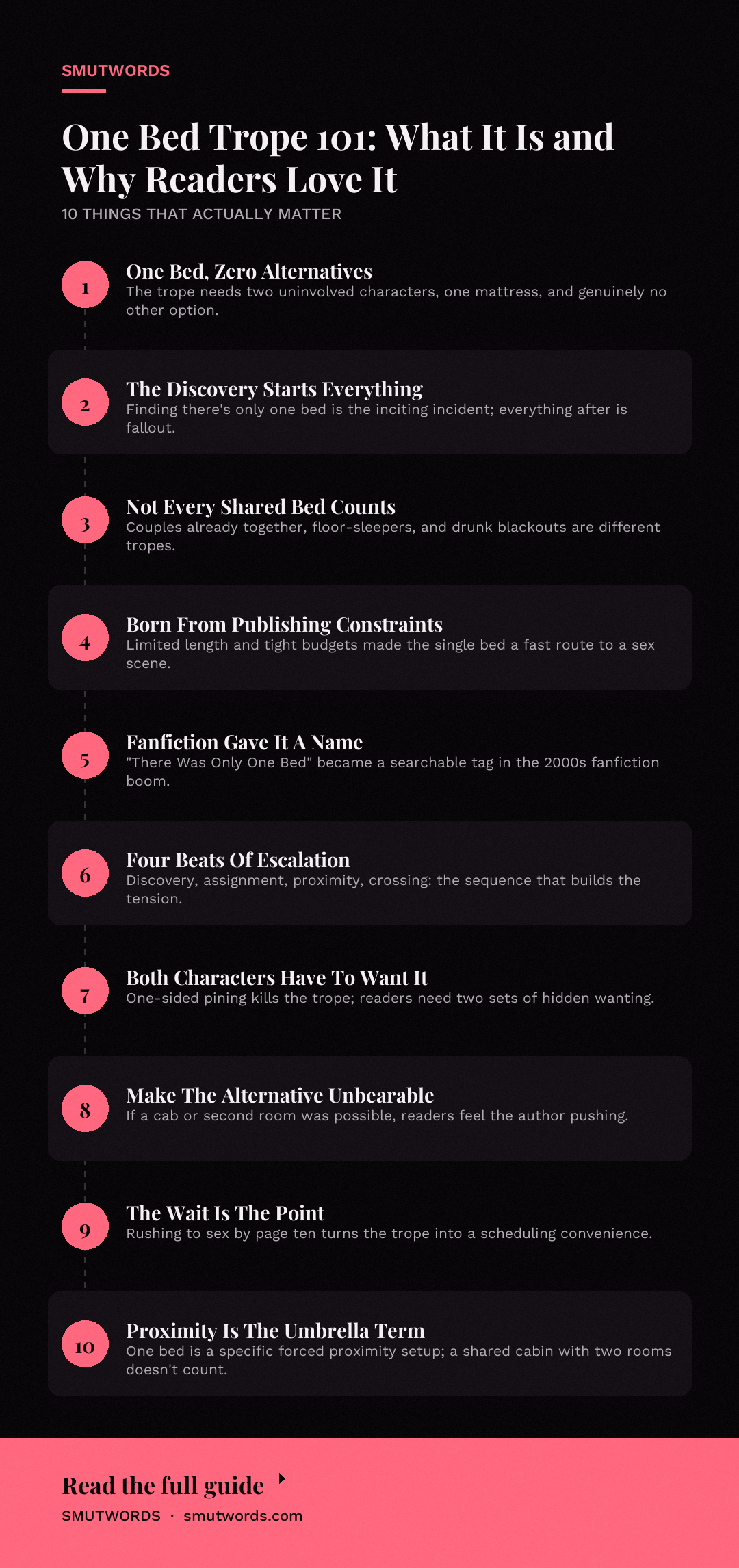
Final Thoughts
The one bed trope works because it turns a boring logistical problem into a pressure cooker. Two people, one mattress, and a night neither will admit they're dreading and hoping for in equal measure. That's the whole machine, and it hasn't stopped working.
If you're ready to read the version that best captures what the setup can do, look for a book that markets the single bed front and center and refuses to rush the first night. The best ones know the space between two bodies on the same mattress is where the entire book actually lives, and they make you wait for it. That wait is the reason to pick the book up.






Loading comments…