
A custody battle romance is a love story built on a legal fight over a child, where two adults who can barely stand to be in the same room are forced into hearings, mediation sessions, and tense handoffs in parking lots. The court schedules the contact. The child makes it personal.
And somewhere between the third continuance and the first time they both show up at the same school play, the hostility starts to bend into something else. This is one of the most reliably intense setups in contemporary romance, because it hands the couple a reason to fight that neither of them can walk away from, and a reason to keep showing up that has nothing to do with wanting each other. Yet.
If you have ever finished a book in one sitting because you needed to know whether the judge ruled before or after the leads finally kissed, you already understand the pull. The custody battle romance runs on consequence. Every scene has a cost attached, and every tender moment happens under a deadline.
What Custody Battle Romance Actually Means
The term describes a romance where the central conflict is a legal dispute over a minor child, and where that dispute is the engine driving the protagonists together rather than a subplot simmering in the background. The legal fight is not decoration. Remove it and the book collapses.
What counts: custody hearings, guardianship petitions, adoption contests, termination of parental rights cases, stepparent standing disputes, and divorce proceedings where the child becomes the battleground. What also counts is the informal version, where no lawyer appears on the page but two adults are locked in a standoff over who gets to raise a kid, and both have a legitimate claim.
What does not count: a single parent who happens to be dating. A courtroom scene that resolves an unrelated matter. A dead ex whose memory creates friction. Those are ingredients, not the dish.
For the label to fit, the child's placement has to be genuinely in question, and the love story has to grow inside that uncertainty.
A common misconception is that the child must be young, or that the biological parents must be the two leads. Neither is true. Plenty of these books pair a biological parent against a guardian, an aunt against an uncle, a stepfather against a father who just got out of prison.
The redemption arc romance overlaps heavily here, because the parent with the worst track record usually has the most ground to cover before a judge, and before a reader, will side with them.
Another misconception: readers assume the child dies, gets kidnapped, or otherwise becomes a plot device. The strongest books in this lane refuse that move. The kid stays a person with opinions, and the resolution respects those opinions instead of overriding them for a tidy ending.
Where Custody Battle Romance Comes From
This trope has a shorter pedigree than enemies-to-lovers or marriage-of-convenience, and its history is mostly a publishing story rather than a folklore one. Through the 1980s, category romance treated children almost entirely as accessories. A baby existed to force a shotgun wedding or to reveal a secret paternity in the final chapter. Custody as a sustained conflict barely registered, partly because divorce itself was still a delicate subject in mass-market romance and partly because legal procedure bored editors.
The shift came in the 1990s, when single-parent romance became a recognizable subcategory. Suddenly the heroine could be divorced, could be raising a child alone, and could be actively angry at the man who left. What those early books rarely did was make the legal fight itself the plot. The ex-husband loomed offstage, and the new love interest solved the problem by being financially stable and emotionally available.
By the 2000s, romantic suspense started treating custody as a thriller engine: kidnapping fears, forged documents, a corrupt family court judge. That era gave the trope its appetite for procedure. Readers learned what a GAL was, what a temporary order meant, what supervised visitation looked like.
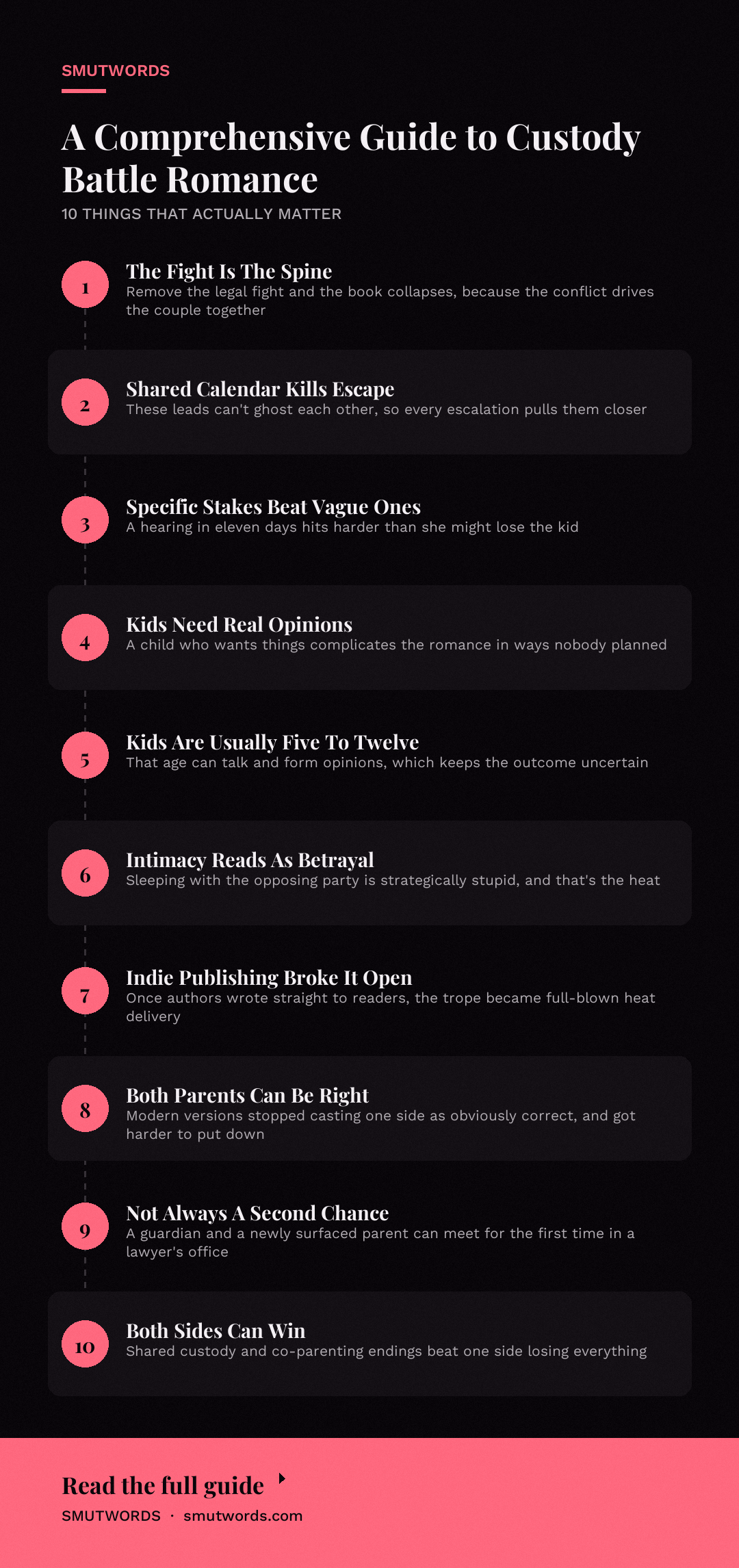
The real turning point was indie publishing. Once authors could write directly to an audience that wanted messy, high-conflict, morally gray leads, the custody battle romance stopped being a cautionary tale about divorce and became a full-blown heat delivery system.
The tropes consolidated fast: the ruthless attorney, the billionaire father, the small-town single mother, the surprise pregnancy revealed in a deposition. Wattpad and later BookTok accelerated the whole thing, because a custody hearing is inherently a cliffhanger, and cliffhangers are what get screenshotted.
What changed most over the last decade is whose side the reader is on. Older versions cast one parent as obviously correct. Modern versions increasingly let both parents be right, or both be wrong in ways that matter. The genre got better at this, and the books got harder to put down because of it.
How It Shows Up in Erotica
On the page, a custody battle romance does specific mechanical work, and you can spot a well-built one from the first chapter. The legal conflict operates as a pressure system. It gives the leads a reason to meet when they hate each other, and it punishes them for avoiding each other.
Every skipped text message has consequences beyond hurt feelings. Depositions get scheduled. Caseworkers make home visits. Someone files an emergency motion because someone else posted the wrong thing online.
The craft problem authors face is that legal procedure is dead weight on the page. A transcript is not a love scene. The strong books solve this by keeping the law mostly offstage and letting the emotional stakes carry the vocabulary. Court becomes a series of charged encounters: the hallway before the hearing, the mediation table, the moment one lead realizes the other has been documenting everything.
The forced proximity that comes with this setup is relentless and it is the trope's greatest asset. These two people cannot ghost each other. They have a shared calendar. They have to agree on a pediatrician.
Common variations authors work with:
- Divorced couple reunion: The marriage already burned down. Now they are back in front of a judge and discovering the attraction never actually left. This leans on marriage in trouble energy even after the marriage is legally over.
- Guardian versus biological parent: One lead raised the child for years. The other shows up with a blood claim and no history. Both have a real case, and the reader should struggle to pick a side.
- Stepparent rights battle: A stepparent who did the actual parenting faces losing access entirely. The other lead is often a grandparent, an ex, or a sibling of the deceased parent.
- Small-town custody clash: Everybody knows everybody, the judge went to school with someone's brother, and the gossip mill functions as a second courtroom.
- Billionaire attorney pull: The ice-cold family law litigator who has never lost, hired by one side, sleeping with the other. This is where the trope gets its sharpest edges, because professional ethics and personal want are in direct collision.
Hate to love is the natural sibling here, and the best custody books borrow its architecture: the leads begin at open war, and every escalation pulls them closer instead of pushing them apart.
Enjoyed this? Get a free book.
Join the list and we will send a complete free story straight to your inbox, plus new releases every week after that. No credit card, no catch.
The difference is the arena. In a straight hate to love, the couple can theoretically stop speaking. Here they cannot. There is a court date.
What makes a strong version work, from an editor's chair:
Specific legal stakes. "She might lose the kid" is vague. "The hearing is in eleven days and her caseworker filed an addendum recommending supervised visitation" is a ticking clock. Vague conflict produces vague tension.
A child with a personality. The child should want things, resist things, and complicate the romance in ways neither adult anticipated. When a kid likes the wrong parent, or likes both, the scene work gets much harder and much better.
Vulnerability placed where it costs something. The classic move is the aftermath of a bad hearing. One lead is sitting in a car in the parking garage, and the other one, who should absolutely not be comforting them, does it anyway. That moment only lands if the two of them have spent the previous chapters genuinely at each other's throats.
Physical intimacy that reads as a betrayal of position. The heat in these books comes from the fact that sleeping together is strategically stupid. Every touch has a consequence attached. Kissing the opposing party in the courthouse stairwell is bad lawyering and excellent fiction.
What makes a flat version: legal jargon dropped in to signal research, a child written as a plot object, and a third-act resolution where the judge hands down a ruling that conveniently solves everything. Readers can feel the cheat. If the custody outcome is the same at the end as it was at the start, the book did not need the fight.
The most underrated tool in this trope is documentation. Text message logs, therapy notes, a custody journal with dates in the margins. Authors who let the reader peek at the paperwork build dread cheaply and effectively, because everybody knows what it means when someone starts keeping records.
There is also a natural bridge here to power-exchange dynamics, since the courtroom establishes a rigid hierarchy that the romance then flips. A lead who gets ordered around all day by a judge, a lawyer, and a caseworker often wants to be the one giving orders somewhere else.
That registers as a praise kink thread in the hands of the right author: a character who has been publicly judged as insufficient and desperately wants someone to tell them they are good at something.
Custody Battle Romance vs Second Chance Romance
These two get shelved together constantly, and the confusion is legitimate because the overlap is real. Second chance romance is defined by the shared past. The leads already loved each other, it fell apart, and the book is about whether the wreckage is salvageable.
Custody battle romance is defined by the shared present conflict. It can absolutely be a second chance, and the divorced couple reunion variant usually is. But it does not have to be. Two people who have never been in a relationship can end up in a custody dispute over a niece, a godchild, or a child one of them did not know existed.
The practical test: if you remove the legal fight, does the book still have a plot? For second chance romance, yes. For custody battle romance, no. The fight is the spine, not the theme.
Frequently Asked Questions
Is custody battle romance always a second chance story?
No. The divorced couple reunion version is a second chance by definition, but plenty of books pair two people with no romantic history at all. A guardian and a newly surfaced biological parent often meet for the first time in a lawyer's office. The attraction is brand new, and so is the hostility.
Can the couple be on the same side of the case?
Yes, and this is an underused variation. Two people fighting a third party, such as a grandparent or a state agency, for the same child have a built-in alliance. The tension then comes from disagreement over method and what is actually best for the kid, not from opposing legal positions.
Do these books always end with someone losing custody?
The satisfying ones find a resolution that gives both leads a place in the child's life, which frequently means shared custody, guardianship with visitation, or a formal co-parenting arrangement. A total victory for one side usually reads as a defeat for the romance, unless the losing party was written as a genuine antagonist rather than a lead.
What is the appeal of the forced proximity in this trope?
Most romance relies on the leads choosing to keep showing up. Here they are legally obligated to. That removes the safety valve. Neither one can retreat to think things over, because mediation is Thursday and the school conference is Friday and the other person will be at both.
Is the child usually a baby?
More often the child is between five and twelve, because that age range can talk, form opinions, and make the outcome genuinely uncertain. Babies are easier to write but harder to build conflict around, since they have no preferences to disappoint.
How steamy do these books get?
They run the full range. Some play the legal fight for pure emotional tension and keep the heat moderate. Others use the pressure of the case to justify extremely charged, high-stakes sex, where the physical contact feels like crossing an enemy line. The trope supports either approach.
Final Thoughts
The custody battle romance works because it refuses to let the couple be casual about anything. Every meeting has weight, every kindness has a motive attached, and every kiss happens in a hallway where somebody could walk in and file something about it.
If you want the version that best captures the trope's full range, start with the books in the ranked list below, which covers everything from divorced couple reunion to guardian versus biological parent. Pick the one whose legal headache sounds the most emotionally expensive, and clear your evening.








Loading comments…