
What Is a Praise Kink? The Short Answer
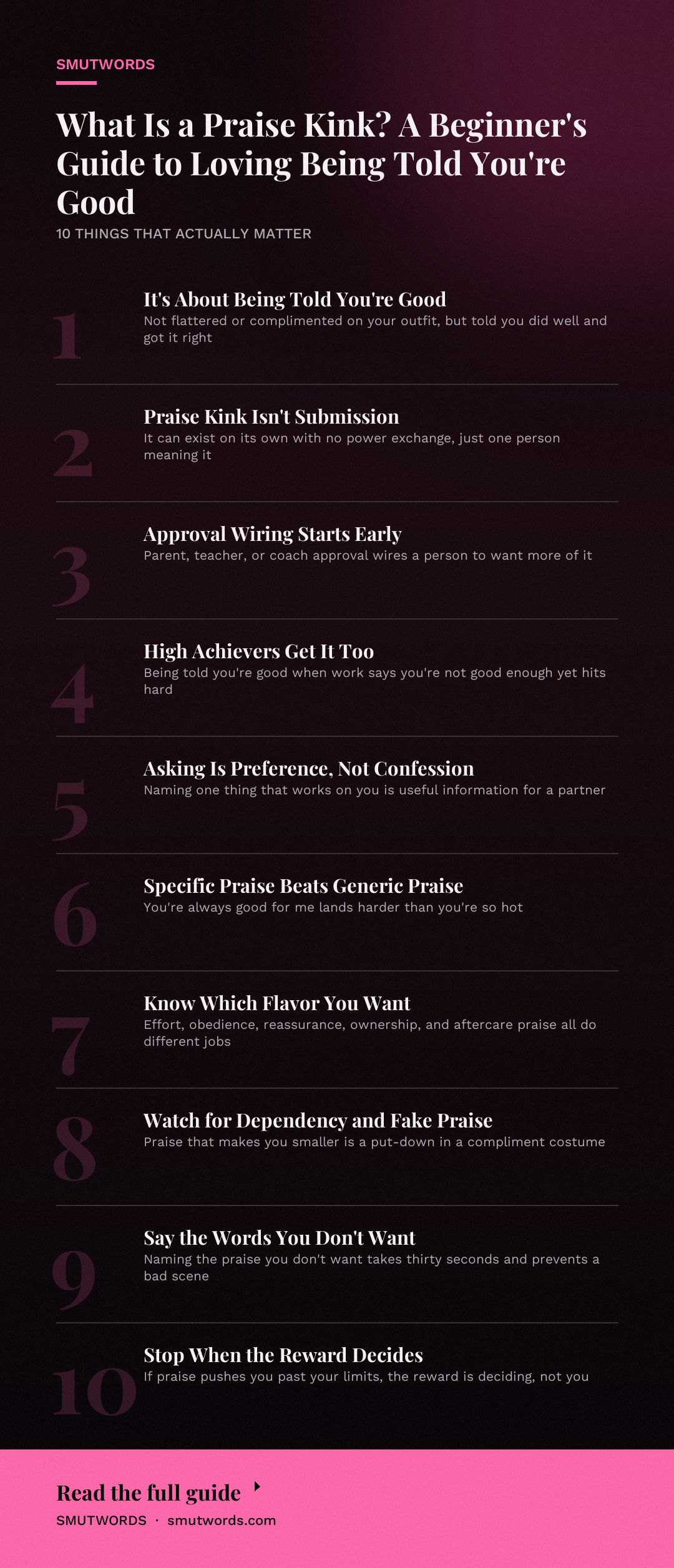
A praise kink is an erotic response to being told you're good. Not flattered, not complimented on your outfit. Told you're good: that you did well, that you're wanted, that someone is pleased with you, that you got it right.
For some people that lands as plain affection. For others it lands somewhere much lower in the body. It's one of the most common kinks out there precisely because nobody has to be talked into enjoying being told they're good at something.
It shows up in Breed Me in Stasis, where the dynamic runs on being told you're needed, but a praise kink doesn't require any particular genre, any particular gender, or any particular level of experience. If you clicked this because the phrase sounded familiar in a way you weren't expecting, you're in the right place.
This is a beginner's guide to what a praise kink actually is, why it works, how to ask for it without making it weird, and how to give it to someone who's asked. It's practical, and it takes consent seriously, because the whole kink runs on a specific kind of trust. You can't get praised well by someone who hasn't agreed to try.
What Counts as a Praise Kink (and What Doesn't)
The core of it is straightforward: words of affirmation, delivered in an erotic context, aimed at you. The words can be small ("good girl," "you're doing so well") or they can be a paragraph. What makes it a kink rather than just liking compliments is the charge. Being told you're good feels like a reward that goes through your nervous system, not just your self-esteem.
Some people get that charge from a partner's approval during sex. Others get it from being told they're doing well at something difficult, which is where the overlap with submission starts. And a lot of people who have a praise kink don't think of themselves as submissive at all. They just want the words.
Praise kink vs. a compliment kink vs. submission
These three get used interchangeably online, and they're not the same thing. A compliment kink can be more general, more about being praised for appearance or talent with no power dynamic attached. Submission involves giving up control, and praise is often how a dominant partner rewards a submissive one. A praise kink can exist entirely on its own, with no power exchange at all, just one person telling another they're good and meaning it.
Where the confusion comes in is that praise is a common tool inside power exchange. A dominant partner says "good girl" or "good boy" to mark that a submissive did the thing they were told to do. That's using praise as a reward. Someone with a praise kink who isn't into submission might still enjoy being told they're good, but the "because you obeyed me" part is doing nothing for them, sometimes the opposite.
Why Praise Kinks Are So Common
Praise hits a spot that a lot of people carry around from childhood and never fully lose: the desire to be told, explicitly, that they did well. Approval from a parent, a teacher, a coach, whatever authority figure mattered most, wires a person to want more of it. When that wiring meets adult attraction, praise becomes erotic.
There's also the relief factor. Being told you're good means, in that moment, you're not being evaluated and failing. A lot of people spend their days quietly worried they're behind, or doing it wrong, or not enough.
Praise in a sexual context interrupts that loop. It's the opposite of being assessed and found wanting.
And for people who find it hard to ask for reassurance in normal life, praise during sex is a way to get it without having to say, out loud, "please tell me I'm okay." The kink does the asking for them, which is why it often shows up alongside a strong need for approval that goes back further than the bedroom.
Who tends to have a praise kink
Anyone. That's not a dodge; it's just true. Praise kinks show up in people who are extremely confident and people who aren't, in people who like being in charge and people who don't, in people who grew up with a lot of praise and people who grew up with almost none.
The one pattern that does show up more than chance is high achievers and people with demanding jobs. Being told you're good when you spend all day being told you're not good enough yet has a specific kick to it.
If a praise kink shows up next to a submission dynamic, it also tends to sit near related kinks: being told what to do, being reminded you belong to someone, being praised for taking something difficult well. That's the same nerve bundle that runs through a lot of power-exchange fiction, including Bound to the Void Broodmother, where praise and ownership are tangled together the whole way through.
How to Tell If You Have a Praise Kink
You probably don't need a quiz. But if you want a checklist, here's one that actually tracks.
- Being called "good" during sex does more for you than a physical compliment about your body.
- You notice yourself performing harder, or trying harder, specifically when someone is watching and might say something approving.
- You find it easier to say "keep going" than "tell me I'm good," but you know exactly which one you want.
- Praise from a partner in the middle of something intense affects your breathing, your focus, or how turned on you get, in a way you can point to.
- The words matter more than the tone. You want to be told, not just touched.
- You reread messages where someone told you you did well, sometimes more than once.
Two or three of those and you're probably not just someone who likes compliments. It's worth knowing before a partner stumbles onto it by accident and wonders why you suddenly went quiet.
How to Ask for Praise Without Making It Weird
The awkwardness people feel about asking for praise is usually about sounding needy. There's a fix for that, and it starts with remembering that everyone involved has already agreed to be there. You're not asking a stranger on the street to flatter you. You're telling a partner one specific thing that works on you, which is useful information, not a confession.
Timing matters more than wording. Bringing it up during sex works for some people; for most, it goes better outside the moment, casually, somewhere private where neither of you is mid-thought. A sentence as short as "I really like it when you tell me I'm doing a good job" is enough. You don't owe anyone a backstory about your childhood.
Three ways to bring it up in real conversation
- Name it as a preference, not a kink. "I like being told I'm good" is easier to say out loud than "I have a praise kink," and they mean the same thing in practice.
- Attach it to something that already happens. If your partner already says nice things in bed, tell them which one landed and ask for more of it. You're redirecting something existing, which is a much smaller ask.
- Use fiction as a shortcut. "There's a scene in this book where he calls her good girl and I can't stop thinking about it" does a lot of work in one sentence. Books are a legitimate way to talk about a kink you haven't named yet.
If your partner's first reaction is confusion, that's fine and normal. Praise kinks are common, but they're also invisible, so plenty of people have never had a partner name one. Give them a beat.
A good way to help them along is pointing at something concrete you both already read or watch. Something like the dynamic in The Wife They All Want gives a partner a reference point without you having to build one from scratch.
How to Give Praise to Someone Who Wants It
If your partner has asked for this, the biggest mistake isn't saying the wrong thing. It's saying it too rarely, or saying it in a way that sounds like a generic compliment rather than something earned. Praise works because it's specific, and it works because it's about them, not about what they're doing to you.
Good praise names something you actually noticed. "You're always good for me" hits differently than "you're so hot." The first one tells them you were watching and that what you saw pleased you. The second one is about your reaction, not their effort.
Timing also does a lot. Praise lands hardest right after someone has pushed through something difficult or asked for something vulnerable. A quick "good" dropped in casually carries weight when it lands in the right second.
Types of praise and when each one works
- Affirmation of effort: "You did that so well." Best right after they've tried something new or pushed past a nervous moment.
- Approval of obedience: "Good girl," "Good boy," "That's exactly what I wanted." Best inside a power dynamic where you've both agreed one person is directing things.
- Reassurance: "You're not too much," "I've got you." Best when someone is anxious or in their head, praise as a way of bringing them back into the room.
- Ownership-flavored praise: "You're mine and you're doing beautifully." This is the praise-plus-belonging combo, and it runs through almost every dominant/submissive scene in the genre. If that's the flavor you want to see it in, Shared by Android Twins uses it constantly.
- Praise as aftercare: the slow, quiet kind that comes after everything's over. This one matters more than people expect, and it's worth reading up on properly. Our guide to aftercare meaning in dating and kink covers why the post-scene version of praise is doing a different job than the mid-scene version.
Common Mix-Ups: Praise Kink vs. Other Kinks
A few kinks get confused with praise often enough that it's worth separating them out.
Praise vs. degradation. Degradation runs on being told you're bad, wrong, worthless, or beneath someone, and people who enjoy it usually enjoy the humiliation, not the comfort. The two kinks can coexist in the same person, often in the same scene, but they're doing opposite things.
Confusing them is one of the fastest ways to ruin a scene for someone who wanted the reassuring half only.
Praise vs. worship. Worship is one person treating the other as something close to sacred: kissing every inch, telling them how beautiful they are, giving rather than directing. There's overlap, but worship tends to be about adoration of the body or the person, while praise is about their behavior and their effort.
Someone with a body-worship kink might not care about being told they did a good job; someone with a praise kink might not care about the adoration and just wants the approval.
Enjoyed this? Get a free book.
Join the list and we will send a complete free story straight to your inbox, plus new releases every week after that. No credit card, no catch.
Praise vs. caretaking. Caretaking involves being looked after, but it can happen silently. Praise has to be said, or written, or signaled some way. It's verbal by definition. The whole point is the words.
The cleanest test is to ask what the person wants you to be paying attention to: their effort, their body, their obedience, or their comfort. Praise is the effort-and-obedience end.
Risks, Real Ones, and How to Lower Them
This is a lower-risk kink than most, but "lower risk" isn't "no risk," and it's worth being honest about the ways it can go sideways.
The biggest one is emotional dependency. If praise becomes the only way you feel wanted, a partner withholding it even accidentally, or a dry spell, can hit much harder than it should. Praise is not a substitute for a partner who treats you well the other 23 hours of the day. If it's starting to feel like the only thing holding you up, that's worth noticing and worth talking about.
The second one is being praised in a way that's actually a put-down wearing a compliment costume. "Good girl for trying, even though you're not usually brave" is not praise. Someone who regularly wraps condescension in praise is a person to be wary of, not a dom.
The test is simple: does the sentence make you feel more wanted, or smaller? Trust the answer.
The third is misalignment with a partner who wants degradation and assumes you do too. If your partner's whole style is verbal degradation and you want praise, that's a real conversation to have, not a thing to hope resolves on its own.
All three are lowered the same way: say plainly what you want, say what you don't want, check in after, and be willing to stop the scene if something's off. Being told you're good should make you feel safer, not more exposed.
How to set boundaries with a praise kink
You want to name two things before you start: the kind of praise you want and the kind you don't, and you want a way to signal a stop that doesn't require stopping the whole scene. Something as simple as "I want to be told I'm doing well; I don't want to be compared to anyone else" is enough.
If you like praise but hate being called a pet name, say so. Praise can carry a lot of different word choices, and getting the actual words right takes thirty seconds of conversation.
If a partner praises you in a way that feels wrong, correct them once in the moment, and talk about it properly later. This works in exactly the same way any other kink works: enough information up front, adjustments in the middle, and a real conversation after.
When to Stop
Stop if you notice you're chasing the praise past your own comfort, meaning you're agreeing to things you don't want because someone told you you were good for doing them. Praise is a reward, and when rewards get attached to things you'd otherwise refuse, it's the reward doing the deciding, not you.
Stop if praise is being used to skip over your limits. "You're so good at taking it" is not consent for anything you didn't agree to. It never is.
Stop if you can't say "that wasn't the kind I wanted" without bracing for a fight. A partner who can hear feedback about a kink is someone worth doing this with; a partner who can't isn't, regardless of the kink.
And if you're someone whose praise kink is tied to a specific dynamic, it's worth knowing that enjoying it in fiction and doing it in life are two different skills. Borrow language from fiction if it helps you ask, but the negotiation is still yours to have.
Cum Drunk Confessions and Free Use Bachelorette Party both run on people being told, in different registers, that they're wanted, which is a fine place to find phrasing if you don't have your own yet. If power exchange is the part you care about, our guide to bully romance shows how far the dynamic can bend before praise stops being praise.
What to do if a praise kink goes wrong in the moment
Say something. You don't need a safeword to say "hold on" or "not that one." If the pause kills the mood, the mood wasn't worth protecting. Once you're both out of the scene, talk about what landed and what didn't, and be specific about the words rather than the feeling. "When you said I was good for doing that, I liked it; when you compared me to someone else, I didn't" is something a partner can actually use next time.
Where Praise Kinks Show Up in Fiction
If you're new to the kink and want to see it played out before you try it, fiction is a low-stakes place to start, and most of the good examples live in the same neighborhood as power-exchange and ownership dynamics.
The version where one person is doing a difficult thing beautifully and the other person watches and tells them so runs through a lot of what's on the site right now, including the quieter breed-and-belong scenes in Breed Me in Stasis.
Worth saying: reading about it doesn't teach you how to do it. Books are useful for finding language and for figuring out which flavor you actually want, but the negotiation is still a live conversation with a real person.
If you also like a specific genre dynamic, you might recognize the praise-kink undercurrent in a redemption arc romance or a rockstar romance, where a character spends most of the book trying to be good enough for someone and gets told, eventually, that they already are. That's the praise kink in its purest narrative form.
If you want the more intense, immersive version, our guide to sensory deprivation is a decent next read, since being deprived of one sense often makes the verbal part land harder, for reasons that are obvious once you think about it.
Frequently Asked Questions About Praise Kinks
Is a praise kink the same as being needy?
No. Wanting to be told you're good during sex is a preference, the same way wanting a specific position is a preference. Needy is a word people use to shame the ask, not a real category.
Can I have a praise kink and a degradation kink at the same time?
Yes, and plenty of people do. In practice this usually means wanting the degradation to come with an eventual return to care, or wanting praise inside a scene that has some edge to it. It's your job to spell out the sequence for a partner, since nobody will guess it.
What if my partner thinks it's childish?
People who call praise childish usually haven't tried being told they're good by someone they're attracted to. You don't have to convince them. You can point them at a book that includes it, ask them to read one scene, and let the material do the work.
Does a praise kink mean I have low self-esteem?
Not necessarily, and the assumption gets made far too often. High-performing, confident people have praise kinks at least as often as anyone else. The kink is about receiving approval from a specific person, not about lacking a sense of self.
Final Thoughts
A praise kink is one of the simplest kinks to try and one of the easiest to get wrong, because the whole thing rests on specific words delivered at the right moment by someone who's actually paying attention.
Ask for it plainly, name the words you want and the ones you don't, and check in after. If you want a book that gets the dynamic right before you bring it up with anyone, start with Breed Me in Stasis, where being told you're wanted and being told you're good are the same sentence.






Loading comments…