
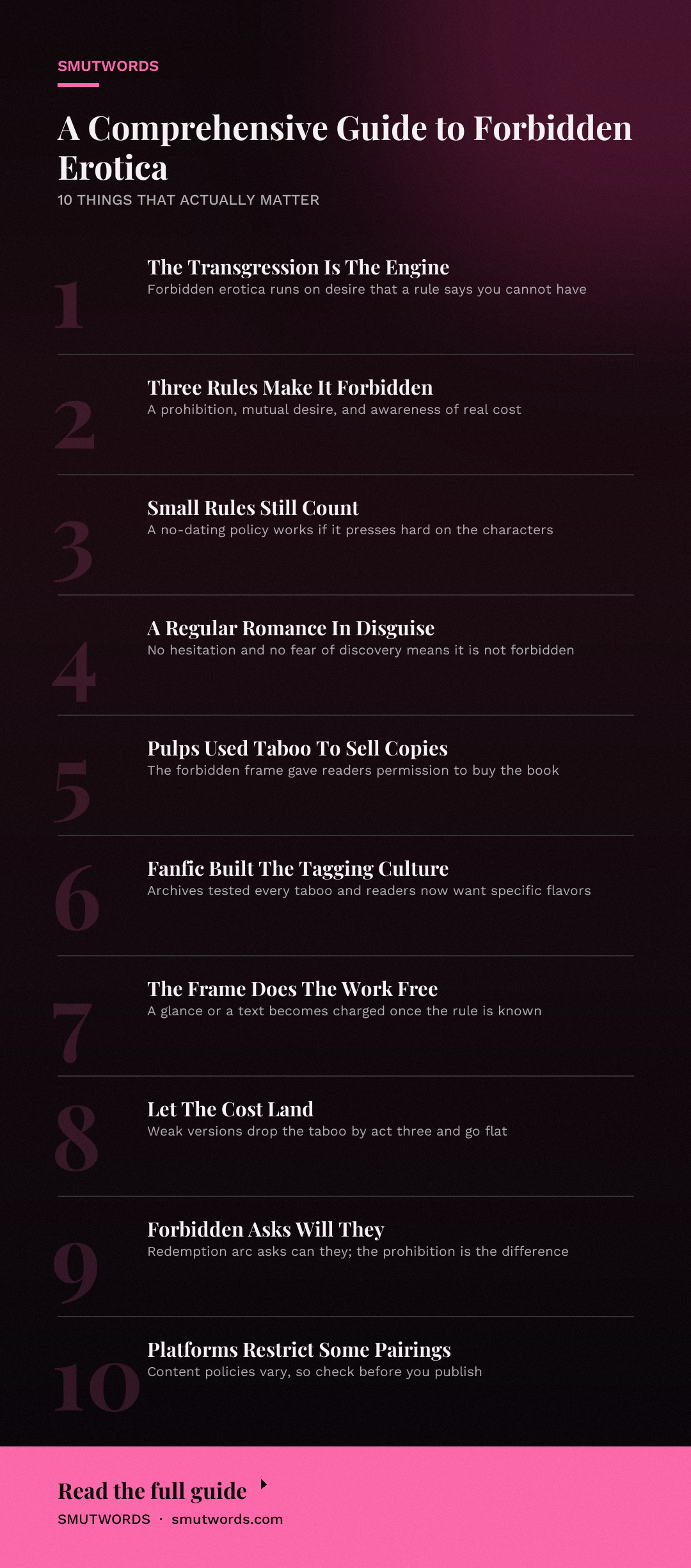
Forbidden erotica is erotic fiction built around desire that the rules say you cannot have: the best friend's partner, the priest, the stepbrother, the professor who controls your grade, the married man in the next hotel room. The transgression is the engine.
The reader knows from page one that this attraction is dangerous, loaded with consequences, and they read on anyway, because the charge comes from exactly that knowledge. Everything else in the genre is a shell around that one fact.
If you landed here, you probably want more than a one-line definition. You want to know why a scene where two people simply touch hands can hit harder in a forbidden story than an explicit scene anywhere else, what separates a good forbidden book from a flat one, and where the trope came from in the first place. That is what this guide covers, in as much detail as the subject deserves.
What Forbidden Erotica Actually Means
The name is literal. Forbidden erotica is erotic fiction centered on a desire that some real or internalized rule declares off limits.
That rule can be social (he is your boss), religious (your faith forbids this), familial (she is your stepsister), or professional (he is your therapist). The common thread is not the specific taboo. It is that a rule exists, both characters know it exists, and the attraction pushes against it anyway.
Three things have to be true for a story to genuinely belong in this category:
- A stated or understood prohibition. The reader has to know what rule is being broken, and so do the characters. Vague rebellion is not enough.
- Mutual or near-mutual desire. Forbidden erotica lives on the tension of two people who both want what they should not. If only one party wants it, you are writing a different story, likely closer to the power dynamics of stalker romance.
- Awareness of cost. Someone stands to lose something real: a marriage, a job, a family, a sense of self. The stakes are what convert a simple crush into a forbidden one.
What does not count is broad and worth naming, because readers get sloppy with the label. A romance between two consenting adults with no rule against them is not forbidden, no matter how dramatic. A villain who simply does bad things is not forbidden either. And a story where the characters never actually feel the weight of the prohibition, where nobody hesitates or fears discovery, is just a regular romance wearing a forbidden coat.
The most common misconception is that forbidden erotica requires an extreme taboo. It does not. The prohibition can be as small as a workplace no-dating policy. What matters is how heavily that rule presses on the characters, not how scandalous it sounds to an outsider.
Where Forbidden Erotica Comes From
Forbidden love is one of the oldest structures in Western storytelling, going back to Tristan and Isolde, Romeo and Juliet, and roughly half the courtly love tradition. But forbidden erotica, as a publishing category distinct from literary tragedy, is much younger and much more commercial. It grew up in the twentieth century alongside the paperback.
The mid-century pulps and the later erotic presses of the sixties and seventies discovered that a forbidden frame sold copies. The taboo gave readers permission to buy the book. There was a cover story built in: this is a story about consequences, not just sex. The framing protected both the publisher and the reader, and it shaped the genre's DNA in ways that persist today.
The internet changed the trope's history more than any single book. Fanfiction archives in the late nineties and early 2000s became the largest laboratory for forbidden erotica ever assembled. Writers tested every prohibition imaginable, tagged them, and built communities around specific flavors of taboo. When those writers moved into self-publishing in the 2010s, they brought the tagging culture with them.
That is why the modern forbidden market is so granular. Readers do not just want forbidden erotica. They want professor and student, or priest and parishioner, or step-siblings after the parents' wedding. The specificity is the point, and it is a direct inheritance from two decades of fanfic categorization.
The other major shift is consent framing. Older forbidden erotica often ran on pure power imbalance with no interrogation of it.
Contemporary versions, especially since the 2010s, tend to make the characters explicitly aware of the imbalance and choose anyway. The rule is still broken. The characters are just allowed to be adults about it.
How It Shows Up in Erotica
Here is the craft observation that matters most: the forbidden frame does the writer's emotional work for free. Any ordinary scene, a hand on a wrist, eye contact across a room, a car ride home, becomes charged the moment the reader knows the attraction is off limits. The same paragraph written into a normal romance would read as filler. Inside a forbidden frame, it reads as a fuse.
That is why strong forbidden erotica is often quieter than readers expect. The best versions do not reach for extreme acts in the first chapter. They build anticipation by stacking small violations: a glance held two seconds too long, a text sent at midnight, a question asked that should not have been asked. Each small breach raises the temperature without spending the big moment.
Common variations authors use:
- Professor or boss and subordinate. The rule is institutional. The risk is career-ending, which keeps the stakes concrete and immediate.
- Step-siblings or step-parents. The rule is familial. The tension comes from proximity and the impossibility of avoiding each other at the dinner table.
- Religious or purity culture conflict. The rule is internalized. The characters are not fighting an external authority so much as a voice in their own heads, which tends to produce the most anguished interiority.
- Adultery and illicit affairs. The rule is a third person's marriage. The guilt is continuous and the discovery risk is constant.
- Age gap with a social barrier. The rule is generational. What matters is not the number but the specific social cost to both parties.
- Secret relationships. The rule is public knowledge. The couple is together and can tell no one, which keeps every scene in two layers: what they do and what they pretend.
What separates a strong forbidden story from a flat one almost always comes down to one choice: whether the writer lets the cost land.
Enjoyed this? Get a free book.
Join the list and we will send a complete free story straight to your inbox, plus new releases every week after that. No credit card, no catch.
Weak versions establish the taboo and then forget it exists halfway through. The characters get their scenes, the rule stops pressing, and the book becomes a normal romance by the third act. Strong versions keep the consequence present to the last page. The characters know what they are risking, and the reader feels it in every scene, not just the first one.
The other differentiator is the choice point. Forbidden erotica earns its ending when a character faces a real decision: keep the secret or tell the truth, leave the marriage or stay, take the job or the person. Books that skip the choice and simply let the couple end up together without a reckoning feel hollow, because the whole structure was built to force that moment.
If you want a parallel in the professional-barrier category, editor and author relationships run on nearly identical machinery, and it is worth reading how that specific dynamic plays out in our guide to editor/author romance. The rule differs. The engine does not.
Forbidden Erotica vs Redemption Arc Romance
These two tropes get confused constantly, because they overlap in dark romance and often appear in the same book. They are not the same thing, and knowing the difference helps readers find what they actually want.
Forbidden erotica is defined by the prohibition. The tension comes from the rule: whether they will break it, whether they will be caught, what happens if they are. The question the reader is turning pages to answer is will they.
Redemption arc romance is defined by the recovery. The tension comes from a character who has done something wrong and is trying to become someone who deserves love. The question the reader is turning pages to answer is can they. There may be no rule against the couple at all.
The two stack well. A forbidden lover with a dark past is a common combination. But if the prohibition is doing the heavy lifting in a book, you are reading forbidden erotica even if the characters have backstories worth redeeming. If the recovery is doing the work and the couple faces no real rule against them, you are reading a redemption arc.
One more useful distinction: forbidden erotica is not the same as possessive or jealous dynamics, which are about how one partner feels about the other rather than what the world says about them. If you are trying to sort out the difference between those two flavors of intensity, our breakdown of possessive sex vs jealousy kink covers it in plain terms.
Frequently Asked Questions
What counts as forbidden erotica?
Any erotic story where a real prohibition stands between the characters and their desire, and both parties know it. That includes institutional rules, religious rules, family rules, and social ones. The specific taboo matters less than whether the rule presses on the characters throughout the book.
Is forbidden erotica the same as taboo romance?
In practice the two terms are used interchangeably by most readers and retailers. "Taboo romance" tends to emphasize the specific act or relationship being off limits, while "forbidden erotica" tends to emphasize the prohibition and the risk of breaking it. The overlap is nearly total.
Why do readers like forbidden erotica so much?
The frame converts ordinary scenes into high-stakes ones. A glance, a touch, a text message all carry the risk of discovery, and readers get the thrill of wanting what is not allowed without any real-world consequence. The genre also delivers a built-in moral choice at the climax, which makes for satisfying endings.
Is forbidden erotica always about cheating?
No. Infidelity is one common variant, but plenty of forbidden erotica has nothing to do with a third party. Professor and student, step-siblings, clergy, and boss-employee stories all involve rules that have nothing to do with an existing marriage.
Does forbidden erotica always have a happy ending?
Not always, but romance-category forbidden erotica usually does. The characters find a way to be together, often by leaving the situation that made the relationship forbidden in the first place. Darker versions sometimes end in tragedy or ambiguity, which is more common in literary and fanfic-adjacent work than in commercial romance.
Are there rules about writing forbidden erotica for publication?
Yes, and they vary by platform. Many retailers restrict content involving family relationships or underage characters, which is why step-romance and age-gap stories are common while other pairings get filtered out. Always check the specific platform's content policy before publishing, because the rules differ significantly between major retailers and direct-sale sites.
Final Thoughts
Forbidden erotica works because the reader already knows the rule, and the writer only has to apply pressure. Get the prohibition clear in the first chapter, keep the cost present all the way through, and let the choice at the end actually hurt before it resolves. That formula has carried the trope from paperback pulps to tagged fanfic archives to the current self-published boom, and it will keep carrying it.
If you want a place to start, our ranked list of the best forbidden erotica books on this page is built from the current catalog and sorted by exactly the qualities described above. Pick one, and pay attention to how early the rule gets established. You will see the machinery working in the first ten pages.






Loading comments…