An editor/author romance is a love story built on the working relationship between someone who shapes books and someone who writes them. The editor has the red pen, the deadline, and the professional authority. The author has the raw talent, the fragile ego, and everything the editor wants to touch.
The friction between those two positions is the entire engine of the trope. It runs on the specific, underrated intimacy of two people staring at the same sentence and disagreeing about whether it belongs.
What Editor/Author Romance Actually Means
The label describes a dynamic first and a plot second. What matters is that one character holds professional authority over the other's creative work, and that authority translates into tension the moment it stops being purely professional. The manuscript becomes the third character in the room.
A book can qualify as an editor/author romance even if the two characters never share a job title with a real publishing house. The core ingredients are narrower than "one works in publishing":
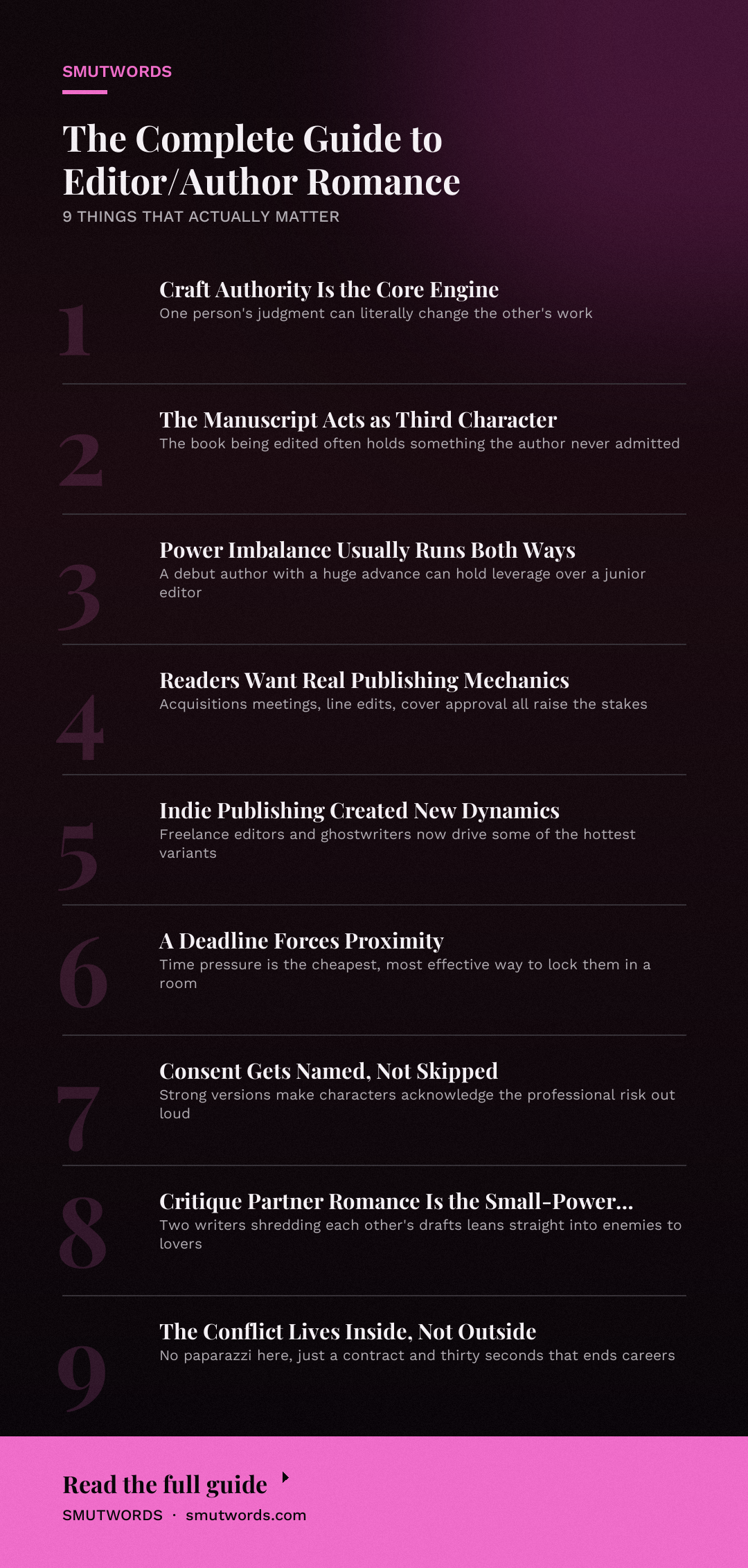
- A power imbalance rooted in craft. One person's judgment can literally change the other's work. Rejections, revisions, and editorial notes carry real weight.
- Shared investment in the same text. The editor is not a bystander. They are inside the sentences, arguing about a word choice at 1 a.m.
- A deadline or contract forcing proximity. The professional relationship supplies the excuse for how often they end up alone together.
- An ethical wire the characters know they are walking. Sleeping with your editor or your author is a professional risk whether the company handbook says so or not.
What does not count is looser than readers assume. If a character edits books for a living but the love interest is a bartender, that is a workplace romance, not this trope. Conversely, a "no title, no contract" version where a freelance beta reader shreds a friend's draft qualifies completely, because the red-pen authority is real even without a job title.
The most common misconception is that this trope is inherently about coercion. It can be written that way, and some dark romance does. But the version that dominates the category is about two competent adults negotiating a mutual risk.
The editor wants the book to be good. The author wants to be understood. Those two wants blur fast.
A second misconception: readers sometimes assume the editor is always the more powerful character. In practice plenty of these books flip it. A debut author with a massive advance and a hot temper has plenty of leverage over a junior editor whose whole career rides on that book selling. Power in this trope is rarely a straight line.
Where Editor/Author Romance Comes From
The trope has been a recognizable publishing-industry plot since at least the mid-twentieth century, when mass-market paperback houses made editors into household-adjacent figures.
The setup kept appearing in category romance throughout the seventies and eighties, usually with the editor as a stern, older man and the author as a young woman whose talent he "discovers." Plenty of those books read today as pure wish fulfillment with a boss-employee framework. Readers who grew up on them still have a soft spot for the stern-editor archetype.
The real shift came in the nineties and 2000s, when the romance industry itself became subject to its own scrutiny. Blogs, review sites, and eventually social media pulled the curtain back on how publishing works. Readers started caring about the mechanical reality: acquisitions meetings, copy edits, cover approval, the difference between a line edit and a developmental one. Editor/author romance evolved alongside that literacy.
By the 2010s the subgenre had gotten specific in a new way. The books no longer treat the editor as an abstract gatekeeper. They name the job.
The Job Titles Get Real
Developmental editor. Literary agent. Acquisitions editor. Ghostwriter.
Each title carries its own flavor of authority, and authors started leaning into the technical texture because readers eat it up. There is something undeniably hot about a character who can say, "Your third act collapses because you're afraid of your own protagonist," and be right.
Indie Publishing Rewrites the Dynamic
In the last decade the trope has also absorbed the rise of self-publishing and indie romance, which created a second wave of dynamics. Freelance editors hired directly by authors. Agents who scout indie bestsellers. Ghostwriters who do the actual writing under someone else's byline.
The ghostwriter romance is essentially this trope with the credit question welded on, and it has become one of the most popular variants on the market.
Writers Writing Their Own Industry
One more modern development worth naming: the trope has gotten self-referential. Romance writers write editor/author romance as a way of processing their own industry.
The result is a subgenre that is unusually honest about its own machinery, which is part of why it reads sharper than the average workplace romance. For a broader look at how that machinery plays out in adjacent subgenres, SmutWords has pieces on possessive sex vs jealousy kink and on primal play that cover territory this trope keeps borrowing from.
How It Shows Up in Erotica
The craft move that makes this trope work is that the manuscript has to be real on the page. If the editor's notes are vague ("I just think it needs more heart"), the book loses the entire reason the dynamic is hot. The strongest versions show the actual sentences under discussion.
You, the reader, get to watch the editor point at a specific line and say something that lands like a slap. Then you watch the author's face do something complicated, and then you watch one of them stand up from the chair. The editing itself becomes foreplay because the stakes of the criticism are legible.
Enjoyed this? Get a free book.
Join the list and we will send a complete free story straight to your inbox, plus new releases every week after that. No credit card, no catch.
A strong editor/author romance usually does four things reliably well:
- Establishes craft authority early. The editor proves they are right about the book at least once before they get the author into bed. Otherwise the power dynamic reads as bullying.
- Uses the manuscript as a mirror. The book being edited often contains something autobiographical the author did not admit to, and the editor notices. That recognition is the emotional core of the trope more often than any single sex scene.
- Puts a deadline on the clock. A two-week intensive revision window, a launch date, an agent's ultimatum. Time pressure is the cheapest and most effective way to force proximity.
- Makes the ethical problem explicit. The characters should know they are risking something. The friction between "we shouldn't" and "we're going to" is the actual product.
The flat versions skip step two. If the manuscript is just a MacGuffin, a document that happens to exist so the characters have a reason to be in the same room, the trope collapses into generic office romance. The manuscript has to mean something specific to both people, and the meaning has to conflict.
Common variations authors reach for:
- Stern editor / difficult genius. The classic. He or she has a reputation for being brutal, the author has a reputation for being impossible, and the editing sessions turn into fights that end in someone's back against a door.
- Reclusive author and the editor sent to crack them. A common shape: the author won't take calls, won't leave the house, and the editor has to physically show up. This variant borrows heavily from celebrity romance energy while staying closer to home.
- Ghostwriter falls for the client. As noted, the credit question adds a layer of ache. The ghostwriter writes the words the client gets famous for, and the sex scenes tend to be loaded with that displacement.
- Literary agent / debut author. Narrower age gap than the classic, high professional stakes, and almost always built around a single submission that shouldn't have worked but did.
- Critique partner romance. The power imbalance is smallest here and the trope leans more toward enemies to lovers. Two writers shredding each other's drafts until they can't pretend the tension is purely editorial.
- Editor as the submissive one. A confident inversion: the person with the red pen during the day wants to be told what to do at night. The reversal usually drives the back half of the book.
The strongest versions handle the consent question head-on because the trope invites it. When one person has institutional power over the other's money and career, smart authors do not pretend that is neutral. They make the characters acknowledge it, then decide what they are going to do anyway. That acknowledgment is what separates a grown-up editor/author romance from a fantasy about your boss cornering you in the break room.
There is also a voyeurism layer worth naming, since editors spend entire books reading things the author never intended to show anyone. The editor becomes a sanctioned witness to the author's most private sentences before they witness the body. If you want the mechanics of that particular dynamic in more depth, the SmutWords piece on voyeurism covers the kink this trope borrows from constantly.
Editor/Author Romance vs Celebrity Romance
These two get confused because both feature a famous or semi-famous person and the ordinary professional who orbits them. The distinction matters.
In a celebrity romance, the famous person's fame is the central problem. Paparazzi, fans, image management, the fear of being turned into a tabloid item. The tension comes from the outside world pressing in.
In an editor/author romance, the famous person is usually famous only in a narrow, industry-specific way most people have never heard of. The pressure is internal and professional. It comes from a contract, a deadline, and the uncomfortable fact that one of them can end the other's career with a decision that takes thirty seconds.
Plenty of books stack the two. A bestseller-editor relationship qualifies as both, and the subgenre sometimes leans on that overlap to get the private intimacy of the editor dynamic and the public spectacle of the celebrity dynamic in the same manuscript.
If you are trying to pick a book and only one of these fits what you want, look at where the conflict actually lives. Strangers with cameras: celebrity romance. Two people fighting about a chapter in a locked office: editor/author.
Frequently Asked Questions
Is editor/author romance the same as boss/employee romance?
They overlap but they are not identical. Boss/employee romance is usually about workplace hierarchy and proximity. Editor/author romance is about authority over a specific creative work the author cares about, which gives the dynamic a sharper emotional edge.
The editor is not just the author's superior. The editor is the person deciding whether the author's sentences are good enough.
Do editor/author romances have to include power imbalance as a problem?
No, but the strongest ones do. If a book ignores the professional risk entirely, the characters can read as thoughtless. Most strong entries in the trope make the two romantic leads actively negotiate the conflict, sometimes by waiting until the contract ends, sometimes by deciding the risk is worth it. Either choice works as long as the characters are aware they are choosing.
What kinds of characters usually appear in this trope?
Recurring archetypes: the cold, exacting editor with a soft spot for one author's prose; the difficult, brilliant author who cannot handle criticism; the junior editor who lands a career-making author and has to hold their ground; the ghostwriter with feelings about a client getting credit. The trope also runs well with older female editor / younger male author, which has become more common in the last ten years.
How explicit do these books usually get?
It varies widely, from closed-door to fully explicit. The trope is more common in steamy contemporary romance than in straight literary romance, and darker versions sometimes push further into redemption arc romance territory if the editor's early behavior crosses a line and has to be atoned for. There are also plenty of books where the heat comes almost entirely from the manuscript feedback scenes, which are more charged than a lot of actual sex scenes in the genre.
Where does the phrase "critique partner romance" fit in?
It is a specific variant of the trope where the two characters edit each other's work rather than one holding professional authority over the other. The power imbalance shrinks, so those books tend to lean harder on the enemies-to-lovers engine. Both fall under the editor/author umbrella.
Is this trope common in dark romance?
Yes, and the dark end of the category pushes the coercion angle much harder than the mainstream version. Since your question is probably about whether you want that version: assume dark romance editor/author books will feature the editor deliberately exploiting the professional relationship, and check the content warnings before you commit.
Final Thoughts
The trope works because it takes the thing writers are most vulnerable about, their actual sentences, and makes a character want to get inside it. The best editor/author romance you can pick up right now is a locked-room, dead-of-night revision story where the manuscript fights back as hard as the two characters do. Start there and work forward.






Loading comments…