
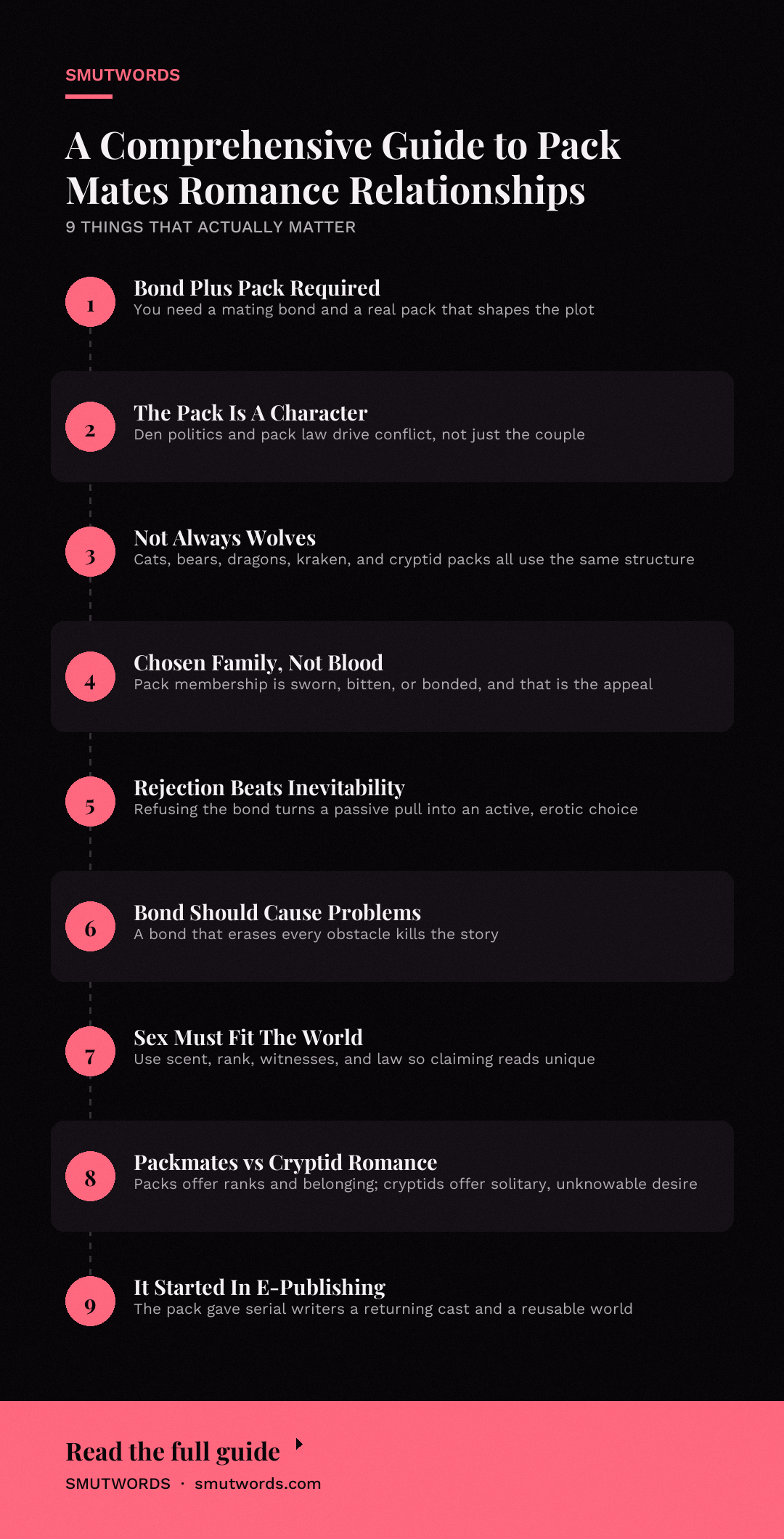
Pack mates romance is the subgenre where werewolves, shifters, or other pack-bound creatures form mating bonds that tie a central couple to a larger group. That group functions as family, security, politics, and sometimes a second (or third) romantic axis all at once.
You get the fated pull between two people, but you also get the den, the hierarchy, the pack mother who hates you, the alpha who wants you dead, and the beta who would die for you. The bond is biological, the belonging is emotional, and the pack is a character in its own right. If you came looking for a definition that goes past one sentence, this is the long version.
What Pack Mates Romance Actually Means
The core unit is the mate bond. Two people, one connection, usually involuntary, usually permanent, usually announced by scent, a mark, a heat cycle, or a wordless recognition the moment they lock eyes. That part overlaps with a lot of paranormal romance. What makes pack mates romance distinct is that the bond does not stop at the pair.
A mating bond in this subgenre enrolls you in a structure. You gain a rank. You gain obligations to people you did not choose.
You inherit a den, a territory, and a set of relationships that demand loyalty the way a marriage demands fidelity. The couple is the engine, but the pack is the chassis, the roads, and every other car on them.
So what counts? A lone wolf who mates and flies off into the sunset is not pack mates romance, even if the hero has a wolf inside him. A story where the heroine joins a pack but never forms a mate bond is closer to pack fiction or omegaverse-adjacent community romance. To land squarely in this category you generally need both: a mating bond and a functional pack that shapes the plot.
Common misconceptions are worth clearing up.
- It must be a wolf. Wolves dominate, but big cats, bears, dragons, and mixed-species packs all appear. Some writers run the same structure with kraken or cryptid communities.
- It's a love triangle. Usually it isn't. Third parties create tension, but the bond itself is typically single-target and unmistakable.
- The pack is just background. In strong entries the pack drives the conflict. Den politics, succession fights, and pack law generate more page time than the couple's first kiss.
- It's always biological family by blood. Pack membership is chosen, sworn, bitten, or bonded. That chosen-family framing is a large part of the appeal.
One more distinction matters for browsing. Pack mates romance overlaps heavily with pack dynamics, which describes the internal power structure (alpha, beta, omega, rank, submission, aggression) rather than the romantic bond. You can have pack dynamics without a mating plot, and you can have a mating plot inside a pack that barely enforces rank. Most books use both, in different proportions.
Where Pack Mates Romance Comes From
The honest history here is a publishing history, because pack mates romance as a recognizable commercial category is younger than most readers assume. Werewolf fiction has deep roots in horror and folklore, but the erotic and romantic version, where the bite is a seduction and the pack is a household, took shape in the late 1990s and exploded in the 2000s through small presses and then digital-first publishers.
Paranormal romance as a shelf was hot in that decade, and werewolves were the workhorse. Vampires got the prestige; wolves got the serials. Writers producing three or four books a year for e-publishers needed structures that could sustain long series, and the pack was perfect. It gave every book a returning cast, a built-in setting, and a new couple without rebuilding the world each time.
Two developments pushed it further. First, the fated-mate device migrated in from fan fiction and online serials, where soulmate bonds were a staple. Second, the omegaverse wave of the 2010s introduced heat cycles, scenting, and designation language to a much wider audience, and pack stories absorbed all of it. By the mid-2010s, the standard beats readers now expect (recognition, marking, heat, rejection, second-chance) had hardened into a formula.
The most interesting shift is in the pack itself. Early entries wrote the alpha as an absolute monarch and treated his authority as romantic. Current books interrogate that. A lot of the most popular work now asks what happens to the person who did not consent to the hierarchy, which is exactly why the rejected mate variant has taken over the category.
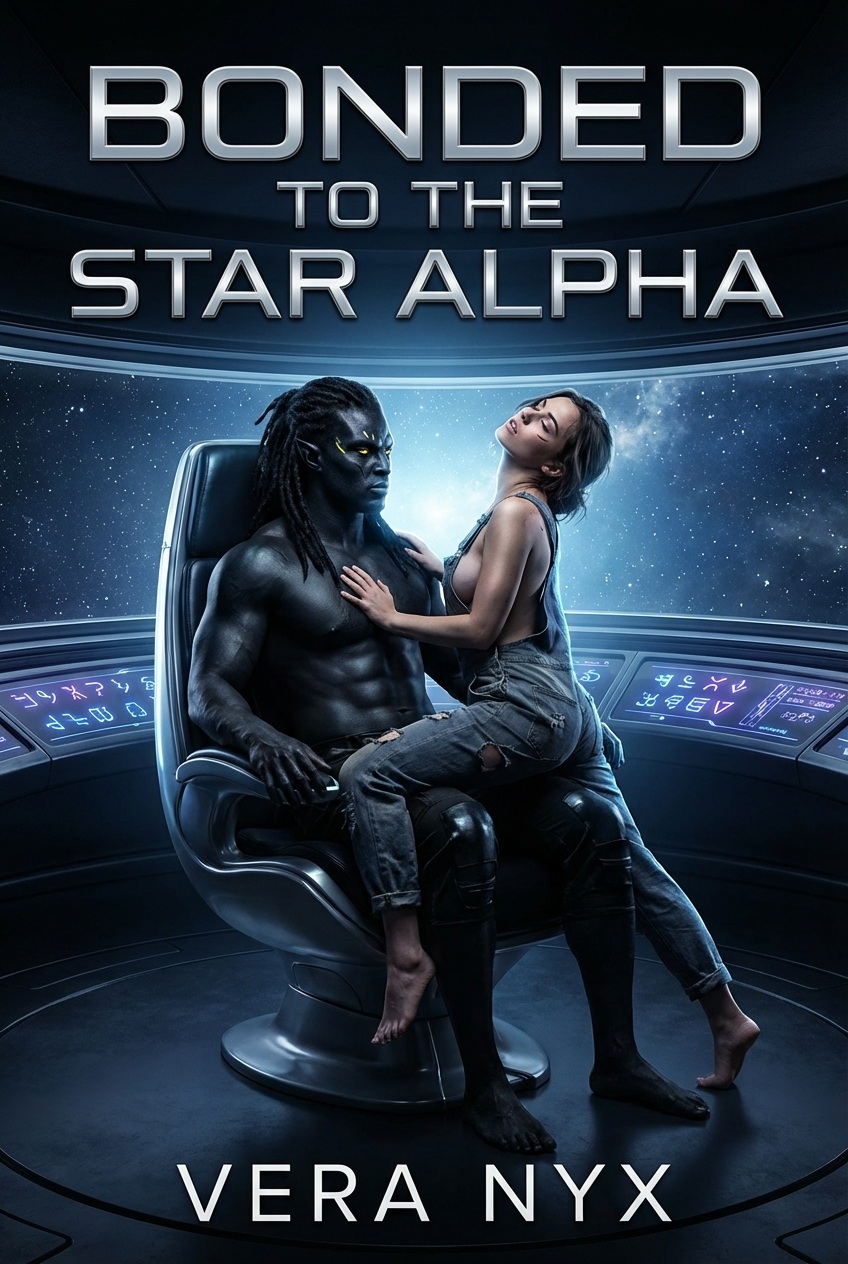
Worth noting: the structure also travels. Move the same dynamics into space and you get alien romance with crew bonds instead of dens. Move them into the old woods and you get elf romance with courts and blood oaths. The pack is portable, which is a large part of why it keeps showing up in new skins.
How It Shows Up in Erotica
Craft-wise, the interesting problem of pack mates romance is that you have two intimacy engines running at once and they compete for heat. The mate bond produces immediate, overwhelming urgency. The pack produces slow, compounding tension. Strong authors alternate them deliberately rather than letting one drown the other.
Here is what the page actually does, in practice.
Recognition scenes. The first meeting is where the subgenre earns its money. Scent does most of the work. The prose slows down, the body overrules the mind, and the heroine usually has a conflicting goal that the bond steamrolls.
Weak versions describe the feeling. Strong versions show the heroine making one bad decision because of it.
Marking and claiming. The bite, the brand, the scar, the name spoken over a pulse point. This is where pack mates romance gets genuinely filthy, because claiming is a sex scene and a legal act and a public statement simultaneously. Books that treat the mark as pure decoration waste it.
Heat and rut. Cyclical, involuntary, and famously used to bypass hesitation. The heat sequence is a staple of pack heat as a variant, and its craft function is to give characters permission the plot has not yet earned. That is a legitimate tool and it works, though it flattens fast if nothing changes between partners afterward.
Pack scenes. Dinners, runs, challenges, funerals, the moment the whole den falls silent when a rival walks in. These are ensemble scenes, and ensemble is where pack mates romance separates itself from standard monster romance, which tends to keep the cast small. There is a useful comparison point in our breakdown of monster romance vs alien romance, since creature-romance readers often blur all three shelves together.
Rejection. The rejected mate variant has become the single most reliable plot engine in the subgenre. One partner denies the bond, usually publicly, and the rest of the book is the fallout. It works because rejection converts a passive magical connection into an active choice, and choice is always more erotic than inevitability.
Common variations worth knowing by name:
- Fated pack: the bond arrives unbidden and the conflict is resistance rather than pursuit.
- Rejected mate: bond refused, dignity destroyed, second chance or revenge follows.
- Pack heat: shared heat cycles inside a group, often polyamorous.
- Alpha succession: the mate bond puts a character in line for leadership, whether they want it or not.
- Rival pack / enemy pack: the bond crosses a territorial line and turns into a diplomatic crisis.
- Omega-focused: designation language and protection dynamics borrowed from omegaverse.
- Human in the den: an outsider mate navigating rules everyone else already knows.
What separates a good one from a flat one comes down to three things.
Enjoyed this? Get a free book.
Join the list and we will send a complete free story straight to your inbox, plus new releases every week after that. No credit card, no catch.
First, the pack has to have opinions. If the secondary characters exist only to congratulate the couple, there is no story, only validation. The strongest books give at least two pack members real agendas that conflict with the bond.
Second, the bond cannot solve the plot. Where pack mates romance goes wrong is when the mate bond becomes a magic wand that erases every obstacle. The bond should create at least as many problems as it resolves.
Third, the sex has to be specific to the world.
A claiming scene in a pack should not read like a claiming scene in any other subgenre. Use the scent, the rank, the witnesses, the law. There is a real craft argument here that applies broadly: constraints produce better scenes, which is why our guide to restraints for beginners makes the same point about physical restriction. A bond with rules is more interesting than a bond with none.
What a Strong Scene Looks Like
Take a challenge scene. A rival alpha contests the pack leader, the heroine's mate, in front of everyone. A weak version stages the fight and ends with victory.
A strong version uses the fight to establish that the heroine's mate bond has political weight, that her body reacted to the challenger's scent and she hated it, and that the pack watched her react. Three conflicts in one scene, and the sex afterward has something to discharge.
That is the density pack mates romance can reach when it is written well, and it is why the subgenre supports such long series.
Pack Mates Romance vs Cryptid Romance
These two get confused constantly, and the confusion is understandable because both involve nonhuman partners in rural or wild settings with territorial instincts. The difference is structural.
In pack mates romance, the creature community is organized, hierarchical, socially legible, and offers the protagonist a place in it. There are rules, ranks, and a group the reader can learn. The appeal is belonging.
In cryptid romance, the partner is usually solitary, uncatalogued, and unknowable. Bigfoot, mothman, lake monsters. There is often no community at all, and the appeal is the opposite: being chosen by something that does not fit anywhere and does not want to. Isolation as intimacy.
If you find yourself wanting the den, the ranks, and the found family, you want pack mates romance. If the idea of a whole society makes you tired and you would rather have one enormous strange creature in a cabin, you want cryptids. Both are valid, and plenty of readers keep a foot in each.
Frequently Asked Questions
What is pack mates romance in simple terms?
A romance subgenre where a mating bond links two shifters (or a shifter and a human) and simultaneously enrolls them in a pack that functions as family, government, and social world. The couple's relationship and the pack's demands are both central to the plot.
Do pack mates romances always include werewolves?
No. Wolves are the most common, but the structure works with any territorial species. Cats, bears, dragons, and mixed packs all appear regularly, and the same skeleton gets reused in science fiction and fantasy settings without the animal element at all.
What is a rejected mate romance?
A variant where one half of the bond rejects it, often publicly and cruelly, and the story follows the consequences. The rejection usually strips the protagonist of status inside the pack, which sets up either a revenge arc or a second-chance reconciliation.
Is pack mates romance always polyamorous?
No, but polyamory is common enough that readers should check tags. Many books are strictly monogamous after the bond forms. Others build entire series around a protagonist bonded to multiple pack members, particularly in the pack heat variant.
What does "fated pack" mean?
It refers to stories where the bond is predetermined rather than chosen, and the conflict comes from characters resisting, misunderstanding, or being denied a connection that already exists. The tension is consent meeting inevitability, which is the engine of most of the subgenre.
Why is the pack so important if the story is about two people?
Because it converts a private romance into a public one. Every choice the couple makes has witnesses, consequences, and political weight. That pressure is what gives pack mates romance its extended-series staying power compared with standalone creature romances.
How does pack mates romance differ from pack dynamics?
Pack dynamics describes the internal hierarchy: ranks, submission, aggression, leadership. Pack mates romance is the romantic framework placed on top of those dynamics. A book can contain one without the other, though most use both.
Final Thoughts
Pack mates romance rewards readers who want the intimacy of a couple and the texture of a community, and it punishes writers who treat the pack as wallpaper.
If you are new to the subgenre and want to see the rejected mate structure executed with real teeth, start with a book that lets the heroine lose something before she wins, and pay attention to how much page time the secondary pack members get. That ratio tells you within twenty pages whether you are holding a keeper or a filler.
Our territorial shifter entry is a good next stop if you want to understand why the boundaries in these books matter so much, and our glossary index will show you where the rest of the creature-romance shelves sit relative to this one.






Loading comments…