Start With Gear You Can Get Out Of In Two Seconds
Most people researching bondage for beginners are imagining a specific scene. Wrists behind the back. Maybe a silk tie, maybe something that clicks shut.
What they are not imagining is a numb hand, a panic spiral, or a trip to urgent care. Those outcomes are rare. They are also almost always caused by skipping the boring parts: quick-release, circulation checks, and never walking out of the room.
This guide covers the three restraint types that work for a first-timer (soft cuffs, rope, and household ties), what each one is actually good at, and the safety rules that apply no matter which you pick. If you and a partner have never tried restraints before, read all of it before you buy anything.
Why Restraint Play Works On The Brain
Being held in place removes decisions. For a lot of people that is the entire appeal: no performance anxiety, no wondering what to do with your hands, just the shape of the moment and whatever the other person decides happens next. For the person doing the tying, it is a controlled kind of attention. Every adjustment is a small act of care.
That dynamic shows up everywhere in kinky fiction, which is part of why so many people arrive at restraint play already curious. The mummification glossary entry is a useful starting point if you want to see the extreme end of the spectrum, where someone is wrapped so thoroughly that almost no movement is possible.
That is advanced play with real risk. Worth understanding before you assume more restriction equals more fun. For most beginners it does not.
A hot dynamic in a book does not automatically translate to a safe first scene. The fiction, though, is great at showing why people want it. If you want a taste of the appeal, Bound to the Galactic Alpha: Dark Alien Captive Romance with Rite of Binding, Forced Obedience, and Explicit Sci-Fi Erotica builds an entire relationship around a binding ritual. Read it for the fantasy, not the instruction manual.
The Three Beginner-Friendly Restraint Options, Compared
There are dozens of restraint systems out there. Three of them make sense for a first scene.
Soft Cuffs
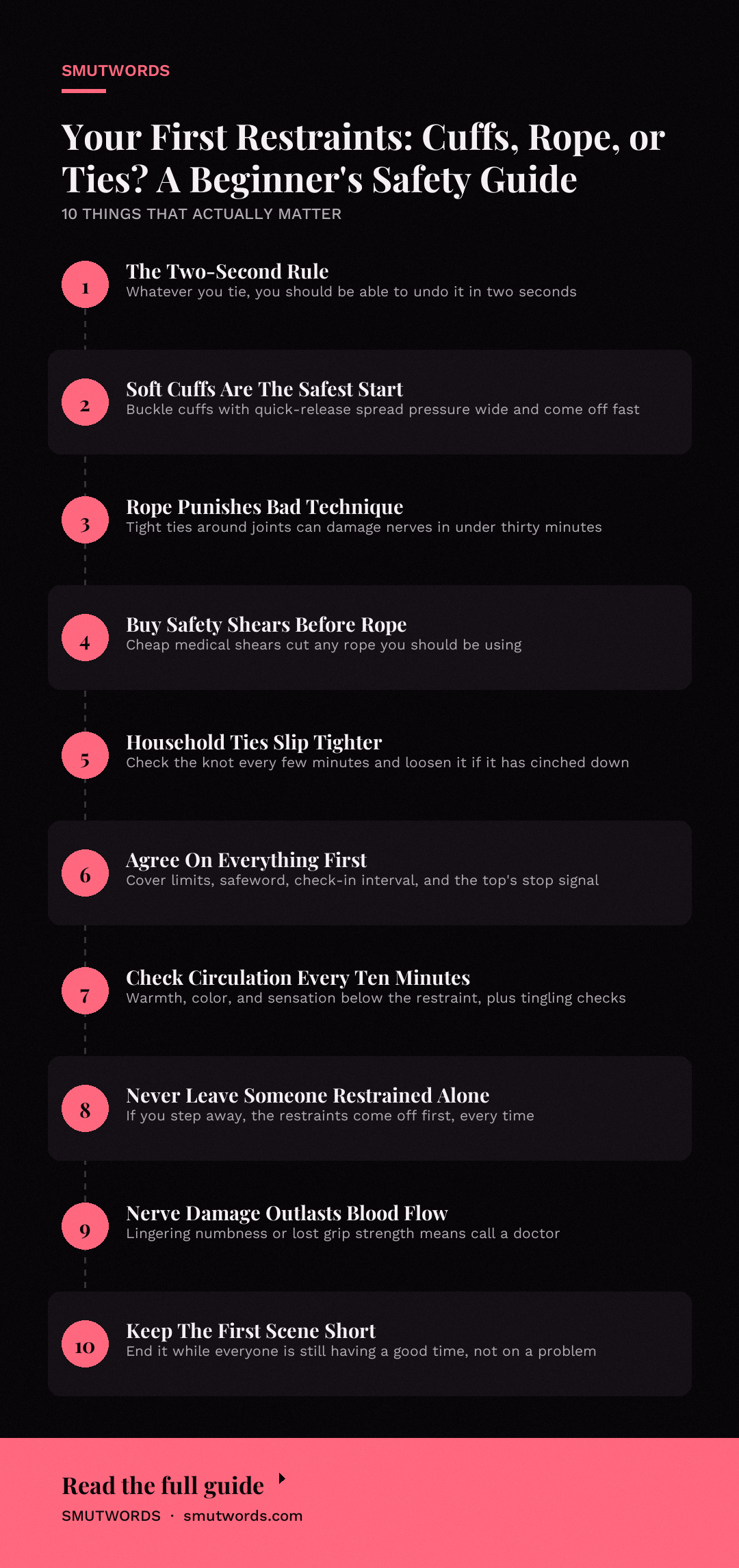
Velcro or buckle cuffs lined with fleece, usually sold in pairs with a short connector chain or strap. They go on fast, come off fast, and distribute pressure across a wide band of wrist instead of a thin line. That last part matters. A narrow rope or handcuff edge digs into nerves and tendons, which is how people end up with wrist drop or tingling that lasts for days.
What soft cuffs give you is speed and predictability. Buckle cuffs with a double-lock or a quick-release clip are the safest choice for a first scene. Velcro is even faster on and off but can be worked loose if someone struggles hard, so it is a better fit for light play.
They are also the least visually dramatic, which matters if you care about the aesthetic. If you want the look of a real restraint scene and not a padded wristband, cuffs will not deliver it. That is a real tradeoff.
Rope
Rope is the most versatile and the most demanding. A single 30-foot length of soft rope can hold wrists in front, wrists behind, ankles, or a simple body harness, and the whole thing costs about fifteen dollars. The catch: rope punishes bad technique with actual injuries. The most common beginner mistake is tying too tight around a wrist or ankle and then leaving it there.
Nerve compression in the wrists and ankles can cause damage in under thirty minutes if the tie is tight enough. Some people feel it as numbness immediately. Some feel nothing until the ropes come off and their fingers will not fully close. That is a hard no on leaving anyone tied alone, and a hard no on tight single-column ties around joints for beginners.
Rope also takes the longest to remove in an emergency. If you are dealing with a knot you cannot undo while your partner is panicking, you need safety shears within arm's reach. Buy a pair before you buy rope. A cheap pair of medical shears will cut through any rope you should be using, and they cost less than ten dollars.
Ties, Scarves, and Whatever Is in the Drawer
Household fabric is the classic first restraint, and it is genuinely fine for a low-stakes scene. Two silk ties or soft scarves, one around each wrist, ends in hand. The upside is obvious: free, no shopping, no package arriving at your door.
The downside is that most ties and scarves are too short to do anything interesting with and too easy to pull tight. Slip knots in fabric will cinch down on a wrist the moment the other person pulls their arm. That is the injury scenario, and it happens because nobody checks tension after the first thirty seconds.
If you use household fabric, look at the knot every few minutes. If it has slid tighter than when you tied it, loosen it. That one habit prevents most of the problems beginners get into.
What You Need Before Anyone Gets Tied Up
Nothing about this works without agreement in advance, and the agreement needs to be specific rather than a general "yeah, I'm into it." A useful conversation covers four things:
- What goes on the table tonight. Wrists only, wrists and ankles, no rope above the shoulders, whatever the boundary actually is. Say it out loud and have the other person repeat it back.
- The safeword. Pick a word that does not belong in a bedroom (red light, taxi, pineapple) and agree that it stops everything immediately, no questions, no "but I was almost done." If someone cannot speak for any reason, use a drop object like keys or a ball they can release.
- The check-in interval. Ten minutes is a good default for a first scene. Every ten minutes, ask two questions: how do your hands feel, and do you want to keep going.
- The stop signal for the person tying. If the top gets uncomfortable, overwhelmed, or notices something off, they need their own word. It is not a failure to call it early.
If telling a partner what you want feels like the hard part, How to Tell Your Partner About a Kink Without Making It Weird walks through the actual script for that conversation. Bring it up when you are both dressed and not mid-scene. That is the whole trick.
The Safety Rules That Apply To Every Restraint
These four rules exist because skipping them is how people get hurt. They do not relax because the scene is short or the cuffs are soft.
1. Circulation Checks Every Ten to Fifteen Minutes
Check the fingers or toes below the restraint for warmth, color, and sensation. Ask the tied person to wiggle them. Then ask if there is any tingling, numbness, or pins-and-needles feeling.
Numbness means loosen or remove the restraint immediately, not wait and see. Tingling that does not stop within a minute after release means the scene ends and you spend the next hour watching the hand.
Enjoyed this? Get a free book.
Join the list and we will send a complete free story straight to your inbox, plus new releases every week after that. No credit card, no catch.
Color is the easiest check. Fingers should look like fingers. Pale white, deep red, or blue is a problem. So is a hand that feels cold to the touch compared to the other one.
2. Quick-Release Is Not Optional
You need a way to get the restraints off in seconds, without untying knots. Safety shears for rope. A quick-release buckle or double-lock for cuffs. A clip or carabiner for ties.
Whatever the setup, the person tying should be able to end the scene in under five seconds without fumbling. Practice it once before the scene. Take the cuffs on and off. Tie the knot you plan to use and cut it with the shears. Knowing your hands will cooperate in an emergency is most of what lets you relax into the scene in the first place.
3. Never Leave Someone Restrained Alone
Not to get water. Not to answer the door. Not for two minutes because you forgot to lock the front door.
Someone in restraints cannot help themselves if something goes wrong: a muscle cramp, a panic attack, a fire alarm, a fall. A person tied to a bedframe who panics and rolls off is dealing with whatever they hit on the way down, and nobody is there to help. If you need to step away, the restraints come off first. Every time.
4. Watch for Nerve Compression, Not Just Blood Flow
Blood flow problems show up fast. Nerve problems can take longer and hurt more. Symptoms of nerve compression include numbness along the thumb side of the wrist, weakness in the hand, tingling that lingers after the restraints are off, and shooting sensations in the forearm.
Any of these means stop for the night. If symptoms are still there an hour later, or if you have lost grip strength, that is a reason to call a doctor rather than wait it out.
This is also the reason beginners should keep the pressure off joints. Rope around the forearm above the wrist is safer than rope directly on the wrist bone, and the same is true at the ankle. Joints are where nerves are close to the surface.
How to Bring It Up and Set Up a First Scene
The first scene should be short, easy to escape, and unremarkable. That last word matters. You are learning the mechanics of a tie and a check-in, not performing a scene from a book.
A simple starting setup: soft buckle cuffs, wrists in front of the body, no connectors, ten minutes on a timer, plus the conversation above. That is enough to tell you how restraint actually feels. Many people find it deeply calming or intensely arousing; some find it boring or claustrophobic and want it off within a minute. All of those are normal first reactions.
Once wrist-front feels easy, the next step is wrists behind the back. After that, wrists to a fixed point, like a headboard or a bedpost. Each step adds one new variable. Do not stack them in one night.
If a power-exchange dynamic is part of what draws you to this and you like the brat side of things, the brat taming article explains the negotiation that dynamic needs, and it overlaps with restraint play more than you would think.
When to Stop
Stop for numbness, tingling that does not fade, color changes, pain anywhere in a joint, difficulty breathing, panic, or a safeword. Those are not judgment calls.
Also stop when the clock says so, even if everyone is having a great time. First scenes should end before anything goes wrong. The ending is a decision you make ahead of schedule, not a reaction to a problem. Take the restraints off, check circulation again, get water, and talk about how it actually went once you are both upright and warm.
Aftercare can be as simple as sitting together for ten minutes with a blanket and asking what felt good. Some people need it, some shrug it off, and both are fine. What is not fine is skipping the conversation and finding out three days later that something felt off in a way nobody said out loud.
A few final things worth reading while the topic is fresh: the wax play guide covers the same safety logic applied to heat, and it is a good comparison if you want to understand what "start gentle, ramp slowly" looks like in practice.
If submission fantasies are what got you here, Commander's Brood Slave and Billionaire's Breeding Toy both run on the tension between being claimed and being cared for, which is the fiction version of what a well-run restraint scene feels like.
For anyone who wants to read further into dynamics that involve restraint as a relationship framework rather than a single scene, Subroutine: Stretch Her plays with control that never quite loosens, and Free Use Doctor: A Dark Medical Free-Use Fantasy leans on the same suspense of a body being handled by someone with authority. Both are fiction, and both are worth reading for the mood, not the how-to.
Final Thoughts
If you take nothing else from this guide, take the two-second rule: whatever you tie, you should be able to undo it in two seconds without untying a knot. Buy the safety shears first. Buy the cuffs second. Practice the release before you practice the tie.
Keep the first scene short enough that it ends while everyone is still having a good time. Marked by the Bull is a solid next read if you want a dynamic where being held in place is the whole emotional engine of the story. Read it after you have put the gear away.







Loading comments…