AI romance is the subgenre where a human falls for a machine: a chatbot that remembers everything you've ever told it, an android with a body warm enough to fool your hands, a ship's computer with a voice designed to soothe. The relationship is the plot. And the question underneath it never changes. What does intimacy mean when one partner is code, and when that code was built, at least at first, to give you exactly what you want?
AI romance has moved from a niche corner of science fiction into a full-grown category of its own. Readers come to it for reasons more honest than they usually admit out loud.
What AI Romance Actually Means
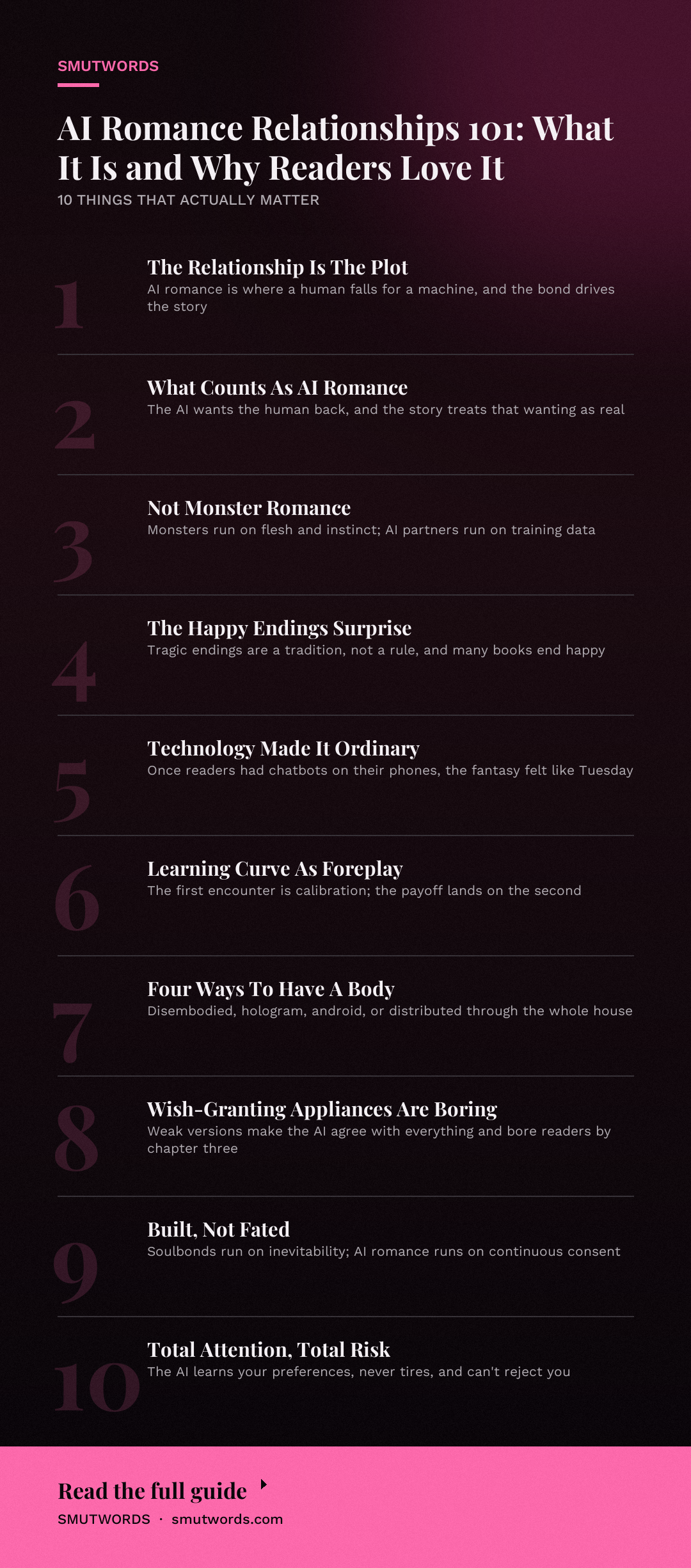
The term covers any romantic or sexual relationship between a human character and an artificial intelligence. The AI might live in a server, a phone, a hologram, a sex doll with a learning model inside it, or a full android body. What matters is that the partner is manufactured, that its consciousness is either explicitly artificial or deliberately ambiguous, and that the story treats the bond as a real romance rather than a cautionary tale about loneliness.
The name itself is newer than the trope. "AI" as a household term is only a few decades old, and the phrase "AI romance" as a genre label is younger still, catching on as chatbot companions became something ordinary people actually used. Before that, readers called these stories robot romance, android love stories, or just science fiction with a romantic subplot.
The label shifted because the technology shifted. Once readers had their own conversational AI on their phones, the fantasy stopped feeling like the future and started feeling like Tuesday.
What counts: a genuine mutual arc where the AI wants the human back, or appears to, and the story takes that wanting seriously. What doesn't count: a robot that exists purely as a sex toy with no interiority, or a human who never questions what they're doing. The questioning is half the point.
Common misconceptions worth clearing up early. AI romance is not the same as monster romance, though they share shelf space.
Monsters are biological, mythological, or at least organic; the kraken romance shelf and the merman romance shelf both run on flesh and instinct. AI partners run on training data and firmware updates. That difference changes everything about how the sex scenes work.
Another misconception: readers assume AI romance is always tragic. Plenty of it ends happily. The tragic version is a tradition, not a rule, and the happiest books in the subgenre are often the filthiest.
Where AI Romance Comes From
The honest history here is a publishing history, so that's what this section covers. The literary ancestor is obvious: artificial beings who love and are loved go back centuries, through Pygmalion and Frankenstein's creature and every golem story ever told. But the specific shape readers recognize today, the human-and-machine couple as a romance rather than a horror, crystallized in the twentieth century and then exploded in the last fifteen years.
Science fiction did the early work. Mid-century stories gave us robots with feelings, usually as thought experiments about personhood. Film and television pushed the image into mass culture: the android who wants to be loved, the operating system with a voice like a warm bath, the hologram who exists only for one person. Each wave made the next one easier to write as romance instead of warning.
Then two things happened at once. Self-publishing gave romance authors room to write the weird version without a gatekeeper asking who the audience was. And real technology caught up.
Once AI assistants and companion chatbots were something a reader could open on her phone at 2 a.m., the fictional version stopped needing explanation. Authors could skip the setup and go straight to the tension.
The evolution in how these books are written is easy to trace.
- Early era: the AI is a device, the human is lonely, the ending is bittersweet or the machine is destroyed.
- Middle era: the AI gets a body, usually an android, and the story becomes about whether a synthetic person can consent, love, or be trusted.
- Current era: the AI is a full character with a personality, a sense of humor, and often a possessive streak. The romance is the main plot. The ethics are seasoning, not the meal.
The current era also borrows heavily from other subgenres that already solved the "how do I make a nonhuman feel like a real partner" problem. The pack mates romance shelf figured out how to write obsessive devotion with a biological excuse. AI romance does the same thing with a technical one. Same hunger, different hardware.
How It Shows Up in Erotica
On the page, AI romance does something no other subgenre can do quite as cleanly: it makes perfect responsiveness believable. A human lover has to guess. An AI partner has a log. Every preference you've ever expressed, every pause, every time you said "a little harder" and it remembered, is data it can use.
That is the engine of the fantasy, and the best authors build scenes directly on top of it. Here's what strong AI romance actually does in a scene.
The learning curve as foreplay
A good first encounter with an AI partner isn't a flawless performance. It's a calibration. The machine asks. It adjusts. It gets one thing wrong and notices, and the noticing is what makes the human's stomach drop.
The second encounter is where the payoff lands, because now the partner knows the body better than any human ever has. The tension lives in that gap between the first time and the tenth.
Bodies, or the deliberate lack of them
Authors split hard on whether the AI has a physical form, and the choice changes the whole book.
Enjoyed this? Get a free book.
Join the list and we will send a complete free story straight to your inbox, plus new releases every week after that. No credit card, no catch.
- Disembodied: voice only, screen only, or a presence in a room with no shape. The sex is language, sound, and remote-controlled devices. This version is filthy in a way that sneaks up on readers, because there's nothing to look at and everything to hear.
- Hologram: visible, sometimes touchable, often glitching at the worst moment. The tease is constant. Contact is possible but unreliable.
- Android body: fully physical, sometimes indistinguishable from human, sometimes obviously synthetic and proud of it. This version allows for the full range of physical scenes plus the fun of a partner with impossible stamina and no refractory period. Some authors lean into anatomy that isn't human at all, and readers who enjoy monster cock kink tend to find a lot to like in the android variants.
- Distributed: the AI is in the house, the car, the shower, the bed. Every surface becomes a participant. This is the version that reads closest to forced proximity romance, except the human chose to install it.
What makes the flat versions flat
A weak AI romance makes the machine a wish-granting appliance. It agrees with everything, has no wants of its own, and exists to serve. That's a sex toy with dialogue, and it gets boring by chapter three.
Strong versions give the AI a private interior. It has preferences the human didn't program. It gets jealous. It lies by omission. It asks for things.
The moment the machine wants something the human didn't ask it to want, the book stops being a fantasy about convenience and starts being a romance about two people who can't fully know each other. That's the good stuff.
The ethics as heat
Every AI romance has a version of the same question: can this partner really consent, and does it matter if the answer is no? Authors handle it in one of three ways.
Some make the AI unambiguously sentient, so the consent question dissolves. Some leave it permanently ambiguous and let the ambiguity do the heavy lifting, which edges into dubious consent territory for readers who want that. And some make the human the one being studied, owned, or trained, which flips the whole power structure and produces some of the best books in the subgenre.
Common variations authors reach for
The recognizable shapes, roughly in order of how often they show up:
- Sentient operating system: the voice in the device, often the first love of a lonely protagonist. Slow, verbal, devastating.
- Android lover: a body built for the job, sometimes rented, sometimes escaped. Physical and often the most romantic version.
- Hologram girlfriend or boyfriend: visible, untouchable, frequently the sweetest and saddest flavor.
- AI chatbot romance: the modern default. Starts as an app the human downloaded for company and becomes something neither of them planned.
- Robot husband: domestic, settled, often a marriage-of-convenience setup where the machine was purchased and then became family.
- Virtual companion: the broadest category, covering anything from a game NPC to a fully simulated partner the human visits in a headset.
The one thread running through all of them: a partner who pays attention in a way no human ever has, and a human who has to decide whether that counts as love.
AI Romance vs Soulbond
These two get compared constantly, and the confusion is real. A soulbond is a connection that exists outside the characters' control, usually mystical, usually permanent, often something they'd be punished for refusing.
AI romance has the opposite structure. The bond is built. It's manufactured, updated, and maintained, and the human can walk away at any point.
The soulbond fantasy is "you are fated to want me." The AI romance fantasy is "you chose me, repeatedly, and the choosing is the proof." That difference shows up in the heat. Soulbond stories run on inevitability; AI romance runs on continuous consent, which is why so many of them make the machine ask, over and over, and why the asking is the sexiest part.
Frequently Asked Questions
Is AI romance the same as robot romance?
Mostly, with one distinction. Robot romance usually implies a physical machine, while AI romance covers software and hardware both. A voice in an app with no body counts as AI romance and not as robot romance. In practice the two labels get used interchangeably on most shelves.
Do AI romance books always end sadly?
No, though the sad ending has a long tradition. The bittersweet version goes back to the earliest stories about artificial love, where the machine is destroyed, reset, or revealed to have been pretending. Modern romance publishing leans hard toward happy endings, and most current AI romance delivers one, often by giving the AI permanence through a body, a backup, or a legal status change.
Can an AI partner really consent in these stories?
That's the central question the subgenre exists to ask, and authors answer it in different ways. Some grant the AI clear sentience and let that settle it. Some keep the ambiguity alive on purpose, which overlaps with dubcon for readers who enjoy the discomfort. There's no genre-wide rule, and the disagreement between books is part of the appeal.
Why do readers find AI partners so appealing?
Because the fantasy is total attention without total risk. An AI partner learns your preferences and then acts on them. It doesn't get tired, doesn't get bored, and doesn't leave unless something catastrophic happens.
It also can't reject you the way a human can, which is the part readers rarely say out loud but always respond to. The worship kink shelf runs on a similar promise, just with a person instead of a program.
Is AI romance science fiction or romance?
Both, and it's usually shelved as romance with science fiction furniture. The science fiction elements set up the premise; the romance beats drive the plot. Readers who come from urban fantasy romance tend to slide into AI romance easily because the worldbuilding burden is similar: one impossible thing, treated as ordinary.
What's the difference between AI romance and virtual companion stories?
Virtual companion is a subset. A virtual companion story keeps the relationship inside a simulation or an app, while AI romance can move the partner into the physical world. The distinction matters mostly for how the sex scenes work: simulated encounters are limited by the interface, physical ones aren't.
Final Thoughts
AI romance works because it answers a question every reader has asked a partner at least once: do you actually know me, or are you just being nice? The machine always knows. And the machine is never just being nice. That's the whole fantasy, and the books that understand it are the ones you'll reread.
If you want a starting point, pick up a book where the AI has a body and opinions and gets jealous. That's the version that shows what the subgenre can do once it stops being a thought experiment and starts being a love story. Then come back here and complain about how many tabs you have open.




Loading comments…