Anticipation play is the deliberate, often agonizing stretching of the time between desire and fulfillment. The wanting itself becomes the main event. In plain language, it is the practice of delaying or denying an expected sensation, orgasm, or piece of information to intensify the eventual payoff. The focus is not on what happens last, but on everything that happens while you wait. It is a core engine of tension in erotica and a versatile tool for partners who want to make the buildup as memorable as the climax.
This guide covers what anticipation play actually means in practice, where the trope comes from in fiction, how authors build it into scenes, and how you can use it to make your own writing or your own bedroom sessions nearly unbearable in the best way.
What Anticipation Play Actually Means
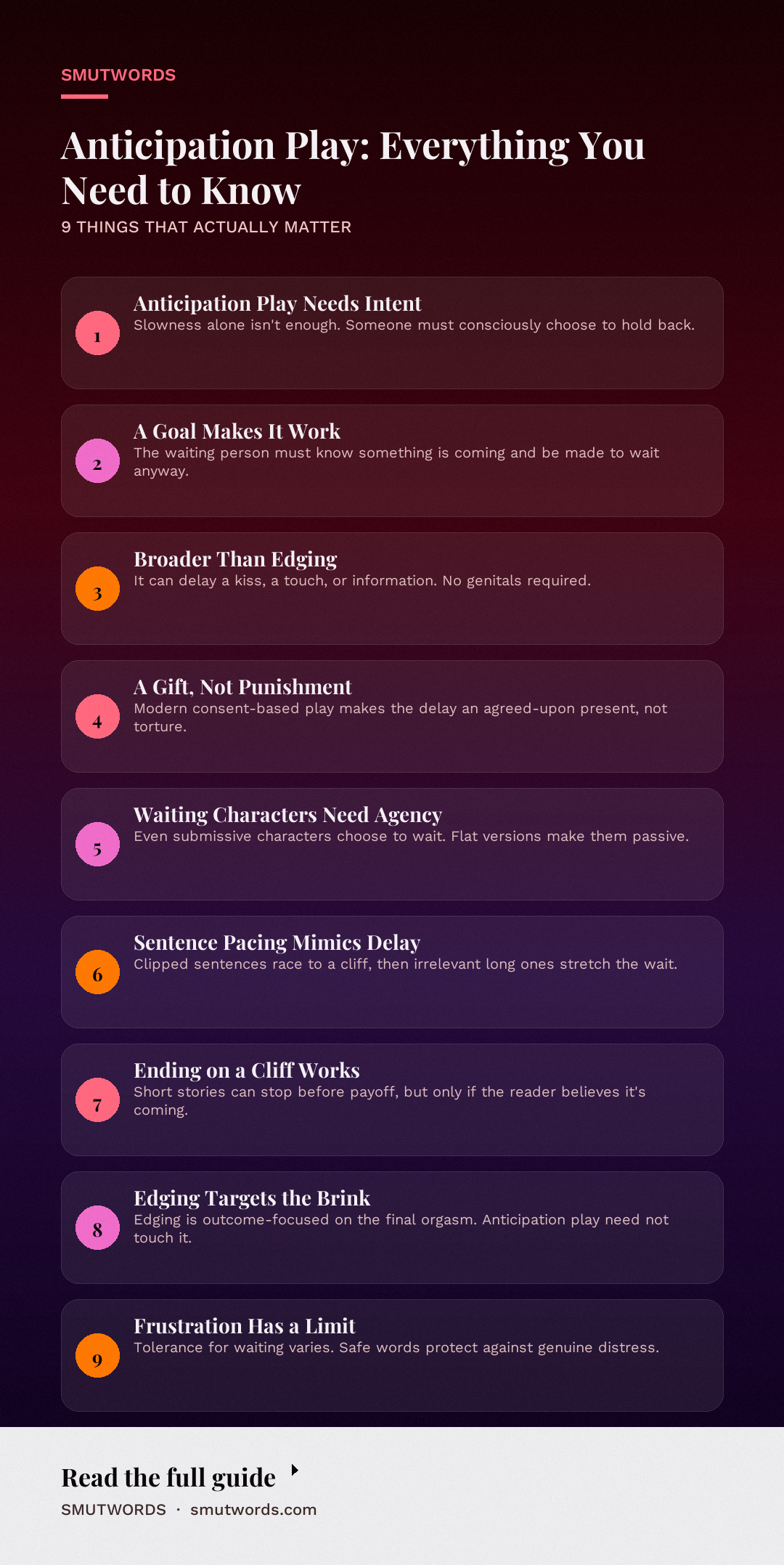
Anticipation play refers to any structured or improvised activity where one partner (or both) deliberately withholds a promised or implied outcome to heighten arousal. The term is broad enough to cover edging, orgasm denial, strip teases, blindfolds, prolonged foreplay, and even the "will they or won't they" tension of a love scene that cuts away at the last moment.
The key is intent. Simply being slow or taking a while is not enough. A lazy handjob that meanders for twenty minutes is not anticipation play unless someone is consciously choosing to hold back.
The practice requires a goal: the delayed payoff is the point. The person waiting knows something is coming, has been told it is coming, and is being made to wait anyway.
It also does not require power exchange dynamics to work. Two equally dominant partners can engage in a mutual stalemate of teasing.
But the practice slots into a larger structure of control instantly. That is why it shows up so often in scenes that involve power exchange. When one person holds the keys to the other's pleasure, the anticipation becomes a form of authority in itself.
Common misconceptions abound. Anticipation play is not a synonym for edging, though edging is one of its most famous subcategories. Edging specifically refers to bringing someone to the brink of orgasm and stopping.
Anticipation play is broader. It can be about delaying a first touch, withholding a kiss, making someone ask for permission, or simply texting all day about what is going to happen that night. It does not have to involve genitals at all.
Where Anticipation Play Comes From
As a recognizable trope in erotica and romance, anticipation has a pedigree as long as the written word itself. Ancient poetry is full of lovers dying to see each other. But as a named, deliberate practice with its own vocabulary, anticipation play is much younger, emerging in the mid-to-late twentieth century alongside the growth of organized BDSM communities.
The rise of the internet changed everything. Before message boards and chat rooms, a couple experimenting with delay had no shared jargon. They called it teasing.
Now, communities created frameworks for talking about it, which allowed writers to codify the behaviors into recognizable patterns. The term "edging" gained traction in the 1990s through online forums. "Orgasm control" and "denial" followed, and anticipation play emerged as an umbrella category that covered all of them plus the gentler, less explicitly S/M versions.
In fiction, the shift was seismic. Erotica before the 1970s often treated the buildup as a series of obstacles (a locked door, a meddling maid). The anticipation came from plot interference.
Modern erotica shifted the obstacle into the characters themselves. One character chooses to make the other wait, and the reader is privy to both the waiting and the wanting. This is a distinctly contemporary flavor of tension, recognizably tied to the power dynamics that emerged from community-organized kink culture rather than from pulp fantasy.
The genre's embrace of consent negotiation also reshaped how anticipation is written.
In older texts, the delay was often a form of torture imposed by a villain. In contemporary work, the delay is an agreement. Both parties know the rules. The anticipation becomes a gift the withholding partner gives to the waiting one, not a punishment.
How It Shows Up in Erotica
Anticipation play is the Swiss army knife of erotic writing because it works at every scale, from a single sentence to a whole novel arc. On the page, the mechanics are always the same: the author promises a payoff, then withholds it, then pays it off in a way that exceeds the reader's expectations. The craft lives in the withholding.
The most common structural forms in erotic fiction are:
- Extended foreplay sequences. The character spends pages teasing, touching, and backing away. The reader is kept at the same level of arousal as the character being teased. These scenes work best when the narration zooms into physical detail: the heat of skin, the dampness of breath, the tremor in a thigh.
- Orgasm delay and denial. The character is brought to the edge multiple times, only to be pulled back. This appears frequently in dynamics where one partner has earned control through scene play. Good versions track the character's changing mental state, not just the physical frustration.
- Distant or implied anticipation. A text message at work promising "tonight," a whispered sentence in a crowd, a character who walks away knowing the other is watching. This variant uses narrative gaps to create craving. The reader waits alongside the character.
- The hidden object or plan. One character has a specific act in mind and refuses to say what it is. The mystery itself becomes the anticipation as the other character, and the reader, tries to guess.
A strong version on the page always gives the waiting character agency. Even submissive characters in a power exchange dynamic are choosing to wait, and that choice is visible. Flat versions forget this and turn the waiting character into a passive recipient.
Enjoyed this? Get a free book.
Join the list and we will send a complete free story straight to your inbox, plus new releases every week after that. No credit card, no catch.
The best anticipation scenes make the waiting character desperate and willing. Their frustration is a measure of how much they trust the person who holds the timing.
Authors also weaponize pacing at the sentence level. Short, clipped sentences speed up a scene to the edge of a cliff. Then a long, languid sentence describing something irrelevant (the shape of a lamp, the pattern on the ceiling) artificially delays the action, which paradoxically makes the reader feel the delay viscerally. That structural mimicry is the entire game.
One critical detail: anticipation play in erotica must eventually pay off, but it does not have to pay off inside the scene. Many of the best short stories end on the cliff, delivering the now-furious hunger to the reader rather than the character. This technique only works if the author has earned it. If the reader does not believe the payoff is coming, the tension collapses into annoyance.
Anticipation Play vs Edging and Denial
Anticipation play is frequently conflated with edging and orgasm denial. The confusion is reasonable since they are related tools that often appear together.
Edging is the repeated act of bringing someone to the brink of orgasm and then stopping. It has a physiological precision: it targets the exact moment before climax and backs off.
Orgasm denial is the broader practice of refusing to allow release at all, either temporarily or for an extended period. Both are forms of anticipation play, but anticipation play does not require them. Not waiting until the last second is not the same as denying the finish.
A useful distinction: edging and denial are outcome-focused. They concern the final orgasm. Anticipation play can start and end without anyone nearing an edge. Slow undressing, prolonged kissing structure, being told to hold still, or a partner who spends ten minutes deciding where to put their mouth are all anticipation play with no edging involved.
If you are reading a book tagged for one, you may not get the others. A story about anticipation might never include a single edge. A story about denial will almost certainly lean on anticipation as a mechanism, but its goal is the denial itself.
That said, the terms are often used interchangeably in casual kink conversation. Many couples use them as synonyms when negotiating. The useful overlap is how they all solve the same problem: making time pass slowly and deliciously. For a deeper look at the physical safety elements of one of the more common physical variants, the bondage safety glossary entry has relevant notes if restraint is part of the waiting game.
Frequently Asked Questions
Is anticipation play always sexual?
No. Anticipation can apply to any kind of sensation or event, like making someone wait to taste a meal they have been smelling or delaying a spanking. However, in erotic contexts the term almost always implies sexual or sensual buildup.
How long can anticipation play last?
From a few minutes to several days. Some couples engage in "slow burn" play where text messages and looks build tension for a week before they physically touch. The limit is not time, but the tolerance of the waiting partner for frustration.
Do you need safe words for anticipation play?
You should have them if the practice involves any power exchange or if one partner is delaying the other's orgasm. Frustration can become genuine distress, so the waiting partner needs a way to tap out. See safeword use for the mechanics of choosing one that fits.
What is the difference between teasing and anticipation play?
Teasing is usually a brief, playful act designed to provoke a reaction. Anticipation play is the sustained, structured version of that tease. A playful grab in the kitchen is teasing. Spending the whole dinner party whispering about what you will do later is anticipation play.
Can anticipation ruin the actual moment?
It can if the buildup sets expectations impossibly high or if the delayed event is a letdown. Strong communication about the eventual payoff prevents this. If the goal is a specific act, both partners should know what it is even if the exact timing is the surprise.
Does anticipation play require one person to be in charge?
No, but it is more common when a power differential exists. When both partners are equally dominant, the anticipation often becomes a mutual standoff where each person tries to make the other crack. That dynamic is its own kind of fun and requires meticulous communication to avoid a race to the bottom.
Final Thoughts
Anticipation play is the rare practice that improves every scene it touches because it forces the writer and the partner to respect time itself. The best version is the one that makes the moment of giving in feel like a relief, not an event.
If you want to see the structure executed by a confident hand who understands delay as a form of care, the guide to car sex has an excellent scene that uses proximity and stolen glances to build a specific kind of anticipation particular to a confined space.
Read it and notice how the author makes you wait alongside the characters. Then go practice waiting on someone you love. If your tastes run more toward control and ownership as the engine of the delay, possessive sex takes the same principle and turns the waiting into a claim of territory, which is a different flavor of the same hunger.







Loading comments…