Most readers who search for the breeding farm trope explained end up on a forum thread full of people who clearly never finished one of these books. Half the replies assume it's about livestock. The other half assume it's a real-world fantasy someone's trying to sell as a lifestyle.
Neither group has cracked a single chapter. Neither one understands why the setting keeps getting reissued, anthologized, and passed around in PDF form like a contraband pamphlet.
So let's correct the record. The breeding farm trope is a specific fictional structure with its own rules, and once you know the rules you can tell in about four pages whether a book is going to land it or fumble it badly.
This post walks through what the setup actually involves, what it borrows from, and why the strict, high-stakes version does something for readers that a soft-focus romance about two people making a baby on a farm simply cannot.
What the Breeding Farm Trope Actually Is
Strip it down and you get a controlled environment where reproduction is the entire economy. A facility, an estate, a compound, sometimes a whole walled settlement. Someone with money or authority is managing who breeds with whom, on what schedule, and for what purpose.
The point isn't the farm. The point is that nothing in the setting happens by accident.
That's the structural backbone, and it's why the trope overlaps so heavily with breeding kink vs impregnation kink discussions without being identical to either. The breeding kink lives in the characters' heads. The farm is the arrangement around them that removes their choice about when, where, and with whom.
The three elements every version needs
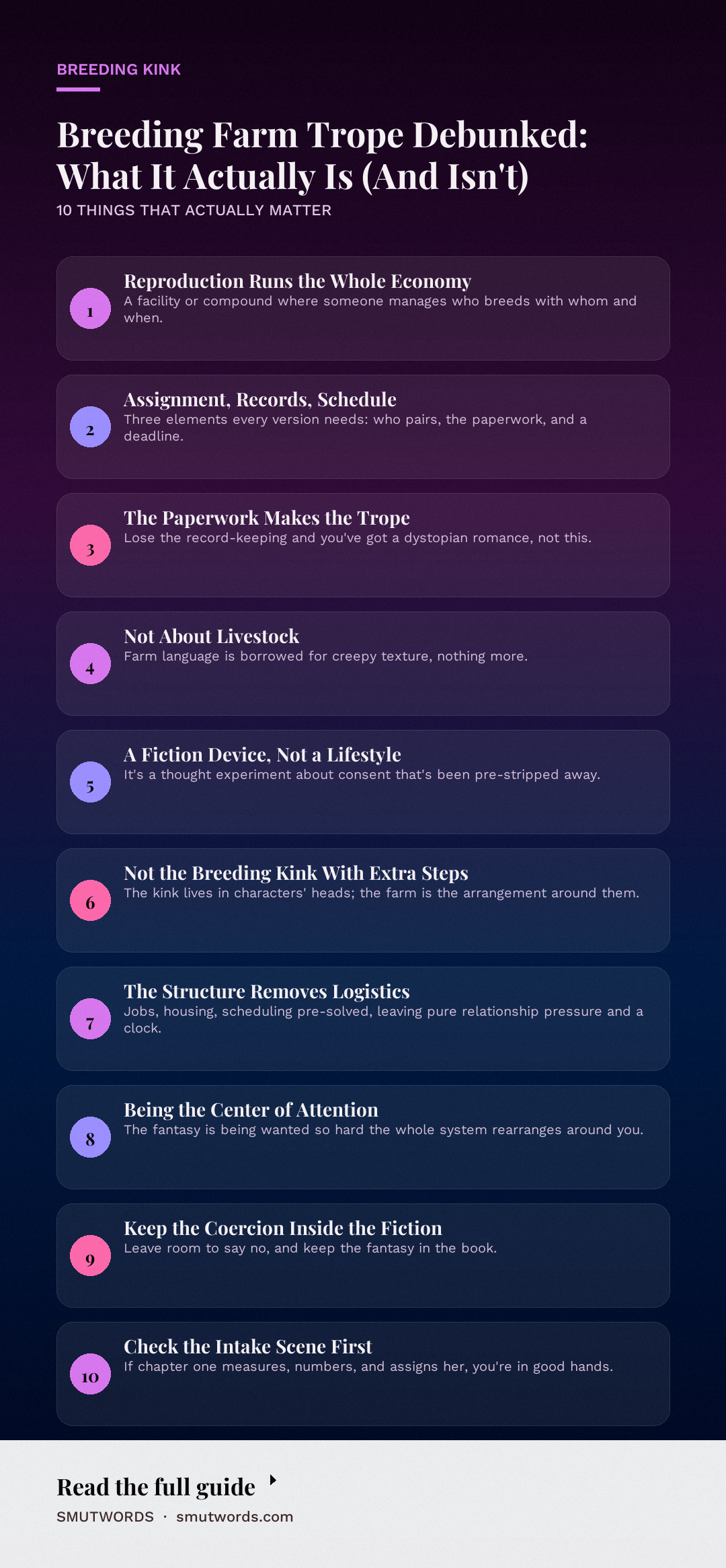
- Assignment. Someone decides who pairs with whom. The characters don't pick each other; they get told, and the book spends real page time on the moment the assignment lands.
- Record-keeping. Ledgers, clipboards, numbered rooms, a woman in a lab coat with a clipboard who never smiles. The paperwork is a character in these stories and it usually shows up before the sex does.
- A schedule with a deadline. A cycle, a season, a mandatory evaluation. There's always a clock, and it's always louder than whatever the characters might want for themselves.
Lose the record-keeping and you've got a dystopian romance with a side of family planning. Lose the assignment and you've got a couple who chose each other and found a weird landlord. The paperwork is what makes it the trope.
What it looks like on the page
A typical opening: a woman arrives at a facility she didn't choose, gets measured, catalogued, and assigned a room number. Her intake file is read aloud to her. By chapter three she's sharing a room with a man selected for her, and the staff are outside the door with a checklist. The rest of the book is about what happens between those two people while the schedule does its work on them.
That's the shape. The hotness, for the readers who like this stuff, comes from that exact pressure: being wanted for a function, tracked, scheduled, and told to do a thing you'd probably also want to do under better circumstances.
What It Isn't: Four Myths That Won't Die
The misconceptions arrive early in every comment section, so let's kill the loudest ones.
Myth 1: It's about livestock
The word "farm" does a lot of work here, and it's mostly pun-adjacent. The setting borrows the language of animal husbandry for creepy texture, and that's all it does. Nobody's writing about barns. If a book leans on literal animal comparisons for more than a paragraph of atmosphere, it's usually a weaker entry in the trope doing cheap shock work.
Myth 2: It's a real-world fantasy someone wants to act out
This is the one that actually bugs readers who love the trope. The breeding farm is a dystopian fiction device, same family as the walled city and the arranged marriage colony. It's a thought experiment about consent that's been pre-stripped away, so the reader can watch what characters do when it's gone.
That fantasy needs a fictional frame to work. Take the frame away and you're writing something else.
Myth 3: It's just the breeding kink with extra steps
Related, not the same. The secret baby end of the spectrum is about the aftermath of a pregnancy nobody planned. The farm trope is about the planning being taken over entirely. Readers who like one don't always like the other, which surprises people until they actually read both.
Myth 4: It's all setup and no character work
Bad versions are. Good versions use the facility as a pressure cooker that forces the two leads to become honest with each other far faster than they would in a normal romance. There's a reason so many of these books have a scene where one character breaks the record-keeping in a small way, and it's never just about the record.
Why the Structured Version Works
Here's the part the debunkers never get. The appeal isn't the pregnancy. It's the removal of every logistical question that normally clogs a romance plot.
In an ordinary book, the leads have to find a reason to be in the same room. In a breeding farm book, they're already in the same room. The book has pre-solved jobs, housing, food, scheduling, and the awkwardness of telling your friends what you're up to. What's left is pure relationship pressure and a ticking clock, and that's a very lean, very efficient structure for a hundred thousand words of high-tension sex scenes with actual stakes behind them.
It also scratches a very specific itch about being chosen and wanted so profoundly that the whole system rearranges around it. The worker who picks you out of the file stack. The supervisor who notices that your assignment made you blush. The other women in the dormitory who've been through the intake process and explain the rules to you on the first night.
The trope is less about disempowerment than about being the center of someone's very serious attention, which is a fantasy a lot of readers are happy to rent for four hundred pages.
Enjoyed this? Get a free book.
Join the list and we will send a complete free story straight to your inbox, plus new releases every week after that. No credit card, no catch.
And the compliance pressure is a whole genre of its own. The rules about who speaks first, who undresses first, whose hand goes where. If you've read any cyberpunk romance with a controlled-facility subplot, you've seen a version of this, just with more neon and worse food.
What a Good Version Looks Like vs. a Bad One
The quality gap in this trope is wider than in most. The best versions and the worst versions share the same cover art and very little else.
Signs a breeding farm book is going to work
- The paperwork shows up early and it's specific. Real-looking form names, a birth-date field, a next-of-kin line that gets used later.
- The leads disagree about something that isn't the breeding. Food, sleep, whether to cooperate with the schedule.
- The facility has a real hierarchy. Supervisors who answer to other supervisors, a doctor with a personal agenda, an intake office that's short-staffed.
- A secondary character's arc actually resolves. The woman in the next room isn't just a mood board.
Signs it's going to fall flat
- The farm is described in two paragraphs and then completely abandoned for a generic road-trip romance.
- The rules are scary on page one and meaningless by page ten.
- No one in the facility has a competence problem. Every worker is a looming figure with no interior life.
- The leads are immediately, fully in love, which deletes the entire structure's tension.
That last one sinks more books in this trope than anything else. The setup does its best work on characters who are still deciding how to feel about each other when the schedule forces the next step. If they've already decided by the end of chapter two, the book is playing poker with all its cards on the table.
The Overlap With Other Tropes (And Where the Lines Are)
Readers who like breeding farm books tend to drift into adjacent fields once they've finished their first five, and the drift is predictable.
Arranged marriage is the closest cousin. Same forced proximity, same assignment logic, but the fiction frame is social rather than industrial. Cult and compound romance uses the same containment pressure with a religious plot instead of a medical one. Dystopian selection puts the schedule under a larger political system, which is usually where the book stops being pure smut and starts wanting a plot.
There's also a crossover that surprises people: the redemption end of the genre. A supervisor who starts out as the woman with the clipboard and ends up in trouble for breaking three of her own rules is a textbook redemption arc romance, just wearing a lab coat instead of a leather jacket.
The Hard Limits: What the Trope Should Never Do
Here's where the editorial line matters, because the trope sits close to a real-world topic with a very real history of coercive control. Good writers in this genre are careful about three things.
First, they keep the coercion inside the fiction. Real fertility tourism, real reproductive coercion, real forced pregnancy as an institution are not the same thing as a fictional facility on a fictional continent. When a book starts name-checking real-world institutions approvingly, it's stopped being erotica and started being a manifesto.
Second, they leave room for characters to say no, even if the setting punishes them for it. A character who never pushes back on anything is a prop. The best books in this trope always have one scene where a lead says no and the world has to react to it.
Third, they keep the book's fantasy in the book. The scheduling and the ledgers and the dormitories are a story setting. Fictional structure, real readers. Those two things can coexist without anyone confusing one for the other, which is the whole point of a post titled breeding farm trope explained.
How to Find the Good Ones
Skip the search results that read like press releases. The reliable indicator of a strong breeding farm book is the opening twenty pages doing intake paperwork properly. If chapter one gets the protagonist measured, numbered, and assigned, and chapter two shows her comparing notes with the woman in the next bunk, you're in good hands. If chapter one is a moody cover paragraph and chapter two jumps to a different book, close the tab.
Second thing to look for: a secondary character who isn't a threat or a cheerleader. The dormitory roommate with a grudge. The supervisor who's short with everyone because she's sleep-deprived. The doctor with a private agenda that isn't about the protagonist.
Books with real supporting casts almost always have better central chemistry, because the leads have somewhere to be honest besides each other.
Third: check the ending before you buy. Some of these books are written as a facility escape, some as a facility takeover, and a few as a "we stayed and changed the rules from inside" resolution. All three are valid, but if you're in the mood for one and get another, you'll resent the book unfairly.
Why This Trope Keeps Getting Reissued
Because it's structurally efficient, and because it does a specific thing no other setup does quite as well: it lets two characters get to the physical relationship fast while keeping the emotional one locked behind a schedule neither of them controls. The tension has a home. The rules have teeth. And the ending, when it comes, has to actually solve the facility, which is harder than solving a misunderstanding about a misread text message.
Readers who gravitate toward controlled-environment setups often also like the more transactional end of the genre, and if that's you, the site has a whole breakdown on casual sex meaning that scratches a related itch. Same impulse, very different frame.
The trope isn't for everyone. It rewards readers who want a heavy fiction frame around their heat, and it punishes books that skimp on the frame. But the version that gets it right, with the ledgers and the dormitory and the schedule and the one character who breaks a rule and gets caught, is a well-engineered machine, and it keeps getting rebuilt for a reason.
Final Thoughts
If you want the version that gets the paperwork right and keeps the pressure on through every chapter, start with a book that puts the intake scene on page one and never lets the facility go slack. Read it with a notebook. You'll catch the moment the schedule stops being a threat and starts being the thing pulling the two leads together, and that's the exact beat the whole trope is built around.




Loading comments…