Picture a kitchen mid-crime scene. Cream on a thigh, pudding down a shirtfront, a whole cake meeting a bare ass. That's sploshing: the fetish for food as sexual material, the wet and sticky and cold and warm stuff of an ordinary kitchen turned into foreplay. The term covers a wide range of messy play, and in erotica it shows up whenever a scene needs to strip a character of composure in the most physical, tactile, faintly ridiculous way possible.
If you landed here because a book threw a bowl of whipped cream at a sex scene and you want to know what you just read, this guide covers the whole territory.
What Sploshing Actually Means
The word is British in flavor and playful in tone, coined to describe the sound and sensation of wet food hitting skin. It sits under the broader wet and messy fetish umbrella, usually shortened to WAM, which takes in mud, paint, foam, and other substances beyond the edible. Sploshing is the food-specific branch.
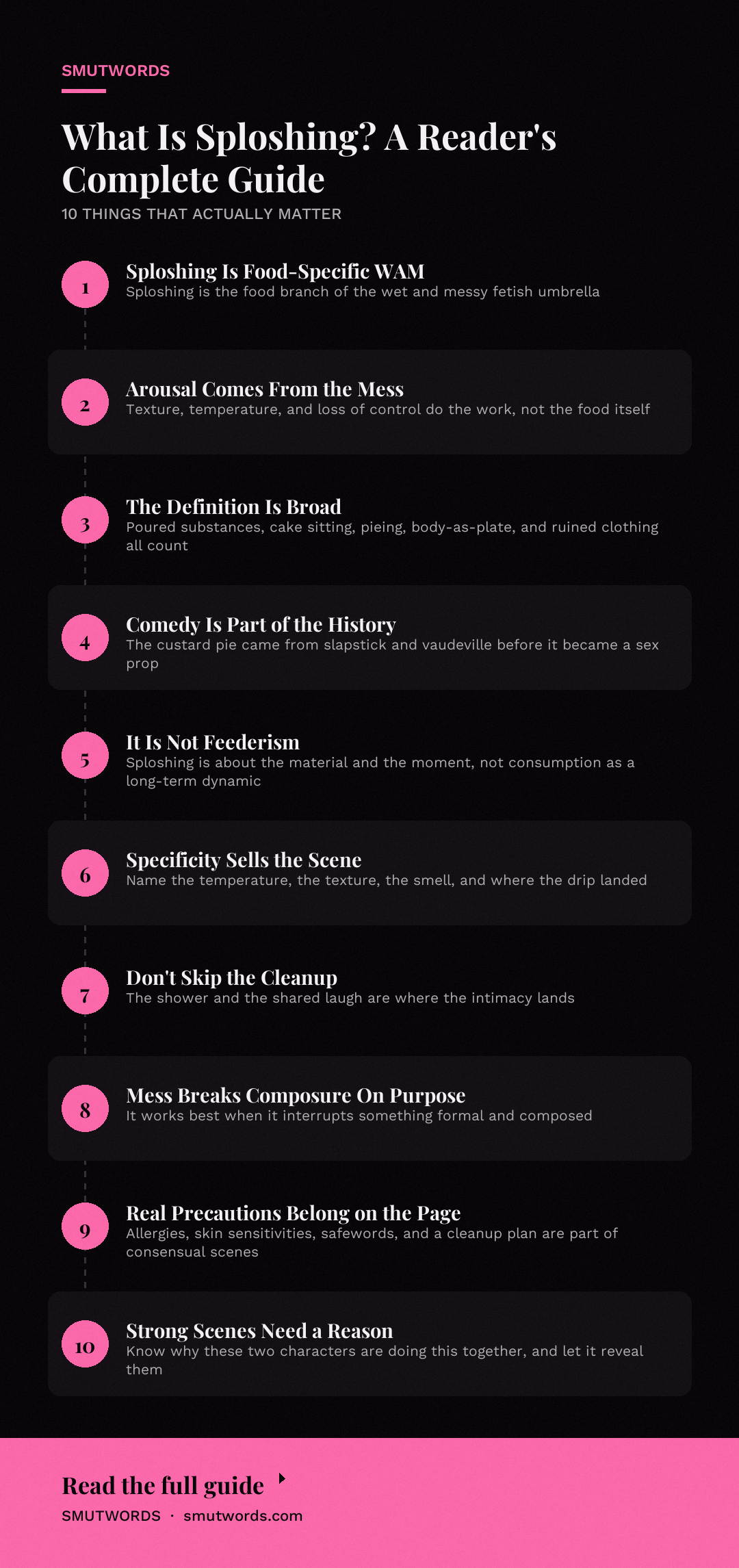
The core of it is sensory: texture, temperature, weight, smell, the visual chaos of a body covered in something it should not be covered in. Arousal comes from the mess itself and from what the mess means. Loss of control. Humiliation. Playfulness. Indulgence. Being marked or claimed.
What counts as sploshing is broader than most people assume. It includes:
- Poured substances: cream, custard, syrup, chocolate sauce, warm oil, jelly.
- Sitting and smashing: cake sitting, where a character lowers themselves onto a cake or pie; fruit crushing; sitting in a bathtub of pudding.
- Throwing and pieing: food fights as foreplay, custard pies to the face, whipped cream launched across a room.
- Body-as-plate: food eaten directly off a partner's skin, which overlaps with the more general food play.
- Ruined clothing: the deliberate destruction of a nice outfit by something sticky, which is often half the point.
What does not count, strictly, is food being prepared and eaten as a normal meal with flirtation attached. A candlelit dinner is not sploshing. A character licking sauce off a partner's finger as a teasing gesture sits at the edge, and most readers would call that food play rather than full sploshing.
Common misconceptions are worth clearing up. Sploshing is not inherently degrading, though humiliation play is one flavor of it. It is not always funny, though humor runs through a lot of it.
And it is not the same as a feederism or weight-gain kink, even though the two sometimes appear in the same book. Sploshing is about the material and the moment, not about consumption as a long-term dynamic.
Where Sploshing Comes From
The recognizable trope as erotica knows it is younger than most fetishes in the glossary. Its history is a publishing and internet-culture story more than an ancient one. Wet and messy play as a named interest grew through niche magazines, mail-order videos, and later online communities from the 1980s onward, and the food-specific branch found its audience alongside it.
The pie-in-the-face gag is older than any of that, borrowed from slapstick comedy and vaudeville. That inheritance matters, because sploshing erotica has always carried a strand of physical comedy. The custard pie is a humiliation prop before it is a sex prop, and writers who understand that write better sploshing scenes.
Cake sitting and the more elaborate food-wrestling scenarios gained visibility through fetish photography and early web forums, where the emphasis was on spectacle and abundance. The aesthetic was deliberately excessive: whole tables of food, entire outfits destroyed, a performer reduced to a sticky mess by the end of a shoot.
In published romance and erotic fiction, sploshing arrived later and more quietly. It shows up most often as a single scene inside a book about something else, a wildcard used to signal that a character is game for anything. Dedicated sploshing romance is rare, which makes the scenes that do exist feel like a find.
The shift over the past fifteen years has been toward consent-forward framing. Earlier material leaned on shock and degradation; contemporary writing tends to include negotiation, laughter, and aftercare, and treats the mess as intimacy rather than pure humiliation. Readers who want the playful version have more to choose from now than ever.
How It Shows Up in Erotica
On the page, sploshing lives or dies on sensory specificity. A weak scene says the character was covered in cream. A strong one tells you the cream was cold from the fridge, that it slid under a waistband, that the smell of vanilla mixed with sweat, that a drip reached the collarbone and stayed there. The whole fetish is texture, and texture is what prose does best.
Editors who have read a lot of this material notice the same failure again and again: the mess arrives as a surprise event and then vanishes. The character is pied, everyone laughs, and the scene moves on without ever putting the reader inside the sensation. Sploshing rewards a writer who slows down, describes the temperature shift, and lets a character react to being sticky for longer than a paragraph.
The most common variations in fiction break down roughly like this:
- The playful ambush: one partner surprises the other with a handful of frosting or a thrown strawberry, and the scene turns into a chase and a food fight that ends in bed.
- The deliberate ritual: a dominant partner arranges food on a submissive's body and eats it slowly, treating the body as a plate and the mess as a form of worship or ownership.
- The ruined outfit: a character in something expensive and carefully chosen gets covered on purpose, and the destruction of the clothing is the erotic charge. This is where sploshing overlaps with a lingerie fetish, since the garment is often the point.
- The public spectacle: cake sitting or a food fight staged at a party or in a semi-public setting, where the risk of being seen adds heat. Our guide to public sex covers how that exposure dynamic works in fiction.
- The punishment or humiliation scene: food used as a tool of degradation inside a power exchange, with a dominant making a submissive sit in a mess or wear it.
What makes a strong version work is the same thing that makes any kink scene land: the writer knows why these two characters are doing this together. Sploshing exposes a character. It is undignified in a way that most people find either thrilling or mortifying, and a good scene uses that exposure to reveal something about the relationship. A character who laughs through a face full of cake is telling you who they are.
The humor is a feature, not a flaw. The best sploshing erotica lets the scene be funny and hot at the same time, because the laughter is part of the intimacy. Characters who can be ridiculous together are characters who trust each other, and that trust is what the reader is really responding to.
Temperature is the most underused tool in the genre. Cold cream and warm syrup feel completely different on skin, and a writer who plays them against each other, alternating hot and cold, gets a physical response from the reader that a single substance never delivers.
Enjoyed this? Get a free book.
Join the list and we will send a complete free story straight to your inbox, plus new releases every week after that. No credit card, no catch.
The clothing angle deserves its own note. Sploshing scenes often spend real time on what a character is wearing before anything gets ruined, and the contrast between careful presentation and total mess is the engine.
That same attention to garments shows up across fetish writing, whether it is the deliberate destruction of a party dress or the charged detail of a high heel fetish scene where the footwear is the focus. The principle is shared: what a character wears, and what happens to it, carries erotic weight.
Cleanup is where weak scenes trail off, and strong ones use the aftermath. The shower, the shared laugh, the tender wiping of frosting off a cheek: this is where sploshing scenes earn their tenderness. A writer who skips the cleanup is skipping the intimacy that the mess was building toward.
For writers building a scene from scratch, a few practical beats keep it grounded:
- Establish what is being used and why. A character who has chosen the substance has chosen the game.
- Describe the first contact in detail, temperature and texture and sound.
- Let the mess escalate in a way that tracks the emotional beat, whether that is playfulness building or control tightening.
- Include the reaction, the laugh or the gasp or the squirm, because the reader needs the body's response.
- End with cleanup and the quiet after, which is where the scene lands emotionally.
One more craft point: sploshing writes well as a disruption. It works best when it interrupts something formal. A character who is mid-argument, mid-apology, or mid-seduction and gets a bowl of something cold down the front is a character whose composure is gone in a single beat, and composure is exactly what the reader wanted to see destroyed.
In real-world practice, and in the fiction that respects it, sploshing involves real precautions. Food allergies and skin sensitivities top the list, since a substance that is fine for one body can be dangerous for another.
Safe edible materials, a clear safeword, and a cleanup plan belong in any scene that is written as consensual. The consent model that fits this kind of play, whether a clear-cut SSC or RACK framework, is worth knowing if you are writing negotiation into a scene.
Sploshing vs Wet and Messy
The confusion readers most often bring to this term is the overlap with the broader wet and messy fetish. The short version: sploshing is the food-specific corner of WAM, while WAM is the whole category. A scene with chocolate sauce and whipped cream is sploshing. A scene with mud, paint, foam, or slime is wet and messy without being sploshing, though the sensory mechanics and the arousal pattern are closely related.
In erotica the two sometimes bleed together, especially in books that build a whole messy-play dynamic rather than a single scene. A writer describing a character covered in something cold and sticky is using the same craft whether the substance is edible or not. The distinction matters mostly when you are searching for a specific flavor of scene.
Frequently Asked Questions
Is sploshing the same as food play?
Food play is the wider term for any erotic use of food, including eating it off a partner or feeding it to them. Sploshing specifically involves the smearing, pouring, or sitting-on of food, so the mess and texture are central. Every sploshing scene is food play, though not every food play scene is sploshing.
What does "WAM" mean in this context?
WAM stands for wet and messy, the umbrella category that includes sploshing along with mud, foam, paint, and other substances. If you see a book tagged WAM, expect mess in general; if it is tagged sploshing, expect food specifically. The terms are often used loosely and interchangeably in casual conversation.
Is sploshing always about humiliation?
No. Humiliation is one common flavor of sploshing, and some readers seek it out, but a lot of sploshing fiction is playful and affectionate rather than degrading. The mess can be about indulgence, silliness, or the intimacy of being ridiculous with someone you trust. It can also be about control and ownership, depending on the dynamic the writer chooses.
What is cake sitting?
Cake sitting is a specific sploshing act in which a character sits on a cake, pie, or similar dessert and the crushing, sticking, and ruining of it is the erotic point. It is a popular variation because it combines the visual excess of sploshing with a direct physical contact that a lot of readers find charged. In fiction it often appears as a dramatic centerpiece moment.
Why do readers find sploshing hot?
Because it strips a character of composure in the most physical way possible, and composure is a thing readers love to see broken in a safe setting. The sensory overload of cold, sticky, or warm substances against skin is intense, and the playfulness of it makes a scene feel intimate and uninhibited. There is also an edge of danger and indulgence in making a mess that the body responds to.
How do writers keep a sploshing scene from becoming silly?
By leaning into the silliness when it fits and grounding it in the character's reaction. A scene goes flat when the mess is described generically or the aftermath is skipped. The fix is specificity: the exact texture, the temperature, the sound, and the character's emotional response before, during, and after the mess.
Final Thoughts
Sploshing is a small, strange, deeply tactile corner of fetish writing, and the scenes that work are the ones brave enough to be funny and filthy in the same breath. If you want a book that treats messy, uninhibited play with real craft, start with the picks in our ranked list below.
Those writers understand that the food was never the point. A character's willingness to get frosting in their hair, up their nose, under their nails for someone they want: that's the part that sticks.





Loading comments…