
Casual sex meaning, in romance and erotica terms, is a specific and reliable story machine: two people agree to a physical arrangement with no romantic expectations, and the plot spends the rest of the book proving them wrong. The characters call it no strings attached. The author knows better. What readers buy when they pick up a casual arrangement story is the slow, delicious collapse of a rule two adults made on purpose and cannot keep.
The term gets used two ways. There is the literal meaning, sex without a committed relationship attached. Then there is the genre meaning, which is a promise the characters make to themselves that the narrative is contractually obligated to break. This guide covers both, with most of the weight on the second, because that is where the fiction lives.
What Casual Sex Actually Means
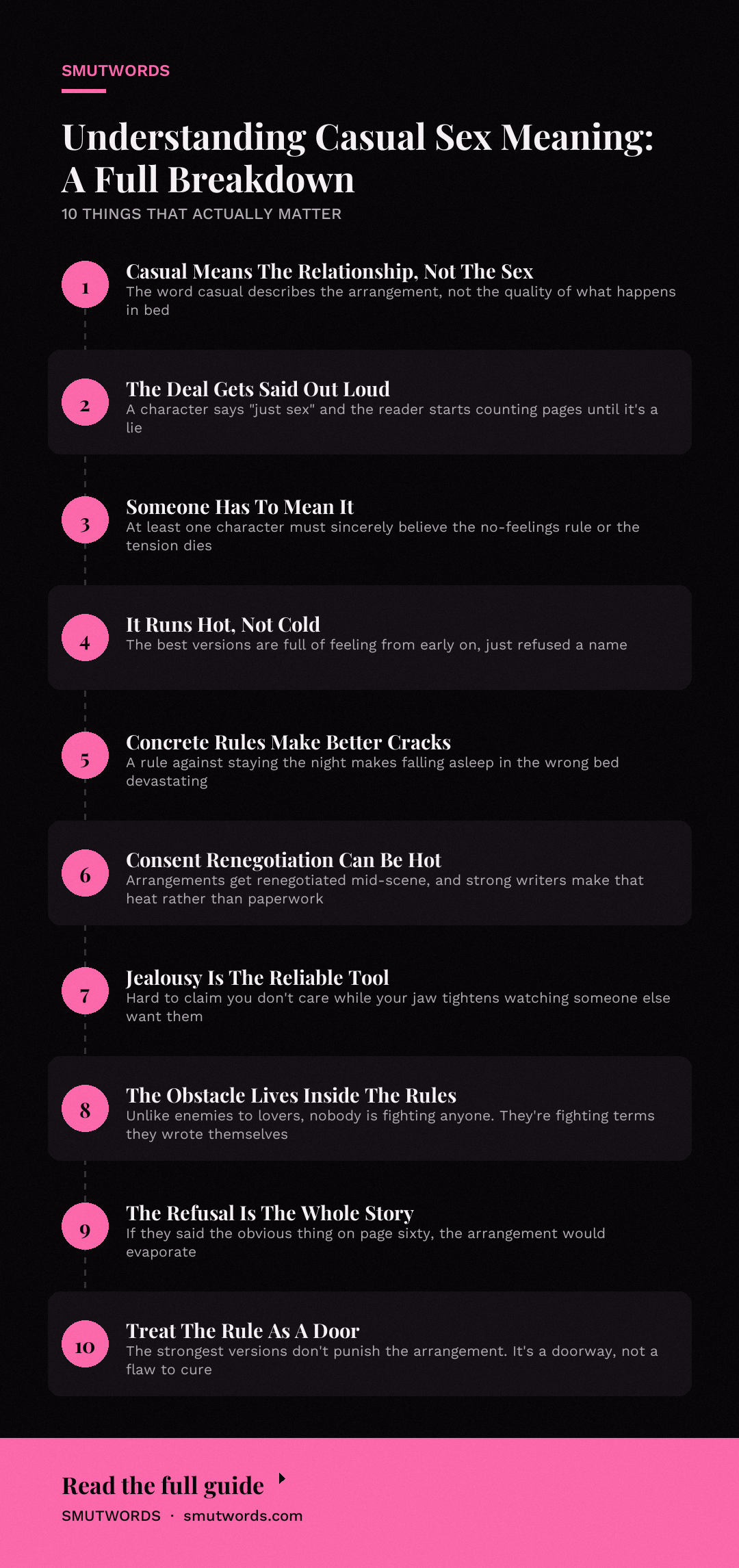
Strip it to the bone: casual sex is sexual activity between people who have not agreed to romantic exclusivity, emotional obligation, or a shared future. The "casual" modifies the relationship, not the quality of the sex. That distinction trips people up constantly.
In a story, the arrangement gets named out loud. That naming is the whole engine. A character says "just sex" and the reader immediately starts counting the pages until that sentence becomes a lie.
What counts as this trope
- An explicit agreement, spoken or strongly implied, that feelings are off the table
- Physical intimacy that starts early in the book rather than at the end
- At least one character who believes the arrangement is sustainable
- A turning point where jealousy, tenderness, or unprotected vulnerability cracks the deal
What doesn't count
A one-night stand is not this trope. Neither is a purely transactional marriage of convenience, where the deal was never about sex in the first place. And a story where both people secretly want a relationship from page one, with no genuine belief in the casual arrangement, loses most of the tension.
The trope requires sincere self-deception. At least one party has to mean it when they say they only want sex. Readers can smell a faked casual arrangement from the first chapter, and it flattens everything.
Common misconceptions
People searching casual sex meaning often assume the trope is about detachment, coldness, or a lack of feeling. It's the opposite. The best versions run hot with feeling from early on; the characters are just refusing to name it.
Another misconception: that casual means low stakes. The stakes are identical to any romance. They're just being held at arm's length by two people who are about to lose their grip.
Where Casual Sex Comes From
Casual sex as a practice is as old as people. Casual sex as a named, marketed romance trope is a much younger thing, and its real history is a publishing history.
For most of the twentieth century, mainstream romance ran on the promise of commitment. Sex happened, but usually as the destination or the reward. A book where two people went to bed early and agreed it meant nothing would have been a scandal even where the sex itself was permitted.
The shift arrived with the rise of contemporary romance and, later, erotic romance as a recognizable category in the 1990s and 2000s. Romance publishers loosened the marriage-or-nothing rule over that stretch, and characters started having sex before page two hundred.
How the trope split from the category
Once sex could happen early, authors needed reasons for it to happen early without resolving the emotional plot. The casual arrangement became that reason. The friends-with-benefits setup and the sex pact between two people who "aren't like that" moved from the edge of the genre to its center.
The indie ebook boom of the 2010s accelerated it. Digital publishing rewarded high heat and fast hooks, and a casual arrangement delivers both by chapter three. The arrangement became a standard opening move rather than a bold one.
How the portrayal has changed
Early versions often punished the arrangement. Someone caught feelings, someone got hurt, and the lesson was that casual sex didn't work. Modern readers want the opposite payoff: the arrangement collapses not because it was wrong, but because it was a doorway.
The other shift is in who gets to want it. The trope used to belong almost exclusively to rakish male leads. Now the "I don't do relationships" speech goes to whoever the author finds most interesting, and it lands harder when the character most invested in the rules is also the one most terrified of needing someone.
How It Shows Up in Erotica
Here's the craft angle, the part that separates a scene that works from one that just fills pages. A casual arrangement story is a machine with three moving parts: the deal, the crack, and the confession. Most weak versions fail at the crack.
The deal
The setup has to be specific.
Not "we're just hooking up" drifting along, but stated terms. Two weeks. One weekend. Nights only, no texts in the morning. A work trip where it stays in the past tense once they're home.
The more concrete the rules, the more satisfying the violations. A rule against staying the night creates an immediate, physical, devastating moment when someone falls asleep in the wrong bed.
The crack
This is where the sex gets interesting.
The best erotica in this trope uses the physical to leak the emotional. A hand that lingers. A kiss that runs too long. A moment of tenderness the characters cannot explain away as heat.
The crack is also where authors can spend real craft on consent and communication. Arrangements get renegotiated, sometimes mid-scene, and strong writers make that renegotiation hot rather than clinical. Consent can be its own kind of foreplay. If you want a fuller sense of the frameworks authors draw on, this breakdown of SSC vs RACK is a useful reference for what to put on the page and what to leave implied.
The confession
Someone breaks the deal out loud. It can be a confession, a fight, a jealousy flare the character has no vocabulary for. The strongest version usually includes a moment when the character who insisted on the rules sees someone else wanting their partner.
Jealousy is the trope's most reliable tool. It's hard to claim you don't care while your jaw is tightening in a hallway.
Common variations authors use
- Friends with benefits. The longest-running version. The friendship predates the sex, which means the stakes are already high before anyone gets naked.
- No strings attached. Usually two near-strangers or distant colleagues who deliberately lower the intimacy. The tension is the slow invasion of the personal into the purely physical.
- Sex pact. A time-limited agreement, often between friends who think they're being sensible. An expiration date guarantees a clock beating under every scene.
- One bed, no feelings. The forced-proximity variant. The characters share space first and set rules second, and the ratio of naked time to real conversation gets increasingly hard to explain.
- Fuckbuddies to lovers. The end state named upfront. The reader watches the title's promise come true, and the pleasure is in how much resistance the characters mount on the way there.
What makes a strong version work
- Both characters get their reasons. A fear of intimacy, a taste of it that went badly, a life that won't hold another person. The arrangement should read as emotionally logical, not convenient for the plot.
- The sex does emotional work. Every scene should change the distance between them, even by a centimeter.
- The rule-keeping costs something. A reader should feel the effort of not texting first, not staying over, not asking the real question.
- The outside world intrudes. A sister who assumes they're dating. A work event where they have to decide whether to stand close. That's where the rule gets tested and found wanting.
What makes a flat version fail
The flat version has one character secretly wanting marriage by chapter two. The other is cool and detached. There is no real belief on either side. The rules exist so the author can break them with zero resistance, and the reader feels the whole thing sag.
Another failure mode: the casual arrangement is treated as a flaw to be cured. The trope is strongest when the arrangement is genuinely appealing and the characters are genuinely changed by it, rather than punished for it.
Enjoyed this? Get a free book.
Join the list and we will send a complete free story straight to your inbox, plus new releases every week after that. No credit card, no catch.
Casual Sex vs Enemies to Lovers
Readers frequently confuse this one with enemies to lovers, and the two do overlap. Both start with sex before there is love, both run on friction, both require a real obstacle before the payoff.
The difference is where the obstacle lives. In enemies to lovers, the obstacle is external and declared: a rivalry, a professional grudge, a family feud. The characters can't stand each other, and desire has to fight its way through open hostility.
In a casual arrangement, the obstacle is internal and quiet. Nobody is fighting anyone. The characters like each other fine. They're fighting a set of rules they wrote themselves.
The other distinction is tone. Hate to love stories run hot and spiky from the start. Casual arrangement stories are warmer, sweeter, more domestic, and their tension comes from how comfortable everything already is.
The threat in an enemies to lovers is that they'll never get along. The threat in a casual arrangement is that they already do, and neither one is ready to say what that means.
How to Read a Casual Arrangement Story without Getting Frustrated
The most common complaint about this trope is that the characters refuse to say the obvious thing for four hundred pages. There is a reason that works, and a way to enjoy it.
The refusal is the story. If the characters said the obvious thing on page sixty, they'd become two people sitting on a couch talking about their feelings, and the whole point of the arrangement would evaporate. The delay is engineered, and the good versions make it feel earned rather than contrived.
Watch for structure. A strong casual arrangement story usually gives the characters at least one moment where they almost say it and one where they say something worse instead. Those near-misses carry the second act.
Pay attention to where the author hides the truth. It's rarely in dialogue. Look for the character who starts leaving things at the other person's apartment, or the one who can't remember when they stopped checking their phone after.
Where the Trope Travels
Casual arrangements show up in nearly every subgenre, and each one changes the flavour of the deal.
In contemporary romance and erotica, the trope is usually set in the ordinary world of work, friends, and small apartments. The stakes are domestic and quiet, which makes the eventual feelings land harder.
In sports and small-town settings, the arrangement often starts as a secret. Nobody's supposed to know, which immediately creates a community of bystanders who can read what the characters can't. That's a different pleasure than a private arrangement, and the trope can carry both.
In some subgenres, the casual arrangement is the hook that lets a grimmer story breathe. A revenge romance can use a no-strings arrangement as a cover for its real plot. A ghostwriter romance can use one as the professional excuse two coworkers need. A lumberjack romance can use one to keep a visiting city character from planning a future in a town she doesn't understand yet.
The trope is a tool, and it fits anywhere sex can happen before love does.
The trope also pairs naturally with kink and specific practices, where the arrangement's clarity is part of the appeal. A hand in the hair is easy to negotiate in a no-strings setup, and this complete guide to hair pulling kink is a useful reference for authors who want their arrangement to have real texture.
Similarly, a semi-public moment can become the crack in the deal, and readers who want to explore that angle can start with what is public sex.
Sensitivity about who gets to be casual matters too. A childhood friends to lovers story that opens with an agreement is playing with a different emotional history than two strangers. The rules arrived on top of years of shared context, which is a harder arrangement to keep clean.
Frequently Asked Questions
What does casual sex mean in a romance novel?
It means an agreement between two characters that the sex is physical and the relationship stays undefined. In romance and erotica specifically, it functions as a promise the characters make to themselves that the plot will break by the end.
Is a friends-with-benefits story the same as casual sex?
Friends with benefits is the most common form of it, but not the only one. A casual arrangement can also start between strangers or colleagues with no friendship attached. The shared requirement is an explicit, stated rule that feelings are off the table.
Why do readers like the casual sex trope if they know the ending?
Because the pleasure is in the collapse, not the surprise. Readers are not being tricked. They are watching two adults insist on something that is clearly not working, and the tension comes from how long and how badly they keep insisting.
What's the difference between casual sex and a one-night stand in fiction?
A one-night stand is a single encounter. The casual arrangement implies repetition, rules, and a relationship that has been defined but not named. The one-night stand is a moment. The arrangement is a whole structure that gets tested over chapters.
Can a casual arrangement be a healthy, consensual setup in a story?
Absolutely, and the best versions write it that way. The arrangement can be honest, negotiated, and respectful, with both characters genuinely choosing it. The emotional complication comes later and arises from new information, not from a lie on the first page.
Is casual sex the same as enemies to lovers?
No, though they overlap. Enemies to lovers puts the obstacle outside the relationship, in a rivalry or a grudge. The casual arrangement puts the obstacle inside the relationship, in the characters' own rules. The sex can happen early in both, but the reason it isn't love yet is different.
Final Thoughts
If you only read one book this trope has produced, start with an author who understands that the arrangement is not the problem to be solved. The best versions of casual sex in romance treat the rule as a door.
Two people walk through it believing they are leaving something behind, and they come out carrying each other. Find one where the sex is good, the rules are specific, and the moment when the deal snaps is worth the wait. That is the version readers keep coming back for, and the version authors keep trying to write better than the last.






Loading comments…