
One of you wants sex four times a week. The other could go a month without noticing. Nobody lied on the wedding night, nobody stopped caring, and yet every attempt to talk about it turns into the same fight with different words.
A mismatched libido is one of the most common things couples walk into a therapist's office about. It's also one of the least mysterious, once you strip off the accusation layer and look at what's actually happening.
This guide is for the couple in the middle of it, or the one quietly bracing for it. We'll cover what a desire gap really is, the conversations that work better than the ones that don't, compromises that hold up over time, and the point where a professional belongs in the room. No moralizing about who should want more or less. Just the practical playbook.
What a Mismatched Libido Actually Means
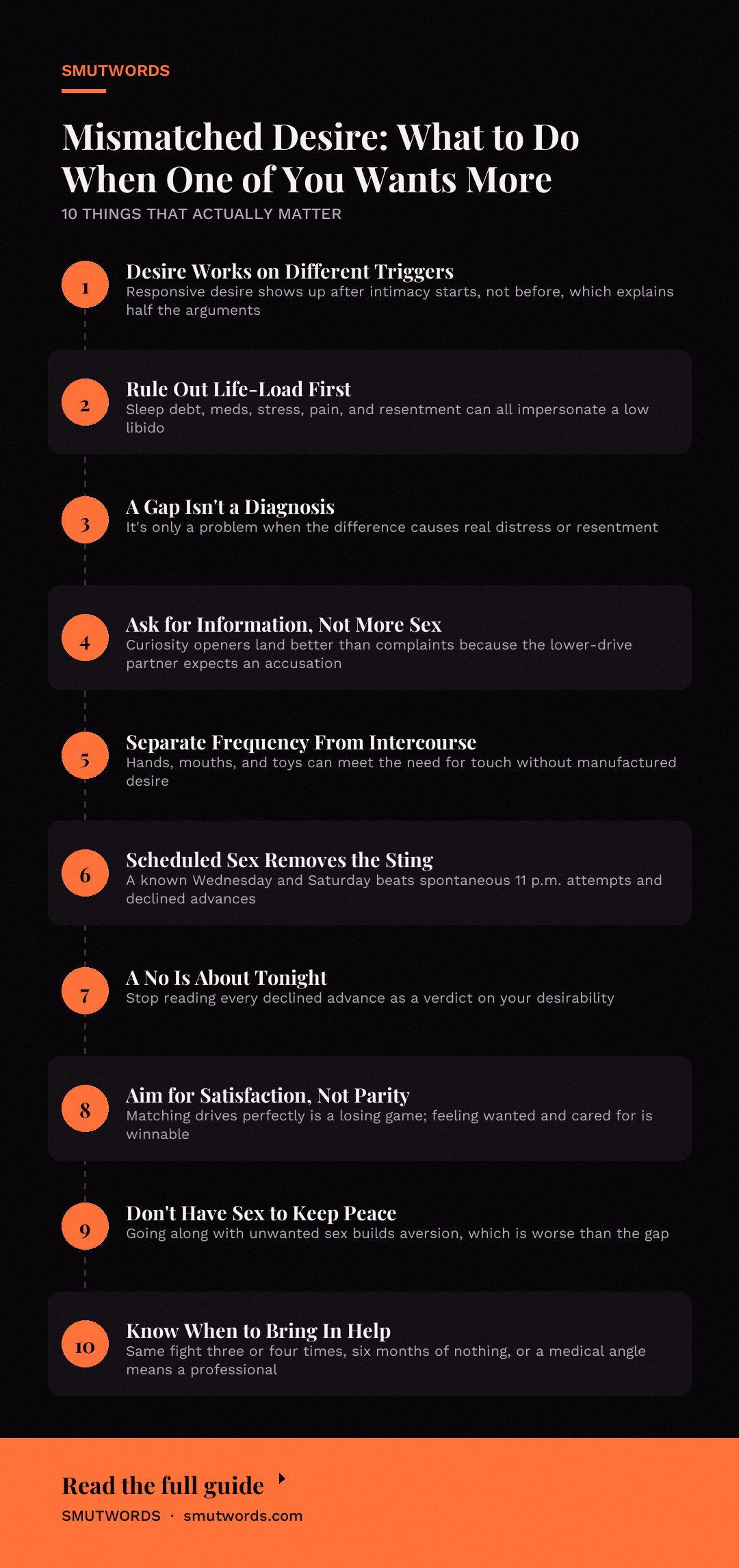
Libido isn't a fixed setting. Researchers who study this tend to describe desire as responsive for a lot of people, meaning it shows up after arousal or intimacy starts rather than arriving before it. That one distinction explains half the arguments couples have about sex frequency.
If your partner never initiates, it might mean their desire works on a slower trigger than yours. It doesn't mean they've stopped finding you attractive. Meanwhile, spontaneous-desire people read the lack of initiation as rejection, when it's really a difference in ignition timing.
We're also talking about a gap, not a diagnosis. Two people who want sex every day are matched. Two people who want it once a month are matched.
A couple only has a libido problem when the difference is causing real distress or resentment for one or both partners. Frequency alone isn't the issue. What the frequency means to each person usually is.
The real things sitting underneath a desire gap
Before you assume the libido number is the issue, rule out the stuff that impersonates a low libido:
- Sleep debt. Newborn, new job, chronic insomnia. Desire lives downstream of basic energy.
- Medication. SSRIs, hormonal birth control, certain blood pressure drugs. Worth asking a doctor about, not the internet.
- Stress and mental load. A partner running on fumes at 10 p.m. is not withholding, they're depleted.
- Physical pain or medical issues. Pain during sex, pelvic floor problems, thyroid stuff. These need a clinician.
- Unspoken resentment. Nobody wants to fuck the person they're quietly furious at.
- Different desire styles. Spontaneous versus responsive, which is worth talking about on its own.
If two or three of these apply, you're not looking at a libido mismatch so much as a life-load mismatch. Fixing the load often does more than any conversation about frequency ever will.
How to Bring It Up Without Starting a Fight
The worst time to raise a desire gap is in bed, right after a rejection. The second-worst time is during an argument. Pick a neutral moment, mid-afternoon on a Saturday, and set the frame before you say anything that sounds like an accusation.
Conversation starters that actually open things up
- "I want to talk about our sex life, and I'm not bringing it up because I'm upset. I want us both to feel good about this."
- "On a scale of one to ten, how satisfied are you with how often we have sex right now? I'll go first."
- "What makes it easier for you to get in the mood? I'm asking because I want to know, not because I'm keeping score."
- "I've been feeling like the one who initiates all the time, and I want to understand what's going on from your side."
- "What's one thing I could do that would make sex feel more appealing on a Tuesday night?"
Notice these aren't requests for more sex. They're requests for information. The partner with the lower drive is almost always braced for an accusation, and opening with curiosity instead of a complaint changes the tone of the conversation before it starts.
What to avoid saying
"You never want me" is the phrase that sets every couple back six months. So is "What's wrong with you," and anything that frames the lower-desire partner as broken or the higher-desire partner as a nag. The higher-desire partner gets to have feelings about the gap; the lower-desire partner gets to have feelings about being pushed. Both are real and both matter.
If you want to understand how a couple can hold tension without turning it into a war, the dynamic in marriage in trouble fiction is basically a masterclass in how much gets left unsaid. Useful to read for the subtleties, not because fiction solves it.
Compromises That Actually Work
The standard advice is "meet in the middle," which is useless. What does the middle of four times a week and once a month even look like? Here are the compromises that real couples report working, roughly in order of how well they hold up.
1. Separate frequency from the physical act
Sex doesn't have to mean intercourse. A couple with a wide gap can find a middle where the higher-drive partner's need for touch, release, and being wanted gets met without the lower-drive partner doing something they don't want to do.
Hands, mouths, toys, mutual masturbation with one hand on the other person. All of it counts. None of it requires the lower-desire partner to manufacture desire they don't have.
The book Ass Worship Specialist is a decent example of how a specific physical focus can create its own kind of intimacy, one that doesn't look anything like standard intercourse and still lands.
2. Schedule it, and stop apologizing for that
Scheduled sex sounds unromantic until you've lived with a desire gap for a year and realized the anticipation of a known Wednesday and Saturday is doing more for your marriage than spontaneous 11 p.m. attempts ever did. Scheduled sex removes the pressure of asking and the sting of being declined. It's a service to both of you.
3. Take "yes, no, or later" off the table as a personal verdict
A no is about what someone can offer right then, not a rejection of the person asking. Couples who stop treating every declined advance as a verdict on their desirability tend to have an easier time. Something you can say explicitly: "When you say no, I'm going to choose to believe it's about tonight and not about us. Help me out by being warm about it."
4. Negotiate the initiation
If the higher-desire partner is always the one asking, resentment builds in one direction. If the lower-drive partner is always being asked, obligation builds in the other. Some couples split this explicitly, like alternate weeks of who initiates, or agree on low-pressure invitations (a hand on the thigh, a text during the day) that don't require an immediate answer.
5. Let solo sex be a pressure valve, not a threat
Masturbation is not cheating on the desire gap. If someone's libido is meaningfully higher, they may want to take care of it alone sometimes, and a couple that has a clear, unashamed conversation about that usually finds the pressure in the relationship drops. The casual sex meaning breakdown touches on how people separate sex from relational stakes; the same logic applies inside a relationship.
6. Aim for satisfaction, not parity
Trying to make a low drive and a high drive match perfectly is a losing game. Making sure both people feel wanted, cared for, and like their needs matter is winnable. Those are different goals. The couples who come out of a desire gap intact tend to drop the parity goal early.
Enjoyed this? Get a free book.
Join the list and we will send a complete free story straight to your inbox, plus new releases every week after that. No credit card, no catch.
When One of You Wants More: Specific Situations
Not all mismatches are the same, so the response shouldn't be either.
One wants more sex, the other wants more emotional connection first
This is the most common mismatch, and the couples who treat it as a sequence instead of a contest do best. The higher-drive partner gets more physical follow-through by investing in non-sexual intimacy first: dates, touch without an agenda, actual conversation.
The lower-drive partner gets more emotional connection by meeting the physical side partway. Both moves have to happen. Only one is not a compromise.
New baby, new job, new medication
Temporary conditions produce temporary libido shifts. Treat these as a season and put a date on the calendar to revisit. "Let's check in again in eight weeks" removes the feeling that this is forever. It's also honest, because sometimes it isn't forever and sometimes it is, and either way you'll know more at the eight-week mark than you do now.
It started around a specific event
If a previously matched couple suddenly isn't, look for the event. An affair, a loss, a move, a health scare, a change in body. The desire gap is often the symptom, and trying to negotiate frequency without addressing the event usually just delays the real conversation.
If you're the kind of couple who likes to borrow from fiction to open a real conversation, The Heir of Two Worlds and Breed Me, General both involve characters whose desire runs hot while other things pull them apart. Reading a scene together and then talking about what felt familiar is a lower-pressure way into a hard conversation than a sit-down with a therapist's office vibe.
When Outside Help Makes Sense
There's a point where gutting it out stops being brave and starts being stubborn. Here's a rough threshold:
- You've had the same conversation three or four times and it keeps ending in the same place.
- One of you is quietly resentful most days. Silent resentment doesn't improve on its own.
- Sex has stopped entirely for six months or more and neither of you is at peace with that.
- Someone has stopped feeling attractive to themselves. That's a mental health issue hiding inside a bedroom issue.
- There's a medical angle. Pain, erectile changes, hormonal symptoms, or a medication you suspect. Start with a doctor.
Look for a certified sex therapist (AASECT is the main certifying body in the US), a couples therapist who specializes in sexual issues, or your primary care doctor first if there's a physical symptom in the picture. A good sex therapist won't tell you who's right. They'll help both of you hear the other person.
The SSC vs RACK guide is worth reading if you're also renegotiating kinks or physical dynamics while you work through the desire gap. Framing consent and limits in explicit terms makes it much easier to bring the same clarity to "how often do we want this" without either partner feeling judged.
What therapy actually does for a libido mismatch
It doesn't talk one partner into wanting more sex. Anyone promising that is running a scam. It does help each partner articulate what they actually need (which is usually different from what they've been asking for), and it helps both of you hear the desire gap as a shared problem instead of a personal rejection. That alone tends to move things.
Here's a sentence couples repeat without realizing how much it costs them: "If you really loved me, you would want me." Taking that one apart in a therapist's office often does more than six months of negotiating frequency at home.
Things Not to Do
A desire gap makes people do some genuinely counterproductive things, and the lower-desire partner often gets blamed for all of them.
- Don't have sex you don't want to keep the peace. Long-term, this builds aversion. Aversion is worse than a gap.
- Don't threaten to leave over frequency. If the relationship is genuinely at stake, say that directly and put real weight behind it. Don't use it as leverage in an argument about Tuesday.
- Don't compare your marriage to anyone's social media. You don't actually know how often your friends are having sex, and neither do they.
- Don't turn sex into a performance review. Scorekeeping, "I initiated last time" ledgers, and tally systems destroy the mood faster than any low libido ever could.
- Don't silently accept a gap you're not okay with. Quietly swallowing resentment is how a couple ends up divorced with no idea how they got there.
Fiction That Gets the Tension Right
If you and your partner want something to read together that opens up desire conversations without feeling like homework, some of the site's heavier dynamics are useful here. The power and control stuff in sadomasochism: everything you need to know shows how explicit negotiation about what each person wants can deepen intimacy rather than kill it.
The bull dynamic in The Weekend Bull Rotation is a good example of a story where characters are direct with each other about what they want, and the directness does more work than the sex scenes.
Free Use Dentist: The Dentist Everyone Uses is the opposite end of the spectrum. Useful if the conversation you need to have is about fantasies one partner has been too embarrassed to say out loud.
Soles of Devotion is worth pointing at if you have a specific kink mismatch, where one of you has a thing and the other doesn't, and want a story about the version where the second partner discovers they like it too. Someone reading for curiosity tends to be a good sign.
None of these books are a substitute for the conversation. But they're a low-stakes way in. If "here's a scene, what do you think about it" is an easier opener than "we need to talk about our sex life," use the easier opener. Whatever works.
Final Thoughts
A mismatched libido is a challenge, not a verdict. If you're the higher-desire partner going quietly crazy, you're not a nag. If you're the lower-desire partner, you're not broken and you're not the reason the relationship is struggling. The couples who come out the other side are the ones who treat it as a shared logistical problem instead of a personal failure for either of them.
If you want a book to open the conversation in a way a couples sit-down can't, Breed Me, General is a solid entry point. The desire runs high, the stakes are clear, and it's easy to talk about which parts remind each of you of anything real.
Start there, then start the conversation. Not tonight. Mid-afternoon Saturday works better.







Loading comments…