Sadomasochism is the consensual exchange of power and sensation where one person gets off on giving pain, control, or humiliation and the other gets off on receiving it. It covers everything from a light spanking to a full-time power exchange.
It also runs through erotica the way a fault line runs through a landscape: sometimes quiet, sometimes the thing everything else is built on. The sadomasochism dynamic is one of the oldest engines in the genre, and one of the most misunderstood by readers who meet it for the first time on a page and want to know what they're actually looking at.
This guide covers what the term means, where it came from, how writers use it, and what separates a scene that works from one that reads like a checklist. It treats the fiction seriously and the practice honestly. If you've ever finished a book with a riding crop on the cover and wondered whether you were supposed to find that hot, you're in the right place.
What Sadomasochism Actually Means
The word is a compound: sadism plus masochism, named for two men who never met and would probably have been appalled to be paired. The Marquis de Sade gave his name to the pleasure of inflicting pain; Leopold von Sacher-Masoch gave his to the pleasure of receiving it. Sexologists fused the two into a single term in the late nineteenth century. The fusion stuck, even though the two impulses aren't actually mirror images of each other.
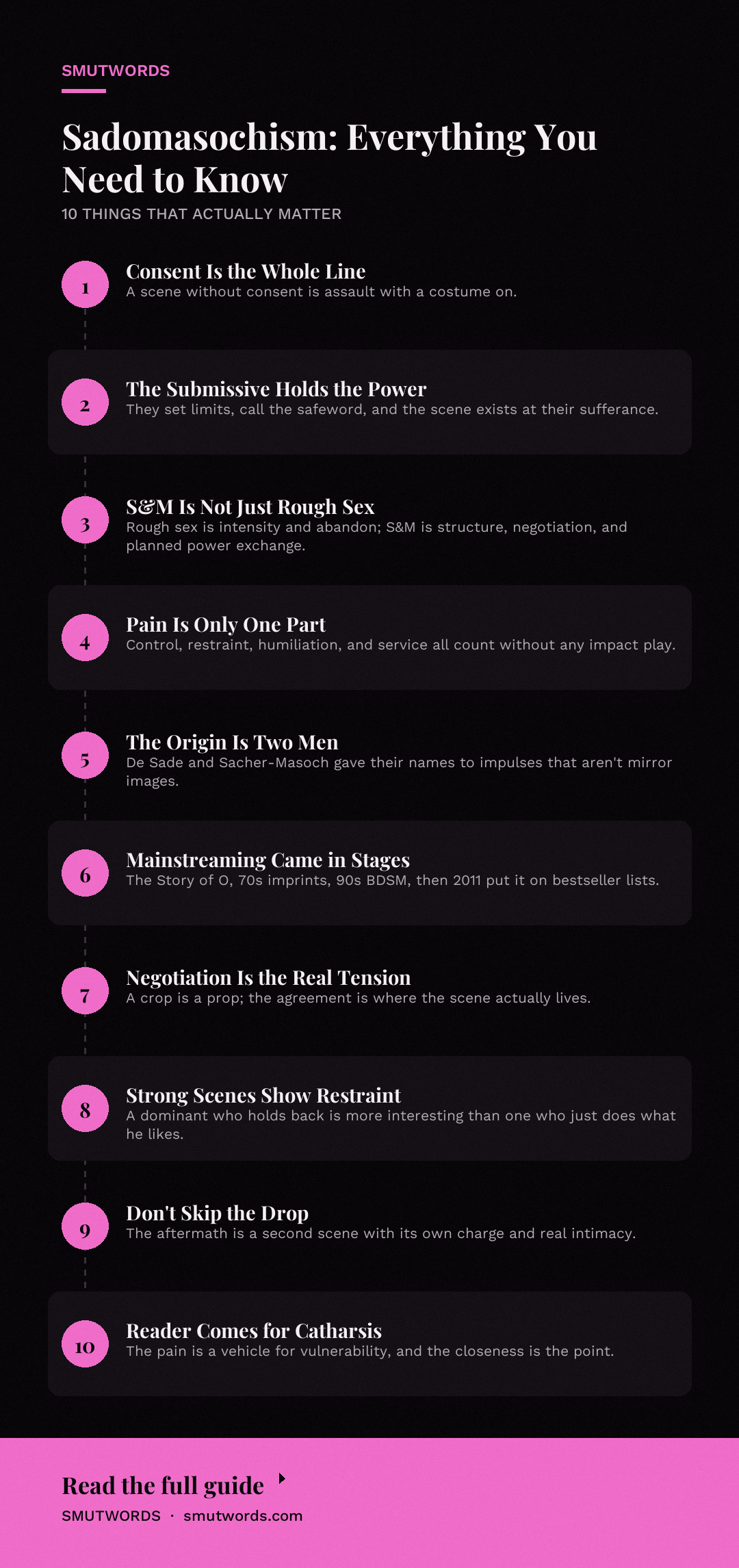
In everyday use, sadomasochism describes a consensual dynamic where pain, restraint, humiliation, or control produce arousal or emotional release for at least one participant and are accepted by the other. The keyword there is consensual. A scene without consent is assault with a costume on, and erotica knows the difference even when it plays with the edge of it.
What Counts and What Doesn't
The term covers a wide range of practices, and not all of them involve physical pain. A rope harness that leaves marks counts. A spoken command that makes someone kneel counts. A negotiated scene where one partner is blindfolded and told not to move counts.
All of it falls under the sadomasochism umbrella because all of it trades in the same currency: an agreed surrender of control in exchange for intense sensation or feeling.
What doesn't count: anything done to a person who hasn't agreed to it, anything done without a way to stop it, and anything framed as punishment for a real-world transgression rather than a scene both people chose. Erotica blurs these lines constantly for dramatic effect. The blur is the point in fiction and the red flag in life, and good writers know which one they're doing.
Common Misconceptions
The biggest misconception is that sadomasochism is just rough sex with extra equipment. Rough sex is about intensity and abandon; sadomasochism is about structure, negotiation, and the deliberate exchange of power. They overlap, but they're different animals, and the difference is usually the thing a reader is actually hunting for when they search the term.
Another misconception: that the person receiving pain is weak or passive. In most well-written S&M dynamics, the submissive partner holds enormous power. They set the limits, they call the safeword, and the entire scene exists at their sufferance.
The dominant performs control; the submissive grants it. Remove the grant and the whole structure collapses.
A third: that sadomasochism and dominance/submission are the same thing. They're related but separable. You can have a scene built entirely on pain with no power exchange, and you can have a power exchange with no pain at all.
Many readers use the terms interchangeably. The best writers don't.
Where Sadomasochism Comes From
As a word, sadomasochism is a product of nineteenth-century sexology, when doctors were busy cataloguing every human appetite and filing it under pathology. As a trope in erotic writing, it's older and messier.
The Marquis de Sade's novels were published in the 1790s and were banned, seized, and passed around in secret for a century and a half. Sacher-Masoch's Venus in Furs arrived in 1870 and gave the world a template for the elegant, cruel dominatrix that romance has been borrowing from ever since.
The publishing history matters more than the clinical one here. For most of the twentieth century, sadomasochistic fiction lived underground: Olympia Press paperbacks, samizdat zines, the leather-bar newsletters that circulated hand to hand. The content was explicit because it had to be. There was no market for a tasteful version, and no publisher willing to print one.
The Mainstreaming Years
That changed in stages. The Story of O (1954) proved a literary sadomasochistic novel could sell to general audiences. The 1970s brought the first commercial BDSM imprints and a slow trickle of mainstream books with power-exchange plots. The 1990s saw the term BDSM enter common parlance, and the 2000s brought internet communities that let readers find exactly the flavor of power exchange they wanted.
The real rupture was 2011, when a certain trilogy about a billionaire and his contract put S&M dynamics on the bestseller lists and in every airport bookstore on earth. Whatever you think of the prose, it changed what publishers were willing to acquire. The decade that followed produced a wave of kink-forward romance, from dark mafia books to small-town doms, and sadomasochism went from a niche subgenre to a shelf category.
The genre has also gotten more careful. Early mainstream kink romance often treated consent as a formality and aftercare as an afterthought. Contemporary books are more likely to show negotiation on the page, to name the safeword, and to include the quiet aftermath where both people check in.
That shift is partly a response to reader criticism and partly a real culture change in the communities the books borrow from. For more on how consent frameworks evolved, the SmutWords piece on Safe, Sane, Consensual vs RACK lays out the two dominant models and where they disagree.
How It Shows Up in Erotica
On the page, sadomasochism is a pressure system. The scene works when the reader feels the weight of the negotiation, the held breath before the first strike, the way a single word from the dominant partner reorganizes the submissive's entire nervous system. A crop is a prop. The tension is in the agreement.
The strongest scenes in the genre share a few structural habits. They establish terms before the action starts, whether through a formal contract, a spoken conversation, or a history between the characters that does the negotiating for them. They show the physical details precisely: the sound of a belt sliding free, the specific temperature of wax, the way rope leaves a pattern.
And they commit to the aftermath, because the drop after a scene is where a lot of the emotional payoff lives.
Common Variations
Writers work this territory in several recognizable modes. Each has its own conventions and its own reader:
- Formal contract dynamics. A written or spoken agreement, often with rules, limits, and a safeword. Common in contemporary kink romance and billionaire books. The contract itself is a plot device as much as a sex scene.
- Pain play with no power exchange. Two people who like marks, impact, or sensation without any dominance framework. Often written as a discovery arc, where one partner introduces the other.
- Full-time power exchange. The dynamic runs outside the bedroom and organizes the whole relationship. This is where keyholding and long-term protocols show up, and it demands more worldbuilding than a single scene.
- Humiliation and degradation scenes. Verbal rather than physical sadism. The degradation kink overlaps heavily here, and the two are often written together.
- Primal and feral variations. The scene strips away formal structure and runs on instinct, pursuit, and animal energy. Primal play and feral play both live at this end of the spectrum, and they're the fastest-growing variant in recent years.
- Institutional settings. Clubs, training houses, and secret societies where sadomasochism is the organizing principle. These books borrow the aesthetics of ritual and often lean on initiation plots.
The variation a book chooses tells you what kind of emotional experience it's selling. Contract dynamics sell trust and negotiation. Pain play sells discovery. Full-time exchange sells surrender and structure.
Enjoyed this? Get a free book.
Join the list and we will send a complete free story straight to your inbox, plus new releases every week after that. No credit card, no catch.
Primal play sells loss of control. A reader who wants one and gets another often bounces, which is why blurbs in this category are so specific about which flavor is inside.
What Makes a Strong Sadomasochism Scene
The flat version of this trope is easy to spot. It's all leather and no interiority. The dominant partner is cruel because the plot needs a villain with a whip; the submissive partner submits because the author needs a body in the scene.
Nobody negotiates, nobody checks in, and the safeword is mentioned once and then forgotten. The scene is a costume, and it reads like one.
The strong version does three things. First, it gives the submissive partner agency, even when that agency looks like surrender. The reader has to believe the submissive could stop the scene at any moment and chooses not to.
Second, it makes the dominant partner's restraint visible. A dominant who wants to hurt someone and holds back is more interesting than one who simply does what he likes. Third, it stays in the body. Sadomasochism is a physical experience, and the prose has to render sensation with specificity: the sting, the heat, the ache afterward, the endorphin rush that makes everything soft and far away.
Consent and aftercare belong on the page in good books. The safeword gets established before anything happens. Limits get discussed. The scene ends with water, a blanket, and a conversation, because the drop is real and the reader who has been through one recognizes it.
Skipping all of that doesn't make the writing edgier. It makes it thinner. For a related craft problem, the SmutWords guide to hair pulling kink makes a similar case about specificity and trust in a single physical act.
The Emotional Payoff
Readers come to sadomasochism for the catharsis. A scene that works leaves both characters wrung out and closer than they were before, and the closeness is the point. The pain is a vehicle for vulnerability, and the vulnerability is what the reader is actually chasing. That's why the best books in this category often read as love stories with a severe aesthetic, and why the ones that treat pain as pure spectacle feel hollow.
There's also an element of emotional release that has nothing to do with sex. Some characters use the scene to let go of grief, rage, or control they can't shed any other way. When a writer gets that right, the sadomasochistic scene functions as a pressure valve for the whole book, and the reader feels the release as intensely as the character does.
That's the difference between a scene that arouses and a scene that moves. The best authors in the genre do both at once.
Writing the Drop and the Aftermath
The aftermath is where a lot of books lose their nerve. A scene ends, and the narrative cuts to the next morning without showing the crash. That omission costs the story its emotional landing. The drop is the physiological and emotional low that follows intense sensation, and it's one of the most reliable sources of real intimacy in the genre.
Show the blanket, the water, the shaky hands, the raw conversation that only happens when both people are wrung out. Show the dominant partner's own vulnerability, because topping takes a toll too. The best books treat aftercare as a second scene with its own charge. It's where the characters say the things they couldn't say before the crop came out.
Sadomasochism vs Rough Sex
These two terms get confused constantly, and the confusion is worth clearing up. Rough sex describes intensity of a certain kind: fast, hard, occasionally bruising, usually spontaneous. Sadomasochism describes a structured exchange of power and sensation, usually planned, always negotiated. You can have one without the other in either direction.
The practical difference is consent architecture. Rough sex relies on ongoing enthusiasm and the ability to stop. Sadomasochism builds in explicit negotiation, named limits, and a safeword before anyone takes off a belt.
If a scene has a safeword and a discussion of limits, it's S&M even if the sex is gentle. If it has neither, it's rough sex, and the writing needs to earn the intensity another way. Most contemporary kink romance blends the two, and that's fine. The labels matter less than whether the scene the reader is in feels safe enough to be thrilling.
A book that skips the negotiation and calls it S&M isn't writing a power exchange. It's writing an assault with a contract-shaped hole where the consent should be.
Frequently Asked Questions
Is sadomasochism the same thing as BDSM?
No. BDSM is an umbrella term that covers bondage, discipline, dominance, submission, sadism, and masochism. Sadomasochism is one piece of that umbrella, focused specifically on the exchange of pain and sensation. You can have BDSM with no sadomasochism at all, and you can have sadomasochism without the other components.
Can sadomasochism be healthy?
Yes, when it's consensual, negotiated, and includes a safeword and aftercare. The established frameworks are known as SSC (safe, sane, consensual) and RACK (risk-aware consensual kink). Both prioritize the informed consent of everyone involved and treat the exchange as something the participants design together.
What is a safeword and why does it matter?
A safeword is a pre-agreed word or signal that stops the scene immediately. It matters because in a power exchange, the usual signals for "stop" are part of the game. A safeword is the one thing that can't be absorbed into the dynamic, and every responsible scene has one.
Is sadomasochism always about pain?
No. Pain is one component, and many sadomasochistic dynamics center on control, restraint, humiliation, or service instead. Sensation play, sensory deprivation, and ritual all fall under the term without any impact play involved. The common thread is the consensual exchange of power, not the specific act.
Why do readers like sadomasochism in romance?
It offers intense vulnerability and a structured container for it. A scene forces both characters to be painfully honest about what they want and what they can handle, and the trust required to get through one is a powerful engine for intimacy. The catharsis readers describe is real: the release of a scene often reads as deeply emotional rather than purely sexual.
What should I look for in a good sadomasochism romance?
Look for explicit negotiation, a named safeword, and aftercare on the page. Look for a submissive partner with agency and a dominant partner whose restraint is visible. If a book skips all of that to get to the whipping, it's using kink as decoration and will read thinner than one that takes the structure seriously.
Final Thoughts
Sadomasochism is the genre's most reliable engine for intimacy through extremity, and the books that do it well treat the agreement as seriously as the act. Pick a writer who has clearly done the reading, and watch how the negotiation is handled before the first crop comes out. That's where you'll find out whether the book is actually about power exchange or just borrowing the leather.






Loading comments…