
Chase and capture play is a kink built on pursuit: one person runs, the other follows, and the scene ends with the runner caught and held. It lives in the space between fear and arousal, where being hunted reads as being wanted.
The chase can be literal (a sprint through the house, a scramble up a staircase) or theatrical (an abduction scenario with a staged grab). Either way, the heat comes from the same engine: someone chose to run so they could be caught, and someone else chose to give chase knowing exactly what happens when they win.
That mutual agreement separates the kink from an actual crime. It is the first thing any good version of this scene establishes, on the page and off.
What Chase and Capture Play Actually Means
The name describes the two halves of the scene. The chase is the pursuit: running, dodging, hiding, being found, running again. The capture is the moment pursuit ends and restraint begins.
Some couples treat capture as the finish line and the sex that follows as the point. Others treat the capture itself as the erotic event, dragging it out with wrestling, pinning, and the slow realization that escape is no longer possible.
What counts as chase and capture play is broader than most people assume. It includes:
- Predator and prey dynamics, where one partner plays the hunter and the other plays something hunted, sometimes animalistic, sometimes fully human and terrified in a controlled way.
- Abduction fantasy, a staged kidnapping with planning, a location change, and a captive who did not "agree" in the fiction even though they agreed completely in reality.
- Resistance play, where the captured partner keeps fighting after being caught, and the struggle itself becomes foreplay.
- Catch me if you can games, playful rather than dark, closer to tag with benefits.
- Home invasion scenarios, which borrow the structure of a break-in and use the house itself as the chase arena.
What does not count: anything without prior consent. The genre sometimes blurs this line on purpose, because the fantasy of being overpowered depends on the appearance of no choice. But the appearance is the product. The agreement underneath is what makes the scene work, and readers who love this trope usually know that distinction even when the characters on the page do not.
A common misconception is that chase and capture play requires a dominant and a submissive in the formal sense. Plenty of scenes run on pure physical competition, with no power dynamic outside the chase itself.
Another misconception is that it has to be rough. A slow, deliberate hunt through a dark house, ending in a single hand closing around a wrist, can be more charged than a full wrestling match.
Intensity is not the same as force.
Where Chase and Capture Play Comes From
The fantasy of pursuit is older than erotica as a category, but its life as a named kink and a recognizable romance trope is a publishing story. Gothic romance gave it an early home: heroines fleeing through corridors, brooding men in pursuit, the hunt framed as courtship. Those novels rarely called it a kink, but the beats were there, and readers responded to them for two centuries.
The explicit version emerged alongside the broader kink publishing boom of the late twentieth century, when small presses and later the internet gave writers room to name what the gothic had only implied.
Predator and prey language entered the vocabulary through animalistic roleplay communities, and it migrated into erotica quickly because it solved a craft problem: it gave writers a physical plot for a sex scene. Someone runs. Someone follows.
Something has to happen next.
The biggest shift came with the indie ebook era. Chase and capture scenes went from occasional set pieces to a full subgenre structure, especially in shifter romance, dark romance, and paranormal erotica, where the predator is often literal.
A wolf chasing his mate through the woods is chase and capture play wearing fur. Readers who would never pick up a book labeled as kink will happily read the same beats in a paranormal romance.
That migration changed the trope's reputation. In kink circles it is discussed with attention to negotiation and safety. In romance, it is often portrayed as fated and inevitable, with the chase standing in for the moment a character stops resisting their own desire. Both versions do the same emotional work: dramatizing the thrill of being wanted past the point of restraint.
The term itself is newer than the fantasy. "Chase and capture play" shows up mostly in kink glossaries and community writing, while "predator and prey" and "abduction fantasy" do more of the work in fiction tags. The overlap is real, and most readers use the labels interchangeably. See breeding kink vs impregnation for how this kind of labeling debate plays out in another corner of the genre.
How It Shows Up in Erotica
On the page, chase and capture play is a pacing device as much as a sex act. It gives a scene a beginning, middle, and end that are physical rather than conversational. The best versions use the chase to build tension the reader can feel in their body: shorter sentences, environmental detail, the sound of footsteps that may or may not be the pursuer. By the time the capture happens, the reader has been running too.
Strong scenes tend to share a few traits. The chase has stakes the reader understands. The capture is a genuine turning point, not just a transition to a different position. And the captured character's reaction carries the emotional payload: relief, defiance, or that specific exhale when the fighting stops because the outcome was always wanted.
Flat versions make the opposite mistake. They treat the chase as filler between two sex scenes, describe it in generic terms, and let the capture happen without consequence. The reader gets motion without momentum. If the runner was never really at risk of being caught, or the pursuer was never really trying, the whole structure collapses into cardio.
Enjoyed this? Get a free book.
Join the list and we will send a complete free story straight to your inbox, plus new releases every week after that. No credit card, no catch.
Variations authors lean on:
- The reluctant capture, where the runner is caught fast and spends the rest of the scene fighting the arousal rather than the hold.
- The prolonged hunt, where the chase itself is the entire erotic arc and the capture is the last page.
- The negotiated game, where both characters know the rules and the heat comes from how far each of them pushes against them.
- The predator shift, common in monster and shifter romance, where the pursuer is something other than human and the capture includes a physical transformation.
- The captive's gambit, where the runner engineered the whole chase to end up caught, and the reader discovers that at the same time the pursuer does.
The craft detail that separates a great scene from a serviceable one is where the author puts the surrender. Capture is a physical event, but surrender is internal, and it does not always happen at the same moment. Some of the best writing delays it: the character is pinned, restrained, entirely caught, and still not yielding, until something in the scene tips them over. That gap between caught and surrendered is where a lot of the heat lives.
Restraint techniques show up often once the capture lands, and authors who know the real craft write it better. Rope work in particular has its own visual language, and a scene that references shibari can borrow the patience and precision of actual rigging instead of hand-waving the knots.
The same goes for scenes that push into the territory of primal play, where the chase is driven by instinct rather than script, or feral play, where the rules of civilized behavior come off entirely. These are cousins of chase and capture, not synonyms, and the best authors know which one they are writing.
Physical safety matters and good fiction reflects it. A chase through a house with a glass coffee table and a staircase is a different scene than a chase through an open field, and readers notice when a character runs barefoot across gravel without consequence.
Establish a safeword before the scene starts, clear the space of hazards, and make sure the person running can actually be caught without injury. In fiction this can be as simple as a line about moving the furniture. In real life it is not optional.
Consent negotiation, when authors include it, is often the most quietly erotic part of the scene. A conversation about what the runner wants to happen when they are caught, held in a calm voice before the chase begins, gives the reader permission to enjoy what follows.
It also solves the genre's biggest structural problem: how to write a scene about being overpowered without writing something cruel. The answer most skilled authors land on is that the power was given, deliberately, and the chase is how the giver enjoys spending it.
Chase and Capture Play vs Primal Play
These two get confused constantly, and the confusion is understandable because they overlap. Primal play is a broader category: it covers any scene where instinct and animal behavior drive the action, including growling, biting, scent marking, and wrestling with no defined winner. Chase and capture play is a specific structure within that territory. A chase can be primal, but a primal scene does not have to include a chase at all.
The practical difference for readers and writers is shape. Primal play is a mood. Chase and capture play is a plot.
If you want a scene built on instinct with no clear beginning or end, you are writing primal play. If you want pursuit, flight, and a decisive moment of being caught, you are writing chase and capture.
There is a related distinction worth knowing for scenes that escalate past the capture. Capture leads naturally into restraint, and restraint can lead into use kink, where the captured partner is taken, held, and used for the duration of the scene.
The three stack well, which is why dark romance authors deploy them together so often. The chase raises the pulse, the capture settles the outcome, and the use kink delivers on the promise the whole scene has been making. It is a structure that shares DNA with no strings attached setups, where the tension comes from what the characters agreed to and how badly they want to break it.
Frequently Asked Questions
Is chase and capture play the same as consensual non-consent?
They overlap but are not identical. Consensual non-consent is an umbrella agreement covering scenes that simulate a lack of consent, and a chase and capture scene often falls under it. But chase and capture can also be fully playful with no non-consent framing at all, more like an energetic game than a forced scenario. The negotiation is what keeps both safe.
What should be agreed on before a chase and capture scene?
At minimum: a safeword, a stopping signal that works even when someone is being held or is out of breath, the physical space where the chase will happen, and what the capture is allowed to escalate into. Clear the area of trip hazards and anything breakable, and agree on how the scene ends so both people know when the fiction stops.
Why do readers like abduction fantasy so much if it sounds dark?
Because the fantasy is not really about danger. It is about being wanted past the point of politeness, by someone who will not take no for an answer even though no was never the real answer. Readers get the fear without the risk, and the surrender without the loss of control. The whole appeal lives in that gap.
Does chase and capture play always end in sex?
No, though in erotica it usually does. In practice the scene can end at the capture, at the struggle, or with whatever the partners negotiated. Some couples run the chase purely for the adrenaline and the intimacy of the pursuit itself. The erotic payoff can be the chase and nothing else.
How do writers handle the safety concerns of a chase scene in fiction?
The strongest approach is to show the negotiation on the page before the chase starts. A quick conversation about rules, a safeword, and clearing the space does two things: it makes the consent explicit for readers who need it, and it raises the tension because the reader now knows exactly what the characters are building toward.
Can chase and capture play work in a scene with more than two people?
Yes, though the structure changes. Group versions often turn into a hunt with multiple pursuers and one runner, which shifts the dynamic from a one-on-one power exchange into something closer to a coordinated orgy with a chase for a front half. The logistics get more complicated, and the negotiation gets more important, but the core beats still hold.
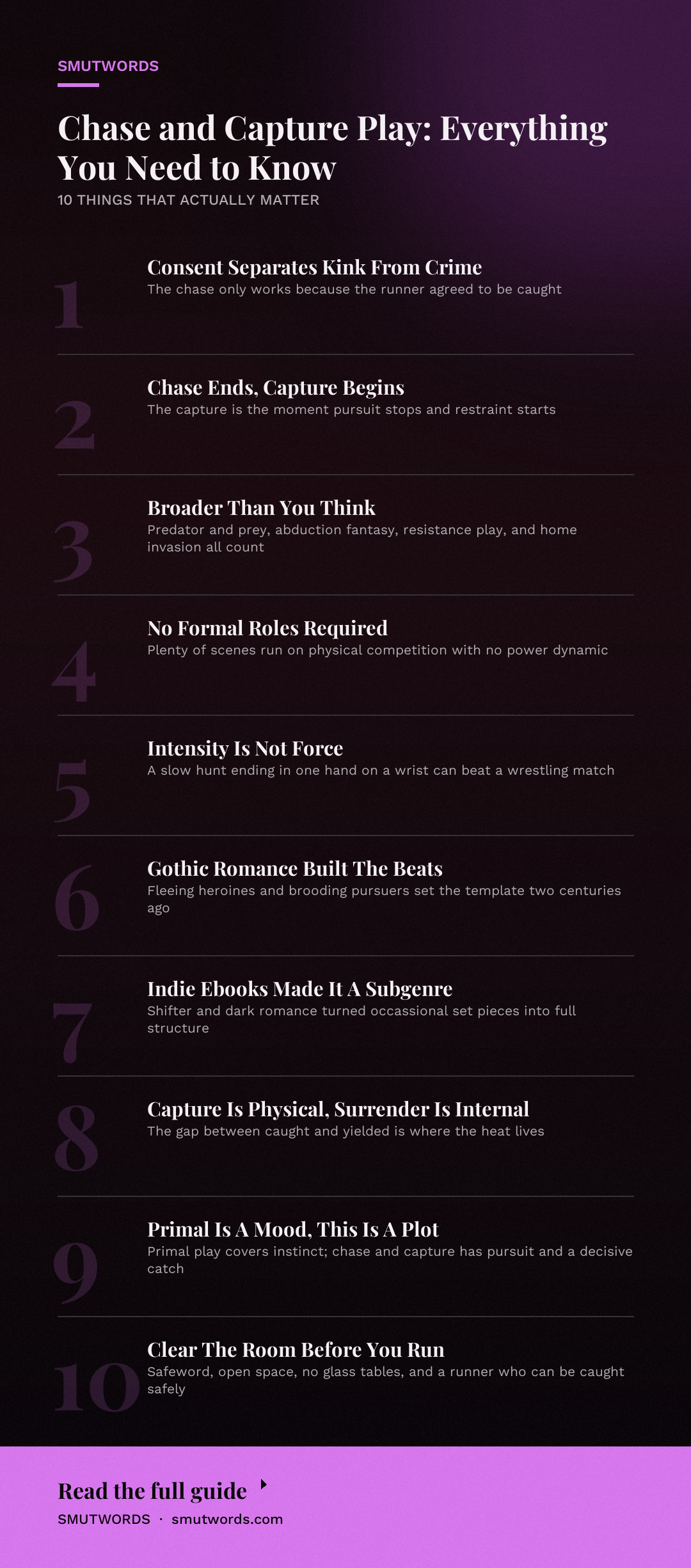
Final Thoughts
Chase and capture play works because it turns desire into motion. The pursuit makes the wanting visible, and the capture makes it mutual. Everything else is craft: pacing, negotiation, and knowing exactly where to put the moment of surrender. If you want to see the trope handled with real skill, the ranked list below has the picks worth your time. Any of them will show you how much heat a single closed hand around a wrist can carry.








Loading comments…