
No strings attached is a sexual arrangement between two people who agree to keep things physical. No exclusivity, no romantic obligation, no shared future on the table. The appeal is obvious: all the heat of real attraction, none of the logistics of a relationship.
It is one of the foundational setups in modern erotica. It gives two characters permission to want each other openly and gives the reader a front-row seat to the part where that permission starts to crack.
What makes it such durable material for fiction is the contradiction baked into the premise. Two adults promise each other nothing, and the story is about how much that promise costs them. The arrangement is always the setup; the feelings are always the plot.
What No Strings Attached Actually Means
The phrase itself comes from puppetry. A marionette with no strings attached is inert, disconnected, free of whoever would otherwise be pulling it. Applied to sex and dating, the metaphor promises the same thing: nobody controlling the other person, nobody owed anything, no invisible cables of obligation running between two bodies.
As a fictional dynamic, no strings attached covers any arrangement where the participants have agreed, explicitly or by mutual understanding, that sex does not carry commitment. It does not require friendship, though it often involves it. It does not require the arrangement to be short; a fuck buddy situation can run for years. What defines it is the shared agreement that the physical relationship is the whole relationship.
Several common misconceptions cling to the term.
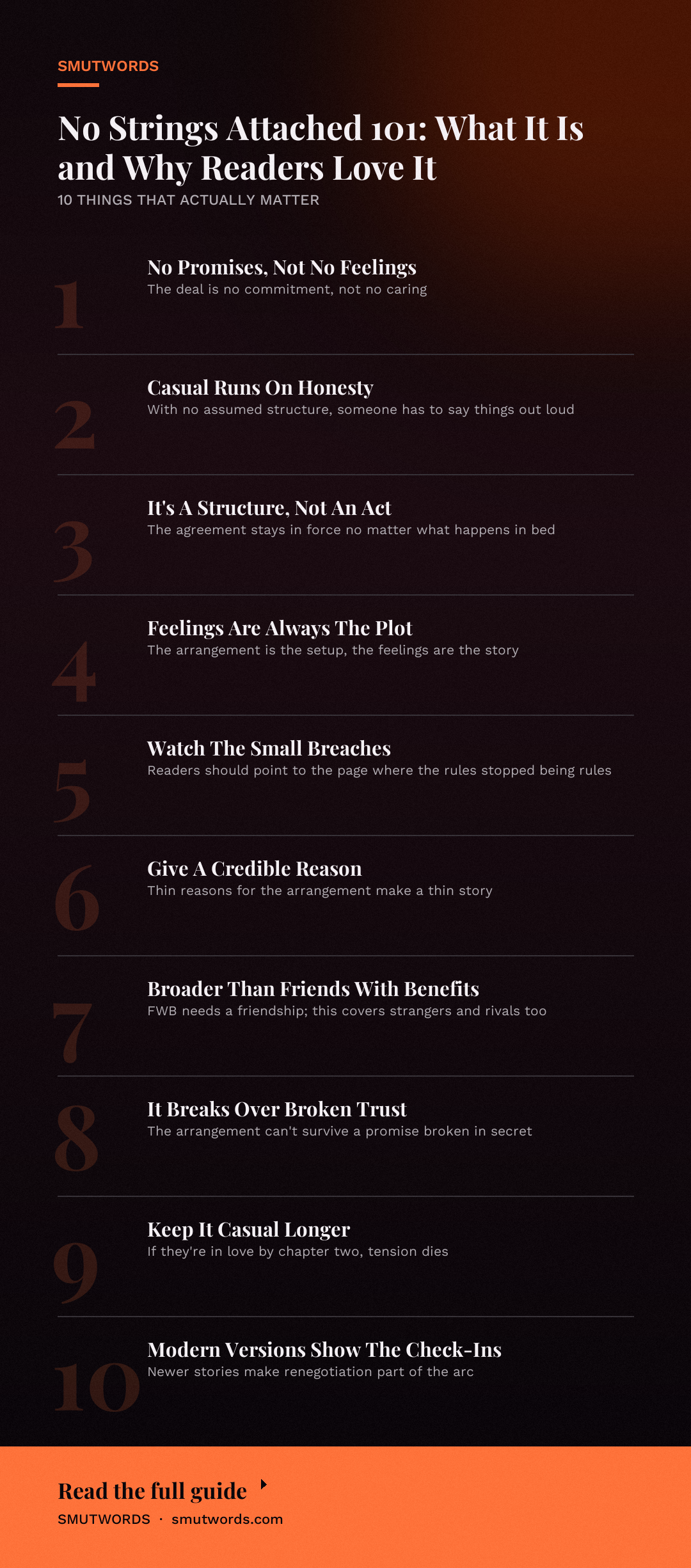
- It means no feelings. It means no promises. Two people can care about each other enormously and still keep the terms casual. The tension between caring and committing is the whole engine.
- It means no communication. The opposite. Functional casual arrangements run on more honesty than most relationships, because there is no assumed structure to fall back on. When things change, someone has to say so out loud.
- It is the same as a one night stand. A one night stand is a single encounter. No strings attached describes an ongoing arrangement, one that gets revisited and reopened.
- It is inherently cold. Plenty of these arrangements are warm, funny, and affectionate. The heat comes from the warmth that refuses to become a label.
One more distinction matters for readers sorting through tags: no strings attached is a relational structure, not a sex act. It tells you how two characters have agreed to treat each other, and it stays in force regardless of what they do in bed. That is why it pairs so easily with almost any kink or dynamic, and why it can quietly reshape the meaning of everything else on the page.
Where No Strings Attached Comes From
The fantasy is ancient. The language is not. "No strings attached" entered English as a commercial phrase in the mid twentieth century, used to describe deals with no hidden conditions, and it migrated into dating vocabulary sometime in the 1960s and 70s as casual sex became culturally speakable. Romance publishing noticed almost immediately.
The 1970s and 80s paperback boom produced plenty of novels where a worldly hero and a wary heroine negotiated an affair on their own terms, though the genre convention of the era almost always required marriage by the final page. The arrangement was a detour, never a destination. Readers who wanted the arrangement itself to be the story had to look elsewhere, often to the spicier imprints and the looser, pulpier corners of the market.
The real shift came with the rise of contemporary romance as a category and, later, the self-publishing explosion documented in our piece on the state of erotica publishing right now. Freed from the assumption that every book had to end at the altar, authors started writing entire novels inside the casual arrangement and letting the emotional collision do the work. The friends-with-benefits romance became a recognized subgenre in its own right, with its own reader expectations.
Online fan fiction accelerated the trend. Tags made the dynamic searchable, and writers pushed it into every possible variant: coworkers, exes, teammates, roommates. The premise evolved from a roadblock on the way to love into the main attraction, and readers began seeking out the specific discomfort of watching two people who promised not to fall for each other start circling the drain.
One recent development is worth noting. Newer books in this space tend to take the communication requirement seriously. Where older stories ran on a single dramatic misunderstanding, current ones often show the two leads actively managing the arrangement, checking in, and renegotiating as feelings shift. The betrayal that drives the third act is less often about the sex and more often about the silence.
How It Shows Up in Erotica
On the page, no strings attached is a structural engine more than a scene type. The author establishes the terms early, usually in a scene of negotiation that doubles as flirtation, and then spends the rest of the book applying pressure to those terms. Every encounter has to mean slightly more than the last one, or the story stalls.
The strongest versions handle the transition with care. Early scenes lean into the freedom: unhurried oral, rough spontaneous sex against a wall, the pleasure of not having to explain yourself. Middle scenes introduce tiny breaches of the agreement.
A hand stays on a back a beat too long. Someone stays the night. Someone notices they started shaving more often. By the late scenes, the arrangement has become a cage the characters rattle against while insisting they are fine.
What separates a flat version from a strong one usually comes down to specificity. A generic friends-with-benefits story gives you two attractive people who hook up between chapters. A good one gives you a reason these particular two people chose this particular arrangement, and a reason it cannot hold.
Common variations authors use
- Friends with benefits. The baseline. Two people who already like each other add sex and subtract romance. The friendship raises the stakes, because there is more to lose. Our glossary has a full entry on friends with benefits.
- Coworkers or teammates. The arrangement has to survive proximity and discretion, which creates constant low-grade tension and a natural secret-keeping plot, similar to the dynamics in our guide to the secret relationship.
- Exes renegotiating. Familiar bodies, known history, and a mutual agreement to leave the past out of it. Spoiler: nobody leaves the past out of it.
- The contract. Sometimes literal. Written rules, scheduled encounters, clauses about sleepovers. The paperwork exists to be violated.
- The rebound arrangement. One party is fresh out of a serious relationship and uses the casual setup as armor. The other party notices the armor.
- The long-distance version. Sex only when schedules align, no daily contact, an agreement that is easy to maintain right up until someone starts counting down to the next visit.
- The kinked version. The casual agreement sits on top of a power dynamic. A dominant and submissive who keep things strictly to scenes, a couple into primal play who insist the intensity is physical only, or a voyeur arrangement where the thrill is in what other people get to see. The kink adds a second layer of denial, because now they are pretending the intimacy is also meaningless.
What makes it work
The first requirement is a credible reason for the arrangement. Maybe one of them is leaving in six months. Maybe one has been burned badly enough that commitment feels like a trap. Maybe they work together and a real relationship would be a professional disaster.
If the reason is thin, so is the story.
The second is a slow, visible erosion. The reader should be able to point to the exact page where the rules stopped being rules. A good author tracks the small breaches, not just the big confession scene.
Enjoyed this? Get a free book.
Join the list and we will send a complete free story straight to your inbox, plus new releases every week after that. No credit card, no catch.
The third is honesty about the physical. No strings attached stories work best when the sex is genuinely good and genuinely varied. The freedom is the point, so the scenes should feel like freedom: spontaneous, a little reckless, sometimes filthy, sometimes tender in a way the characters refuse to examine.
The fourth is a real reckoning. The arrangement has to break, and it has to break over something the reader believes in.
Someone catches feelings and hides them. Someone assumes the other has met someone. Someone breaks a boundary they agreed to, and the other person realizes how much it mattered.
This is where ongoing, honest communication stops being a real-world footnote and becomes the plot's central pressure point. A fictional casual arrangement can survive a lot of things, but it cannot survive a promise broken in secret, and neither can the trust underneath it.
Where it goes wrong
The most common failure is a couple who were never really casual. If both leads are obviously in love by chapter two and the arrangement is merely a stalling tactic, the reader loses the tension the premise was supposed to deliver. Keep the arrangement plausible for longer than feels comfortable.
The second failure is a third-act conflict built on a misunderstanding that two sentences of conversation would resolve. Undisclosed feelings are a legitimate conflict for this trope, but the author has to make the concealment itself feel motivated, not convenient.
The third failure is consequence-free sex. If the physical scenes have no emotional weight, the story reads as a list of encounters rather than a spiral, and the eventual collapse has nothing to collapse from.
No Strings Attached vs Friends with Benefits
These two terms get used interchangeably in conversation, and in plenty of publishing too, but there is a real distinction worth knowing when you are browsing tags.
Friends with benefits specifically requires an existing friendship. The two people liked each other before they started sleeping together, and that pre-existing relationship is part of the deal. No strings attached is the broader category: it covers any arrangement without commitment, including ones where the two people are barely friends, actively dislike each other, or are total strangers outside the bedroom.
In practice, a lot of books tagged friends with benefits are also no strings attached, and vice versa, but the difference matters for how the emotional arc works. In friends with benefits, the risk is losing a friendship you already had. In the broader no strings attached version, the risk is losing something you did not realize you were building. Our glossary entry on friends with benefits covers the narrower version in full.
Frequently Asked Questions
Is no strings attached the same as casual sex?
Casual sex is the act. No strings attached is the agreement that surrounds it. Two people can have casual sex once and never speak again, or they can build an ongoing arrangement with rules, check-ins, and a shared understanding that it stays physical. The term usually implies the second version, an arrangement with some continuity rather than a single encounter.
Why is this such a popular trope in erotica?
It removes the obstacle that usually slows a sex scene down. The characters already agreed to sleep together, so the author can write the heat without spending chapters on courtship. Then it supplies a fresh obstacle, because feelings have a way of arriving whether or not anyone signed up for them. You get immediate physical payoff and slow-burn emotional tension in the same book.
Does no strings attached always end in love?
In romance, usually yes. The genre's contract with the reader tends toward an emotional resolution, and the whole point of the trope is watching the arrangement fail. In erotica that is not structured as romance, the ending can be more open. Plenty of stories let the arrangement stand and treat the fleeting connection as the point.
What is the difference between a booty call and a no strings attached arrangement?
A booty call is a single instance, usually spontaneous and often late at night. No strings attached describes the standing arrangement that makes the booty call possible. The booty call is one scene; the arrangement is the whole relationship structure the scene lives inside.
Can a no strings attached arrangement work in real life?
Yes, and the ones that work tend to share a few features. Both people actually want the same thing, both people are honest when that changes, and neither person is using the arrangement to avoid a conversation they should be having. Ongoing, candid communication about shifting feelings and limits is what keeps the arrangement from turning into a betrayal, and it is also what keeps a reader from losing patience with your characters if you write it.
How do I find books with this dynamic?
Search the tag directly, and also look at adjacent terms: friends to lovers, casual arrangement, fake dating, and second chance. Readers who like one usually like the others. If you want the heavier end of the spectrum, look for authors publishing in the spicier end of the indie market, where the arrangement often gets more page time and less moralizing.
Final Thoughts
No strings attached endures because it puts two people in a room with permission to want each other and no permission to need each other, then watches the second part fail. If you want to see the dynamic done with real precision, start with a friends-with-benefits romance where the friendship predates the sex and the author takes the falling seriously rather than rushing it.
The best versions of this trope never pretend the strings were never there. They just make you feel them tighten.








Loading comments…