
Most praise kink scenes fail for the same reason bad dirty talk fails: the writer is performing a feeling they haven't actually built. Twenty lines of good girl, you're so perfect, you're doing so well stacked back to back don't create a praise kink. They create a word-count problem with a pulse. If you want to know how to write praise kink that lands, the work happens before the compliment ever leaves anyone's mouth.
The compliment is the payoff. The scene is the setup for why hearing it wrecks somebody.
This is the craft part, and it's fussier than it looks. Praise is one of the few kinks that lives almost entirely in tone and timing rather than action, which means sloppy execution shows immediately. A reader who doesn't have the kink can still get dragged in by good writing. A reader who does have it will notice every place the dialogue goes flat and starts repeating.
What a praise kink actually is on the page
Strip away the terminology and a praise kink is a character who gets off on being told they're good. Specific approval lands as arousal.
The breakdown of praise kink vs degradation kink covers the contrast well, and reading them side by side is instructive, because degradation has it easy. Insults are varied. Compliments have a smaller vocabulary and a much higher cheese risk.
The kink tends to show up in characters who spent the book earning nothing: the neglected middle kid, the workaholic who's never been told the effort counted, the one who's only ever been wanted for what they can do. When you write that backstory properly, a single "you did good" is doing the work of a whole sex scene. Praise kink is a wound dressed as a compliment.
The tell that you're writing it wrong
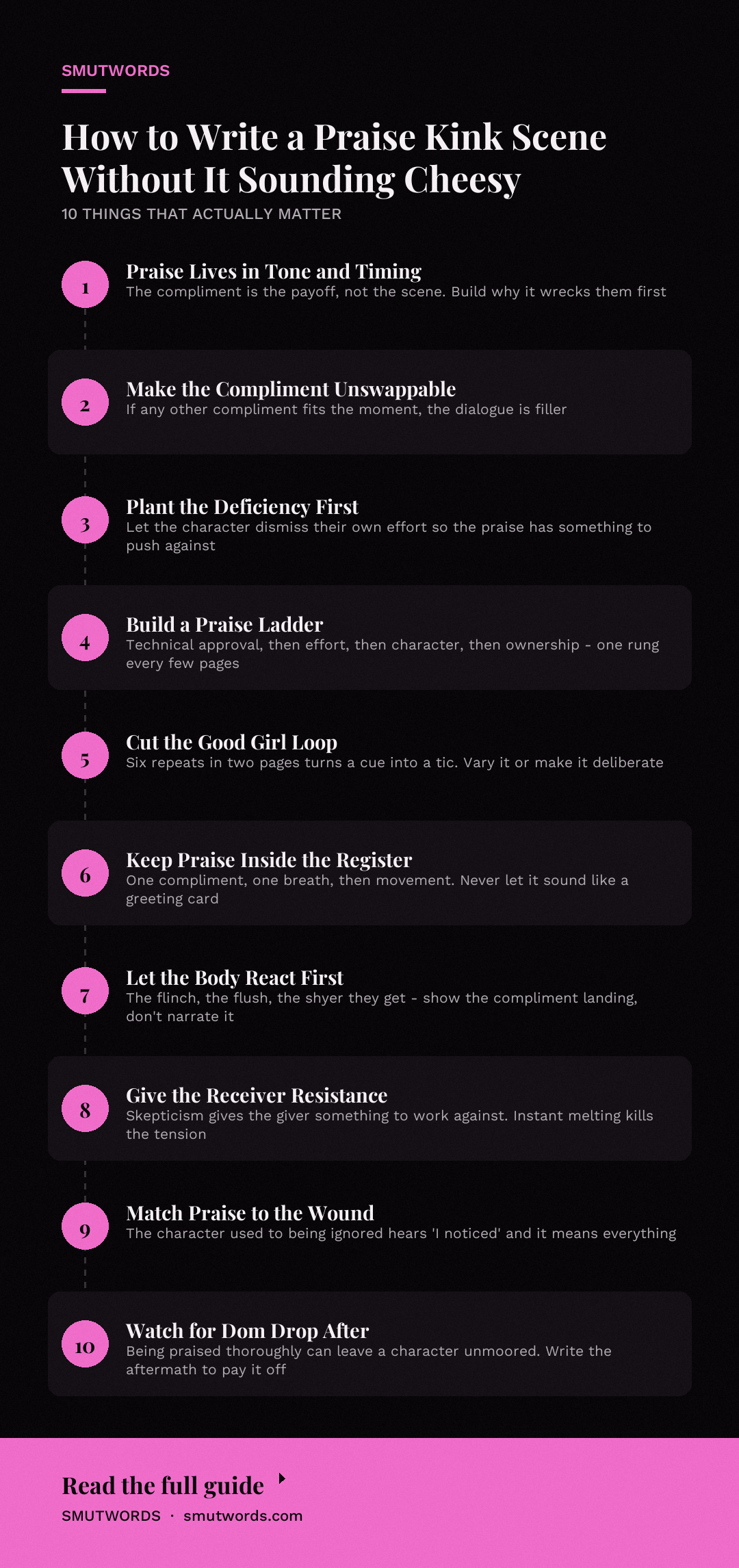
If you can swap the compliment for any other compliment and nothing changes, the dialogue is filler. "You're so good" only means something if the scene has established what this person believes they aren't. The praise has to contradict a specific fear the character carries. Otherwise you're just writing nice things at them.
Earn the compliment before you write it
Here's the structural problem most drafts have: the praise arrives in the first paragraph of the scene, fully formed, at maximum intensity. No contrast, no buildup, nowhere to escalate to. You've spent your best line on line one.
Do the patient version. Plant the deficiency first. Give the reader a moment where the character fails at something small or dismisses their own effort out loud ("it's not a big deal, anyone could've done it") so the praise later has something to push against.
In He Paid Him to Fuck Me, the financial arrangement does the setup work: the narrator is being compensated, which means every kind word lands against the knowledge that he's paying for this. When the praise finally comes, the reader already knows the ground it's falling on.
That's the trick. Contrast is the whole engine. A character who's used to being ignored hears "I noticed" and it means everything.
A character who's praised constantly needs something rarer than a compliment to feel it. Match the compliment to the deprivation.
Build a praise ladder
Write your compliments in ascending order of vulnerability and pace them across the whole scene, not the opening. Something like:
- Technical approval. They did the specific thing right. "That's it, just like that, keep going." Low-stakes, mechanical, gets the body talking.
- Effort recognition. "You're trying so hard for me." Acknowledges the work, not the skill. This is where the character who's never been seen starts to come apart.
- Character praise. "You're so good, you know that?" Now it's about who they are, not what they did. Volatile. Use it once, maybe twice.
- Ownership. "You're mine, and you're so good." The merge of possession and affirmation. This is the top of the ladder and most scenes shouldn't get here until the last third.
Note the spacing. You're moving up a rung roughly every few pages of scene, letting each one land and settle before you climb. Rushing the ladder is the single most common reason praise scenes read as saccharine. Compliments need air around them to feel real.
Cut the repetition before your reader does
"Good girl" is doing a lot of uncredited labor in this genre, and that's fine, it's a signature. But if your hero says it six times in two pages, it stops being a cue and becomes a verbal tic. The reader starts counting.
The fix isn't to ban the phrase, it's to vary the delivery and let the surrounding action do the carrying. Swap some for different words, and let others be physical instead of verbal. A hand at the back of the neck while the praise drops. A pause where the character expects the compliment and doesn't get one.
Sometimes withholding the line is more powerful than saying it. Writers who lean too hard on the verbal side might enjoy the pressure in Shared Without Shame, where the exposure itself does some of the affirmational heavy lifting without a single compliment on the page.
Two mechanical rules that save a lot of drafts:
- Never say a compliment twice in a scene unless the repetition is the point. Repetition should be a dramatic choice, not a default. If you use it deliberately, make the second time land differently.
- Anchor each compliment to something specific. "You're perfect" is generic. "Look at you, still holding still for me" is a callout to a specific moment and it can't be swapped out.
Write praise as dirty talk, not as affirmation poster
The cheese sneaks in because writers switch registers mid-scene. The scene is filthy and then suddenly the dialogue sounds like a greeting card. The compliments need to stay inside the same register as everything else, which means keeping them short, slightly raw, and sometimes mid-action rather than delivered in a clean pause.
Enjoyed this? Get a free book.
Join the list and we will send a complete free story straight to your inbox, plus new releases every week after that. No credit card, no catch.
Watch the register here. "You're so beautiful and so good and I'm so proud of you" is three compliments welded together and it reads like a text from your mum.
One compliment. One breath. Then movement. Keep the praise embedded in the physical scene so it never floats free of the sex.
This applies across kinks. A praise-heavy monster breeding romance scene lives or dies on the same instinct: the affirmation has to sound like it belongs to the creature saying it, with that creature's particular coldness or awe in the delivery. Same rhythm, different vocabulary.
An alien beast doesn't tell you you're "incredible," it tells you you're worthy in a way that's creepier and better. See Lured by the Lizard Beast for how to keep a nonhuman register from collapsing into stock phrases. The xenophilia guide is useful if you're building that species's whole idea of what counts as approval in the first place.
Make the praise body-led, not head-led
Praise kink is verbal, but the scene should notice the body receiving it. The flinch, the flush, the way a character gets shyer the more they're told they're good. That physical reaction is what converts the compliment from nice to hot on the page.
Don't narrate the arousal, show the involuntary response to the words. The character who looks away after being told they did well. The intake of breath at "that's my girl." A small, undignified sound they didn't authorize. When the body reacts before the character can censor it, the reader feels the compliment land because they're watching it land on somebody.
Give the praise-receiver some resistance
The hottest praise scenes have a receiver who doesn't quite believe it yet. Skepticism is your friend. A character who deflects, argues, or laughs it off gives the praise-giver something to work against, and the escalation of the scene becomes a slow persuasive campaign. That's far more interesting than a receiver who just melts instantly on page one.
Think of it like the long game of a fake dating dynamic: the tension comes from the gap between what's said aloud and what's actually true, and the payoff is the moment the gap closes. Praise scenes run on the same gap. The character thinks they're unremarkable; the other person keeps insisting otherwise until the insistence wins.
Case study: putting the pieces together
A scene that works might stagger its beats roughly like this. The praise-receiver botches a small task in the first third and apologizes too much. The praise-giver notices the over-apologizing and doesn't comment.
Mid-scene, the giver offers a technical compliment tied to something the receiver just did well, and the receiver brushes it off. That brush-off is the invitation. The giver comes back harder, more specific, naming the exact effort the receiver made, and this time it's harder to deflect because it's so precise.
By the final third the praise is character-level and possessive, and the receiver, exhausted and finally seen, stops resisting. Nothing in that sequence is saccharine because nothing is unearned. Each compliment refers backward to a moment the reader watched.
The characters aren't trading flattery, they're having an argument about the receiver's worth, and the giver is winning. That's the scene. The hollow-eyed attention of The AI Wants to Watch is a good model for it, because a machine that has catalogued everything you've ever done and still chooses to tell you you're good is a praise kink with teeth on it.
Common mistakes that make it cheesy
Run your draft against these before you call it done:
- Maximum praise from sentence one. No room to climb. Fix by saving the strongest compliment for the last third.
- Compliments that could belong to anyone. Swap "you're amazing" for something only this character's specific action could earn.
- Praise in a register clash. Dirty talk stops to sound like a compliment card. Keep it raw and mid-action.
- A receiver who never doubts. No resistance, no tension, no scene.
- The "good girl" loop. Six repetitions and the phrase is dead. Vary it or use it deliberately.
- Compliments about appearance only. Skill, effort, and character are hotter and rarer than beauty, especially for a praise kink built on being seen.
Where praise kink overlaps with other dynamics
Praise doesn't exist in a vacuum, and the best writers know how to braid it into whatever the book's actual engine is. In a redemption arc romance, praise is the forgiveness the character is trying to earn, so each kind word lands like a step toward absolution. In a childhood friends to lovers story, the praise can already be loaded with years of history, which makes it heavier without needing extra lines.
The Permission Slip short shows how a single approving look can carry a scene when the relationship has already established who's allowed to give it.
There's also a useful warning buried in kink dynamics: a praise-heavy scene where the submissive character comes down hard afterward is dom drop territory, not because something went wrong, but because being told you're good so thoroughly can leave a character unmoored after. Knowing that lets you write an aftermath that pays off the praise instead of undercutting it.
Final Thoughts
The fastest way to feel how all this works is to read a scene that earns its compliments and watch where the praise actually falls.
Free Use Casino is a good one to study for pacing, because the affirmation is doled out slowly across a scene that's already got plenty else going on, and each kind word has to fight for space. Read it once for the plot and once to mark every place a compliment lands and how much air surrounds it. That second read is the lesson.








Loading comments…