
A bakery at 4 a.m. smells like yeast, butter, and the particular desperation of someone who has been awake for three hours already. That smell is why baker romance trope books keep selling. You can set an erotic scene in a boardroom or a spaceship, but the reader has never stood in a cold kitchen with flour on their forearms at dawn.
They have stood in a bakery. They know what the air feels like in there. Culinary romance works on the body before it works on the plot.
Why the baker romance trope books keep working
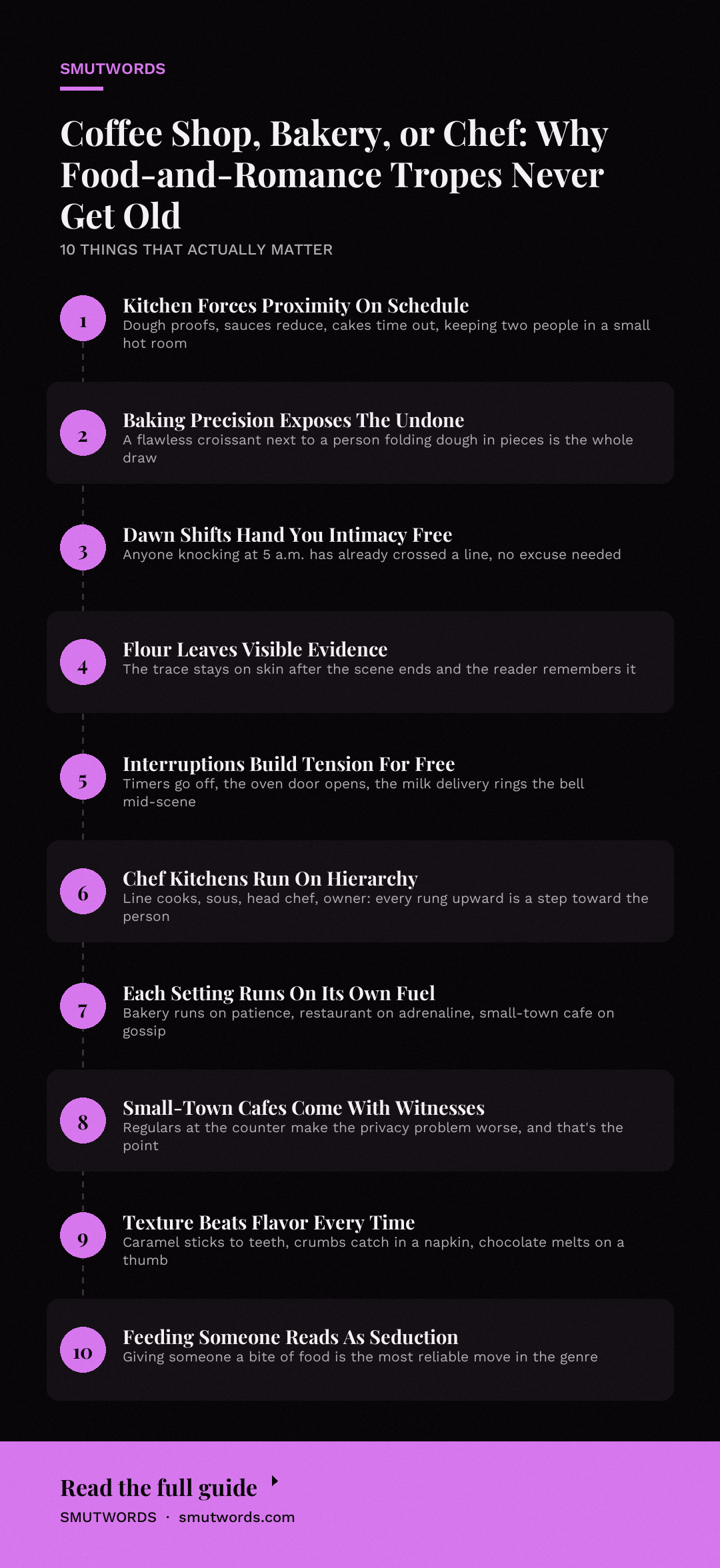
The kitchen gives writers a machine that produces heat on a schedule. Dough has to proof. Sauces have to reduce. A cake has to come out of the oven at the exact second.
Every one of those steps forces two people into a small hot space with their hands busy and their clothes getting ruined. You don't need a contrived excuse to trap them in a room together. The room is already the job.
Baking is precise in a way cooking rarely is. A pastry chef who can't measure is a pastry chef with a failed batch and a bad mood.
Baker romance trope books lean on that precision because it offers something erotica needs: a character who is disciplined in one area and completely undone in another. The croissant is flawless. The person folding the dough is a mess.
The early-morning hours do the rest. A baker's shift starts when the rest of the world is asleep, so the love interest who shows up at 5 a.m. has already crossed a line.
Maybe they're the landlord who smells the ovens and finds a reason to keep knocking. Maybe they're a rival baker who rented the space next door out of spite. The setting hands you an intimacy problem for free.
Flour is the key detail readers remember. It gets on your cheek. It gets on your hands. It gets on the other person when you grab them mid-proof.
Any scene where touching is the point gains a visible trace of it, and writers who know what they're doing use that trace. She's still got flour on her neck when he leaves. He wiped his hands but missed a streak across his jaw. The scene ends and the evidence stays on the skin.
What a good bakery scene actually contains
Strong versions pile up small physical details. Weaker ones skip straight from "he walked in" to the bedroom and lose the setting entirely.
- The hands. Bakers are kneading, rolling, and piping for hours. Their hands are strong, warm, and callused, and a scene that acknowledges that is already doing more work than a paragraph about the hero's jawline.
- The temperature. Ovens run hot. The back room is a sauna. Everyone is in a t-shirt by 6 a.m. and miserable about it, which is a built-in reason for clothing to come off slowly.
- The smell. A writer who names the specific thing coming out of the oven (cardamom buns, sourdough, lemon tarts) gives the reader something to hold onto during the sex scene. The scent keeps the room real while the action is happening.
- The interruption. The timer goes off. The oven door opens. Somebody's phone rings with a delivery arriving early. Culinary scenes are full of interruptions, and interruptions are how tension gets built without a single word of dialogue.
The interruption is the underrated piece. A bakery has sounds that arrive on their own schedule, which gives a writer a legitimate way to stop a scene at the worst possible moment. He has her against the prep table. The bench scraper clatters to the floor.
A second later the bell over the door rings because the milk delivery showed up. Nothing has to be contrived. The setting does the interrupting.
Restaurant kitchens and the chef who runs them
A restaurant kitchen is louder and meaner than a bakery, and the tone shifts with it. Service is a war. Tickets come in fast, the pass is a narrow metal shelf, and every plate that goes out has a story attached to it.
Chef romance lives on that pressure. The person in charge of the line is used to being obeyed, which is why forbidden boss romance overlaps so cleanly with chef stories. Same power imbalance, different apron.
The hierarchy inside a kitchen gives you a ladder to climb. Line cooks answer to the sous, the sous answers to the head chef, the head chef answers to the owner and to the reviewer from the paper who is currently sitting at table nine.
A new hire at the bottom of that ladder has to earn their way up, and every promotion is also a step closer to the person they want. Rivalry works the same way. Two line cooks gunning for the same position is a workplace rival setup with knives in it, which is why the structure in workplace rivals translates so easily to the kitchen.
Food critics make excellent antagonists and better love interests. Somebody whose job is to judge the cooking is already inside the character's defenses. The critic who pans the restaurant and then comes back alone on a Tuesday night is a specific, useful scene.
She reviews the food in public. She orders dessert and stays long enough for the chef to notice.
Baker, chef, or small-town cafe: which setting does what
The three backdrops are useful for different things, and picking the wrong one for your story makes the whole thing wobble.
- Bakery. Best for slow-burn and rivals-to-lovers. The schedule forces proximity at odd hours, and the physical work of baking (kneading, rolling, lift, wrist) gives you body language to write. It runs on patience.
- Chef/restaurant. Best for power dynamics and enemies-to-lovers. The hierarchy is already there, the pressure is constant, and the person running the line has a legitimate reason to be controlling. It runs on adrenaline.
- Small-town cafe. Best for second-chance and secret relationships. The regulars are watching, the town is talking, and the couple has to keep things quiet. It runs on gossip.
A small-town cafe also gives you a reliable cast of side characters who make the privacy problem worse. The retired man at the counter who has opinions about everyone's love life. The two old friends who always take the window seat.
Enjoyed this? Get a free book.
Join the list and we will send a complete free story straight to your inbox, plus new releases every week after that. No credit card, no catch.
If the couple is trying to keep their relationship out of the weekly paper, those people are the reason it can't be done. The setting produces its own obstacles.
Why food scenes are so re-readable
A sex scene is limited by what bodies can do. A food scene is limited only by what the writer has eaten. That's the structural advantage that keeps re-readers coming back to baker romance trope books. The reader is not just following the plot. They are tasting something.
Writers who get this right create what amounts to a second narrative running alongside the first. He feeds her something she didn't order and watches her face while she tastes it. The careful description of her reaction does more seduction work than a paragraph of kissing would.
The same holds in reverse. Two characters destroying a plate of bread and butter at midnight after a bad week is a scene about intimacy that never once names it as such. The most reliable move in the genre is having one person give the other person something to eat.
It is a small act of care that reads as sexual when the writer wants it to and as tender when the writer doesn't. Characters can talk around their feelings with a fork in their hand. "Try this" is a sentence that can be flirtation, an apology, or a dare, depending entirely on what happens after the spoon leaves the bowl.
Culinary settings that borrow from other genres
The best baker romance trope books mostly stay in the real world. But the cooking formula is portable, and romance authors keep proving it. Put a kitchen on a colony ship and the ration bars get desperate. Put a bakery in a monster's underground lair and the flour becomes a peace offering.
Lured by the Lizard Beast pulls monster-romance heat into a cave, and the same logic of feeding someone first applies. Monster breeding romance runs on instinct and provision, which is not so far from what a baker does when he puts a warm roll in someone's hand.
Food is also a reliable vehicle for coercion and permission in darker stories. The hosting character controls the meal, and the hosted character has to accept what's offered. That dynamic is how exhibition and sharing fantasies get set up.
Shared Without Shame leans on that same structure of being presented, of being served up to someone else's appetite, and Permission Slip makes the granting of access the whole point of the scene.
Even the small-town cafe can take a turn. A town where everyone knows your business is the perfect pressure cooker for a relationship that shouldn't be on the menu. That's where secret baby plots and small-town romance share their engine: the community's eyes on the couple.
Writers who want the heat of a restaurant with the scrutiny of a village can have both. The evening rush is the restaurant scene. The gossip after closing is the small-town part.
Writing a food scene that actually works
Most food-and-romance scenes fail the same way. The writer names a dish, describes it as delicious, and moves on. That's a placeholder, and readers can feel the gap.
Specificity is the fix. Write what the dish looks like on the plate. Write what it sounds like when someone takes a bite. Write the second after eating, when a person is still chewing and can't speak, and the other person is watching them.
That pause is where a lot of heat lives. Three seconds of eye contact while somebody swallows beats a paragraph of description about the hero's body.
Texture does more than flavor. Caramel sticks to teeth. Pastry crumbs catch in a napkin. Chocolate melts on a thumb before it melts anywhere else.
If you want the reader to feel a scene, give them a texture they know. The rule writers in this subgenre keep rediscovering is that the best line about food is often a line about friction.
There is also a version of this in the tech-fantasy corner. The AI Wants to Watch turns surveillance into appetite, and a diner's earliest scene is not so far from a cafe at two in the morning with the camera already on. Cyberpunk romance writers know this move well. The food in the future is always flavorless paste until someone shares it with someone else and it becomes a thing worth wanting.
Baker, chef, and small-town cafe questions readers ask
- Why do so many baker romance trope books start at dawn? Because the pre-opening hours are the only time the bakery belongs to the characters alone. Once the doors open, the customer is the enemy of the sex scene, and the writer knows it.
- What's the difference between chef romance and bakery romance? Pressure and hierarchy. A chef romance has a chain of command. A bakery romance has a schedule. Both force the couple together, but in different moods.
- Are small-town cafés just bakery stories with more neighbors? Almost. The café adds a public audience that the bakery hides from. If you want the couple to be watched, put them in the window seat of the café at lunch.
- Does the food have to be realistic? No, but the reaction to it does. Readers will accept a fantasy dish. They won't accept a character who takes a bite and then keeps talking for a full paragraph as if nothing happened.
- Why does food make a scene hotter? Because eating is already a sensory act happening to the body, and the writer can borrow that feeling without inventing it. Everyone in the room has eaten. Nobody has to be convinced.
Any romance can describe desire. The food ones have a whole other physical experience to borrow from, including sound, texture, smell, and the specific human experience of being hungry and then not being hungry anymore. The kitchen gives the writer a vocabulary the reader already speaks.
If you want to see how far a culinary premise can stretch before it breaks, that's the place to start reading. A diner at closing time, a chef with a critic on his calendar, and a baker who watches the other person swallow are all the same structure wearing different aprons.
Final Thoughts
Start with He Paid Him to Fuck Me if you want the bought-and-serviced version of a food scene, where the transaction is the point and the power runs down the meal. For the sweeter end, redemption arc romance and a kitchen full of flour will carry you a long way, and Free Use Casino shows what happens when the setting stops being a convenience and starts being an appetite of its own.






Loading comments…