
Most people who want a D/s relationship don't need a lecture about what it is. They already know the shape of it: one person gives the order, the other trusts enough to follow, and somewhere in that gap the whole thing catches fire.
What they actually need is the road from "I think I want this" to "we have a working dynamic that doesn't blow up in our faces." That road has stops on it. Skipping them is how people get hurt.
So here's the real walkthrough for how to start a D/s relationship, from the first conversation to a negotiated, revised, actually-sustainable power exchange. It runs on communication the way an engine runs on fuel, which means the talking isn't the boring prelude. The talking is the thing.
| Stage | What Happens | Exit Point |
|---|---|---|
| 1. The conversation | Name the interest, gauge the response | Partner not interested: respect it and move on |
| 2. The inventory | Separate hard limits, soft limits, and curiosities | Limits overlap enough to proceed: move to stage 3 |
| 3. The trial period | One to three months of low-stakes practice with a scheduled review | Daily-life friction or unmet needs surface: negotiate or stop |
| 4. The permanent framework | Written agreement with review dates | Checking in becomes inconvenient or skipped: reopen the conversation |
One thing to get straight before any of this: the story in your head is not the relationship. The story is the fantasy version, and it's allowed to be hot and unrealistic and entirely yours. The relationship is the part where the other person has opinions, a bad week, and a roommate who comes home early.
What a D/s Relationship Actually Is (and Isn't)
A D/s relationship is a negotiated consensual power exchange, where one person takes on a Dominant role and another takes on a submissive role, and both agree to it knowing they can back out. That last clause is the entire thing. Remove it and you have abuse wearing a costume.
The core elements are consistent across every variation:
- Consent that's ongoing: agreed to before a scene and revocable mid-scene
- Negotiated limits: written down, revisitable, taken seriously
- A power gap that both parties want: the Dominant wants to lead, the submissive wants to be led
- Protocols and rituals: the small repeatable habits that make the dynamic feel real
- Aftercare: the decompression after intensity, for both of you
What it isn't is a personality trait, a wellness practice, or a thing that fixes an unhappy relationship. If a couple can't communicate about groceries, adding a power exchange on top is pouring gasoline on a fire and expecting warmth.
Stage One: Have the Conversation Before You Have the Conversation
You can't start a D/s relationship without bringing it up, and bringing it up is the hardest part. Most people are so afraid of the response that they never get past the fantasy.
The way to do it is low-stakes, private, and vague enough to bail out of. Something like: "I've been reading some stuff about power exchange dynamics. It kind of got into my head. Have you ever thought about that?"
That's a door held open, not a demand. If they ask what you mean, you have a concrete answer ready: a few specific things you're curious about, not a full script. If they recoil, you've lost nothing except the silence. If they seem curious even a little, you're in business.
What to say (and what not to say)
Do say: "I want to try X, I'm unsure about Y, I don't want Z." Name a couple of specific things rather than a label, because labels carry baggage. "I want you to give me orders sometimes" lands better than "I want to be your submissive" on a first attempt.
Don't hand them a 40-page document on date one. Don't spring it during sex and then act wounded when they're startled. And don't frame it as an ultimatum: "if you loved me, you'd try it" is coercion wearing affection's clothing.
Stage Two: The Inventory (Limits, Desires, Deal-Breakers)
Before any dynamic goes live, sit down and build an actual inventory, written down if the two of you can stomach the vulnerability of paper. The inventory has three columns, and getting them confused is the beginner mistake that causes the most damage.
- Hard limits: absolute no, no negotiation, no exceptions. Tattoo on the inside of both skulls.
- Soft limits: maybe, with the right person, on a good day, after discussion. Revisit quarterly.
- Curiosities: things you'd want to explore if you weren't scared
Include the unglamorous stuff alongside the kinky stuff. Who cooks. Who answers the texts.
Whether you live together. How the relationship fits around kids, jobs, and family.
A power exchange lives inside ordinary life. It can't float above it, and the couples who forget that are the ones surprised when a dynamic that worked in the bedroom starts cracking in the kitchen.
If the two of you have wildly mismatched hard limits, that's information, not a tragedy. You're learning whether a dynamic is viable before either of you has invested months in it.
Stage Three: The Trial Period (This Is Where Most People Skip Ahead)
Here's the move that separates workable dynamics from wreckage: start with a trial period. Pick a duration, one month to three months, and agree at the outset that at the end you both have a real conversation about whether to continue.
The trial formalizes something everyone needs anyway. It gives you permission to be a beginner without it being a referendum on who you are. It also gives you a built-in exit that isn't a breakup or a betrayal.
What a trial period should look like
Keep it low-stakes. Choose two or three protocols, not twelve. If the whole thing collapses in a week, you want to have lost a game, not a life.
Some starter protocols that work:
- A daily check-in text at a fixed time
- A weekly ritual, like serving coffee in a specific way
- A title used in private only
- A bedtime or morning routine
What you don't do during a trial period is add anything with real physical risk. Breath restriction, heavy rope suspension, anything that could genuinely hurt someone: off the table until a dynamic is stable and both of you know the person you're playing with.
A trial period is not a performance test. It's a trial rhythm.
Stage Four: Protocols, Rituals, Titles (The Actual Substance)
Once you're past the trial, everything starts getting real, and the substance of a D/s relationship turns out to be mostly small things. The structure is made of rituals.
Protocols are the agreed-on rules: how to ask permission, when to wear what, how to address your Dominant, which decisions get delegated. Rituals are the repeatable acts that mark the dynamic: opening a door a specific way, writing in a journal each night, kneeling when you come home.
Titles matter to a lot of people. "Sir," "Master," "Daddy," "Mistress," "pet," "little one," "sweetheart." Pick the ones that make both of you feel the dynamic instead of laughing at it. You can change them next week.
If you like reading the dynamic before you build your own, the scene where two people negotiate exactly this is where fiction does some of its best work. The push and pull of a forbidden boss romance or the uneasy trust of a soldier romance gives you a sense of the shape without the paperwork.
The "rules for rituals" test
Ask three questions of every protocol you're tempted to add: can we both do this on a bad day, does it make the dynamic feel stronger, and is it enforceable without resentment building?
If any answer is no, don't add it. A beginner Dominant stacking twenty rules in the first week while the submissive quietly suffocates under them is the most common mistake in the book. You can always add. Subtracting is harder.
Enjoyed this? Get a free book.
Join the list and we will send a complete free story straight to your inbox, plus new releases every week after that. No credit card, no catch.
For a picture of what a strong protocol structure looks like on paper, the relationship architecture in The Companion That Fucks Back treats the protocol as the relationship itself, which is honestly closer to reality than most fiction gets.
Stage Five: Check-Ins and Reviews (The Part That Keeps It Alive)
A D/s relationship that survives past the first six months is one where both people are willing to have boring maintenance conversations at regular intervals. Weekly check-ins, monthly reviews, quarterly full inventory.
The check-in has three questions:
- What is working?
- What is not?
- What do we want to try next?
Do them when neither of you is running on fumes. Do them in neutral clothes, not mid-scene. Record the answers if you need to.
The point isn't the ritual of reviewing. The point is that nobody has to pretend everything's fine when it isn't.
Sometimes a review turns up something difficult. A trial protocol has started to feel like a chore. A title that landed six months ago now reads as condescending.
Someone's needs have changed. The dynamic changes with them or it stops being consensual power exchange and becomes a costume one person is wearing alone.
If you want to read about what goes wrong when a dynamic's rules stop fitting the people inside them, His New Addiction and Officer's Orders: Breed Her both hinge on that collision between protocol and person.
The Real Risks (and How to Lower Them)
No honest guide to starting a D/s relationship leaves this part out. The risks are real, and the way to handle them is not to be scared of them but to name them and plan around them.
Risk 1: Coercion dressed as dominance. The Dominant pushes past a limit "for the dynamic's sake." The submissive says yes because they're afraid of losing the relationship. The fix is a hard limit both people honor even when aroused, plus a no-questions safe word that ends everything instantly.
Risk 2: Sub frenzy. A beginner submissive goes so fast and so hard it outpaces their own judgment, agreeing to things they wouldn't agree to a month later. The fix is the trial period, and a Dominant willing to say no to their own submissive.
Risk 3: Dom drop and burnout. Many Dominants assume they don't need aftercare. They do, and the crash can hit a day or two after an intense scene.
Discuss decompression for both people and watch for it. If you want a deeper dive on the "after" part, this guide on writing aftercare into a dark scene explains the mechanics well enough to teach it, whether you're writing fiction or living it.
Risk 4: Isolation. A dynamic so sealed off that both people stop checking in with friends, therapists, and any other outside view. The fix is to keep at least one person outside the dynamic who knows what you're doing and who you check in with, separately from your partner.
Risk 5: Blurred consent around nonconsensual fiction. Plenty of people enjoy the fantasy of a stalker romance or a revenge romance, where the erotics come from being taken over against your will.
Reading or enjoying that is fine. Acting on it without negotiation is not. The line is consent, and it stays clear as long as you've taken the trouble to draw it.
If you're drawn to imaginary scenarios that would be catastrophic in real life, the forbidden stepbrother trope and the breeding farm trope are good reminders that fantasy and consent can coexist without being the same thing.
When to Stop (and How)
The dynamic should end, or change significantly, when consent isn't freely and enthusiastically given. That means ending or pausing it when:
- One person is going along with protocols out of fear, guilt, or obligation
- A limit has been crossed and the trust isn't recoverable right now
- The dynamic is making one person's mental health worse, not better
- One person wants to renegotiate the structure and the other refuses to discuss it
Ending a D/s dynamic does not have to be a breakup or a failure. It can be a step back into a different structure, a pause for six months while you both go to therapy, or a full stop with a friendship intact.
How to stop: name it in a conversation when you're calm, offer the reasons, do not blame the other person's role for your own decision, and do a real aftercare conversation for the relationship itself. What do we want to keep? What do we want to release? What do we tell each other going forward?
If you're considering changing the shape of the whole thing, from a D/s dyad to an open, polyamorous, or swinging structure, get the definitions clear first. This comparison of open relationships, swinging, and polyamory is a genuine starting point.
And if the dynamic worked but the shape of it is changing, or if you're curious about group structures, fiction explores that architecture well. The group dynamic in Free Use Dungeon Master's Harem treats the rules as a shared language instead of a single leash.
How to Start a D/s Relationship: The Short Version
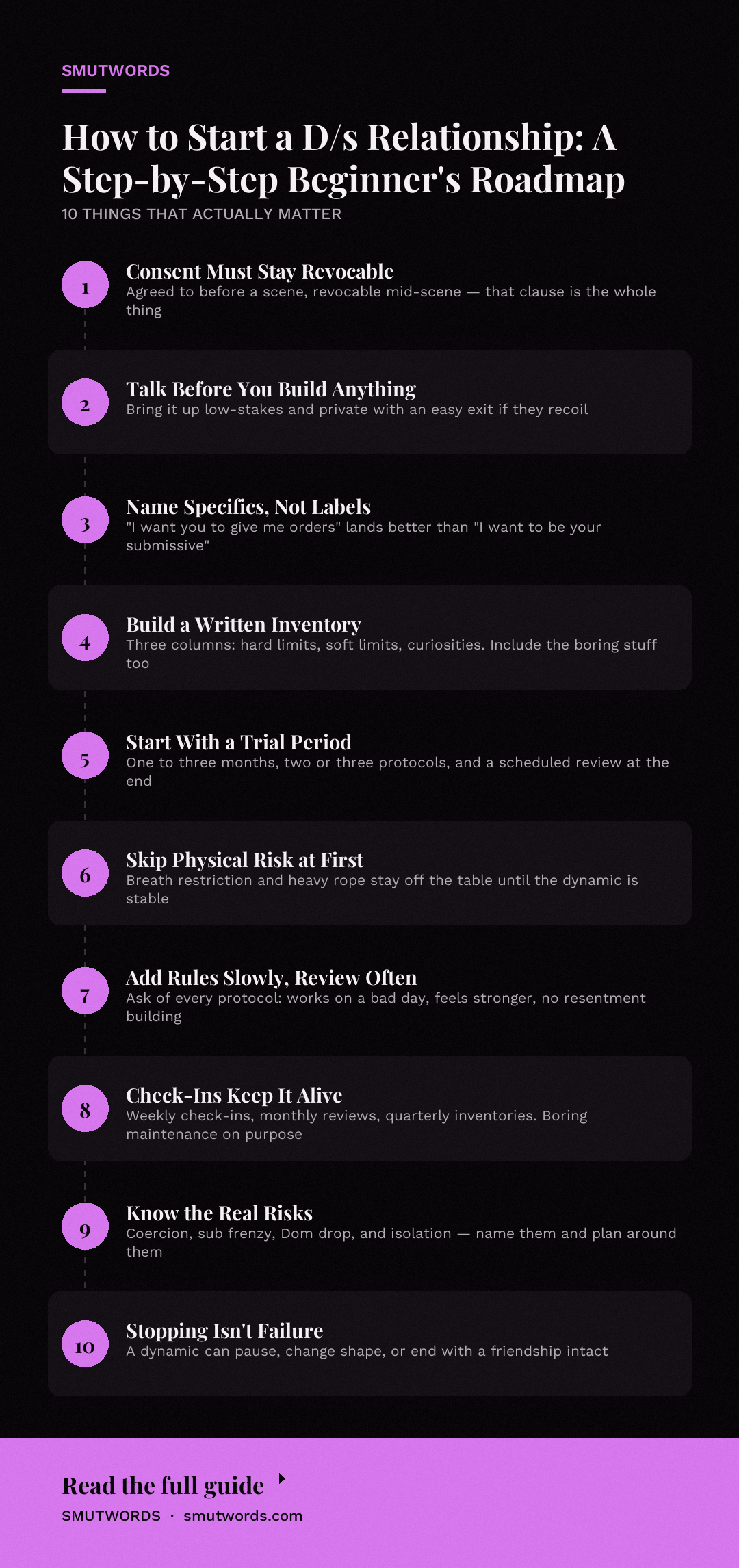
Bring it up early, gently, in private. Build an inventory with hard limits, soft limits, and curiosities, written down. Run a trial period with two or three protocols and a scheduled review. Add rules slowly, review them often, and treat the regular check-in as the core of the relationship.
Know the risks and plan around them. Know when to stop, and be able to stop cleanly.
That's the roadmap. The whole thing amounts to two people who trust each other enough to talk honestly about what they want and enough to change course when it stops working. That's the part the fantasy gets wrong. The real version is quieter, and it's the one that lasts.
If you want to see a dynamic built with real attention to protocol and the people inside it, The Living Gene Vault is the story a beginner can actually learn from: slow build, careful negotiation, and rules that stay alive.
Final Thoughts
The best book to read after this one is the one that shows the slow negotiation, not the montage. The Living Gene Vault treats the building of a dynamic as the plot, which is unusual and weirdly instructive. Start there, then come back and write your own inventory.







Loading comments…